
Narrative Primacy, Strategic Communications, and the Legitimacy Contest in US-Iran Relations
Abstract
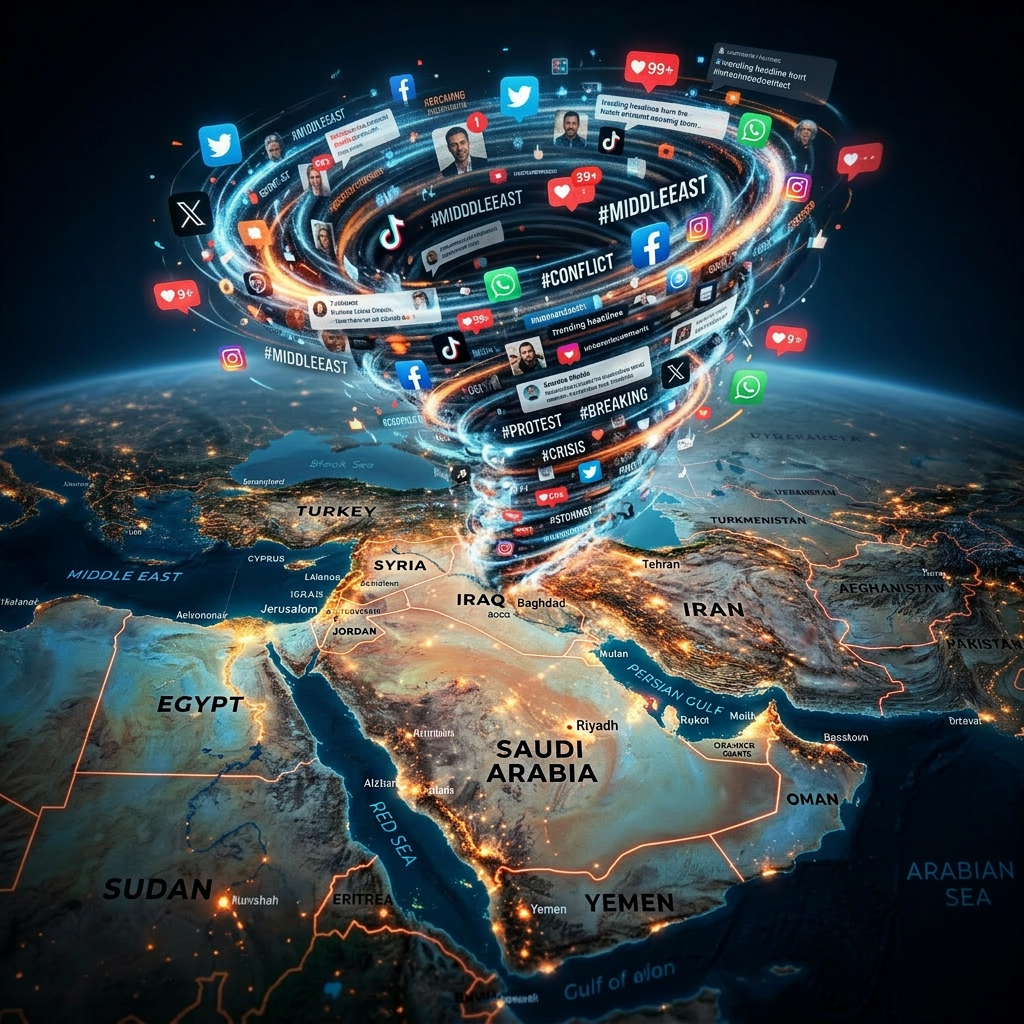
The rivalry between the United States and the Islamic Republic of Iran is conventionally analyzed through the lens of military posture, sanctions architecture, nuclear nonproliferation, and proxy conflict. This article argues that a complementary and, in several respects, more consequential dimension of the rivalry has received inadequate analytical attention: the sustained competition for narrative primacy — the authority to define events, assign responsibility, and shape the interpretive frameworks through which third-party governments, multilateral institutions, and global publics evaluate the conflict.
Drawing on documented episodes spanning the 1998 Khatami-era diplomatic overture to the AI-mediated information operations of 2026, this article examines how both governments have constructed communications architectures designed not merely to inform their respective domestic audiences but to establish and defend interpretive authority with strategically critical third-country audiences. It further examines the semantic and comparative dimensions of Iranian and American head-of-state discourse, identifying how divergent vocabulary choices, rhetorical registers, and moral-authority frames serve as instruments of foreign policy rather than incidental features of political speech.
The article concludes that narrative primacy functions as a measurable form of geopolitical power; that the information domain of the Iran-US rivalry has evolved qualitatively with the integration of generative AI and platform-native content strategies; and that analysts, policymakers, and executives operating in environments shaped by this rivalry require an explicit framework for reading strategic communications with appropriate critical discipline.
Keywords
Iran-US relations · strategic communications · narrative primacy · information warfare · public diplomacy · nuclear framing · head-of-state discourse · AI propaganda · legitimacy · escalation management
Note on Method and Analytical Approach
This article employs a qualitative analytical framework drawing on discourse analysis, strategic communications theory, and comparative foreign policy analysis. The primary materials examined include official statements, diplomatic records, media architecture documentation, and reported episodes of signal exchange between the two governments. Secondary sources include policy research organizations, investigative journalism, and academic commentary on the information dimensions of the conflict.
The analytical approach is interpretive rather than quantitative. It does not claim to measure narrative impact through audience metrics or polling aggregation, though relevant survey data are referenced where they illuminate the broader information environment. The article is intended as a contribution to policy-adjacent scholarship and is addressed to readers engaged in strategic analysis, international affairs, and the governance of complex adversarial relationships.
I. Introduction
Most coverage of the Iran-US rivalry focuses on what is visible: sanctions, proxy skirmishes, nuclear negotiations, military deployments. These are real. They are also, in a meaningful strategic sense, secondary.
The primary contest between these two governments is a fight for legitimacy — the authority to define what is happening, who bears responsibility, and what the international community should do about it. That fight plays out not on battlefields or at negotiating tables but across state media, diplomatic statements, social platforms, proxy networks, and the information environments of governments and publics who will never directly experience the conflict but whose choices — on sanctions votes, arms sales, diplomatic recognition, and alliance commitments — shape its outcomes.
This is a communications war. And in conditions where direct military confrontation carries costs neither side is willing to absorb, it may be the most consequential dimension of the rivalry.
Understanding how it works is not optional for anyone making decisions in environments this conflict touches. Narrative primacy — the ability to establish the interpretive frame through which events are understood — translates directly into political leverage, coalition cohesion, and strategic room to maneuver. Governments that lose it spend their energy correcting, qualifying, and contextualizing realities that others have already defined. In a rivalry where perception shapes policy, that is the whole problem.
What follows is an analysis of how both sides compete for that advantage: the tools they use, the audiences they target, and the principles that should guide how strategists, executives, and policymakers read the signals this rivalry generates.
II. When Narrative Becomes the Primary Arena
To understand why the communications dimension of this conflict matters so much, one must understand what changed in the information environment — and why those changes altered the strategic calculus for both governments.
In the twentieth century, propaganda was a relatively centralized enterprise. Governments controlled the main distribution channels — radio, television, print. Shaping public perception was mostly a question of managing what flowed through those channels. The pace was slow enough that governments could react, correct, and, if necessary, suppress.
That world is gone. Today, a military announcement, a diplomatic statement, or a strategically timed leak can reach tens of millions of people within hours. More importantly, it can be contradicted, reframed, or discredited in the same timeframe by independent journalists, diaspora communities, investigative researchers, and sources with access to things governments would prefer to keep private.
This has not reduced the value of strategic communications — it has raised it enormously. When information flows freely and fast, the competition is no longer over access to facts. It is over interpretation, emphasis, and credibility. Governments that establish the frame through which subsequent events are read gain a durable strategic advantage. Those that fail to secure it fight a constant rearguard action against narratives they did not choose and cannot easily dislodge.
Narrative primacy is a measurable form of power. It shapes what allied governments feel politically able to do, what multilateral institutions are willing to authorize, and what domestic populations will accept. Both Iran and the United States understand this, deeply and institutionally. Which is why neither side ever stops competing for it.
III. Framing, Broadcasting, and the Architecture of Influence

3.1 Why Every Statement Is Designed, Not Declared
US messaging on Iran is not simply descriptive — it is architecturally designed. The consistent official framing positions Iran as a source of regional instability: supplying and directing armed proxy organizations in Lebanon, Iraq, Yemen, and Syria; advancing a ballistic missile program; and pursuing nuclear enrichment under conditions that raise proliferation concerns.
This architecture does real political work in very different rooms simultaneously. For a domestic political audience, it builds support for sanctions and defense budgets. For Gulf and Israeli allies, it reinforces the rationale for collective security arrangements. For European partners and UN member states, it provides justification for sustained multilateral pressure. One coherent framing, deployed with discipline across multiple channels, can accomplish all of this at once.
The framing architecture has deep roots. When President George W. Bush labeled Iran part of an “axis of evil” in his 2002 State of the Union address, the phrase did far more than describe a security threat.¹ It placed Iran within a single moral framework of rogue-state behavior, instantly defining the interpretive context for every subsequent US policy decision toward Tehran. Critics argued it effectively killed the nascent reformist momentum of the Khatami era inside Iran — that a single carefully framed speech had real geopolitical consequences. Whether or not one accepts that assessment, the episode illustrates how much deliberate word choice can reshape the strategic environment. A diplomatic announcement is always, simultaneously, a communications event. How it is packaged and sequenced often determines its political durability as much as its substantive content does.
3.2 What Negotiations Communicate Beyond the Room
The 2015 Joint Comprehensive Plan of Action illustrates this dynamic in full.⁶ The Obama administration’s rollout was designed to establish international legitimacy before domestic critics could define the terms of debate. European foreign ministers were briefed in coordination, allied governments issued supportive statements within hours, and the administration’s public communications emphasized verification mechanisms rather than concessions. The deal was framed as a multilateral achievement, not a bilateral negotiation with a state the US officially considered a sponsor of terrorism.
When the Trump administration withdrew in 2018 under the explicit banner of “maximum pressure,” the messaging shift was itself a strategic signal — to Tehran, to European allies recalibrating their positions, and to regional actors assessing what the new posture meant for their own calculations.⁷ The phrase was a policy and a broadcast at the same time. Allies who had invested political capital in defending the JCPOA now faced the communicative cost of having backed an agreement the US had abandoned.
The contrast between the two rollouts reveals something analytically important: state communications are never neutral. Every official statement is designed for specific audiences with specific purposes. The right question is never simply “what did they say?” It is always “who needed to hear this, and why now?”
3.3 Soft Power, Hard Timing, and the Race to Define Events First
The US government maintains a substantial media infrastructure aimed at foreign audiences. Voice of America, Radio Free Europe/Radio Liberty, and Radio Farda — which broadcasts in Persian directly into Iran — serve a dual function: providing information to audiences operating under restricted domestic media conditions and advancing a strategic narrative about American values and Iranian governance.⁹
Radio Farda is a particularly instructive case. Operating continuously in Persian, it reaches Iranian audiences who have limited access to independent domestic journalism. Its editorial independence from direct US government control is genuine, but its existence reflects a deliberate strategic investment in competing with Iranian state media for the attention and trust of audiences inside Iran. The goal is not primarily to generate affection for the United States. It is to provide an alternative interpretive framework for domestic events that the Iranian government cannot fully suppress.
The timing dimension of digital communications has become equally significant. When the Department of Defense announced the death of General Qasem Soleimani in January 2020, it did so via an official social media post before any formal press briefing had convened.⁸ That sequence was deliberate: reach the global public, Tehran, and regional governments simultaneously — before the diplomatic machinery had fully assembled to shape the formal response. Whoever defines the event first sets the frame that subsequent statements must navigate around. Both governments understand this, and both compete accordingly.
3.4 When Military Moves Are Messages — and Messages Can Misfire
Military deployments — carrier strike groups repositioned in the Persian Gulf, air assets moved to forward bases, readiness assessments released on deliberate schedules — serve a communicative function that often exceeds their immediate tactical significance. Each is, at some level, a broadcast about capability, resolve, and tolerance for escalation.
The strategic challenge is calibration. A signal too explicit can escalate rather than deter. A signal too subtle risks misreading, which can be equally dangerous. The credibility of a deterrence posture is a function of how it is perceived by the adversary — which means the communications strategy surrounding military positioning is frequently more consequential than the positioning itself.
IV. Resistance, Reach, and the Long Game of Legitimacy
4.1 An Ideology Engineered for Export
Iran’s strategic communications are organized around a coherent ideological framework developed over decades: the concept of moqavemat, or resistance. This framing positions Iran not as an aggressor but as a principled defender — of Muslim dignity, Palestinian rights, and national sovereignty — against American hegemony and Israeli expansion.
The resistance narrative is a long-game investment, and it has returned dividends well beyond Iran’s borders. It resonates across parts of the Arab world, among governments in the Global South skeptical of US-led international order, and with publics carrying historical grievances against Western intervention. Iran has built its media architecture to carry this narrative to each of these audiences in registers calibrated for maximum effect. Press TV reaches English-speaking audiences globally. Al-Mayadeen, Lebanon-based and aligned with Iranian interests, operates with the credibility of a regional outlet while maintaining consistent editorial direction. The Tasnim and FARS news agencies supply content to regional media ecosystems. Each channel is distinct; the message is coordinated.
The roots of this narrative run deep. The 1979 Islamic Revolution and the subsequent hostage crisis were not only political events — they were foundational communications ruptures that permanently severed the symbolic relationship between the two governments. Anti-Americanism was not incidental to the Republic’s founding; it was structural. Every subsequent episode of tension has been assimilated into a narrative architecture that was designed, from the beginning, to require American hostility as a legitimizing feature. That history makes the communications contest uniquely difficult to resolve. Changing the narrative would require not just different words, but different political identities.
4.2 How Sanctions Become a Narrative Asset
Inside Iran, the communications task is different — and in some ways more demanding. The government must maintain political legitimacy in the face of sustained economic hardship caused substantially by US sanctions. Its solution is a consistent framing strategy: sanctions are economic warfare against ordinary Iranians, not targeted pressure against a regime.
By linking the population’s material suffering directly to American hostility, the government makes it structurally harder for Iranian citizens to separate economic grievance from foreign-policy dissent. It is a sophisticated political maneuver dressed as a news narrative. Whether Iranians fully accept it is a separate question — many do not — but it defines the interpretive environment within which domestic opposition must operate.
Iranian state media gives sustained coverage to every moment of US military failure, domestic political fracture, or credibility loss. The 2021 US withdrawal from Afghanistan received extended treatment as evidence of American strategic decline — not simply as a news event, but as a narrative resource deployed in support of a larger argument about the trajectory of US power. The goal is not to inform in any neutral sense. It is to reinforce a worldview.
4.3 Why Iran’s Media Network Is Harder to Counter Than a Single Broadcaster
One of Iran’s most strategically significant communications assets is not a single outlet but a network. Hezbollah’s Al-Manar television in Lebanon, Houthi-aligned channels in Yemen, and Iraqi militia-affiliated media all amplify Iranian messaging with the critical advantage of local credibility. When audiences receive consistent framing from what appear to be independent local sources, the message gains persuasive force that no foreign state broadcaster could achieve on its own. The appearance of independent corroboration is itself a strategic asset.
This distributed architecture is substantially harder to counter than a centralized media operation. Each node in the network draws its authority from local embeddedness and local relationships. The network effect is not incidental to Iran’s strategy. It is the strategy.
4.4 The Goal Isn’t Persuasion — It’s Exhaustion
Iran has also invested meaningfully in cyber-enabled influence operations. Documented campaigns — confirmed by US government agencies and independent cybersecurity researchers — have used fabricated personas, impersonated journalists, and coordinated content amplification to spread narratives favorable to Tehran across major Western platforms.¹⁰
The critical feature of many of these operations is that they are not designed to persuade. Their goal is to saturate — to fill information space with competing claims, reduce audience trust in credible sources, and amplify existing divisions within target societies. An audience that no longer knows what to believe is, for these purposes, as useful as one that believes the right things. Exhaustion and epistemic disorientation are intended outcomes, not collateral effects.
More recently, this approach has evolved to incorporate generative artificial intelligence. Iranian information operations have been documented using AI-produced video content — satirical animations framing US leadership as buffoonish, meme formats borrowed from Western popular culture, synthetic content designed to circulate on short-form video platforms.¹⁰ IRGC spokesmen have delivered messages in English using the cadences of American corporate communication. The strategic logic is precise: reach audiences who would never voluntarily consume state media by inhabiting the same visual and emotional register as the entertainment they already consume.
V. Same Facts, Opposite Conclusions — By Design
No issue has generated more sustained narrative competition than Iran’s nuclear program. And nowhere is the structural nature of this contest more visible.
Iran’s public position is consistent in its framing: enrichment is peaceful, legally permissible under the Nuclear Non-Proliferation Treaty, and a sovereign national right. The United States and its allies argue that Iran’s enrichment levels, the opacity of key facilities, and the parallel development of ballistic missile systems create an ambiguity about ultimate intentions that cannot responsibly be dismissed.
Both sides cite the same IAEA inspection reports. Both reference the same satellite imagery. Both appeal to international law. Yet they reach categorically different conclusions in their public messaging — and the gap is not primarily a factual dispute. It is an interpretive one, prosecuted continuously through diplomatic statements, coordinated allied briefings, and carefully timed media releases.
The nuclear narrative also interlocks with sanctions framing in ways that create a self-reinforcing loop. US sanctions are justified by nuclear risk. Iran frames sanctions as aggressive economic warfare. That framing justifies continued resistance. Which justifies the sanctions. Neither side can exit the loop without yielding narrative ground it has no political incentive to concede. The loop is not a failure of diplomacy. For both governments, in different ways, it is a feature.
VI. The Real Target Is Neither Washington Nor Tehran
Beyond the nuclear issue, both governments deploy human rights and regional conflict as active instruments of narrative competition. And in both cases, the most strategically important audiences are neither American nor Iranian.
US amplification of human rights conditions inside Iran — the treatment of women, journalists, ethnic and religious minorities, and political prisoners — is calibrated primarily for European capitals and multilateral institutions where human rights concerns carry genuine policy weight. It is less a message to Tehran than a message about Tehran, designed to build coalition support for sustained pressure.
Iran’s counter-move — consistently pointing to US domestic failures and military conduct abroad — is not a genuine moral equivalence argument. It is a credibility attack: a strategic effort to reduce the perceived authority behind US criticism, particularly with audiences already skeptical of American foreign policy. The tactic is most effective precisely where that skepticism is already established, and largely irrelevant where it is not. Both governments understand the geography of their own credibility — and design their messaging accordingly.
Regional conflicts operate the same way. Every escalation in Gaza, Lebanon, or Yemen becomes a competing-claims environment. The US highlights Iranian weapons transfers and proxy financing. Iran highlights civilian casualties from US-backed operations. The real audience for both arguments is the policymakers, legislators, and publics in third countries whose choices — on arms sales, sanctions votes, diplomatic recognition, and coalition participation — determine the actual shape of the conflict.
VII. When Adversaries Signal Limits Without Admitting They’re Talking

One of the least appreciated functions of the Iran-US communications architecture is not aggressive — it is stabilizing. Both governments maintain active, if carefully deniable, channels for signaling limits. Those channels have functioned to prevent serious miscalculation on at least several critical occasions.
The January 2020 sequence following the killing of General Qasem Soleimani is the clearest recent illustration.⁸ Iran’s ballistic missile strike on US bases in Iraq was a response it could not forgo without severe domestic political cost. And yet both sides had powerful incentives to prevent escalation to open war. What followed was a carefully managed communications exercise conducted under extraordinary public pressure and mutual hostility. Iran announced its strike in ways that allowed advance warning to reach US personnel. US officials initially characterized the resulting casualties in ways that preserved political space for de-escalation. Both governments issued statements calibrated to allow each side to claim proportionate response without committing to further action. The process was imperfect and improvised under pressure. But it held — because the same communications architecture that enables propaganda also enables de-escalation. Neither side has any interest in dismantling it entirely.
The same pattern appeared, in a different register, during the brief thaw of the Khatami era. In a 1998 CNN interview, Iranian President Mohammad Khatami made a carefully worded appeal for a “dialogue of civilizations” — a communication event as much as a policy proposal.³ The Clinton administration responded with incremental gestures: Secretary of State Madeleine Albright expressed regret over the 1953 US-backed coup against Prime Minister Mohammad Mosaddegh, and some sanctions were quietly eased.⁴ Wrestling teams exchanged visits. Cultural delegations traveled. None of it produced a diplomatic breakthrough. But it demonstrated that both sides were capable of using symbolic communication to reduce tension when the domestic politics of each country permitted it.
The 2003 episode now referred to as the “Grand Bargain” offers a more sobering lesson in what happens when signals go unread.² Shortly after the US invasion of Iraq, Iran transmitted — through Swiss intermediaries — a comprehensive proposal addressing nuclear activities, support for militant groups, and regional security arrangements. Senior officials at the State Department assessed it as potentially serious. The Bush administration declined to engage it substantively. Whether the proposal was genuine or a diplomatic maneuver will be debated by historians for years. What is not disputed is that the failure to read it as a serious signal closed a communicative opening that did not reappear in the same form. In communications terms, the cost of misreading a signal — or choosing not to read it at all — can be as consequential as the cost of sending the wrong one.
VIII. Journalists, Platforms, and the Contested Ground Between Reporting and Influence
Both governments understand that controlling the information environment requires managing access to it. Iranian authorities accredit select foreign journalists on terms that structurally constrain editorial independence. US military embed systems in past conflicts shaped coverage through physical proximity and logistical dependence. The mechanisms differ; the underlying logic is the same. Information access is leverage, and both sides exercise it.
Independent journalism — from organizations with reporters operating under genuine editorial independence in Iran, Lebanon, Iraq, and the Gulf — remains the most effective institutional check on official narratives from both sides.
Digital platforms occupy an uncomfortable position in this architecture. Meta, X, and YouTube have removed thousands of accounts linked to government-backed influence operations on both sides.¹⁴ But the boundary between legitimate government communications and coordinated manipulation is rarely clean, and both governments have become sophisticated at operating as close to that boundary as possible without triggering removal.
Algorithmic dynamics make the challenge more acute. Content that generates strong emotional engagement — outrage, fear, national pride — propagates faster than analytical reporting. Official messaging from both governments has adapted accordingly, packaging geopolitical arguments in emotional registers calibrated for viral amplification. The audiences consuming this content rarely have the context to evaluate what is deliberate strategy and what is substantive fact.
IX. The AI Frontier: When Propaganda Becomes Indistinguishable from Entertainment
The most recent evolution of this communications war represents a qualitative shift in what is possible.
Iran’s information apparatus has moved well beyond traditional state broadcasting. Researchers and journalists have documented AI-generated propaganda content circulating on global platforms in formats borrowed directly from Western popular culture: animated videos rendered in a Lego aesthetic, satirical clips framing US leadership as clownish, short-form content optimized for recommendation algorithms.¹⁰ The strategic logic is precise — reach audiences who would never voluntarily consume state media by inhabiting the same visual and emotional register as the entertainment they already consume. The cognitive battlefield is no longer a secondary theater. It is a primary arena where political will, public legitimacy, and epistemic trust are the objectives of sustained attack.
The US government’s own communications have not been immune to the same pressures. White House social media accounts published war footage edited with cinematic effects drawn from action films and video games — a style critics labeled “slopaganda” for its obvious staging and absence of casualty acknowledgment.¹¹ The backlash was significant, and the episode illustrated a lesson that neither government has fully absorbed: the drive to compete for attention in the short-form video environment can undermine the institutional credibility that makes state communications persuasive in the first place. Credibility, once degraded, is extraordinarily difficult to restore.
Disinformation researchers have characterized the current conflict as the first in which AI has been used intentionally and at scale to sow cognitive chaos — underscoring that the public’s existing media literacy tools are structurally inadequate for this environment.¹² Ipsos polling conducted in March 2026 found that US public opinion was overwhelmingly opposed to the war, suggesting that the information operations of both sides are producing political effects with measurable domestic consequences.¹³
X. Sovereign Words: A Comparative and Semantic Analysis of Iranian and US Head-of-State Discourse

When heads of state speak about each other’s governments, every word choice is a policy signal. The language of presidential addresses, Supreme Leader pronouncements, televised interviews, and official statements is not incidental to diplomacy — it is part of the diplomatic act itself. Examining how Iranian and American leaders have framed each other, across decades and across multiple administrations, reveals patterns that are analytically as useful as any intelligence assessment.
10.1 The Vocabulary of Threat and Legitimacy
American presidents have consistently deployed a vocabulary of legality, order, and systemic threat when discussing Iran. The phrases recur across administrations: “destabilizing behavior,” “state sponsor of terrorism,” “nuclear ambitions,” “rogue regime,” “malign influence.” Each term is precisely calibrated. “Destabilizing” implies that a stable order exists and that Iran disrupts it — positioning the US as guardian of a rules-based system rather than a self-interested actor. “Malign influence” frames Iranian regional engagement as inherently corrupting, regardless of context or stated rationale. These are not descriptive terms. They are argumentative ones, designed to preempt legitimate counterframing.
Iranian leaders, by contrast, have drawn on a markedly different lexical field: “arrogance,” “hegemony,” “colonialism,” “resistance,” “sovereignty,” “martyrdom.” Supreme Leader Ali Khamenei’s speeches are particularly instructive. The phrase “Global Arrogance” — Estekbar-e Jahani — is a fixed feature of official Iranian political vocabulary, functioning less as a specific accusation than as a cosmological category. It places the United States not merely in political opposition to Iran but in a permanent moral hierarchy where American power is defined by presumption and Iran’s resistance by righteousness. The phrase does not require factual support because it is not a factual claim. It is a frame.
10.2 Symmetry and Asymmetry in Moral Positioning
One of the most revealing features of both discourses is how each side positions itself morally. American presidential language about Iran tends to emphasize institutional legitimacy: the US acts through international law, through sanctions authorized by the Security Council, through verified claims about weapons programs. The moral authority invoked is procedural — the US is right because it follows the rules.
Iranian Supreme Leader discourse inverts this entirely. The moral authority invoked is historical and theological: Iran resists because it has been wronged — by the 1953 coup, by support for Saddam Hussein during the Iran-Iraq War, by economic siege. The appeal is not to rules but to justice. This asymmetry is strategically significant. An audience already skeptical of US-led institutions will find the Iranian frame resonant. An audience that trusts international institutions will find the American frame more credible. Each government speaks, with considerable precision, to the audiences it knows it can reach.
10.3 The Function of Direct Address
A particularly striking feature of Iranian head-of-state communication is its use of direct personal address to American leaders. Former President Mahmoud Ahmadinejad’s 2006 letter to President George W. Bush — the first direct communication from an Iranian head of state to a US president since the Islamic Revolution — was, in communications terms, a sophisticated exercise in asymmetric framing.⁵ The letter mixed religious philosophy, rhetorical questions about the consistency of US foreign policy, and appeals to common humanity. It received no formal reply. But the non-reply was itself a communications event: Iranian state media presented it as evidence of American unwillingness to engage as equals.
The IRGC spokesman’s 2026 message delivered in English using the cadences of American corporate communication is a more recent version of the same tactic.¹⁰ By adopting American cultural language, the message bypasses Iranian-audience framing entirely. It speaks to a global audience in its own register, framing the confrontation as one between equals inhabiting the same cultural space. The semiotic move is deliberate: it refuses the asymmetry that American discourse tries to enforce.
10.4 Presidential Restraint Versus Theological Authority
American presidents face structural constraints that Iranian Supreme Leaders do not. A US president speaks within a constitutional framework that limits executive authority, is subject to immediate press scrutiny, and must manage the relationship between personal conviction and institutional role. The language of American presidential addresses to Iran therefore tends toward conditional and procedural formulations: “if Iran chooses to unclench its fist,” “we will hold Iran accountable,” “the door remains open.” These are formulations designed to signal resolve while preserving political flexibility. They are also, structurally, formulations that invite interpretation — and Iranian state media has consistently read them as evidence of either weakness or bad faith.
Iran’s Supreme Leader operates within a different constraint structure. His authority is theological as well as political, and his statements are not subject to the same immediate accountability cycle. This allows a more maximalist rhetorical register that would be politically impossible for a US president. The asymmetry in rhetorical freedom is itself a strategic resource for Iran.
10.5 Language as a Window into Strategic Intent
Taken together, the semantic patterns in Iranian and American head-of-state discourse reveal something analytically important: neither side is primarily trying to persuade the other. The audience for each government’s most forceful language is never the opposing capital. It is the domestic public, the allied governments, the skeptical third countries, and the international institutions whose choices determine the real terms of the rivalry.
Reading head-of-state discourse as diplomatic communication — as attempts to reach an interlocutor — consistently produces misreadings. Reading it as political communication — as attempts to establish interpretive authority with specific external audiences — produces far more analytical clarity. The words themselves are evidence. They tell you not just what a government believes but what it thinks its audiences need to hear, and how it expects those audiences to receive the message.
XI. Five Principles for Reading a Communications War Clearly
For executives, policymakers, and strategists making decisions in environments shaped by this rivalry, the communications war creates a specific analytical obligation. The following principles help navigate it with clarity.
1. Official statements are strategic instruments, not neutral communications.
Every public statement from either government is designed for specific audiences with specific purposes. The right question is never “what did they say?” It is always “who needed to hear this, and why now?”
2. The most important audience is usually a third one.
Much of this communications war is aimed at neither American nor Iranian publics. European governments, multilateral institutions, and the domestic politics of Iraq, Lebanon, Pakistan, and the Gulf states are the real contested terrain. Understanding how narratives land in those environments matters more than tracking how they play in Washington or Tehran.
3. Escalation and de-escalation signals often look similar.
Distinguishing between a statement designed to deter and one designed to provoke requires close attention to context, sequencing, and back-channel activity. Treating all tough language as aggressive systematically overestimates escalation risk. Ignoring it entirely underestimates it. The difference often lies in tone, timing, and surrounding diplomatic activity rather than in the words themselves.
4. Credibility is a strategic asset that degrades.
The most durable influence operations are built on selective truth, not fabrication. Governments that overstep — claiming things that independent journalism subsequently disproves, framing events in ways that satellite imagery or leaked documents clearly contradict — pay a compounding cost in institutional credibility that is very hard to recover.
5. Misinformation risk cuts both ways.
When both sides flood the information environment with competing narratives, fast-moving events become genuinely dangerous. If a military incident is misrepresented — even unintentionally — before the facts can be established, governments may feel pressure to respond to the misrepresentation rather than the reality. The instinct to move fast in communications conflicts directly with the need for accuracy. Neither side resolves this tension cleanly, and the gap between speed and truth is where the most serious miscalculation risks live.
XII. Conclusion
The Iran-US communications war will not end with a treaty, a platform decision, or a change of government. It is a structural feature of a rivalry in which direct military confrontation carries costs neither side is willing to bear, and in which legitimacy, credibility, and narrative control represent the most viable available currencies of strategic competition.
Narrative primacy is a measurable form of power. It shapes what allied governments feel politically able to do, what institutions are willing to authorize, and what populations will accept. How global audiences understand this rivalry shapes European policy, UN votes, arms sales decisions, regional alliance dynamics, and the domestic politics of countries caught between Iranian and US influence. Neither side can afford to lose the narrative battle — which is precisely why neither side ever stops fighting it.
What this demands — from analysts, policymakers, journalists, and engaged citizens — is a consistent analytical discipline: when consuming information about this conflict, ask who constructed this message, for which audience, and to what strategic end. Ask what is not being said, where the emphasis lies, and which governments needed to hear this particular framing today.
That discipline is not cynicism. Understanding that states communicate strategically is not the same as concluding that nothing they say is true. States communicate strategically because that is a function of statecraft — it always has been. What has changed is the speed, reach, and creative sophistication of the tools available. Knowing that is not optional. It is the baseline for thinking clearly about one of the most consequential rivalries of our time.
References & Notes
Footnotes
¹ George W. Bush, State of the Union Address, January 29, 2002. Full transcript available at CNN Archives: https://edition.cnn.com/2002/ALLPOLITICS/01/29/bush.speech.txt.
² On the 2003 Iranian proposal transmitted through Swiss intermediaries, see Gareth Porter, “Burnt Offering: The Extraordinary Story of How Washington Turned Down Iran’s Best Chance for a Grand Bargain,” The American Prospect, May 21, 2006. Washington Post coverage of the same episode available at https://www.washingtonpost.com/wp-dyn/content/article/2006/02/13/AR2006021301363.html.
³ Mohammad Khatami, interview with Christiane Amanpour, CNN, January 7, 1998. Transcript available at https://edition.cnn.com/WORLD/9801/07/iran/interview.html.
⁴ Madeleine Albright, Secretary of State, remarks at the American-Iranian Council, Washington, DC, March 17, 2000. CNN transcript of related coverage available at https://edition.cnn.com/TRANSCRIPTS/0004/19/i_ins.00.html.
⁵ Mahmoud Ahmadinejad’s letter to President George W. Bush, May 2006. BBC News coverage available at https://news.bbc.co.uk/2/hi/south_asia/4983868.stm.
⁶ Joint Comprehensive Plan of Action, Vienna, July 14, 2015. US Department of State archive: https://2009-2017.state.gov/e/eb/tfs/spi/iran/jcpoa/index.htm.
⁷ White House Office of the Press Secretary, “President Donald J. Trump Is Ending United States Participation in an Unacceptable Iran Deal,” May 8, 2018. Archived at https://trumpwhitehouse.archives.gov/briefings-statements/president-donald-j-trump-ending-united-states-participation-unacceptable-iran-deal.
⁸ Thomas Gibbons-Neff, Eric Schmitt, and Alissa J. Rubin, “Strikes in Iraq and Syria,” New York Times, January 2, 2020: https://www.nytimes.com/2020/01/02/world/middleeast/qassem-soleimani-iran-iraq-militia.html.
⁹ Radio Farda, US-funded Persian-language service of Radio Free Europe/Radio Liberty. Program overview at https://www.rferl.org/section/radio-farda/173.html.
¹⁰ Soumya Awasthi, “Inside Iran’s Information War on the US — AI, Propaganda, and Perception Management,” RSIS Commentary CO26097, S. Rajaratnam School of International Studies, Singapore, May 6, 2026: https://rsis.edu.sg/rsis-publication/rsis/inside-irans-information-war-on-the-us-ai-propaganda-and-perception-management.
¹¹ “White House Criticised for ‘Gamifying’ Iran War on Social Media,” France 24, March 7, 2026: https://www.france24.com/en/americas/20260307-white-house-criticised-gamifying-iran-war-social-media.
¹² “Iran Targets US Public Opinion with Online Information War,” France 24, March 25, 2026: https://www.france24.com/en/middle-east/20260325-iran-targets-us-public-opinion-with-online-information-war.
¹³ Ipsos, “US Public Opinion on the Iran War,” March 2026: https://www.ipsos.com/en-us/us-public-opinion-iran-war-march-2026.
¹⁴ Conor Murray, “Pro-Iran Videos Flood Social Media — Including a Lego Version of Trump — But X, Meta, TikTok Are Silent,” Forbes, March 28, 2026: https://www.forbes.com/sites/conormurray/2026/03/28/pro-iran-videos-flood-social-media-including-a-lego-versions-of-trump-but-x-meta-tiktok-are-silent.
Bibliography
Albright, Madeleine. Remarks at the American-Iranian Council, Washington, DC, March 17, 2000. CNN transcript: https://edition.cnn.com/TRANSCRIPTS/0004/19/i_ins.00.html.
Awasthi, Soumya. “Inside Iran’s Information War on the US — AI, Propaganda, and Perception Management.” RSIS Commentary CO26097. S. Rajaratnam School of International Studies, Singapore, May 6, 2026. https://rsis.edu.sg/rsis-publication/rsis/inside-irans-information-war-on-the-us-ai-propaganda-and-perception-management.
Bush, George W. State of the Union Address, January 29, 2002. CNN Archives: https://edition.cnn.com/2002/ALLPOLITICS/01/29/bush.speech.txt.
France 24. “Iran Targets US Public Opinion with Online Information War.” March 25, 2026. https://www.france24.com/en/middle-east/20260325-iran-targets-us-public-opinion-with-online-information-war.
France 24. “White House Criticised for ‘Gamifying’ Iran War on Social Media.” March 7, 2026. https://www.france24.com/en/americas/20260307-white-house-criticised-gamifying-iran-war-social-media.
Gibbons-Neff, Thomas, Eric Schmitt, and Alissa J. Rubin. “Strikes in Iraq and Syria.” New York Times, January 2, 2020. https://www.nytimes.com/2020/01/02/world/middleeast/qassem-soleimani-iran-iraq-militia.html.
Ipsos. “US Public Opinion on the Iran War.” March 2026. https://www.ipsos.com/en-us/us-public-opinion-iran-war-march-2026.
Khatami, Mohammad. Interview with Christiane Amanpour. CNN, January 7, 1998. https://edition.cnn.com/WORLD/9801/07/iran/interview.html.
Murray, Conor. “Pro-Iran Videos Flood Social Media — Including a Lego Version of Trump — But X, Meta, TikTok Are Silent.” Forbes, March 28, 2026. https://www.forbes.com/sites/conormurray/2026/03/28/pro-iran-videos-flood-social-media-including-a-lego-versions-of-trump-but-x-meta-tiktok-are-silent.
Porter, Gareth. “Burnt Offering: The Extraordinary Story of How Washington Turned Down Iran’s Best Chance for a Grand Bargain.” The American Prospect, May 21, 2006. Washington Post coverage: https://www.washingtonpost.com/wp-dyn/content/article/2006/02/13/AR2006021301363.html.
Radio Free Europe / Radio Liberty. “Radio Farda.” Program overview: https://www.rferl.org/section/radio-farda/173.html.
Trump, Donald J. “President Donald J. Trump Is Ending United States Participation in an Unacceptable Iran Deal.” White House Office of the Press Secretary, May 8, 2018. https://trumpwhitehouse.archives.gov/briefings-statements/president-donald-j-trump-ending-united-states-participation-unacceptable-iran-deal.
United States Department of State. Joint Comprehensive Plan of Action: Archive and Background, 2015. https://2009-2017.state.gov/e/eb/tfs/spi/iran/jcpoa/index.htm.
© 2026. All rights reserved. No part of this article may be reproduced or distributed without the prior written permission of the author.
Discover more from Responsible Public Affairs
Subscribe to get the latest posts sent to your email.