
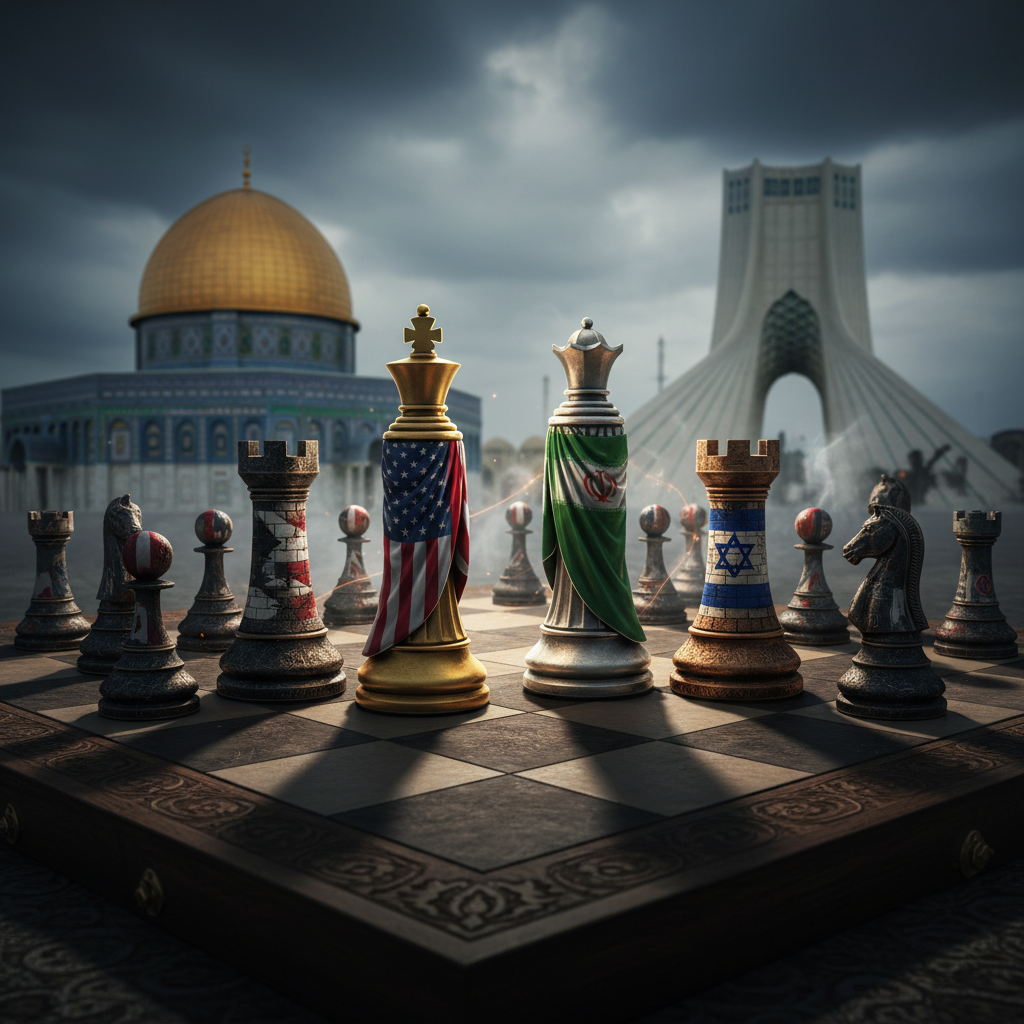
Key Points
Iran’s Central Role in the Crisis
Iran remains at the heart of an international crisis involving Washington and Tel Aviv, driven by its accelerated nuclear program, ballistic expansion, repeated violations of international obligations, and structural support for a network of regional armed groups.
Despite formal commitments under the Non-Proliferation Treaty (NPT) and the Joint Comprehensive Plan of Action (JCPOA), Tehran now exceeds authorized thresholds for uranium enrichment, storage, and advanced centrifuge development, as confirmed by recent IAEA and US Congress reports (Iranian Nuclear Program Status, Nuclear Production and Associated Risks, Iran’s Compliance with International Obligations).
The US strategy combines military pressure (naval force diplomacy), multilateral sanctions, and renewed diplomatic efforts, while Iran delays through negotiations, expands its nuclear capabilities, and intensifies its violations.
Regional Dynamics and Proxy Conflicts
The decline of Iran’s “ring of fire” strategy has given way to renewed conflicts involving Hezbollah, Hamas, the Houthis, and pro-Iranian militias in Syria and Iraq. This shift highlights Iran’s operational transition from conventional fronts to asymmetric harassment.
The debate over regime change underscores the limitations of external strikes without internal popular dissent, as the regime’s repression and security resilience remain significant obstacles.
Negotiations over Gaza’s demilitarization reveal Iran and its allies’ indirect stalling tactics, including ambiguity around “light” weapons and the concealment of underground infrastructure, fueling security uncertainty.
Strategic Context
History and Evolution of Iran’s Nuclear and Ballistic Program
- Timeline and Infrastructure:
Iran’s nuclear program began in the 1950s (under the Shah) but accelerated post-1979 Revolution. The 2002 revelation of secret sites in Natanz and Arak marked a turning point, followed by rapid uranium enrichment under the Atomic Energy Organization of Iran (AEOI). Key sites like Natanz, Fordow, and the Bushehr reactor demonstrate Iran’s technological growth, supported by a complex network of subcontractors, foreign suppliers, and concealment practices.Since the US withdrawal from the JCPOA, Iran has lifted its restrictions, enriching uranium up to 60%, installing advanced centrifuges, and stockpiling uranium sufficient to produce a weapon within a week, according to US estimates. - Technical Capabilities and Military Risks:
While Iran has growing enriched uranium stocks and mastery of fuel cycle stages, US intelligence (ODNI 2025) suggests it has not yet militarized or decided to produce a bomb. However, advancements in metallurgy and centrifuge expertise significantly shorten the timeline for potential military escalation. - Ballistic Missiles:
Iran’s ballistic missile development, under the Ministry of Defense and Aerospace Industries Organization, has advanced in range, precision, and system diversification. Despite UN sanctions (Resolution 2231) limiting exports until 2023, Iran has accelerated modernization, a cornerstone of its regional deterrence.
Legal Framework, Compliance, and Sanctions
- International Oversight and Non-Compliance:
From 2005 to 2025, the IAEA reported numerous Iranian violations of UN requirements on enrichment, sensitive equipment production, and transparency regarding potential military dimensions. Cooperation with the IAEA has often been suspended during crises, with the latest (summer 2025) leading to a temporary inspector withdrawal. - Sanctions and Snapback Mechanism:
Following the US withdrawal from the JCPOA (2018), France, Germany, and the UK reactivated the snapback mechanism in September 2025, reinstating all UN sanctions. This extended multilateral oversight indefinitely, despite Tehran’s opposition.
Operational Approaches
Regional Dynamics and Iran’s Proxy Network
- From “Ring of Fire” to Asymmetric Warfare:
Since 1979, Iran has relied on a network of non-state armed groups (Hezbollah, Hamas, Houthis, Iraqi and Syrian militias) as regional leverage. The Quds Force of the Revolutionary Guards coordinates these alliances, serving as a tool for indirect deterrence and protector of Shia and Palestinian populations.While Hezbollah remains dominant in Lebanon (with over 150,000 missiles and rockets), Iran’s strategy has shifted to diffuse, multichannel harassment, avoiding direct confrontation. - Strategic Impact and Indirect Diplomacy:
Iran’s logistical and financial support for Hamas, Hezbollah, and other proxies aims to tie Israeli forces across multiple fronts and influence Gaza negotiations (disarmament, tunnels, light vs. heavy weapons).
Compliance, Diplomatic Blackmail, and Internal Pressures
- Popular Aspirations and Regime Resilience:
Despite internal dissent, the regime’s deterrence and repression capabilities remain strong. Analysts agree that without mass insurrection, external strikes alone risk strengthening the central regime. - Gaza Connection: Tactical Traps and Hamas Resilience:
Hamas, supported by Tehran, proposes limited disarmament of “light weapons” while maintaining underground networks, seen as a tactical pause to preserve military capacity.
US Naval Presence and Strategic Objectives
The US has bolstered its naval presence in the Persian Gulf, Eastern Mediterranean, and Oman Sea, deploying nuclear-powered carriers, amphibious groups, and advanced missile defense systems. This aims to deter Iran and its allies, secure maritime routes, and provide rapid response capabilities.
Key Objectives:
- Ensure global energy supply security amid drone and missile attacks.
- Protect regional partners and maintain strike readiness.
- Reinforce US-Israel-Gulf defense coordination.
Strategic Goals
- Iran: Maintain nuclear threshold capability, maximize diplomatic and regional influence, and ensure regime survival.
- US & Israel: Prevent nuclear militarization, contain Iranian proxies, and ensure regional security.
- Proxies (Hamas, Hezbollah): Leverage Iranian support to preserve military capacity and influence disarmament processes.
- Regional Partners: Seek durable solutions, curb nuclear and ballistic proliferation, and avoid large-scale regional conflict.
This report integrates cross-referenced analyses from IAEA documents, US Congress reports, and other sources, providing an updated and rigorous view of the Iran-US-Israel dynamic in early 2026.
@BrookingsInst (Brookings Institution)
@Heritagefoundation
@CFR_org (Council on Foreign Relations)
@ChathamHouse (Chatham House)
@TheWilsonCenter (Wilson Center)
@CarnegieEndow (Carnegie Endowment for International Peace)
@RANDCorporation (RAND Corporation)
@MEIWashington (Middle East Institute)
@ICG (International Crisis Group)
@UN (United Nations)
@EU_Commission (European Commission)
@NATO (NATO)
@OECD (OECD)
@IntlCrimCourt (International Criminal Court)
Politiques et diplomates influents :
@SecBlinken (Antony Blinken, US Secretary of State)
@JosepBorrellF (EU High Representative for Foreign Affairs)
@UN_Spokesperson (UN Spokesperson)
@Reuters
@BBCWorld
@TheEconomist
@ForeignPolicy
@LCI
@lefigaro
@KimGhattas (Kim Ghattas, Middle East journalist)
@FarnazFassihi (Farnaz Fassihi, NYT journalist on Iran)
@IgnatiusPost (David Ignatius, Washington Post)
@RobinWright99 (Robin Wright, Middle East expert)
@BFMTV
@CNEWS

