
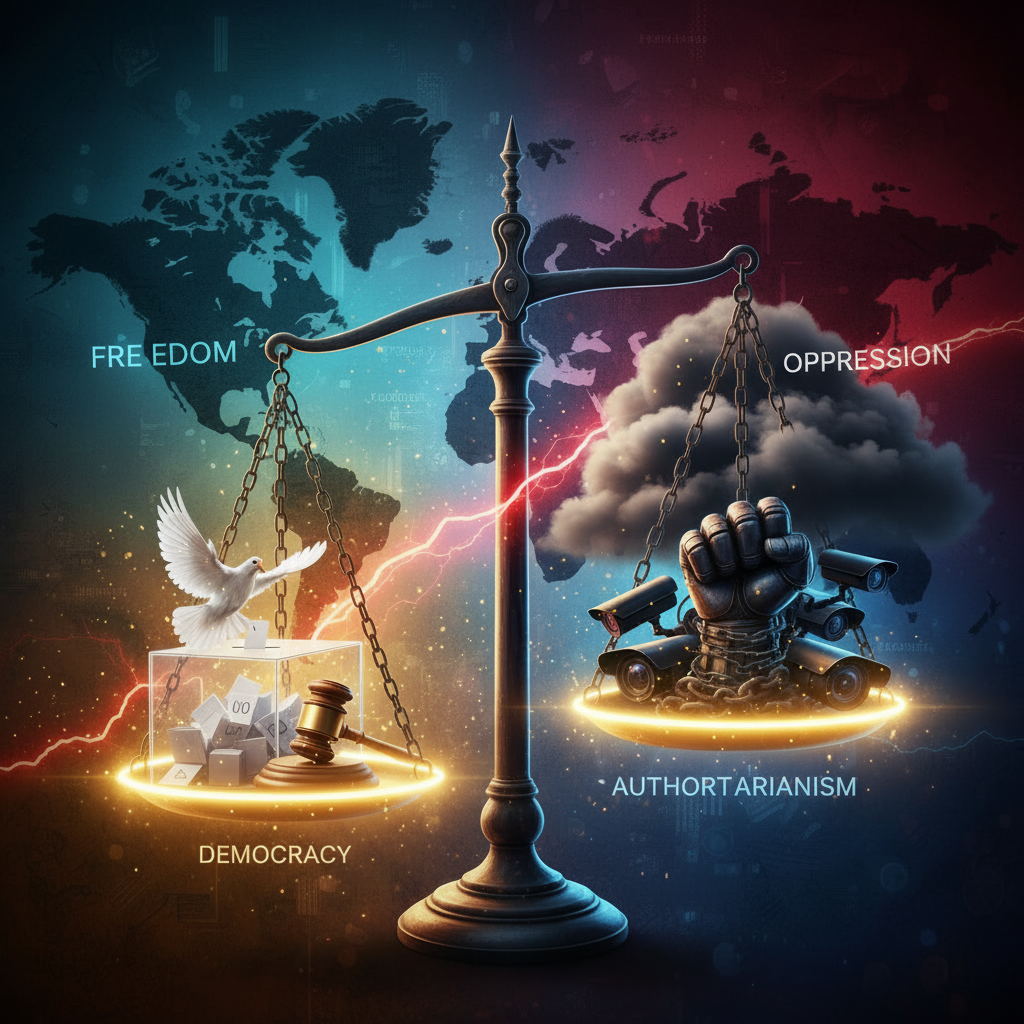
Throughout history, political alliances have shaped the global order in profound ways. During the interwar years, the Soviet-led Communist International supported revolutionary, anti-capitalist movements, laying the foundation for communism’s post-World War II expansion. Similarly, after the Cold War, the U.S.-led global order promoted democracy and liberal values, albeit inconsistently, sparking waves of democratic transitions. But today, the dynamics have shifted. Cross-border collaboration, once a tool for advancing democracy, is now being leveraged to strengthen authoritarianism.
A growing coalition of authoritarian regimes, illiberal governments, anti-establishment parties (often on the far right), and even private entities is working together to undermine democratic principles. What unites them isn’t a shared ideology but a mutual rejection of democratic norms like checks on executive power, civil liberties, and the rule of law. From leaders in democratic nations who weaken institutional safeguards, such as former U.S. President Donald Trump, to entrenched autocrats like Belarusian President Alexander Lukashenko, these figures are consolidating power, spreading disinformation, and delegitimizing their opponents. By pooling resources and amplifying propaganda, they are building a global network that increasingly favors autocracy.
This “illiberal alliance” was prominently showcased in September 2025, when Chinese President Xi Jinping, North Korean leader Kim Jong Un, and Russian President Vladimir Putin stood together in Beijing, symbolizing their defiance of liberal norms. However, this high-profile summit was just the surface of a much larger trend. In 2024 alone, the nonprofit Action for Democracy documented over 45,000 instances of collaboration among authoritarian regimes, illiberal governments, and opposition groups worldwide.
The Decline of Democracy
Liberal democracy is facing a profound crisis. For more than two decades, the world has been experiencing what some call a “democratic recession.” According to the Varieties of Democracy (V-Dem) Index, 45 nations moved toward autocracy in 2025, leaving only 29 countries classified as full democracies.
What’s even more alarming is how difficult it has become for democracies to recover once they backslide. In the past, countries like Uruguay and India managed to rebound after periods of authoritarianism. But in recent years, such recoveries have become rare. Research shows that since 1994, most nations that regained democracy after a period of autocratic rule began backsliding again within five years.
One of the key drivers of this trend is the rise of transnational support networks for autocrats. While history offers examples of authoritarian collaboration—such as the fascist alliances of the 1930s—today’s networks are far more sophisticated and well-resourced. Autocratic regimes now represent over 70% of the global population and control an increasing share of the world’s wealth. Their growing economic and military power, combined with advancements in digital technology, has made it easier for them to influence politics across borders.
Unlike the centralized alliances of the past, such as the Soviet-led Comintern, today’s illiberal networks operate as decentralized, overlapping systems. These networks include Russian mercenaries, funding from Gulf states, Chinese surveillance technologies, and far-right political movements in the West. Often, these elements reinforce one another. For instance, in the Central African Republic and Mali, Russian private military companies, financed through illicit gold deals with the UAE, have bolstered authoritarian regimes. Such collaborations entrench autocratic control and erode democratic norms.
The Role of Propaganda
Authoritarian regimes aren’t just collaborating militarily or economically—they’re also waging an ideological battle. While their worldviews may differ, their messaging often shares common themes, such as opposing gender equality and LGBTQ rights. In Europe and the U.S., right-wing groups frame these issues as threats to traditional values, while in other regions, they are portrayed as foreign impositions undermining cultural sovereignty. The ultimate goal is the same: to weaken trust in democratic institutions and normalize authoritarian governance.
Disinformation has become a powerful weapon in this effort. For example, in 2024, Russian-linked actors staged a provocative display in France, placing coffins draped in French flags near the Eiffel Tower to stir public anger over the government’s support for Ukraine. Similarly, China has used its Confucius Institutes and state-linked media to influence political discourse abroad, suppress criticism, and support pro-Beijing candidates. These efforts extend authoritarian influence into democratic spaces, undermining transparency and pluralism.
Authoritarian middle powers also play a significant role in suppressing democratic movements. Turkey’s supply of drones to authoritarian leaders in conflict zones and the UAE’s support for repressive actors in Africa and the Middle East are examples of how military and financial tools are used to entrench illiberal governance. Illicit financial networks further enable these collaborations, as seen in Azerbaijan’s bribery of European lawmakers and Hungary’s financial support for far-right parties in Spain.
Reclaiming Democracy’s Strength
If democracies hope to counter the rise of authoritarianism, they must adapt to the changing landscape. First, democratic values need to be made relevant to people’s everyday lives. Citizens must see how democracy can deliver tangible benefits. For instance, ahead of France’s 2024 elections, grassroots organizers used social media to counter disinformation and encourage voter participation, demonstrating the power of creative, community-driven strategies.
Second, democracies must confront authoritarian disinformation more effectively. The EU’s Digital Services Act, which requires platforms to curb harmful content and disclose their algorithms, is a step in the right direction. However, broader international cooperation is needed to establish clear standards for online platforms and promote information integrity.
Funding is another critical area. Democratic governments must expand support for independent journalists, civic organizations, and anti-corruption initiatives while cutting off the financial flows that sustain authoritarian regimes. Efforts like the EU’s “Democracy Shield” initiative show promise, but more must be done to disrupt the networks that enable autocratic actors.
Finally, the democratic alliance needs fresh leadership. Countries outside Europe and North America should play a greater role in shaping the pro-democracy agenda. Initiatives like the Democracia Siempre summit, hosted by Chile, highlight the potential for new coalitions to bring fresh energy and ideas to the fight for democracy.
Democracy is under threat, but it’s not too late to act. By strengthening their institutions at home and confronting authoritarian networks abroad, democracies can reclaim their footing. The battle for the future of governance is far from over, but with bold, coordinated action, democracy can prevail.
#DemocracyUnderThreat, #GlobalGovernance, #Authoritarianism, and #DemocracyMatters.
@UN, @EU_Commission, @FreedomHouse
Endnotes
Here’s the list of endnotes from the rewritten text:
- Source: Action for Democracy, 2025 Report.
- Source: Action for Democracy, 2024 Data.
- Source: Varieties of Democracy (V-Dem) Index, 2025.
- Source: Journal of Democracy, 2024 Study.
- Source: V-Dem Data, 2022.
- Source: Reports on Russian Mercenary Activity, 2024.
- Source: French Government Investigation, 2024.
- Source: Confucius Institute Reports, 2023.
- Source: Middle East Policy Journal, 2025.
- Source: European Parliament Corruption Reports, 2024.
- Source: French Election Campaign Analysis, 2024.
- Source: EU Digital Services Act, 2022.
- Source: EU Democracy Shield Initiative, 2025.
- Source: Democracia Siempre Summit, 2025.

