
Executive Summary
On February 27, 2022, Germany reached a turning point. Chancellor Olaf Scholz’s announcement of a Zeitenwende—a “watershed moment” in German foreign and security policy—was more than a pledge to funnel hundreds of billions of euros into the Bundeswehr. For the first time since World War II, Germany cast aside its long-held reservations about military power. Although Russia’s invasion of Ukraine was the catalyst, the effects of this transformation will echo throughout Europe for years to come (Scholz, 2022).
Germany’s ambition to take on a leading military role—with defense spending set to reach approximately $189 billion by 2029—opens up new possibilities but also stirs anxieties. Stronger German defense strengthens Europe against real threats, especially from the East. Yet, memories of the past weigh heavily: Will neighbors and partners feel reassured or threatened by Berlin’s new assertiveness? Can Germany balance its position as Europe’s economic engine with this new military leadership, without reviving old fears or igniting rifts within the European Union?
In this paper, we unpack Germany’s rearmament through the lens of international relations, European historical memory, and current political shifts. We untangle the difference between “great power” and “superpower,” assess Germany’s evolving global role, and consider both external concerns and internal risks, such as the rise of nationalist parties like Alternative for Germany (AfD). Ultimately, the path Germany chooses—collaborative leadership or going it alone—will decide whether its resurgence brings Europeans closer or drives them apart (Kundnani, 2022).
I. From Restraint to Resolve: Germany’s Pivotal Moment
For decades after reunification, Germany steered clear of military assertiveness. Shielded by NATO and powered by European integration, German governments focused on economic growth and diplomatic influence. Trade—with Russia for energy and China for exports—dominated policy, while defense spending lagged behind commitments (Pew Research Center, 2022).
That all changed with Russia’s invasion of Ukraine. The Zeitenwende was more than a budget shift—it was a wakeup call that “hard power” matters again as America’s role in Europe shifts. As analyst Liana Fix points out, Germany is striving to become a “normal power”—prosperous, democratic, and willing, if necessary, to defend its neighbors (Fix & Schwarzer, 2022).
But change won’t come easy. Decades of underfunding have left the Bundeswehr underprepared, while many Germans still feel uneasy about military power. Germany’s real challenge isn’t just new equipment, but a new mindset—one that reassures both its citizens and its allies.
II. Measuring Power: Great Power or Superpower?
Understanding Germany’s changing role requires distinguishing between superpowers and great powers:
- Superpowers—like the United States and, arguably, China—shape global affairs with overwhelming economic and military heft.
- Great Powers—such as France, the UK, or Russia—hold sway over their regions and can project force overseas.
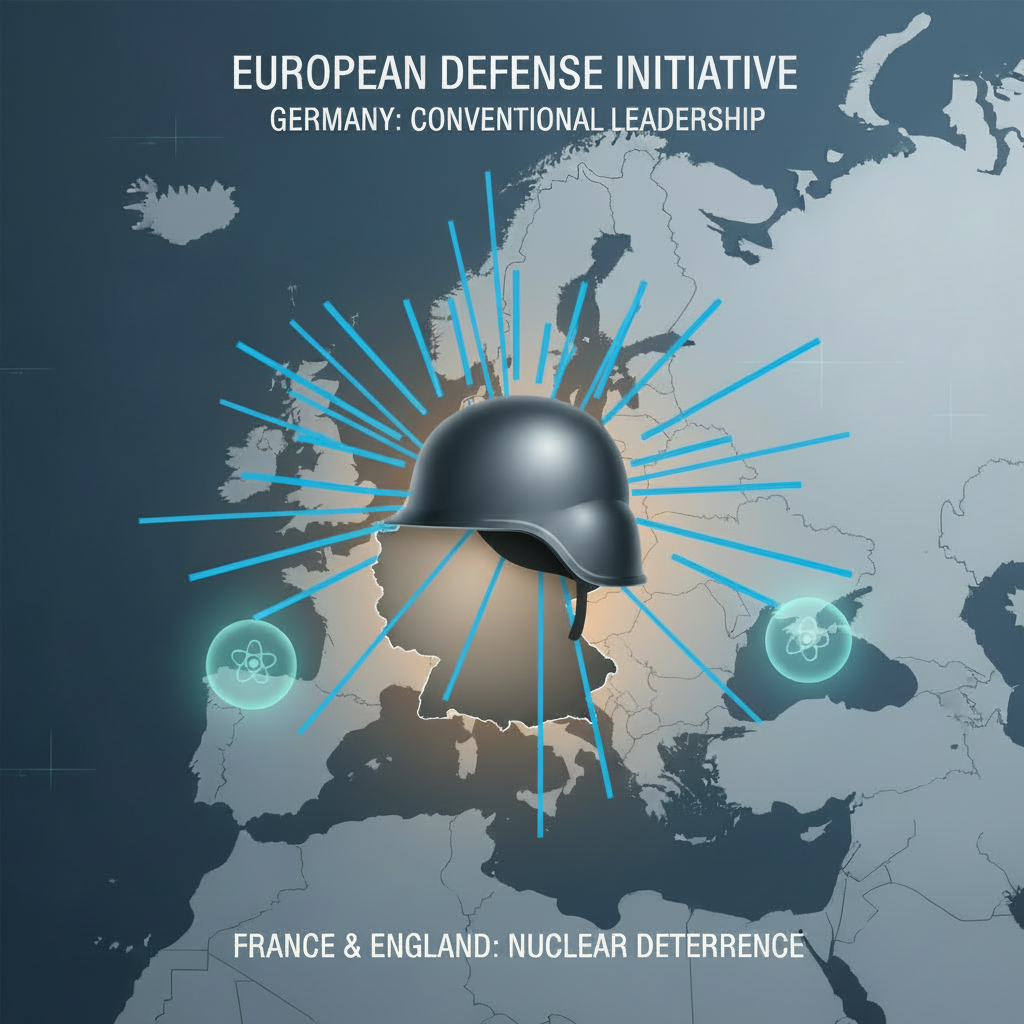
Economically, Germany is already the heavyweight of Europe. Militarily, it has lagged far behind. The Zeitenwende signals a real commitment to bridging that gap. By 2029, Germany’s defense budget is projected to surpass NATO benchmarks, overtaking France and the UK combined (NATO, 2023). As Germany’s military resources grow, so too does its influence within NATO and the EU. Old power centers may shift subtly but steadily from Paris and London to Berlin, shaped as much by capability as by diplomatic intent.
III. Allies and Anxiety: Europe’s Security Dilemma
Europe’s modern history casts a long shadow, especially when it comes to German military strength. Eastern European countries, acutely aware of the Russian threat, have urged Berlin to step up. Others, recalling the destructive potential of unfettered German power, worry that defense can quickly become dominance.
This uneasy balance is the classic “security dilemma”: When one country ramps up defenses, others may feel defensive—or even threatened. Germany has taken steps to reassure neighbors—tying new investments to NATO, advocating for shared procurement, and emphasizing interoperability (European Council on Foreign Relations, 2023). But these checks are not ironclad. Should American support decline, Germany could find itself as Europe’s lone security anchor, free or even pressured to put its own interests first.
Economics add a layer of friction. Critics in Paris, Warsaw, and Brussels have bristled as Germany steers defense contracts to domestic firms, often citing “national security” within EU loopholes. Without greater industrial collaboration, mistrust could fester. The same applies to fiscal disparities: Germany’s budget surpluses make large military investments possible, but not every EU partner can keep up (Brattberg & Lippert, 2023).
IV. Fault Lines at Home: Nationalism and Political Risks
The rest of Europe isn’t alone in feeling uneasy—many Germans feel the same. The rise of the populist, anti-establishment AfD party reveals deep domestic anxieties about the right direction for German power, Europe, and democracy itself (Deutsche Welle, 2023).
An expanded defense budget is a political gamble. So far, mainstream parties remain committed to anchoring Germany’s military in NATO and the EU, and to robust checks and balances. But if economic or social tensions were to boost the AfD or similar actors into power, this cross-party consensus could fracture. Germany’s democracy is strong, but not immune to strain. The historian Michael Kimmage reminds us that the line between responsible security policy and dangerous risk-taking is “thinner than it looks” (Kimmage, 2022). Europe’s scars are not as old as we might wish.
V. Looking Forward: Will German Power Unify or Divide?
Looking ahead to 2035, Germany’s choices—and those of its allies—will shape Europe’s next chapter.
Germany as Europe’s Anchor
Ideally, Germany will channel its new muscle into NATO and EU initiatives, serving as Europe’s logistic and defensive backbone. By supporting NATO’s eastern flank and complementing French and British strengths, Germany could foster lasting unity, resilience, and strategic independence from the United States (NATO, 2023). In this model, Berlin’s leadership is balanced by partnership, not domination.
Risks of Rivalry and Division
But if Germany’s resurgence is seen as unilateral or self-interested, old habits could return. France might muscle up or seek outside alliances. Smaller EU countries could band together to limit German influence. If U.S. engagement drops, competitive blocs might reappear, and trust could erode, shaking the security foundations Europe has built since 1945 (European Council on Foreign Relations, 2023).
Conclusion: Promise and Peril
Germany’s rearmament is both an opportunity and a challenge for Europe. The habits of caution and consensus that stabilized the continent for decades are being tested by real threats. If German leaders act with vision and humility—anchoring their ambitions in partnership—Europe could emerge stronger than ever. If not, old divisions could reignite.
The coming years will determine whether Germany becomes the pillar that secures European peace, or the spark that rekindles old rivalries. The outcome lies not just in Berlin, but in the faith and choices of Germans and their European neighbors. The future, as historian Timothy Garton Ash has observed, “will be made in Germany—or unmade” (Garton Ash, 2022).
References
- Brattberg, E., & Lippert, B. (2023). Germany’s Reluctant Rearmament: European Dilemmas. Carnegie Europe.
- Deutsche Welle. (2023). Germany: Far-right populist AfD sees support soar.
- European Council on Foreign Relations. (2023). Germany’s new defence policy: A European Zeitenwende.
- Fix, L., & Schwarzer, D. (2022). Zeitenwende: Germany’s Turning Point. Council on Foreign Relations.
- Garton Ash, T. (2022). Zeitenwende: Germany’s historic turning point. The Guardian.
- Kimmage, M. (2022). Germany’s Nostalgia for Power. Foreign Affairs.
- Kundnani, H. (2022). Germany’s Turning Point. Foreign Affairs.
- NATO. (2023). NATO Defence Expenditure data.
- Pew Research Center. (2022). In Germany, public support for defense spending climbs.
- Scholz, O. (2022). Bundestag speech on Germany’s Zeitenwende. Bundesregierung.
#Germany #GermanDefense #Bundeswehr #Zeitenwende #GermanLeadership #EuropeSecurity #GermanyInEurope #GermanMilitary #Berlin #MadeInGermany #GermanInnovation #GermanStrategy #GermanyNATO #GermanyEU #GermanThinkTanks #GermanMedia
#France #FrenchDefense #ArmeeDeTerre #FranceInEurope #FrenchLeadership #Paris #FrenchMilitary #EuropeSecurity #FranceStrategy #MadeInFrance #FrenchInnovation #FranceNATO #FranceEU #FrenchThinkTanks #FrenchMedia
#Brussels #EuropeanUnion #NATO #EuropeanDefense #EUDefense #EuropeSecurity #EuropeanLeadership #EUInnovation #EuropeStrategy #DefenseInEurope #BrusselsLeadership #EUandNATO #EuropeUnited #EuropeanThinkTanks #EuropeanMediterrannee
#IndoPacific #IndoPacificSecurity #AsiaPacific #IndoPacificStrategy #IndoPacificDefense #QuadAlliance #PacificPartnership #IndoPacificInnovation #IndoPacificLeadership #IndoPacificCooperation #IndoPacificThinkTanks #IndoPacificMedia
#USA #USDefense #Pentagon #USMilitary #USLeadership #USNATO #USIndoPacific #USInnovation #USStrategy #AmericaInEurope #AmericaInAsia #USGlobalLeadership #USAllies #USThinkTanks #USMedia
@GermanyDiplo @GermanyNATO @BMVg_Bundeswehr (German Ministry of Defense) @AuswaertigesAmt (German Foreign Office) @GermanyinEU @GermanyinNATO @BundeswehrInfo @GermanyUN @GermanyCoE @SWPBerlin (German Institute for International and Security Affairs) @DGAPBerlin (German Council on Foreign Relations) @dwnews (Deutsche Welle) @SPIEGEL_English (Der Spiegel) @FAZ_NET (Frankfurter Allgemeine Zeitung)
@FranceDiplo @FranceNATO @Defense_gouv (French Ministry of Defense) @FranceinEU @FranceinNATO @ArmeeDeTerre @FranceUN @FranceCoE @Elysee (French Presidency) @IFRI_Paris (French Institute of International Relations) @IRIS_FR (Institute for International and Strategic Affairs) @LeMonde_EN (Le Monde) @FRANCE24 (France 24) @LesEchos (Les Echos)
@EU_Commission @NATO @EUCouncil @Europarl_EN @EUNATO @EUDefenceAgency @EU_ISS (EU Institute for Security Studies) @NATOpress @NATO_KFOR @NATO_ACT @Carnegie_Europe (Carnegie Europe) @EgmontInstitute (Egmont Institute) @CEPS_thinktank (Centre for European Policy Studies) @POLITICOEurope (Politico Europe) @Euronews @EUobserver
@ASEAN @India_MEA (India Ministry of External Affairs) @Japan_MOFA (Japan Ministry of Foreign Affairs) @AusDefence (Australian Department of Defence) @DFAT (Australian Foreign Affairs) @MOFAkr_eng (South Korea Ministry of Foreign Affairs) @PacificForum @IndoPacom (US Indo-Pacific Command) @LowyInstitute (Lowy Institute) @CSIS (Center for Strategic and International Studies) @ICWA_NewDelhi (Indian Council of World Affairs) @TheDiplomat (The Diplomat) @SCMPNews (South China Morning Post) @ABCNews (Australia)
@StateDept @DeptofDefense @USNATO @US_EUCOM (US European Command) @USArmy @USNavy @USAirForce @SecDef (US Secretary of Defense) @POTUS (President of the United States) @VP (Vice President of the United States) @USIndoPacom @USMissionEU @BrookingsInst (Brookings Institution) @CFR_org (Council on Foreign Relations) @Heritage (The Heritage Foundation) @RANDCorporation (RAND Corporation) @nytimes (The New York Times) @washingtonpost (The Washington Post) @ForeignPolicy (Foreign Policy) @TheAtlantic (The Atlantic)

