
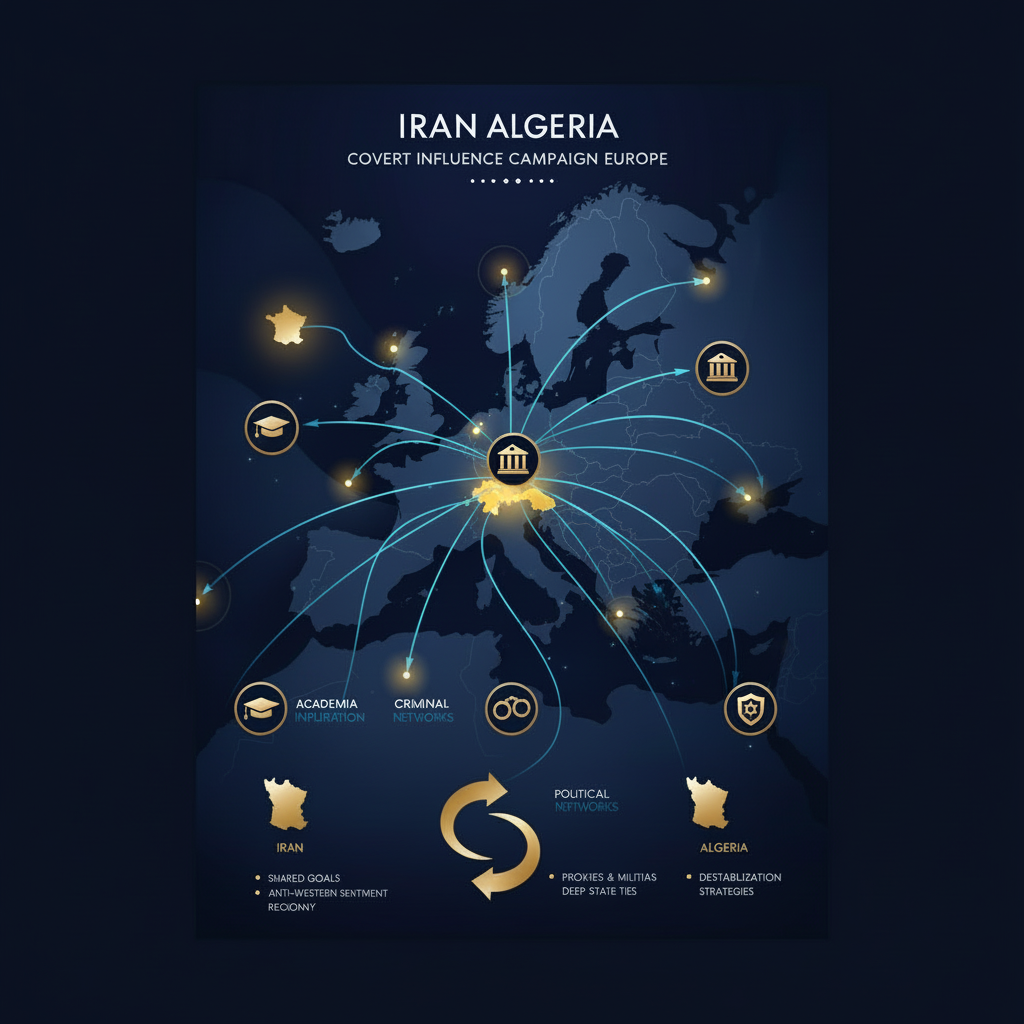
While Iran’s geopolitical maneuvers continue to draw international scrutiny, its covert influence operations in Europe present a growing, yet underestimated, threat. These efforts, bolstered by a strategic partnership with Algeria, unfold against the backdrop of Iran’s struggle to rebuild its nuclear and ballistic programs. This reveals a complex strategy: maintaining influence by exploiting vulnerabilities within European societies while facing significant internal and external challenges.
Iran’s Destabilization Campaign in Europe: A Strategy Inspired by the Soviet Era
Iran’s covert activities in Europe, and specifically in France, are part of a deliberate strategy designed to weaken social cohesion, influence policymakers, and promote its geopolitical objectives. These operations, which are reminiscent of tactics employed by the Soviet Union during the Cold War, are sophisticated and deeply rooted in various sectors of French society.
Key Tactics in France: An In-Depth Analysis
The Iranian destabilization campaign in France relies on a series of carefully orchestrated tactics that exploit institutional and social fractures to maximize their impact.
Influencing Key Figures in Society
Iran actively targets influential figures, including academics, scientists, and diplomats, by proposing narratives that align with its geopolitical goals. These individuals, often positioned in key institutions like universities, think tanks, and ministries, become conduits for disseminating Iranian propaganda.
- How it works: Academic conferences, cultural exchanges, and collaborative research projects often serve as cover for establishing connections with potential allies. These events allow Iran to legitimize its discourse and gain credibility within intellectual and political circles.
Key Tactics in France: An In-Depth Analysis
Iran’s destabilization campaign in France relies on a series of carefully orchestrated tactics that exploit institutional and social fractures to maximize their impact.
Influencing Key Figures in Society:
Iran actively targets influential figures, including academics, scientists, and diplomats, by proposing a narrative that aligns with its geopolitical objectives. These individuals, often positioned in key institutions like universities, think tanks, and government ministries, become conduits for disseminating Iranian propaganda.
- How it works: Academic conferences, cultural exchanges, and collaborative research projects often serve as cover for establishing connections with potential allies. These events allow Iran to legitimize its discourse and gain credibility within intellectual and political circles.
Utilizing Criminal Networks:
Criminal organizations are employed to target Jewish and Israeli communities in France, creating a climate of fear and division. These actions divert attention from Iran’s broader strategic goals while weakening the social fabric.
- Impact: Attacks against Jewish institutions, such as synagogues or cultural centers, are not limited to intimidation. They also contribute to a broader narrative aimed at sowing instability.
Collaboration with Algeria:
The partnership between Iran and Algeria has become a central pillar of its operations in France. This alliance exploits Algeria’s logistical networks and historical ties with France, offering Iran a solid base to expand its influence.
- Mechanism: Thanks to its established presence in French society, Algeria provides logistical support, while Iran contributes financial and ideological resources. Together, they infiltrate French political and social institutions.
Organized Campaigns Against French Jewish Authors:
Iranian-backed efforts aim to discredit and silence Jewish voices in France. These campaigns often involve coordinated attacks, boycotts, and attempts to undermine the credibility of Jewish intellectuals and authors.
- Example: Jewish intellectual figures have been the target of harassment campaigns, their works publicly denigrated or rejected in media aligned with Iranian interests. This contributes to creating an environment hostile to freedom of expression and intellectual debate.
Utilizing Criminal Networks
Criminal organizations are employed to target Jewish and Israeli communities in France, creating a climate of fear and division. These actions divert attention from Iran’s broader strategic goals while fracturing the social fabric.
- Impact: Attacks against Jewish institutions, such as synagogues or cultural centers, are not limited to intimidation. They also contribute to a broader narrative aimed at sowing instability.
An Overwhelmed French Executive
Faced with these sophisticated tactics, the French executive branch, including the presidency and the Ministry of Foreign Affairs, appears largely overwhelmed. Institutions struggle to grasp the scale and complexity of Iranian-Algerian strategies, which limits their ability to respond effectively.
- Why this weakness? French institutional structures, often focused on immediate crises, lack the coordination and resources to counter such insidious operations. Furthermore, the clandestine nature of these activities makes their detection and neutralization particularly difficult.
These tactics demonstrate Iran’s ability to adapt its strategies to the European political and social context, making its operations all the more difficult to counter.
The Iran-Algeria Alliance: A Growing Threat to European Security
The strategic partnership between Iran and Algeria represents a significant escalation of the threats facing Europe. Although these two nations have historically pursued distinct regional agendas, their current collaboration constitutes a formidable force capable of destabilizing European societies and undermining Western influence.
Common Goals and Strategic Alignment
Iran and Algeria share several objectives that form the foundation of their alliance:
- Opposition to the West: Both countries perceive Western policies as a threat to their sovereignty and regional ambitions. Their partnership aims to counter these policies and promote their own narratives.
- Support for Proxy Networks: Iran’s expertise in managing proxy groups, combined with Algeria’s logistical capabilities, strengthens their ability to influence events in Europe and North Africa.
- Extension of Influence: By collaborating, Iran and Algeria can extend their reach beyond their respective regions, targeting European institutions and societies.
Risks for Europe
The Iran-Algeria alliance poses a multidimensional threat to European security, encompassing political, social, and economic aspects. Here are the main identified risks:
- Political Destabilization: By infiltrating political institutions and influencing decision-makers, this alliance can disrupt European unity and complicate decision-making processes.
- Social Fragmentation: By targeting specific communities, such as Jews and Israelis, the alliance contributes to social division and the erosion of trust within European societies.
- Economic Disruptions: Covert operations targeting critical infrastructure, such as energy supplies and transportation networks, could disrupt European economies.
- Terrorism and Proxy Warfare: The alliance’s support for proxy groups and criminal networks increases the risk of terrorist attacks and other forms of violence in Europe.
Conclusion: A Persistent and Evolving Threat
Iran’s covert influence campaigns in Europe, combined with its strategic partnership with Algeria, represent a growing threat to European security and stability. These efforts, which include institutional infiltration, the exploitation of criminal networks, and the promotion of divisive narratives, are part of a broader strategy aimed at weakening Western influence.
The apparent inability of the French executive to respond effectively to these threats underscores the need for a coordinated and proactive approach. By strengthening intelligence-sharing mechanisms, building social resilience, and targeting the financial networks that support these operations, Europe can mitigate risks and protect its societies against this evolving threat.
Key Organizations:
@- @AtlanticCouncil
@- @CSIS
@- @CrisisGroup
@- @TheWilsonCenter
@- @CarnegieEndow
#Iran #Algeria #EuropeanSecurity #Geopolitics #CovertInfluence #Destabilization #IranianProxies #ForeignPolicy #NationalSecurity

