
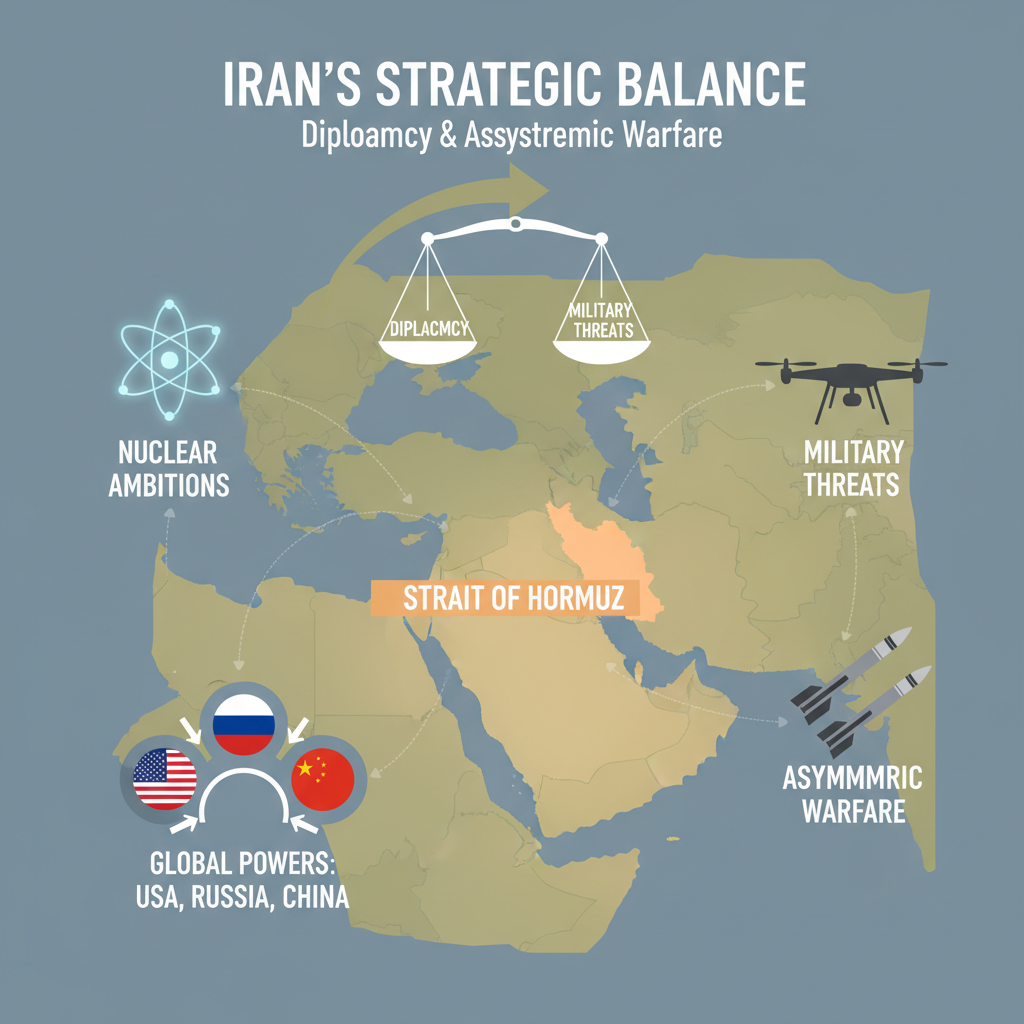
The foreign policy of the Islamic Republic of Iran is a fascinating subject of study for experts in international relations and military sciences. Often described as dualistic, it constantly oscillates between diplomatic negotiation and military coercion. This approach is not contradictory but rather constitutes a coherent strategic doctrine rooted in realist theory, aimed at ensuring regime survival, projecting regional power, and neutralizing external threats.
This article offers a technical analysis of this grand strategy by breaking it down into its three fundamental pillars: the nuclear program as a deterrence lever, the doctrine of asymmetric warfare as a force projection tool, and a geopolitical positioning designed to exploit fractures in the international system.
The Nuclear Paradigm: Deterrence Through Ambiguity and Thresholds
Iran’s nuclear program is the central axis of its national security strategy. It should not be analyzed solely through the lens of proliferation but as a multifunctional instrument of power. It simultaneously serves as a deterrence tool, a negotiation lever, and a symbol of technological sovereignty.
The Concept of “Breakout Time” as a Bargaining Chip
Technically, Iran’s strategy hinges on mastering the concept of “breakout time”—the time required to produce enough weapons-grade uranium (HEU) for a nuclear weapon. By reducing this timeframe to mere weeks or even days through the accumulation of 60% enriched uranium and the use of advanced centrifuges (IR-6, IR-9), Iran fundamentally alters the strategic equation.
This posture does not indicate an immediate intent to militarize. Instead, it creates a situation of “threshold deterrence,” where Iran remains just below the status of a nuclear-armed state, making the cost of a preventive intervention extraordinarily high. Any military strike on its facilities, such as the fortified Fordow site or Natanz, risks pushing the regime to cross the nuclear threshold definitively. This latent threat forces adversaries, particularly the United States and Israel, to remain engaged in negotiations, even when they appear deadlocked. The 2015 Joint Comprehensive Plan of Action (JCPoA) aimed to extend this breakout time to over a year in exchange for sanctions relief. The U.S. withdrawal from the agreement allowed Iran to technically justify reducing this timeframe.
The Role of Ballistic Delivery Systems
The credibility of even latent nuclear deterrence depends on the ability to deliver it. The intensive development of Iran’s ballistic missile program is therefore inseparable from its nuclear strategy. Intermediate-range missiles like the Shahab-3, Sejjil, or Khorramshahr are capable of reaching the entire Middle East and parts of Europe. By focusing on improving their precision (Circular Error Probable, or CEP), Iran enhances the conventional threat of its missiles while maintaining a credible option for a potential unconventional payload.
The Doctrine of Asymmetric Warfare: Compensating for Conventional Weakness
Aware of its inferiority to the conventional military power of the United States, Iran has theorized and implemented a doctrine of asymmetric warfare. This doctrine does not aim to defeat the adversary in direct conflict but to impose unsustainable political, economic, and human costs, thereby deterring action. It rests on two main axes: Anti-Access/Area Denial (A2/AD) and proxy warfare.
A2/AD in the Persian Gulf
The Strait of Hormuz is the quintessential theater for Iran’s A2/AD strategy. The goal is to make the cost of U.S. naval intervention prohibitive. This strategy combines multiple layers of defense:
- Anti-ship ballistic missiles (ASBM): Systems like the Khalij Fars threaten aircraft carriers and other high-value naval assets at long range.
- Naval mines: Iran possesses a significant stockpile of mines that can be rapidly deployed to block or disrupt shipping lanes.
- Swarm tactics: Swarms of fast, heavily armed boats, coordinated by the Islamic Revolutionary Guard Corps (IRGC), are designed to overwhelm the defenses of a carrier strike group.
- Drones and coastal submarines: These provide surveillance and can conduct surprise attacks on naval targets.
This persistent threat to the free flow of 20% of the world’s oil gives Iran a major economic coercion lever.
Power Projection Through Proxies
The other pillar of asymmetric warfare is the use of allied non-state actors to project Iranian influence and harass its adversaries. From Hezbollah in Lebanon to the Houthis in Yemen, and Shia militias in Iraq and Syria, this “resistance network” allows Iran to:
- Conduct military actions against Israel or the U.S. while maintaining “plausible deniability.”
- Extend its strategic influence to the Mediterranean (“Shia corridor”).
- Threaten multiple fronts simultaneously in the event of direct conflict.
The transfer of advanced technologies (drones, precision missiles) to these groups increases their effectiveness and blurs the lines between state and non-state warfare.
Geopolitical Positioning: Exploiting Global Rivalries
On the grand chessboard of international relations, Iran employs a strategy of hedging and balancing. It seeks to exploit rivalries among major powers to maximize its strategic autonomy.
The Sino-Russian Axis: A Strategic Counterweight
In response to U.S. pressure, Iran has turned to Russia and China:
- With Russia: This is a tactical and security partnership. Russia provides diplomatic protection at the UN Security Council and advanced military equipment (e.g., S-300 air defense systems, discussions on Su-35 fighter jets). Their cooperation in Syria has strengthened operational ties.
- With China: The relationship is primarily economic. China is a vital buyer of Iranian oil, bypassing U.S. sanctions. The 25-year strategic partnership agreement offers Iran long-term development prospects and an alternative to the Western financial system.
For Tehran, this axis is not a formal alliance in the Western sense but a counterweight that prevents total isolation and helps resist U.S. “maximum pressure.”
Managing Rivalries with the U.S. and Israel
The confrontation with the U.S. and Israel is managed through a cycle of controlled escalation and de-escalation. Iran responds to sanctions or military actions (such as the killing of Qasem Soleimani) with calibrated retaliations (missile strikes on U.S. bases, proxy attacks). The goal is to demonstrate its retaliatory capacity and restore deterrence without triggering a full-scale war it cannot win.
Conclusion: A Doctrine of Survival and Influence
Iran’s grand strategy is a model of defensive realism, where every action—diplomatic or military—is subordinated to the primary objective: regime survival and the preservation of strategic autonomy. The nuclear program acts as an existential insurance policy, asymmetric warfare as a force multiplier, and geopolitical positioning as a means to navigate a hostile environment.
While successful in many respects, this strategy carries inherent risks. The possibility of miscalculation leading to unintended escalation remains high. Additionally, it places immense and enduring pressure on Iran’s economy and population. The sustainability of this doctrine will depend on the regime’s ability to manage these internal contradictions while maintaining a precarious balance of terror with external adversaries.
#IranStrategy #Geopolitics #InternationalRelations #MilitaryScience #DefenseStrategy #MiddleEastTensions #NuclearAmbitions #AsymmetricWarfare #GlobalSecurity #StraitOfHormuz #USA #Russia #China #MiddleEastPolitics #InternationalSecurity #MilitaryAnalysis #GlobalStability #DiplomacyAndDefense #NuclearProliferation #DefenseTechnology #RegionalConflict #EnergySecurity #GlobalTradeRoutes #MiddleEastGeopolitics #ConflictResolution #DefenseInnovation #ProxyWarfare #NavalStrategy #A2AD #MissileDefense #DronesInWarfare #PersianGulf #GlobalRisk #StrategicBalance #InternationalAffairs #MiddleEastSecurity #DefensePolicy #GlobalPowerDynamics @UnitedNations @IAEAorg @NATO @BrookingsInst @CSIS @ForeignAffairs @MiddleEastInst @ChathamHouse @AtlanticCouncil @CarnegieEndow @RANDCorporation @UNDP @UNPeacekeeping @ICRC @WorldBank @IMFNews @TheEconomist @ForeignPolicy @Reuters @BBCWorld @AlMonitor @MiddleEastEye @DefenseOne @WarOnTheRocks @JaneDefence @GlobalSecurityOrg @ArmsControlNow @CFR_org

