
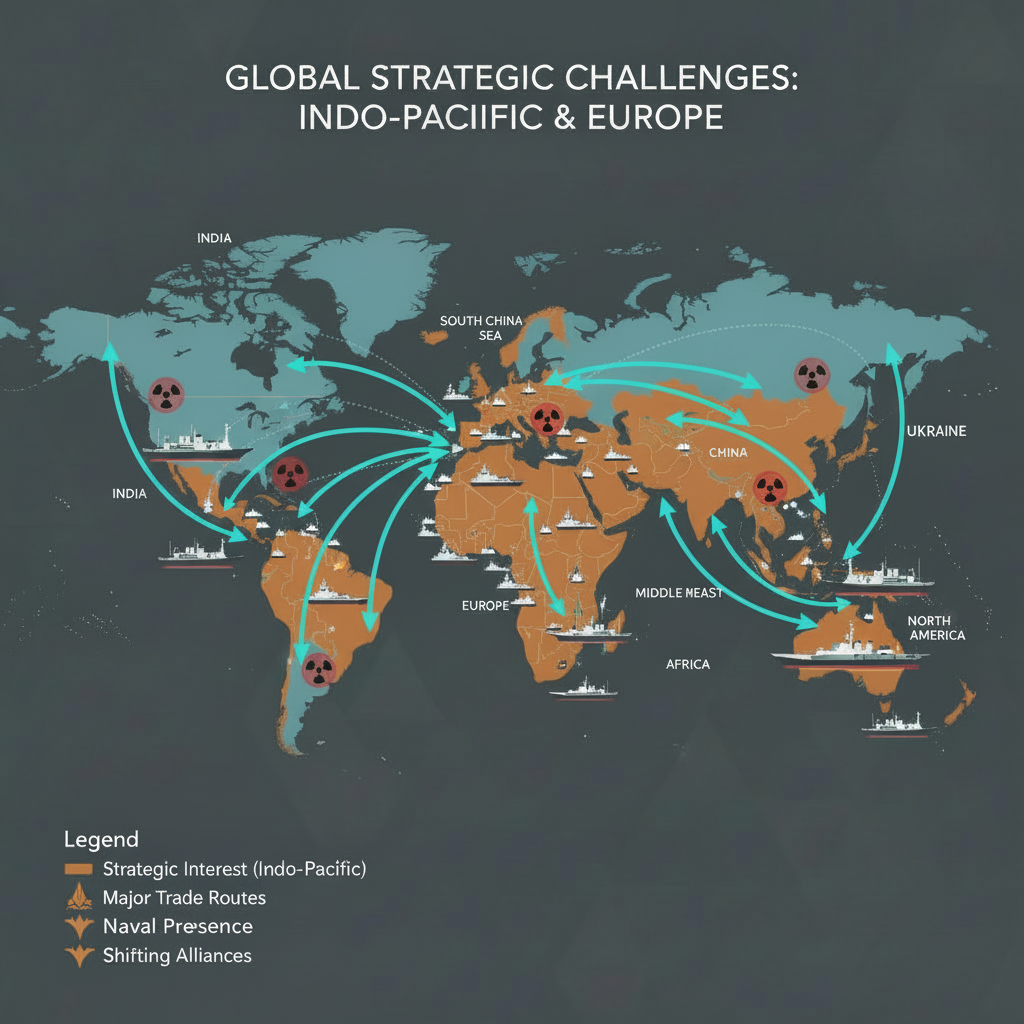
Executive Summary
As the world undergoes profound shifts, it is crucial to grasp the underlying dynamics transforming our security and collective future. The Indo-Pacific and Europe, long considered stable poles, are now interlinked and subject to growing shocks. This defining moment challenges our certainties, calls for bold thinking and solidarity, and highlights that our shared security is at stake.
China’s assertive rise, the sometimes uncertain repositioning of the United States, the brutal war in Ukraine, the resurgence of nuclear threats, and breakthrough technological innovation are shaking the established order. Yet behind every crisis, opportunities emerge to reinvent alliances, diplomacy, and civic solidarity. Facing uncertainty, every player—state, business, or citizen—must consider their role in a rapidly changing world.
1. Strategic Shifts in the Indo-Pacific
A Crossroads of Promise and Tension
The Indo-Pacific embodies both global economic dynamism and the nexus of major strategic rivalries. Here, youthful energy and vibrant start-up sectors mingle with the underlying fear of military escalation. Yesterday’s certainties under the American security umbrella are fading, leaving deep questions: Who now guarantees regional security? Whom can we trust?
China’s Growing Assertiveness
China is methodically extending its influence, investing heavily in the Belt and Road Initiative, bolstering its naval presence, and developing breakthrough technologies—especially in artificial intelligence and cybersecurity. According to the Stockholm International Peace Research Institute (SIPRI), China’s military budget has soared by more than 75% over the past decade, fueling tensions throughout the Indo-Pacific basin (SIPRI Fact Sheet 2023).
Taiwan: A Fragile Bastion of Democracy
Amid these rising tensions, Taiwan stands as a symbol of democratic resilience in the face of Chinese pressure. The island’s population has embraced innovation: comprehensive cybersecurity training, civil preparedness drills, and strengthened collaboration with major tech powers. Unfortunately, repeated Chinese air incursions and large-scale military exercises serve as constant reminders that local peace is never guaranteed.
Regional Neighbors Seek Their Own Path
- Japan: Emerging from its traditional restraint, Japan is significantly increasing military spending.
- South Korea: Debates the merits of independent deterrence, facing North Korean threats and shifting alliance dynamics.
- Australia: Strengthens strategic cooperation through AUKUS, banking on technology and shared intelligence.
2. Europe and the Middle East: Multidimensional Security and Tensions
Europe: From Illusion to Resilience
Europe’s naivety collided head-on with the harsh reality of the Ukraine invasion in 2022. Since then, the continent has demonstrated unity through logistics mobilization, increased defense budgets, and a sharp awareness of the need for energy and strategic autonomy. Sweden and Finland, long neutral, have joined NATO, signaling renewed confidence in collective defense. Meanwhile, the European Union strives to balance American influence with its own decision-making aspirations on the world stage.
Energy Resilience and Concrete Solidarity
Confronted by the shock of Russian gas shortages, Europe has innovated: rapidly expanding LNG terminals, pooling resources, and accelerating the shift to renewables. Germany has made major investments in green hydrogen, France is fast-tracking nuclear integration, and new collaborations are emerging for energy storage and network cybersecurity. Even with challenges, this movement demonstrates unprecedented collective commitment.
Iran, Israel, and the Powder Keg of the Middle East: Uncertainty and Escalation
In recent years, the Middle East has become the epicenter of global concern. Behind every diplomatic or military incident lie global stakes far beyond regional borders.
Iran’s Pursuit of Power and Autonomy
Iran continues to modernize its nuclear program, crossing thresholds seen as worrisome by the IAEA and the Western community (IAEA Report, February 26, 2024). Despite strengthened economic sanctions and internal social pressures, Tehran remains uncompromising in its strategic ambitions—supporting Hezbollah militia in Lebanon, the Houthis in Yemen, and refusing any concessions seen as undermining its sovereignty.
Israel: Preemptive Defense
Israel has been adamant it will never allow a nuclear-armed Iran. With strong U.S. support—often at odds with European allies over strategy—the Netanyahu government continues targeted strikes in Syria and Iran to slow nuclear progress and weaken pro-Iranian paramilitary capabilities. According to intelligence sources like The Guardian and Al Jazeera, any further nuclear advances by Iran could trigger major military action.
U.S. Naval Deployments: Deterrence or Escalation?
Since late 2023, the United States has significantly reinforced its maritime presence off the Middle East coast. Two Navy carrier strike groups operate in the Eastern Mediterranean and the Persian Gulf, and Aegis-equipped destroyers are deployed to intercept potential missiles, especially in retaliation against Israel. According to a CNSNews report (February 2024), these maneuvers are aimed at demonstrating Washington’s commitment to its allies—but many experts warn they could trigger a dangerous spiral.
Persistent rumors of imminent U.S. attacks on Iranian nuclear or military sites continue, though neither the Biden administration nor the Pentagon have confirmed such plans. Think tanks such as Carnegie Endowment and the French Institute of International Relations (IFRI) note that even a minor military incident could create an escalation that would be difficult to contain.
A Region on a Knife’s Edge, Palpable Anxiety
For local populations, the consequences of a miscalculation or open conflict would be dire: threats to global oil supplies, risk of strikes on Israeli or Gulf cities, inflation, and mass displacement. Many emphasize the urgent need for renewed dialogue, credible international monitoring, and inclusive diplomacy to prevent the worst outcomes. According to Amnesty International and Human Rights Watch, the humanitarian fallout of a regional conflict would affect not only neighboring states but millions of civilians worldwide, further exacerbating food insecurity and economic instability.
4. The Technological Race and Reinvented Security
Who Will Control the Future?
Technology is the most open battlefield: drones, military AI, satellites, hypersonic weapons—everyone is investing to stay ahead. According to the OECD and SIPRI, military innovation budgets reached record levels in 2023.
Taiwan & the Indo-Pacific: Innovation Laboratory
Strategically vulnerable yet technologically advanced, Taiwan is strengthening partnerships with the United States and Europe to safeguard its semiconductor industry. Any supply chain disruption or targeted attack would have devastating consequences for the global economy (source: Semiconductor Industry Association).
Europe Learns to Blend Tradition and Modernity
The war in Ukraine has driven Europe to invest in digital defense, robotics, and predictive analytics. Joint NATO exercises and public-private partnerships (Airbus, Thales, Leonardo) are accelerating rapid adaptation, inspiring new models for collective resilience.
Perspectives: Adapting for the Long Term
Tomorrow’s world will be built on evolving alliance networks, shared sovereignty, and new civic responsibilities. Now is the time to invent creative solutions, rebuild trust through collective action, and maintain ongoing dialogue between institutions, businesses, and civil society.
- Indo-Pacific: Every Incident Sends Shockwaves Worldwide
Europe and the world are closely watching tensions in Taiwan, the security of critical routes, and supply chain reliability. Major companies are conducting strategic audits to anticipate the next crisis. - The Nuclear Question Returns to Center Stage
The domino effect risk—if new states acquire nuclear weapons—worries international bodies, spurring research and diplomacy. - Evolving Alliances Must Be Invented
We have left behind rigid blocs; today’s reality is networks of interest and trust. Strategies and tools must be constantly adapted, collective intelligence and solidarity valued to face crises.
In conclusion:
More than ever in recent history, global stability depends on our ability to combine technological innovation, demanding dialogue, and human solidarity. The road ahead is long and sometimes uncertain, but strengthening our collective resilience and mobilizing citizens can open the door to a safer, more just, and sustainable world. Let’s seize this opportunity to reinvent our future—together.
#Geopolitics | #GlobalSecurity | #NATO | #UnitedNations | #MiddleEast | #IndoPacific | #China | #Russia | #USMilitary | #EuropeanUnion | #StrategicAlliances | #NuclearRisks | #TradeRoutes | #DefenseStrategy | #GlobalDiplomacy | #InternationalRelations | #WorldPolitics | #SecurityChallenges | #GlobalTrends | #StrategicPartnerships
@BBCWorld | @CNN | @Reuters | @AP | @TheEconomist | @AlJazeera | @NYTimes | @WSJ | @FT | @DWNews | @LeMonde | @Le_Figaro | @France24_en | @Guardian | @TimesofIndia | @SCMPNews (South China Morning Post)
@NATO | @UN | @EU_Commission | @WorldBank | @IMFNews | @WHO | @WTO | @OECD | @ASEAN | @AfricanUnion | @OAS_official (Organization of American States)
@StateDept (US Department of State) | @DeptofDefense (US Department of Defense) | @KremlinRussia_E (Kremlin) | @ChinaDaily | @IsraeliPM (Israeli Prime Minister) | @Iran_GOV (Iranian Government) | @Elysee (French Presidency) | @10DowningStreet (UK Prime Minister) | @Bundeskanzler (German Chancellor) | @IndiaGov (Indian Government) @Cnews @LCI

