
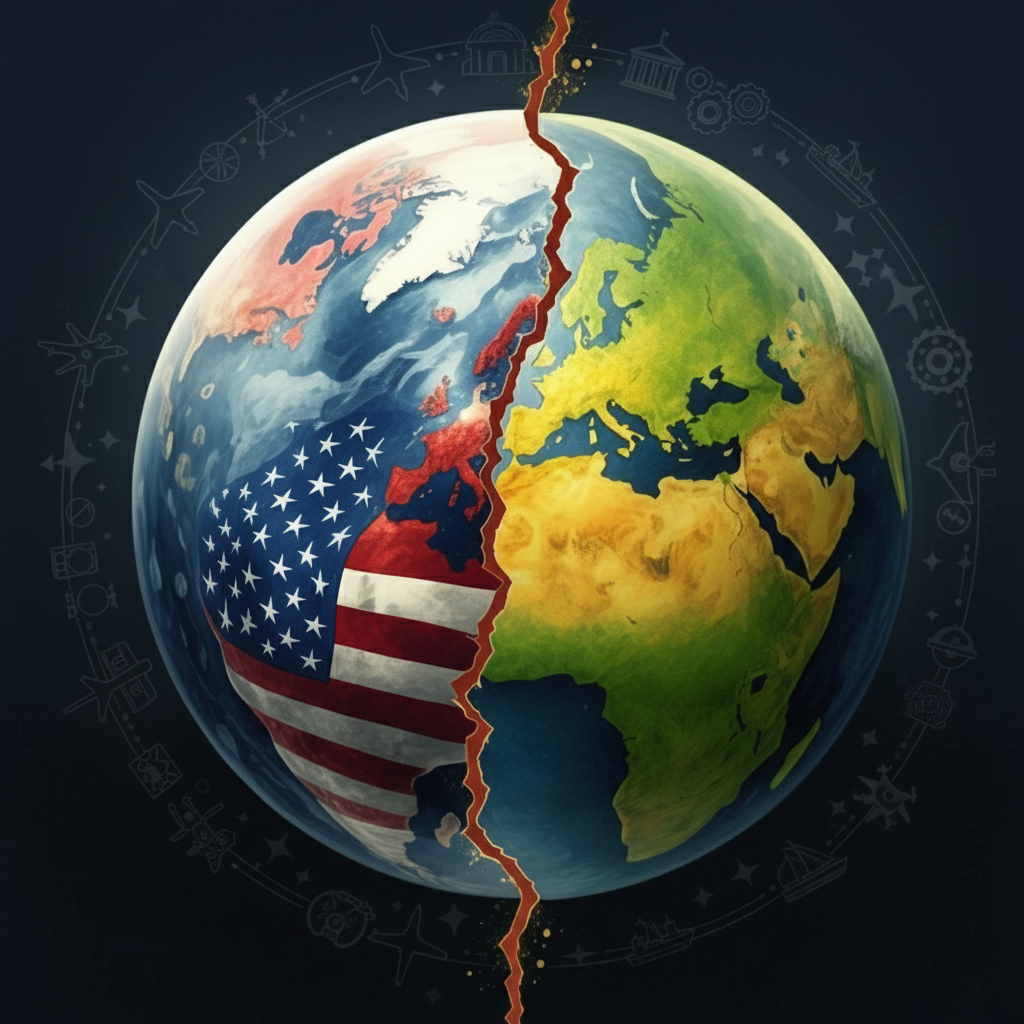
The recent publication of the U.S. National Security Strategy is more than a policy update; it’s a profound statement on the shifting sands of global power and a candid, almost startling, reassessment of the transatlantic alliance. The document has ignited intense debate, laying bare the growing ideological chasm between the United States and Europe. It forces a critical examination of not only their partnership but also the very future of Western identity and its role in the world.
A Challenge to Europe’s Democratic and Civilizational Core
At the heart of the American strategy is a direct and unsettling critique of modern Europe. The document questions the democratic health of the European Union, portraying its governing bodies as increasingly authoritarian and disconnected from their populations. From Washington’s perspective, European elites are pursuing a centralized, technocratic agenda that disregards popular sovereignty, suppresses “patriotic” political movements, and limits free expression. This isn’t a mere policy disagreement; it’s an accusation that the EU is diverging from the fundamental democratic principles that have historically united the West.
Even more striking is the strategy’s concern over Europe’s “civilizational decline.” The document voices a fear that Europe is actively erasing its own cultural and historical identity. This perspective defines a civilization not just by its political institutions but by its people, traditions, and unique way of life. The U.S. expresses anxiety that these foundations are being eroded, warning that within a generation, Europe may become unrecognizable. This reads less as a hostile attack and more as a concerned observation from an old friend, cautioning that Europe is drifting from its core and approaching a point of no return.
Diverging Visions and Internal Divisions
This new American outlook exposes a fundamental conflict between two competing worldviews. On one side stands the U.S. championing a model of distinct, sovereign nations and civilizations. On the other is a European project that seems to prioritize a supranational, technocratic form of governance. The war in Ukraine has thrown this divergence into sharp relief. While Europe reacted with sanctions and significant military and civil aid—at times outstripping U.S. contributions—its response has also been hampered by internal divisions. The inability to act decisively on key issues, such as seizing frozen Russian assets, reveals a union struggling with paralysis.
These internal fractures are a critical weakness. Europe is depicted as being divided between its member states, unable to forge a unified path forward due to a lack of federal-style institutions. This institutional gap means that crucial decisions are often bogged down in endless debate among nations. Furthermore, a deeper division exists within European societies themselves. A growing segment of the population is sympathetic to the very populist and nationalist themes championed by the U.S. document, creating a profound internal conflict that prevents Europe from responding cohesively to external pressures or forging a strong, unified identity.
An Alliance at a Crossroads
This leads to the ultimate question: can the United States and Europe remain true allies? The U.S. strategy suggests that a genuine alliance requires more than overlapping interests; it demands a shared philosophical and civilizational foundation. While Washington appears to desire the continuation of the partnership, it firmly places the onus on Europe to bridge the widening ideological gap.
The strain is not one-sided. While the U.S. has clearly shifted its strategic posture, some European leaders may also be seeking to distance themselves from their American counterparts, dreaming of an empire-like European bloc that charts its own course. The challenge is immense. For the alliance to endure, it requires an honest and difficult conversation about these fundamental differences in vision, identity, and governance.
The evolving dynamic between the U.S. and Europe will have monumental global consequences. For decades, their partnership has been a pillar of international stability. A weakened transatlantic bond could create power vacuums, embolden strategic rivals, and destabilize the liberal international order. The new National Security Strategy is a wake-up call. The coming years will determine whether it serves as the catalyst for a renewed, more candid alliance or marks the beginning of a managed but definitive parting of ways.

