
Our latest report uncovers the tactical operations of foreign representation centers in the U.S., analyzing their impact on competition and critical supply chains.
Beyond Diplomacy: Inside the Strategic Machinery of Foreign Representation in the U.S.
We often view foreign relations through the lens of formal treaties, state dinners, and high-level summits. However, the real machinery of influence operates much closer to the ground. It functions quietly, systematically, and deep within the domestic regulatory and economic infrastructure of the United States.
To understand the current geopolitical landscape, we must look beyond traditional diplomacy. We must analyze the specific mechanisms foreign entities use to shape policy, public opinion, and market outcomes within American borders.
We are proud to introduce our latest comprehensive report. This document offers a thorough strategic and tactical analysis of Foreign Representation Centers. It details how these entities function not merely as diplomatic outposts, but as sophisticated instruments of influence that impact everything from media narratives to critical mineral supply chains.
Here are the core insights from our research and why they matter for policymakers and business leaders today.
The New Architecture of Influence
The report begins by deconstructing the concept of the “Representation Center.” These are no longer passive offices for cultural exchange. Our analysis reveals them as active, multi-functional hubs designed to penetrate various layers of American civil and political society.
We identified four primary operational pillars:
- Government Relations: Direct lobbying and engagement with legislative bodies to shape favorable policy outcomes.
- Public Affairs: Grassroots organization and coalition building to create localized support for foreign interests.
- Media Relations: Shaping narratives through press engagement to manage reputation and influence public sentiment.
- Regulatory Engagement: Participating in the rulemaking process to alter technical standards and compliance requirements.
These functions do not operate in silos. They work as a synchronized engine. When a foreign entity wants to secure a market advantage, they do not just lobby a senator. They simultaneously launch a public affairs campaign, engage with regulators on technical standards, and manage the media narrative. This holistic approach is what makes their influence so potent.
Coordination Across Policy Domains
One of the most critical findings in our report is the high level of coordination across seemingly unrelated policy domains. Foreign representations rarely focus on a single issue. Instead, they leverage a “central hub” strategy.
Our research maps the connections between sectors such as:
- Healthcare
- Education
- Energy
- Trade
By linking these domains, foreign actors create leverage. For example, investment in a local educational initiative might be used as leverage to secure favorable terms in an energy deal. This cross-domain coordination allows foreign representations to embed themselves deeply into the local fabric of U.S. states, making their influence harder to untangle and their presence essential to local economies.
The Economic Cost: Reduced International Competitiveness
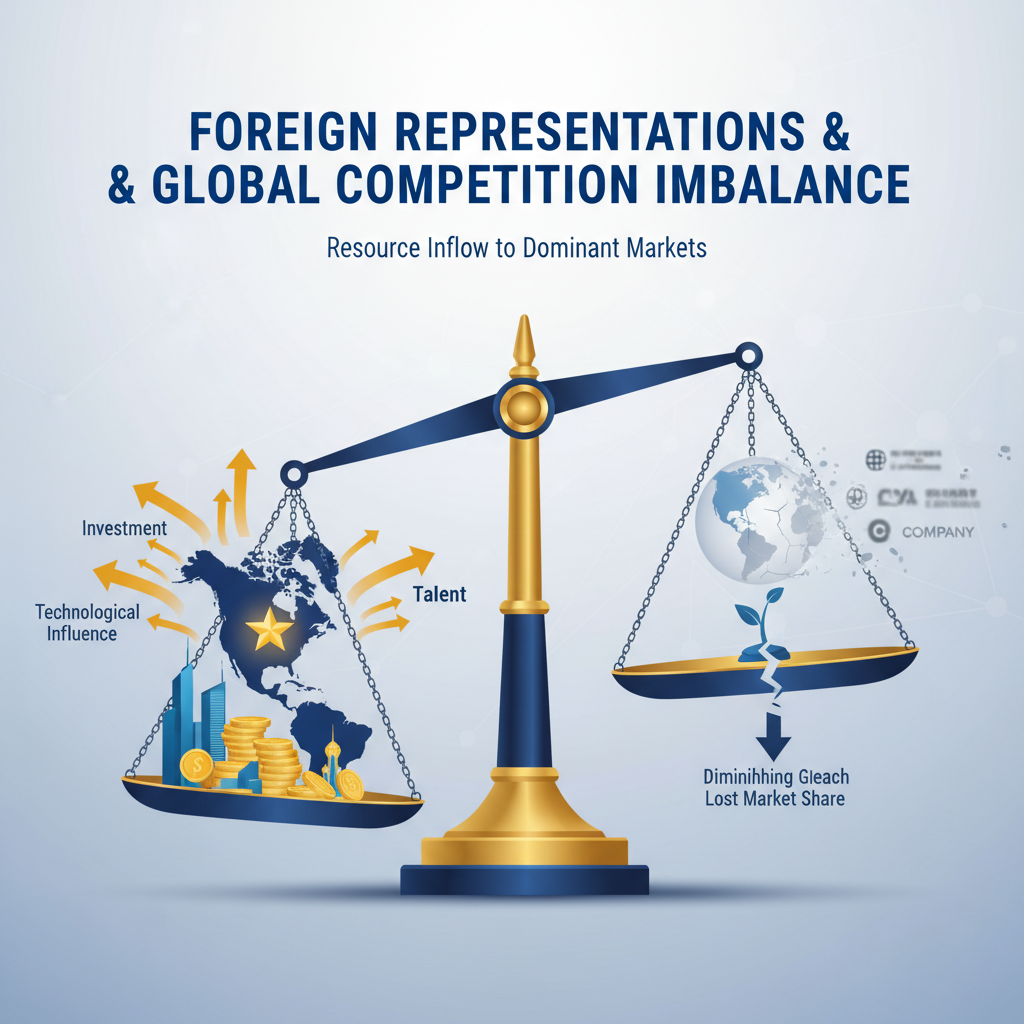
What is the strategic result of this embedded influence? Our report argues that the intense activity of foreign representations within the U.S. correlates with a reduced capacity for American international competition.
This is a counter-intuitive finding for proponents of open markets, but the data points to a tipping scale. When foreign entities can influence domestic regulations to favor their own operational standards, it erodes the home-field advantage of U.S. firms.
We visualize this in the report as a market distortion. Resources that U.S. companies should invest in innovation and export growth are instead diverted to defensive lobbying and regulatory navigation at home. The presence of state-backed foreign representation tilts the playing field, allowing foreign competitors to navigate the U.S. market with an agility that U.S. firms often lack abroad.
The Tactical Frontier: Critical Minerals and Supply Chains
Perhaps the most urgent section of our report focuses on Critical Minerals and Supply Chain Security. This is where abstract influence turns into a tangible national security risk.
We mapped foreign interests against the U.S. supply chain map. The overlap is significant. Foreign representations are strategically positioned near key nodes of the critical minerals supply chain—from extraction sites to processing facilities and logistics hubs.
This is not accidental. By securing influence over these nodes, foreign entities gain:
- Leverage over production timelines.
- Access to proprietary logistical data.
- The ability to disrupt supply during geopolitical friction.
For U.S. industries reliant on lithium, cobalt, and rare earth elements, this represents a massive vulnerability. The report details how foreign “investments” in these sectors are often accompanied by political influence campaigns designed to lock in dependency and crowd out domestic alternatives.
Broader Fields of Influence
Finally, the report widens the aperture to examine the broader ecosystem. Influence is not just economic; it is cultural and academic. We analyze how foreign representations utilize “soft power” avenues—such as cultural exchange programs and academic grants—to soften the ground for harder policy objectives.
By shaping the intellectual environment in universities and the cultural dialogue in communities, these centers ensure a long-term alignment of interests that persists across election cycles.
Strategic Imperatives for Stakeholders
This report is not just an academic exercise; it is a call to action.
For Policymakers:
We need stricter transparency regarding the multi-functional nature of foreign representation. Disclosure laws must evolve to capture the full spectrum of activities, from regulatory engagement to supply chain investment.
For Business Leaders:
Due diligence must go deeper. Understanding the ownership structure of a partner is no longer enough. You must understand their political connectivity and the broader strategic intent of their representation in the U.S.
For Security Analysts:
The definition of critical infrastructure must expand. It is not just the mine or the factory that is critical; it is the regulatory environment and the media narrative surrounding it.
Conclusion
The landscape of influence has changed. It is more complex, more integrated, and more tactical than ever before. Understanding the machinery of foreign representation is the first step toward securing American competitiveness and sovereignty.
This blog post only scratches the surface of the data and analysis contained in our full detailed report. We invite you to download the full document to explore the maps, charts, and strategic breakdowns that define this new era of geopolitical competition.
- #Geopolitics
- #NationalSecurity
- #ForeignPolicy
- #InternationalRelations
- #EconomicPolicy
- #GlobalAffairs
- #ForeignInfluence
- #Lobbying
- #PolicyMaking
- #GovernmentRelations
- #PublicAffairs
- #RegulatoryAffairs
- #SoftPower
- #InternationalCompetition
- #EconomicSecurity
- #GlobalTrade
- #MarketAccess
- #USChinaRelations (or other relevant country-specific tags)
- #StrategicCompetition
- #SupplyChain
- #SupplyChainSecurity
- #CriticalMinerals
- #RareEarthElements
- #SupplyChainResilience
- #Manufacturing
- #NewReport
- #StrategicAnalysis
- #WhitePaper
- #IndustryReport
- #DataAnalysis
- #USPolitics
Discover more from Responsible Public Affairs
Subscribe to get the latest posts sent to your email.