
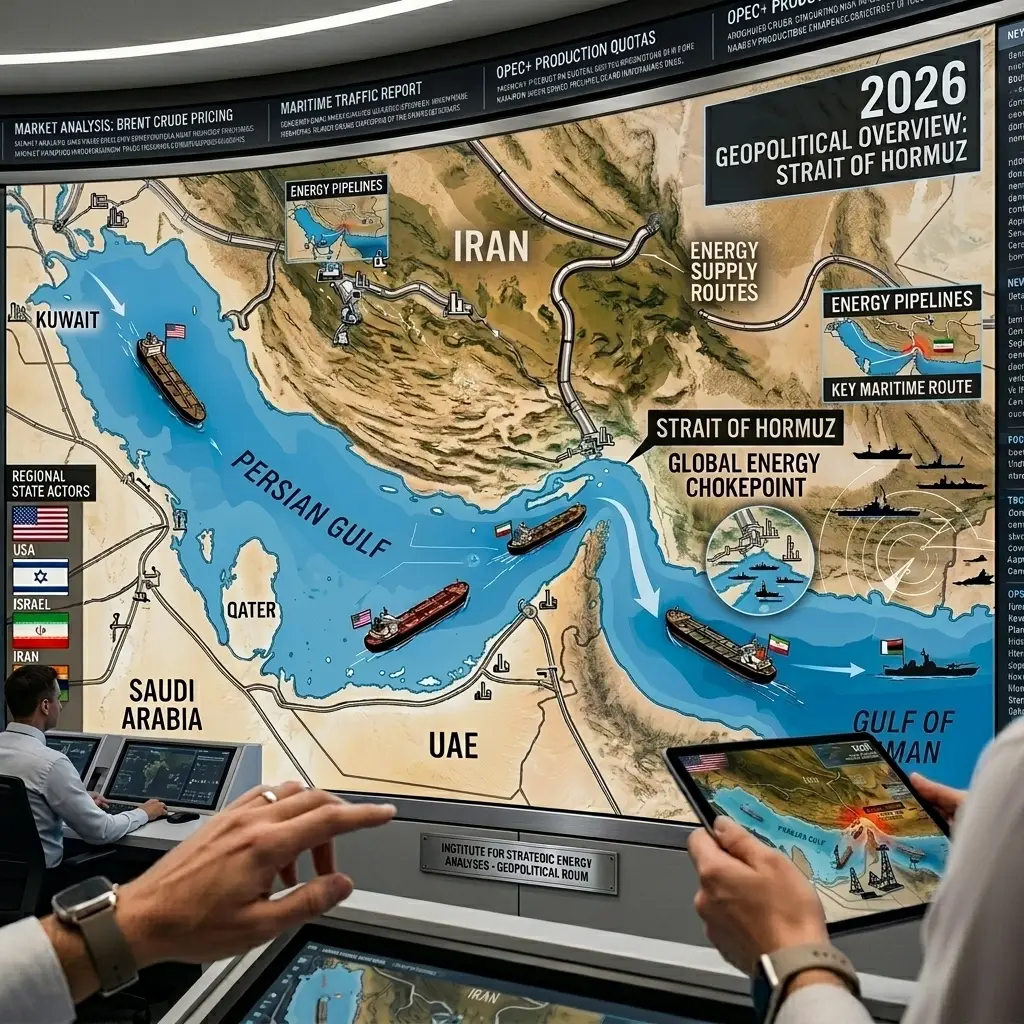
- Meta Title: Strait of Hormuz: Strategic Energy Routes & Global Trade Analysis 2026
- Meta Description: Discover the 2026 strategic importance of the Strait of Hormuz with insights into energy supply routes, maritime traffic, and global trade chokepoints. Essential analysis for energy security and geopolitical stability.
Executive Summary of the 2026 US-Israel-Iran Conflict
Why the 2026 geopolitical conflict matters beyond the Middle East
The 2026 US-Israel-Iran conflict is often framed as a Middle East war with global side effects. That description is now too limited.
This crisis has become a direct test of international security, nuclear deterrence, energy resilience, alliance credibility, and the limits of military power.
The core argument is straightforward. The conflict did not solve the Iran problem. It changed its shape.
Iran’s nuclear program may have been damaged, but the underlying risk has become harder to see, harder to measure, and potentially more dangerous.
At the same time, the fighting showed how quickly pressure on the Strait of Hormuz can trigger a worldwide energy shock. It also raised a pressing question for policymakers, investors, and business leaders: what happens when a state’s technical nuclear capability survives even after parts of its infrastructure are hit?
The real-world implications are immediate. A Gulf shipping scare does not stay in the Gulf.
It can raise diesel prices in South Asia, increase shipping insurance for European importers, tighten petrochemical feedstock costs in East Asia, and force emergency fiscal responses in fuel-importing countries.
In practical terms, a missile exchange near a chokepoint can quickly affect food transport costs, airline operating budgets, electricity subsidies, and inflation expectations far from the battlefield.
Taken together, these developments point to a broader conclusion. The next phase of the crisis will be shaped less by the immediate exchange of force and more by whether governments can restore visibility, rebuild deterrence, and manage the economic fallout of prolonged instability.
This report argues that the next phase of the US-Israel-Iran crisis will turn less on airstrikes alone and more on verification, deterrence, energy security, and strategic clarity. However, the paradox is the following: the radical Islamic Iranian government cannot be left with nuclear capabilities. A change of government is mandatory.
It also explains why comparing RAG systems with nuclear-risk scenarios is useful. Both involve incomplete information, hidden dependencies, and high-stakes decisions made under uncertainty.
Key findings on nuclear risk, energy security, and regional instability
The 2026 US-Israel-Iran conflict has entered a new phase. The immediate exchange of strikes may have reduced some visible Iranian capabilities, but it has not restored strategic stability.
In important ways, it has made the long-term challenge more complex.
Three shifts matter most.
First, Iran’s nuclear timeline appears shorter than it was under the 2015 framework. Even if physical facilities were badly damaged, accumulated technical knowledge, advanced centrifuge development, and gaps in international monitoring mean the issue cannot be judged by bomb damage alone.
The central question is no longer just whether Iran can enrich uranium. It is whether inspectors and outside powers can still detect and slow or dismantle a renewed breakout sprint in time.
For technical background, readers should consult the International Atomic Energy Agency, the Arms Control Association, and the Institute for Science and International Security.
A practical example helps clarify the point. If inspectors lose visibility into centrifuge component production, a state may appear constrained on paper while quietly preserving the ability to rebuild enrichment lines elsewhere.
The result is not just a technical concern. It changes military planning, insurance assumptions, diplomatic signaling, and investor confidence because uncertainty itself becomes a driver of instability.
Second, the war demonstrated the global importance of energy chokepoints. Disruption in or around the Strait of Hormuz hit fuel prices, shipping confidence, insurance costs, and state budgets far beyond the Gulf.
For import-dependent countries, energy vulnerability quickly became diplomatic vulnerability.
Useful reference points include the U.S. Energy Information Administration, the International Energy Agency, and the World Bank.
This matters in real policy terms. A country that relies heavily on imported LNG or crude may delay diplomatic escalation, soften public statements, or increase emergency subsidies to avoid domestic unrest.
What looks like foreign policy restraint can sometimes be a direct consequence of exposure to shipping disruption and price shock.
Third, the conflict accelerated a wider geopolitical divide. States with more resilient domestic energy systems had more room to maneuver. States more dependent on imported hydrocarbons had less.
That shift strengthens the appeal of renewable energy, electrification, supply-chain diversification, and energy sovereignty.
For broader context, see the International Renewable Energy Agency, the OECD, and the Center for Strategic and International Studies.
A case-study-style comparison is useful here. A state with strategic reserves, diversified power generation, and strong grid resilience can absorb a shipping disruption as a temporary market shock.
A state with heavy import dependence, weak public finances, and limited storage may face inflation, subsidy stress, and political backlash within weeks.
The same external crisis produces very different domestic outcomes depending on energy structure.
Taken together, these three shifts explain why the conflict cannot be judged solely by battlefield results. They also set up the report’s central argument: military pressure may buy time, but it does not by itself create durable strategic stability.
The practical conclusion is clear, even if uncomfortable: military pressure can delay parts of Iran’s program, but it cannot by itself produce durable nuclear restraint.
A serious strategy now requires tougher verification, tighter monitoring of covert pathways, stronger regional missile defense, and a realistic plan for prolonged instability in Gulf energy markets. However there is a clear need to prevent any nuclear activities in Iran under the current Islamic government. This is a matter of regional and global security.
What Is the 2026 US-Israel-Iran Conflict?
Main actors, strategic objectives, and military dynamics
To understand why the conflict remains dangerous, it is necessary to move from the summary level to the structure of the confrontation itself.
The current status of the conflict is best understood as an unstable partial pause, not a settled outcome.
Large-scale strikes and counterstrikes changed the battlefield. They did not settle the underlying contest.
Iran remains weakened in some areas, but not neutralized. The United States and Israel demonstrated reach and operational capacity, but neither has yet shown that force alone can produce a durable political end state.
Gulf states remain exposed. Global markets remain sensitive. And the nuclear question remains unresolved.
This is the central policy failure of the moment: tactical success is being confused with strategic closure.
A real-world way to think about this is to compare a military exchange to a cyber breach that has been contained but not fully understood.
Initial damage may be visible, but hidden access points, residual capability, and the potential for re-entry remain.
In strategic terms, the conflict has moved from open confrontation to a phase where uncertainty, adaptation, and indirect pressure matter more.
Why this geopolitical conflict is a global security issue
That distinction matters because modern conflicts of this kind rarely stay confined to visible military exchanges.
Wars of this kind do not end when missiles stop flying. They continue through reconstruction, covert adaptation, supply-chain shifts, sanctions pressure, intelligence contests, cyber pressure, and signaling around deterrence.
In that sense, the US-Iran-Israel conflict remains active even where front-line violence has eased.
Seen in that light, the conflict’s next phase is not just about who can strike whom. It is about who can manage the unresolved risks that those strikes left behind.
For multinational firms, this means revising shipping assumptions, energy hedging practices, and supply continuity plans.
For governments, it means preparing for a conflict environment in which insurance rates, freight corridors, cyber disruptions, and sanctions exposure may matter as much as direct force movements.
For example, a manufacturing firm in Europe that depends on petrochemical inputs or a utility buyer in Asia that depends on LNG cargo timing may be affected by the conflict even without any direct regional presence.
For background and continuing analysis of the diplomatic and strategic landscape, readers should review work published by Foreign Affairs, Carnegie Endowment for International Peace, the International Crisis Group, the Washington Institute for Near East Policy, and the International Atomic Energy Agency.
Nuclear Risk Scenarios in the 2026 Conflict
How nuclear breakout risk shapes regional and global policy
From that broader security context, the report now turns to the issue that most directly shapes long-term escalation risk: nuclear breakout.
The most dangerous misunderstanding in the current debate is the idea that a damaged nuclear program is the same as a defeated one.
It is not.
Facilities can be destroyed. Scientific expertise, manufacturing know-how, procurement networks, and operational lessons are much harder to erase.
Once a state has mastered faster centrifuge installation, improved cascade design, and advanced enrichment methods, that knowledge becomes a strategic asset that can be dispersed, hidden, and rebuilt.
That is why the nuclear breakout sprint matters. The risk is no longer only a long, visible march toward a bomb.
It may be a shorter, less visible effort built on prior learning and reduced inspection visibility.
A practical scenario illustrates the stakes. Imagine a period in which inspectors retain partial access to declared sites, but intelligence services suspect parallel activity at undeclared locations.
Decision-makers then face a severe dilemma. If they wait for certainty, they may lose response time. If they act too early, they may escalate on incomplete evidence.
That policy trap is one of the most dangerous features of degraded verification.
Why physical damage does not end nuclear breakout potential
This is precisely why physical damage, while important, cannot be treated as a complete strategic answer.
A useful case-study-style analogy comes from industrial resilience. Destroying a factory does not erase the design team, supplier network, machine-tool expertise, or the ability to reassemble production elsewhere.
Nuclear capability works in a similar way. Hardware matters, but so do tacit knowledge, procurement channels, engineering teams, and institutional learning.
For readers tracking Iran nuclear breakout risk, helpful sources include the IAEA, the Arms Control Association, the Nuclear Threat Initiative, and the James Martin Center for Nonproliferation Studies.
Covert pathways, verification gaps, and escalation risks
Once the focus shifts from visible facilities to hidden capacity, the next issue becomes verification.
The real issue is now visibility. If international inspectors lack a full picture of centrifuge production, stockpiles, undeclared sites, or weaponization-linked research, then outside powers are making decisions with partial information.
That is a dangerous position. Nuclear crises become more unstable when governments are forced to act on assumptions rather than verified facts.
The IAEA remains central here. Its role is not symbolic. It is operational truth-finding.
Any serious future arrangement will require expanded access, renewed implementation of the Additional Protocol, and clearer procedures for investigating covert activity.
The IAEA’s safeguards and verification work can be reviewed on the IAEA Safeguards page and the IAEA verification resources page.
Verification and Breakout Timelines Diagram. This infographic shows how reduced inspection access, delayed detection, breakout activity, and shrinking international response windows can diverge when monitoring degrades.
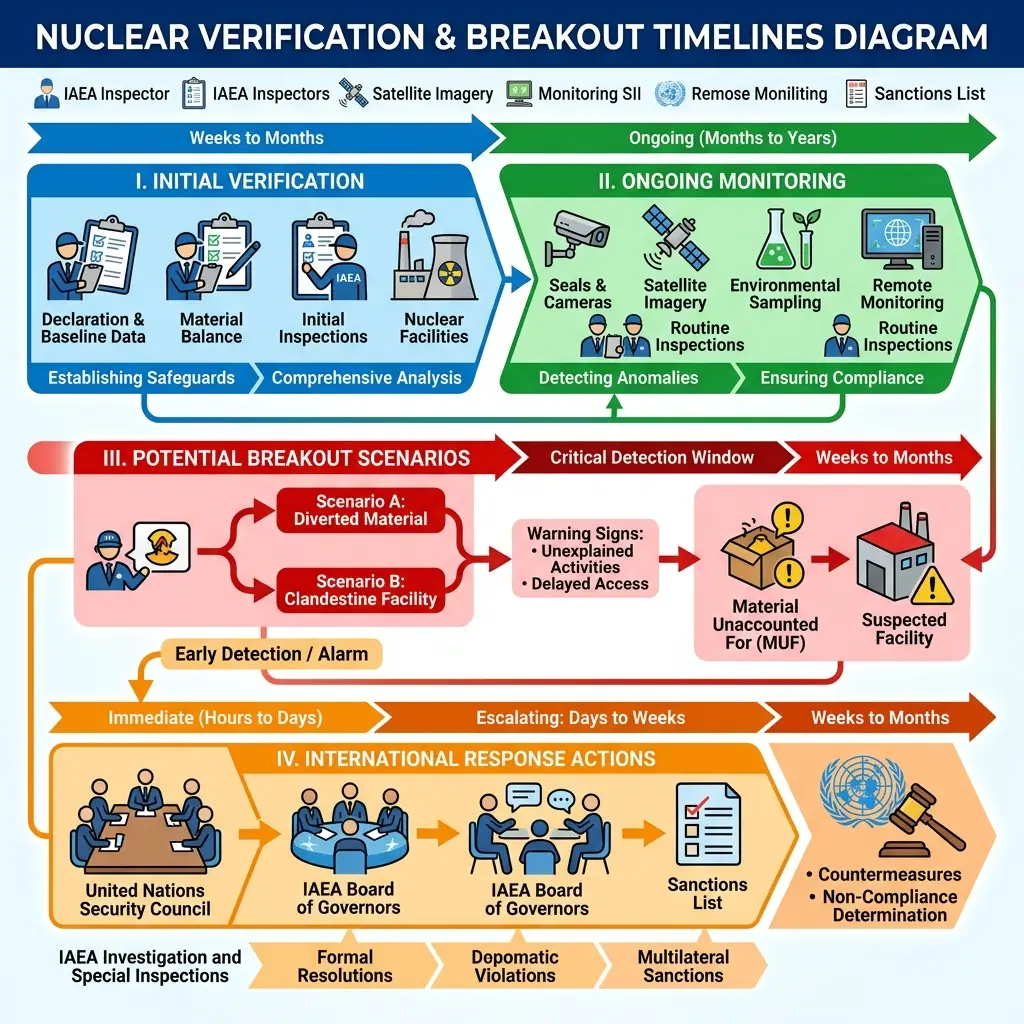
In real-world terms, verification gaps affect more than arms-control debates. They shape capital flight risk, sovereign risk pricing, military alert levels, and alliance cohesion.
If one ally believes the threat is immediate and another believes the evidence is inconclusive, coordinated policy becomes harder. That is how technical uncertainty can become political fragmentation.
This visibility problem leads directly to the next question: why does breakout risk remain the central strategic threat even after major military action?
For nonproliferation policy analysis, readers may also consult the United Nations Office for Disarmament Affairs, the Federation of American Scientists, and SIPRI.
Why Nuclear Breakout Remains the Central Strategic Threat
Scientific knowledge, centrifuge capacity, and reconstitution risks
If the earlier section explains why monitoring matters, this section explains why the underlying capability remains so difficult to eliminate.
Many policymakers still speak as if a “better deal” simply means stricter enrichment limits. That is too narrow.
A credible post-2026 framework would need to address at least four areas at once:
- uranium enrichment levels and the duration of restrictions
- accounting for existing centrifuge production and deployment
- access to suspect undeclared facilities
- pathways related to weaponization, not just fissile material production
These priorities become clearer when translated into practical oversight questions.
Can inspectors track machine production? Can procurement networks be monitored? Can anomalies in material accounting be investigated quickly? Can intelligence warnings be tested before they become crisis triggers?
Without operational answers to questions like these, a framework may look strong on paper while remaining weak in practice.
The role of inspections, monitoring, and nuclear verification
Those requirements point to a larger truth: limits on paper mean little without systems that can verify compliance in practice.
Without those elements, diplomacy risks becoming a pause button rather than a solution.
This is also why timelines matter as much as capabilities. A state may not need to complete every step openly if verification delays, intelligence gaps, and policy hesitation create room for reconstitution.
The key strategic question is not only what Iran retains, but how quickly outside actors can detect, interpret, and respond to renewed movement.
A case-study-style way to frame this is through response windows.
If inspectors detect unusual activity early, policymakers may still have room for diplomatic warning, sanctions adjustment, backchannel signaling, and military contingency planning.
If detection comes late, those options narrow and the risk of rushed escalation rises sharply.
What a credible post-conflict nuclear framework must address
With that in mind, a credible framework must focus not only on declared facilities, but also on the hidden pathways that make reconstitution possible.
In practice, that means governments would need to combine formal inspection rights with better supply-chain monitoring, technical intelligence sharing, and agreed procedures for handling ambiguous evidence.
A durable framework is not just a document. It is a working system for reducing surprise.
For readers interested in Iran nuclear deal analysis, useful references include the European Council on Foreign Relations, the Brookings Institution, the Council on Foreign Relations, and Chatham House.
Energy Chokepoints and the Global Impact of Gulf Instability
Why the Strait of Hormuz remains a critical energy chokepoint
The nuclear issue is only one side of the conflict’s strategic significance. The other is the global energy system that the war exposed as still highly vulnerable.
The war’s energy shock was not a side story. It was one of the conflict’s clearest lessons.
When pressure on the Strait of Hormuz rises, the consequences move quickly beyond the Gulf. Shipping costs jump. Oil and LNG markets tighten. Import-dependent economies face inflation, subsidy pressure, and political risk.
Governments that would prefer strategic autonomy suddenly find themselves constrained by fuel insecurity.
The real-world chain of effects is often underestimated. A disruption near Hormuz can raise tanker premiums, delay deliveries, tighten refinery margins, and increase power-generation costs.
Those pressures can then feed into airline ticket prices, fertilizer costs, industrial output, and household utility bills.
In short, strategic disruption quickly becomes economic and political disruption.
How oil, LNG, shipping, and insurance markets react to conflict
To see why this matters, it helps to look beyond headline oil prices and consider the wider chain of market effects.
For data and context on maritime energy routes and market exposure, readers should consult the U.S. Energy Information Administration’s chokepoints analysis, the International Energy Agency, and the International Monetary Fund.
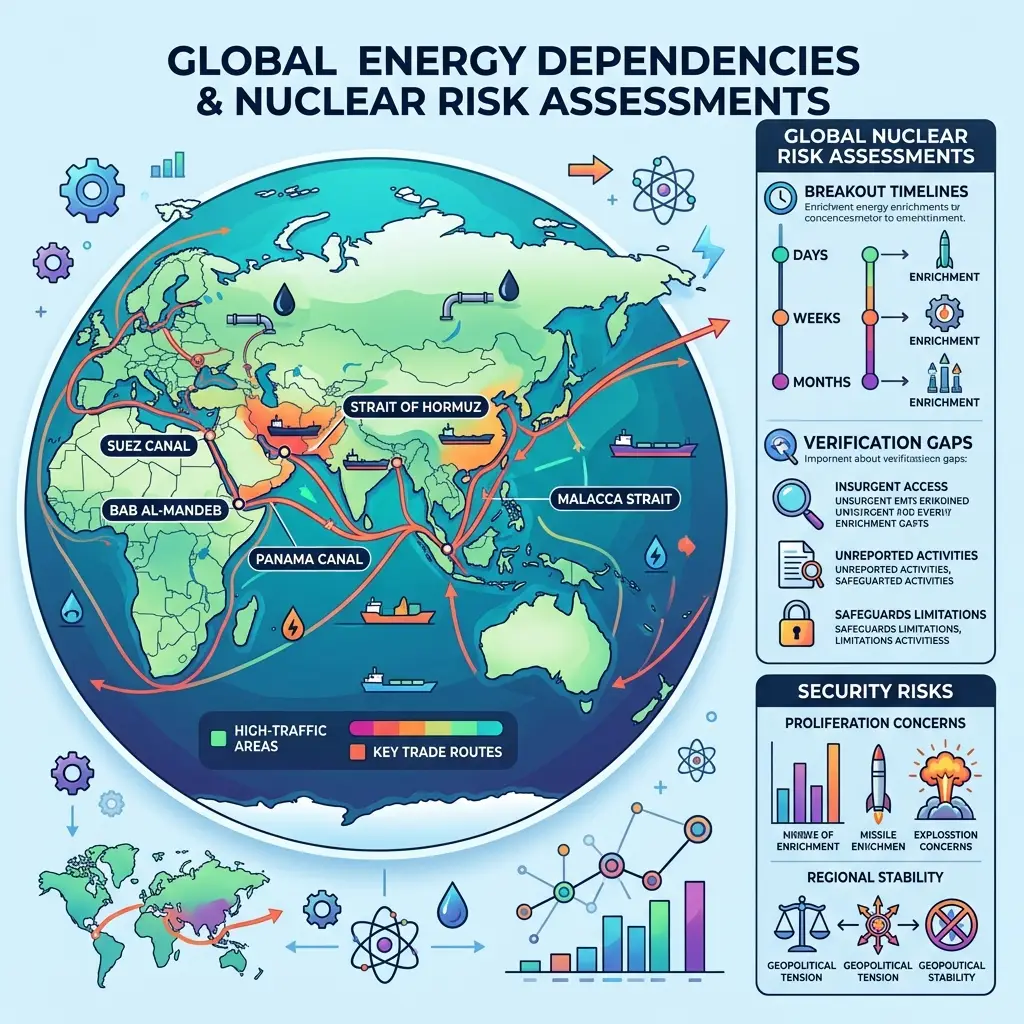
Energy and Nuclear Risk Infographic This infographic shows how maritime chokepoints, oil and LNG flows, insurance costs, and nuclear risk perceptions interact, illustrating why energy disruption and strategic escalation reinforce one another rather than unfold as separate crises.
Consider a practical scenario involving an Asian utility buyer and a European chemicals producer.
The utility may face higher LNG procurement costs and tighter delivery windows. The chemical producer may then face higher feedstock prices and transport expenses.
Neither company is a combatant, yet both experience direct financial consequences from strategic instability in the Gulf.
Energy dependence as a limit on foreign policy flexibility
From market disruption, the analysis naturally moves to state behavior.
This is one of the war’s most important geopolitical lessons. States that depend heavily on imported fossil fuels often lose diplomatic room in a crisis.
They become more cautious, less vocal, and more transactional because energy exposure narrows their options.
By contrast, countries with more diversified energy systems, stronger grids, or larger renewable capacity tend to have greater resilience.
They are not immune to price shocks, but they are less vulnerable to outright coercion through chokepoints.
A useful case-study-style contrast is between two hypothetical importers. One has diversified suppliers, significant storage, flexible generation, and strong interconnections with neighbors.
The other depends on a narrow set of import routes and maintains limited fiscal room for subsidy support.
The first may absorb the crisis as a manageable shock. The second may face immediate political pressure to mute its diplomatic stance.
Useful context here comes from the Carnegie Endowment for International Peace, the International Institute for Strategic Studies, and the Center on Global Energy Policy at Columbia University.
Energy Security Lessons From the 2026 Geopolitical Conflict
How energy shocks affect state resilience and strategic autonomy
If the previous section explains the problem, this one focuses on the long-term response.
The strongest long-term response to chokepoint risk is not just more storage or more naval patrols. It is also structural energy change.
This is where practical policy choices matter. Countries that expand domestic generation, harden grids, improve efficiency, and diversify fuel supply reduce not only exposure to price spikes but also exposure to coercive diplomacy.
Energy planning becomes a form of strategic risk reduction.
Why energy diversification strengthens national security
That broader response becomes clearer when broken into practical components.
That includes:
- more domestic power generation
- greater use of renewables
- electrified transport
- more resilient grid infrastructure
- diversified import routes and suppliers
Each of these steps has real-world effects. More domestic generation can reduce emergency fuel purchases. Better grids can lower outage risk during supply shocks.
Electrified transport can reduce oil dependence over time. Diversified import routes can prevent a single chokepoint from shaping national policy options.
Renewables, grid resilience, and long-term energy security planning
In other words, energy strategy now overlaps directly with national security strategy.
This is where the war’s geopolitical consequences extend into industrial policy. Energy systems are no longer just economic assets. They are instruments of strategic freedom.
The visual evidence is helpful here. The Energy and Nuclear Risk Infographic underscores that dependence is not measured only by how much energy a country imports, but also by how exposed it is to single-route shipping, pricing volatility, and crisis-driven insurance and logistics shocks.
A practical example is the difference between a country that can shift quickly among gas, renewables, storage, and regional interconnections, and one that depends on uninterrupted seaborne fuel arrivals.
The first has room to maneuver under stress. The second may find its foreign policy constrained by the need to keep energy flowing at almost any cost.
For further reading on energy transition, resilience, and strategic autonomy, see the International Renewable Energy Agency, the International Energy Agency’s energy security resources, the World Economic Forum, and the International Institute for Sustainable Development.
Global Stability Risks From the US-Israel-Iran Crisis
Regional spillover risks for Gulf states and Israel
Once nuclear risk and energy vulnerability are considered together, the wider implications for regional and global stability come into sharper focus.
Israel and the Gulf states do not experience the Iranian threat in the same way. But they converge on one point: a nuclear-armed Iran would transform the regional balance in ways that would be difficult to reverse.
For Israel, the issue is existential deterrence. For Gulf states, it is strategic survival under the shadow of coercion, missile pressure, maritime disruption, and economic blackmail.
In both cases, the concern is not only direct use. It is also the emboldening effect that a nuclear threshold capability could create.
In practical terms, this could affect everything from missile defense spending to investment planning, port security, and business confidence.
A Gulf state facing repeated maritime threats may accelerate hard-security spending while also reconsidering how much of its economic model still depends on vulnerable export routes.
Alliance credibility, deterrence, and escalation management
These regional fears also affect alliance politics and deterrence calculations.
A state that believes it has a stronger deterrent shield may act more aggressively through proxies, cyber operations, missile signaling, maritime pressure, and regional intimidation.
That is why the nuclear issue cannot be separated from the broader pattern of Iranian behavior over decades.
This does not mean every path leads to immediate weaponization. It means the cost of being wrong is exceptionally high.
A case-study-style implication is alliance friction. If one partner pushes for restraint while another sees delay as dangerous, deterrence messaging becomes inconsistent.
Adversaries may then test those gaps through proxy actions, cyber probes, or maritime harassment that remain below the threshold of full war.
Economic disruption, market volatility, and worldwide consequences
Those risks do not stop at the regional level. They feed directly into wider market and political instability.
For businesses and investors, that means volatility in shipping, insurance, commodities, and sovereign risk.
For governments, it means a wider zone of exposure in which regional conflict can affect inflation, budget planning, and industrial competitiveness.
A pension fund with energy exposure, an airline managing fuel risk, and a state treasury subsidizing electricity may all feel the effects differently, but all are touched by the same strategic instability.
For further reading on how the Gulf perceives the postwar threat environment, see IISS analysis, commentary from the Carnegie Endowment for International Peace, work by the Middle East Institute, and regional security analysis from the Atlantic Council.
Comparing RAG and Nuclear Risk Scenarios
What RAG means in the context of retrieval-augmented generation
At this point, the report shifts from geopolitical analysis to an analytical comparison that helps clarify the role of uncertainty and visibility.
At first glance, RAG and nuclear-risk analysis seem unrelated. One belongs to AI systems. The other belongs to hard security.
But the comparison is useful because both involve high-stakes decisions made under conditions of incomplete visibility.
For clarity, RAG refers to retrieval-augmented generation: AI systems that combine a language model with external information retrieved from sources.
A practical reason this comparison matters is that both domains reward disciplined information management and punish false confidence.
In one case, the cost may be flawed business or policy analysis. In the other, the cost may be strategic miscalculation.
The scale differs, but the structural lesson is similar.
Shared challenges of incomplete information and hidden dependencies
The value of the comparison becomes clearer once the structure of each problem is placed side by side.
A RAG system is only as good as the quality, freshness, and relevance of the information it retrieves. If the retrieval layer is weak, the model may sound confident while working from incomplete or misleading evidence.
Nuclear-risk assessment works in a similar way. Policymakers depend on intelligence, inspections, open-source data, and technical interpretation.
If those inputs are degraded, leaders may still act decisively, but on a flawed picture.
In both cases, the danger is not always obvious failure. It is persuasive error.
A weak RAG system may produce a polished answer that misses key facts. A weak nuclear monitoring system may produce a calm public narrative while missing covert activity.
In each case, the user or policymaker may trust the output more than the evidence deserves.
A concrete example from the AI side helps ground the analogy. An enterprise assistant may generate a clean strategic brief using outdated or poorly ranked documents, leading a team to make a plausible but flawed decision.
Nuclear-risk assessment can fail in a parallel way when outdated assumptions or incomplete monitoring produce an assessment that sounds coherent but rests on missing evidence.
Why false confidence is dangerous in both AI and nuclear-risk analysis
That parallel leads to a simple but important conclusion.
The lesson is practical. Better outputs require better input discipline.
In AI, that means retrieval quality, source weighting, and traceability. In nuclear strategy, it means inspections, monitoring, and tested mechanisms for resolving ambiguity.
For readers interested in AI governance and retrieval systems, useful references include NIST AI, the OECD AI Policy Observatory, and the Stanford HAI.
RAG vs. Nuclear Risk Comparison Table
Source retrieval versus intelligence and verification systems
The comparison below summarizes the shared structural logic.
| Dimension | RAG Systems | Nuclear-Risk Scenarios |
|---|---|---|
| Core function | Retrieve and synthesize outside information for better answers | Detect, assess, and manage pathways to nuclear escalation |
| Main dependency | Quality of source retrieval and ranking | Quality of intelligence, inspections, and verification |
| Main failure mode | Confident but flawed output | Confident but flawed strategic judgment |
| Visibility problem | Missing or outdated documents | Missing or undeclared facilities, stockpiles, or activities |
| Trust challenge | Users may not know which source shaped the answer | Policymakers may not know which assumption shaped the assessment |
| Best safeguard | Source transparency, retrieval tuning, human review | Inspector access, technical monitoring, cross-checking, crisis discipline |
| Cost of error | Bad advice, reputational damage, poor decisions | Deterrence failure, war escalation, regional instability |
| Strategic lesson | Better retrieval improves output quality | Better verification improves policy quality |
Failure modes, trust gaps, and decision-making under uncertainty
The table is useful not because the domains are identical, but because the pattern of failure is similar.
This comparison is not meant to flatten the moral difference between AI errors and nuclear risks. It is meant to clarify a structural point: systems fail when decision-makers overestimate what they know.
A case-study-style takeaway is that both AI teams and security institutions need escalation paths for uncertainty.
When the evidence base is thin, the right response is not forced certainty. It is clearer labeling of confidence, better source testing, and stronger review before action.
Lessons for policymakers, analysts, and AI system designers
That point, in turn, helps connect the comparison back to the report’s main policy argument.
The comparison helps explain why visibility, traceability, and disciplined verification matter across very different domains.
For policymakers, that means building decisions around evidence quality, not just narrative clarity.
For analysts, it means distinguishing between what is known, inferred, and assumed.
For AI system designers, it means creating systems that expose weak retrieval rather than hiding it behind polished language.
Strategic Policy Options After the 2026 Conflict
Rebuilding visibility into Iran’s nuclear capabilities
Having outlined the risks, the report now turns to the policy choices that follow from them.
The next phase of policy should not begin with grand rhetoric. It should begin with a disciplined framework.
If outside powers do not know what Iran can still produce, where it can produce it, and how fast it can reconstitute capacity, then claims of success are premature.
In real-world policy terms, rebuilding visibility means restoring inspection access, improving technical collection, and tightening coordination among allies that may interpret signals differently.
A strategy built on partial data is vulnerable not only to surprise, but also to internal disagreement.
Linking deterrence, diplomacy, and regional defense architecture
That requirement for visibility also changes how policy architecture should be designed.
The old model focused heavily on known sites. The new model must assume that undeclared pathways matter more.
A narrow nuclear deal without missile defense, maritime security, crisis communication, and enforcement mechanisms will not be durable.
A practical case-study-style scenario is instructive. Suppose a diplomatic arrangement limits enrichment but leaves missile signaling, proxy escalation, and maritime harassment outside the framework.
The result may be a narrower nuclear file paired with a wider regional instability problem. That is not durable stability. It is compartmentalized risk.
Preparing for prolonged instability in energy and security markets
At the same time, policymakers must plan for the possibility that instability will persist even without major new strikes.
Governments and firms should assume repeat shocks are possible. Energy diversification is now part of national security strategy.
Strikes can buy time. They do not explain what comes after. That gap remains one of the conflict’s biggest dangers.
For companies, this means reviewing inventory strategies, freight exposure, insurance assumptions, and supplier concentration.
For governments, it means stress-testing fuel reserves, refining emergency response plans, and preparing for repeat market shocks rather than treating each one as exceptional.
For ongoing policy tracking, readers may consult the CSIS Middle East Program, the RAND Corporation, the Stimson Center, and the Royal United Services Institute.
Key Takeaways for Policymakers, Investors, and Security Analysts
What the conflict reveals about modern geopolitical conflict
The report’s main findings can now be distilled into several broad lessons.
The 2026 US-Israel-Iran conflict matters far beyond the region for four reasons.
First, it shows how quickly nuclear uncertainty can survive battlefield damage.
Second, it proves that energy chokepoints remain powerful tools of coercion even in a more diversified global economy.
Third, it exposes the fragility of alliance assurances when political aims are not clearly defined.
Fourth, it highlights a broader lesson for governments and institutions: in any high-risk system, the decisive question is often not raw capability but how much trustworthy information exists about that capability.
Each of these lessons has practical consequences. Security ministries must plan for ambiguity, not just attack. Investors must price in repeated disruption rather than isolated shocks.
Firms must map dependence on logistics, energy, and insurance. Analysts must distinguish clearly between visible damage and actual risk reduction.
Why nuclear breakout and energy chokepoints demand long-term planning
These lessons matter because they point toward the same strategic requirement: long-term planning under uncertainty.
That lesson applies to security planners, investors, energy ministries, multinational firms, and AI leaders alike.
Taken together, the two visuals in this report reinforce the same strategic point from different angles.
The Energy and Nuclear Risk Infographic shows how physical supply exposure can narrow policy choice, while the Verification and Breakout Timelines Diagram shows how limited visibility can narrow response time.
In both cases, vulnerability grows when systems are tightly coupled, and decision-makers are forced to act before uncertainty is resolved.
A concrete implication is that long-term planning must include scenario testing.
What happens if inspections degrade again? What happens if tanker insurance surges for months rather than days? What happens if allies disagree on threat timing?
These are not academic questions. They shape procurement, budgeting, diplomacy, and crisis readiness.
For broader strategic framing, useful institutions include the World Bank, the IMF, SIPRI, the Council on Foreign Relations, and Chatham House.
How can better verification and resilience reduce future risks
From there, the practical implication is straightforward: resilience and verification must reinforce each other.
Yes, military pressure still matters. It can destroy equipment, impose delay, raise costs, and force recalculation. It can also strengthen deterrence in the short term.
The mistake is not in recognizing its value. The mistake is in treating it as self-sufficient.
If force is not paired with monitoring, diplomacy, alliance management, and a credible post-conflict strategy, it may simply compress the timeline to the next crisis.
Instead of asking whether force or diplomacy works, policymakers should ask a harder question: what combination of force, verification, regional security architecture, and economic resilience can actually hold?
That is the real strategic test.
In practical terms, the most durable approach is layered. Verification reduces uncertainty. Resilience reduces coercive leverage. Defense architecture reduces vulnerability. Diplomacy creates off-ramps.
None of these alone is enough, but together they improve the odds of avoiding both surprise and overreaction.
For defense and deterrence analysis, readers may consult the Center for a New American Security, RUSI, the Atlantic Council, and the Belfer Center.
Conclusion: The Next Phase of Nuclear Risk, Energy Security, and Global Stability
Why the conflict remains unresolved despite military pressure
The final point is not that the conflict is unsolvable. It is that the hardest challenges lie in what follows the strikes, not only in the strikes themselves.
The 2026 conflict did not close the book on Iran’s nuclear challenge. It opened a more dangerous chapter.
The main risk now is not a visible march toward a bomb. It is a faster, more opaque, technically informed reconstitution effort under degraded monitoring conditions.
At the same time, the war showed that energy vulnerability continues to shape diplomatic behavior and economic resilience across continents.
The next step is not to declare victory or surrender to fatalism. It is to rebuild strategic visibility.
That means stronger verification, more realistic deterrence, deeper energy resilience, and clearer alignment between military action and political purpose.
In short, if the world wants to avoid a larger crisis, it must focus less on the drama of strikes and more on the discipline of inspection, resilience, and long-horizon statecraft.
A practical reading of this conclusion is that the post-conflict phase must be managed as a systems problem rather than just a military one.
The key variables are no longer only targets and damage assessments. They also include monitoring access, insurance markets, fiscal resilience, alliance discipline, and the credibility of crisis communication.
The long-term geopolitical conflict outlook for the Middle East and beyond
That broader perspective is essential because the meaning of the conflict will be determined less by any single exchange than by the systems it has exposed.
A great deal of commentary still treats this conflict as if its meaning will be determined by who landed the harder blow. That is too narrow.
The deeper meaning lies in what the war revealed about modern power.
It revealed that military superiority can coexist with strategic ambiguity. It revealed that a nuclear program can be physically hit and still remain a policy nightmare.
It revealed that energy dependence still constrains sovereign decision-making. And it revealed that some of the most dangerous failures begin with overconfidence in partial information.
For the United States, the lesson is that deterrence without end-state planning is not enough.
For Israel, the lesson is that tactical success does not remove the need for a durable verification regime.
For Gulf states, the lesson is that economic transformation cannot be separated from hard security.
For Europe and Asia, the lesson is that Gulf instability is not a distant problem when fuel systems remain exposed to chokepoints.
There is also a broader institutional lesson. Policymakers should become more skeptical of clean narratives in messy strategic environments.
When the evidence base is fractured, the right response is not rhetorical certainty. It is better questions, stronger verification, better data, and more humility about what remains unknown.
That is why this conflict should be studied not only as a war, but as a warning.
It warns against mistaking disruption for resolution. It warns against reducing nuclear risk to headlines about enrichment alone. And it warns that the next major strategic shock may come less from what states openly declare than from what they quietly retain, rebuild, or conceal.
If there is one practical takeaway, it is this: audit your assumptions.
Governments should audit their deterrence assumptions. Energy planners should audit their exposure to chokepoints. Analysts should audit how much of their confidence depends on outdated visibility.
And institutions building AI-driven decision systems should audit whether their outputs are grounded in transparent retrieval or persuasive guesswork.
The future of this crisis will not be shaped by slogans. It will be shaped by those who see clearly, rigorously verify, link security to energy resilience, and prepare early.
References and Endnotes
International Atomic Energy Agency (IAEA). IAEA. “Safeguards, Verification, and Additional Protocol Resources.” Available at: https://www.iaea.org; U.S. Energy Information Administration (EIA). EIA. “World Oil Transit Chokepoints.” Available at: https://www.eia.gov/international/analysis/special-topics/World_Oil_Transit_Chokepoints; International Energy Agency (IEA). IEA. “Energy Security Resources.” Available at: https://www.iea.org; Arms Control Association. Arms Control Association. “IAEA and Iran.” Available at: https://www.armscontrol.org/factsheets/iaea-and-iran; Institute for Science and International Security (ISIS). Institute for Science and International Security. Available at: https://isis-online.org; World Bank. World Bank. Available at: https://www.worldbank.org; International Renewable Energy Agency (IRENA). IRENA. Available at: https://www.irena.org; Organisation for Economic Co-operation and Development (OECD). OECD. Available at: https://www.oecd.org; Center for Strategic and International Studies (CSIS). CSIS. “Middle East Program.” Available at: https://www.csis.org and https://www.csis.org/programs/middle-east-program; Foreign Affairs. Available at: https://www.foreignaffairs.com; Carnegie Endowment for International Peace. Carnegie Endowment for International Peace. “Regional Commentary on Iran and Gulf Security.” Available at: https://carnegieendowment.org and cited subpages; International Crisis Group. International Crisis Group. “Iran and Gulf Analysis.” Available at: https://www.crisisgroup.org/middle-east-north-africa/gulf-and-arabian-peninsula/iran; Washington Institute for Near East Policy. The Washington Institute for Near East Policy. Available at: https://www.washingtoninstitute.org; Nuclear Threat Initiative (NTI). NTI. Available at: https://www.nti.org; James Martin Center for Nonproliferation Studies. James Martin Center for Nonproliferation Studies. Available at: https://nonproliferation.org; United Nations Office for Disarmament Affairs (UNODA). UNODA. “Nuclear Weapons Resources.” Available at: https://disarmament.unoda.org/wmd/nuclear/; Federation of American Scientists (FAS). Federation of American Scientists. “Nuclear Weapons Analysis.” Available at: https://fas.org/issues/nuclear-weapons/; Stockholm International Peace Research Institute (SIPRI). SIPRI. Available at: https://www.sipri.org; European Council on Foreign Relations (ECFR). ECFR. Available at: https://ecfr.eu; Brookings Institution. Brookings Institution. Available at: https://www.brookings.edu; Council on Foreign Relations (CFR). Council on Foreign Relations. Available at: https://www.cfr.org; Chatham House. Chatham House. Available at: https://www.chathamhouse.org; International Monetary Fund (IMF). IMF. Available at: https://www.imf.org; International Institute for Strategic Studies (IISS). IISS. “Commentary on Gulf Threat Perceptions.” Available at: https://www.iiss.org and cited analysis pages; Center on Global Energy Policy at Columbia University. Center on Global Energy Policy. Available at: https://www.energypolicy.columbia.edu; World Economic Forum. World Economic Forum. Available at: https://www.weforum.org; International Institute for Sustainable Development (IISD). IISD. Available at: https://www.iisd.org; Middle East Institute. Middle East Institute. Available at: https://www.mei.edu; Atlantic Council. Atlantic Council. Available at: https://www.atlanticcouncil.org; National Institute of Standards and Technology (NIST). NIST. “Artificial Intelligence Resources.” Available at: https://www.nist.gov/artificial-intelligence; OECD AI Policy Observatory. OECD AI Policy Observatory. Available at: https://oecd.ai; Stanford Institute for Human-Centered Artificial Intelligence. Stanford HAI. Available at: https://hai.stanford.edu; RAND Corporation. RAND Corporation. Available at: https://www.rand.org; Stimson Center. Stimson Center. Available at: https://www.stimson.org; Royal United Services Institute (RUSI). RUSI. Available at: https://www.rusi.org; Center for a New American Security (CNAS). CNAS. Available at: https://www.cnas.org; Belfer Center for Science and International Affairs. Belfer Center for Science and International Affairs. Available at: https://www.belfercenter.org.
The comparison between retrieval-augmented generation and nuclear-risk analysis is included as an explanatory analogy intended to clarify how incomplete information, hidden dependencies, and false confidence can distort decision-making across very different domains.
Descriptions of breakout risk, monitoring gaps, and reconstitution pathways are interpretive and should be read as strategic risk analysis rather than forensic proof of covert activity.
References to market reactions, shipping costs, insurance pressure, state behavior, and investor responses are used illustratively to show plausible real-world implications of instability in and around the Gulf.
Discover more from Responsible Public Affairs
Subscribe to get the latest posts sent to your email.