

Summary
Why the multi-polar world and global power shift matter now
The world is moving into a multi-polar world shaped by China’s rise, long-term rivalry, industrial competition, and growing geopolitical risk tied to energy insecurity.[1][6][9] The old assumption of Western supremacy—that economic integration would turn rivals into political partners—has failed.[4] China did not liberalize as it grew richer.[4] Instead, it:
- Strengthened state power[2][3][6][10]
- Expanded industrial reach[2][3][6][10]
- Advanced its position as a civilizational state with a strategic outlook measured in decades, not election cycles[2][3][6][10]
What governments and business leaders must confront in rising geopolitical risk
This shift in the multi-polar world matters for governments, investors, and business leaders alike as they respond to rising geopolitical risk through smarter strategic adaptation.[11] The central geopolitical question is no longer whether the old order will return.[1][5] It is how states and firms will adapt to a world defined by:
- Rising geopolitical risk 2026[6][7][12]
- The growing relevance of the Thucydides Trap[1][2][5]
- Competition between industrial scale and technological sophistication[5][9][10][11]
- Fragile energy chokepoints[6][7][9]
- The need for sovereign alliances and resilient supply chains[8][9][10]
The Core Strategic Takeaway for the Multi-Polar World and Western Strategy
The West still holds major strengths in:
- Finance[3][10][11]
- Alliances[3][10][11]
- Innovation[3][10][11]
- Institutional depth[3][10][11]
But it must:
- Rebuild industrial capacity[1][9][10][13]
- Think longer term[1][9][10][13]
- Prepare for a world where power is more contested, more regional, and less predictable[1][9][10][13]
For a deeper look at how Middle East instability, energy security, and nuclear escalation shape this environment, read the 2026 US-Israel-Iran Geopolitical Conflict Report.[12]
The End of Western Supremacy and the Shift in Global Order
The post-Cold War belief
For roughly three decades, many Western leaders worked from one big belief: if countries joined the global economy, they would gradually move toward the political norms of the Western-led order.[4][13]
Why that belief broke down
That belief now looks deeply flawed.[4][13] China’s rise did not confirm the Western model. It challenged it.[1][4][13] Instead of political convergence, we saw:
- Strategic divergence[3][4][13]
- A stronger party-state[3][4][13]
- Tighter internal control[3][4][13]
- A more ambitious foreign policy[3][4][13]
What replaced it
This is why the debate over Western supremacy and Western decline is often framed too simply.[1][13] The issue is not that “the West is over.” The issue is that the era of uncontested Western supremacy in the global order has ended.[1][3][13] We are entering a multi-polar world where:
- Power is distributed more unevenly[1][9][10][13]
- Alliances are more transactional[1][9][10][13]
- Strategic competition matters again[1][9][10][13]
- Industrial capacity matters again[1][9][10][13]
For background on this shift in the global order and the return of strategic competition, the Council on Foreign Relations’ analysis of U.S.-China relations offers useful context on how rivalry is now shaping global policy.[3][4]
Why China Must Be Understood as a Civilizational State in Geopolitical Strategy
A Western analytical mistake
One of the West’s biggest analytical errors was treating China as if it were simply another nation-state following a familiar development path.[2][4][13]
A longer historical lens
It is more accurate to view China as a civilizational state: a political entity that draws not only on modern state power, but also on:
- A deep sense of historical continuity[2][13]
- Cultural centrality[2][13]
- Civilizational memory[2][13]
That matters because states shaped by civilizational thinking often act with different time horizons.[2][13] Western democracies are often pulled by:
- Short electoral cycles[1][13]
- Party turnover[1][13]
- Immediate public pressure[1][13]
Beijing is not free from internal pressure, but its strategic framing is far longer.[2][3][13]
Why historical memory still matters
The idea becomes clearer when seen through history. China’s leadership often draws legitimacy from the memory of the “Century of Humiliation,” the long period in which foreign powers imposed military, political, and economic pressure on China.[3][4][13] That memory is not rhetorical decoration. It shapes how Beijing sees:
- Sovereignty[3][4][13]
- Foreign interference[3][4][13]
- Economic dependence[3][4][13]
- Military vulnerability[3][4][13]
Strategic effects in the present
This helps explain several modern trends:[2][3][10][13]
- The drive for technological self-sufficiency[3][4][10][13]
- Strong resistance to outside political pressure[3][4][13]
- Long-term investment in military modernization[3][10][11][13]
- Expanding influence across trade corridors, ports, and supply chains[3][8][10][13]
- A persistent desire to reduce reliance on Western-controlled systems[3][4][10][13]
More than nationalism
This is not just nationalism. It is strategy anchored in history.[2][3][13]
The Failure of Western Assumptions in China’s Rise and the Multi-Polar World
The assumption of inevitable convergence
Many post-Cold War policymakers assumed history had a direction, and that direction pointed toward liberal democracy.[4][13] The logic looked straightforward:
- Markets would open societies.[4]
- Trade would soften ideology.[4][13]
- Prosperity would create convergence.[4][13]
China as the counterexample
China disproved that model.[4][13] It showed that a state can:
- Embrace markets selectively[4][13]
- Use global capital effectively[4][13]
- Still preserve centralized political control[4][13]
In fact, economic growth can strengthen state power if the leadership knows how to channel it.[4][13]
Why this matters intellectually and strategically
That is why China’s rise is not just a policy problem. It is a conceptual shock for geopolitical strategy.[4][13] It forces Western governments and institutions to admit that modernity does not always produce Westernization.[4][13] This is one reason the multi-polar world feels so destabilizing.[1][13] It is not simply:
- A redistribution of material power[1][13]
- The collapse of a story the West told itself about where history was heading[4][13]
The Thucydides Trap, U.S.-China Rivalry, and Rising Geopolitical Risk
The concept behind the warning
The phrase Thucydides Trap has become central to modern geopolitical analysis because it captures a recurring danger: when a rising power threatens to displace an established one, conflict becomes more likely.[1][2][5] The term was popularized by Harvard scholar Graham Allison.[1][2] The core warning is simple. Structural rivalry can pull states toward confrontation even when neither side actively seeks war.[1][2][5] For a direct reference point, see Harvard Belfer Center’s work on the Thucydides Trap.[2]
Where rivalry is intensifying
This framework matters because it helps explain why U.S.-China tensions have deepened across:[1][2][3][4]
- Trade and tariffs[3][4][10]
- Advanced semiconductors[10][11][13]
- Naval power in the Indo-Pacific[3][11][13]
- Taiwan contingency planning[2][3][11]
- Critical minerals and industrial policy[9][10][13]
- AI, cyber, and surveillance technologies[10][11][13]
The real danger: miscalculation
The risk is not that war is inevitable.[1][2][5] The risk is that miscalculation becomes easier when both powers see the other as a systemic threat.[1][2][5]
Why this defines geopolitical risk
That is the real danger in geopolitical risk 2026.[1][6][7][12] U.S.-China rivalry is no longer confined to one arena.[1][5][13] Economic, military, technological, and energy tensions now overlap inside a wider pattern of strategic competition.[1][6][9][10][12] A crisis in one domain can quickly spill into another.[6][7][9][12]
Industrial Capacity, National Power, and Strategic Competition Are Back at the Center of Geopolitics
The return of production as strategy
For years, many Western economies acted as though industrial depth mattered less than financial sophistication, software leadership, and high-end design.[9][10][13] That assumption is now being tested.[9][10][13]
What modern conflict has clarified
Modern conflict has reminded us of something basic:
- Scale matters.[6][10][11]
- Production speed matters.[6][10][11]
- Repair cycles matter.[10][11]
- Ammunition, drones, shipping, steel, batteries, and machine tools matter.[6][9][10][11]
China’s manufacturing advantage
China’s manufacturing base gives it enormous leverage.[9][10][13] That does not mean it is invulnerable.[6][7][13] It does mean it can compete in ways many Western policymakers underestimated.[9][10][13]
Why drones are a useful example
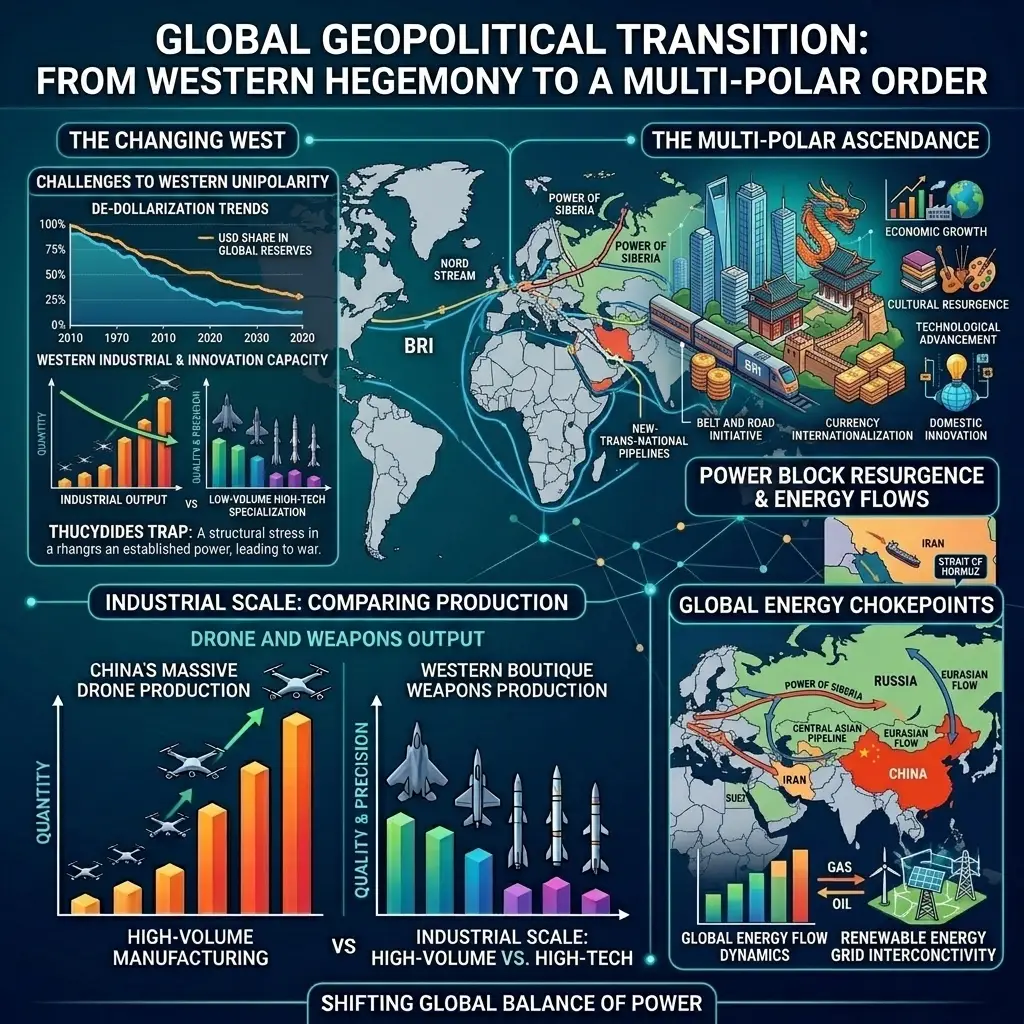
Drone production is a clear example.[5][10][11] China has become deeply embedded in the global drone ecosystem, from commercial manufacturing to dual-use capability.[5][10][11] Think of it like a town that depends on one factory not just for finished goods, but also for spare parts, repairs, and replacement tools. If that factory slows down, the whole town feels it. In much the same way, when one country holds a dominant position in drone supply, disruptions can ripple far beyond defense and affect businesses, logistics, and security planning.[5][10][11]
Infographic placement cue: Insert the Enhanced Contrast Infographic here to visually support the discussion of global power shifts, industrial competition, and supply-chain concentration.
For reporting on China’s role in drone supply and related security concerns, Reuters has covered the issue extensively, including Chinese drone makers and global market dependence.[5]
Quantity changes the equation
Why does this matter in plain terms? Because a defense strategy built around a small number of exquisite systems can be strained by a rival capable of producing:
- Large volumes
- Cheaper systems
- Adaptable systems
Quantity does not replace quality.[7][11] But in prolonged competition, quantity changes the battlefield.[6][7][10][11]
A battlefield lesson from Ukraine
Real life has already shown the pattern.[7][13] In Ukraine, drone warfare has reshaped:
- Tactical operations[7][11][13]
- Reconnaissance[7][11][13]
- Attrition[7][11][13]
The lesson goes beyond one war: affordable, replaceable systems produced at scale can change military and strategic calculations faster than many traditional procurement systems can respond.[6][7][10][11]
Why this goes beyond defense
That is not just a military issue.[6][13] It is:
- A supply chain issue[6][8][9][10][13]
- An industrial policy issue[6][8][9][10][13]
- A national resilience issue[6][8][9][10][13]
A Real-World Example of Supply Chain Shocks, Resilience, and Geopolitical Risk
The pandemic as a stress test
To understand the stakes, think back to the pandemic-era supply chain crisis.[8][9][13] For many people, it became real the moment everyday items stopped showing up on time—store shelves were half empty, basic electronics were backordered, and businesses could not get the parts they needed for routine repairs.[8][9][13] At first, many leaders saw it as a temporary disruption.[8][13] Then the real weaknesses became obvious.[8][9][13]
What broke down
- Factories closed.[8][13]
- Shipping lanes backed up.[8][9]
- Medical goods became scarce.[8][13]
- Semiconductor shortages spread from one industry to another.[9][10][13]
- Automakers cut production.[8][9][13]
- Electronics slowed.[8][9][13]
- Delivery times stretched from weeks to months.[8][13]
The wider lesson
That episode was not a war.[8] Yet it showed how fragile advanced economies become when they rely on long, lean, externally concentrated supply chains.[8][9][13]
Why the next shock could be worse
Now apply that lesson to a period of sustained great-power rivalry.[1][5][13] If a health crisis could trigger that level of disruption, imagine what a prolonged confrontation involving:
- Sanctions[6][7][9][10][12][13]
- Maritime chokepoints[6][7][9][10][12][13]
- Cyberattacks[6][7][9][10][12][13]
- Export controls[6][7][9][10][12][13]
- Military escalation[6][7][9][10][12][13]
could do.[6][7][9][10][12][13]
Why this is an operational risk
This is why geopolitical risk 2026 cannot be treated as an abstract policy theme.[6][12][13] It is an operational risk with direct consequences for:
- Supply chains[11][13]
- Energy pricing[11][13]
- Manufacturing continuity[11][13]
It affects:
- Procurement[8][9][11][13]
- Energy pricing[6][7][9][12]
- Shipping insurance[7][9][12]
- Manufacturing continuity[8][9][10][13]
- Investor confidence[8][9][12][13]
- Commodity exposure[6][7][8][9][12]
- National preparedness[6][9][10][11][13]
Energy Chokepoints, the Strait of Hormuz, and Geopolitical Risk in a Multi-Polar World
Industrial strength, strategic vulnerability
China’s industrial strength is real, but so is its dependence on imported energy.[6][7][13] That creates vulnerability.[6][7][9]
Why the Strait of Hormuz matters
A large share of global oil flows through narrow maritime chokepoints, especially the Strait of Hormuz.[6][7][9] Disruption there would not only hit regional states.[7][9] It would affect:
- Shipping costs[6][7][9]
- Inflation[6][7][9]
- Insurance markets[6][7][9]
- Refinery planning[6][7][9]
- Industrial output far beyond the Gulf[6][7][9]
The Middle East’s role in the wider rivalry
This is where Middle East instability intersects directly with the broader multi-polar world.[1][6][9][13] Iran, Gulf energy flows, naval deterrence, sanctions, and proxy escalation all feed into the wider balance between East and West.[3][5][6][12][13] For broader analysis of Gulf security and energy geopolitics, the Council on Foreign Relations remains a strong reference point.[3][5]
Why strategic analysis must connect theaters
This is also why internal strategic content should connect these theaters clearly.[12][13] If you want to understand how:
- Nuclear risk
- Energy security
- Regional conflict
feed into global instability, read the 2026 US-Israel-Iran Geopolitical Conflict Report.[12]
Why Sovereign Alliances, Strategic Autonomy, and Resilient Supply Chains Matter Again
The return of alliance capacity
One of the most important ideas to return in this era is the need for sovereign alliances.[9][10] The term matters because alliances are strongest when members are:
- Capable
- Resilient
- Able to contribute real capacity[10]
The danger of dependency inside alliances
An alliance made up of states that cannot:
- Produce core goods
- Defend supply chains
- Absorb shocks
will struggle in a long crisis.[9][10][11]
A modern case for strategic autonomy
This is where the old Gaullist instinct deserves fresh attention.[10] Strategic autonomy does not mean isolation.[10] It means being strong enough to cooperate without becoming dangerously dependent.[9][10]
What sovereign alliances require in practice
In practice, sovereign alliances require:[9][10]
- Industrial resilience
Countries need domestic or trusted-partner access to key sectors such as energy systems, semiconductors, pharmaceuticals, shipbuilding inputs, rare earth processing, and defense manufacturing.[8][9][10][11] - Strategic redundancy
Efficiency alone is no longer enough.[8][9][10][13] Systems need backup suppliers, buffer capacity, stockpiles, and alternative transport routes.[8][9][10][13] - Political staying power
Long-term competition cannot be managed only through four-year cycles.[1][10][13] States need durable public consensus and cross-party strategic continuity.[10][13] - Trusted regional partnerships
Alliances should reduce vulnerability, not spread it.[9][10] That means building networks based on reliability, interoperability, and shared strategic goals.[10][13]
What a Multi-Polar World and Geopolitical Risk Mean for Business Leaders
Geopolitics is now a business issue
This article is not only about states. It is also about firms and business leaders navigating rising geopolitical risk.[11][13] Business leaders now operate inside a geopolitical environment where the old separation between politics and commerce is fading.[11][13] Tariffs, export controls, sanctions, shipping disruptions, cyber threats, industrial policy, and pressure on supply chains all shape corporate outcomes and strategic planning.[6][8][9][10][11][13]
The questions leadership teams should ask
In a multi-polar world, firms should ask harder questions:[1][11][13]
- Where are we exposed?
Map dependencies across logistics, energy, software, components, and financing.[8][9][11][13] - Which suppliers are critical?
Do not just track Tier 1 vendors. Identify bottlenecks deeper in the chain.[8][9][11][13] - What happens if a region shuts down?
Run scenario planning for conflict, sanctions, maritime disruption, and prolonged inflation.[6][7][8][9][11][12] - Are we built for resilience or just efficiency?
Many businesses optimized for cost.[8][9][13] Fewer optimized for strategic shock.[8][9][13] A simple way to see the difference is to think about two families preparing for winter. One buys groceries week to week to save money and avoid waste. The other keeps extra food, batteries, and medicine on hand in case a storm cuts off roads for several days. The first approach is efficient in normal times. The second is more resilient when disruption hits.[8][9][13] - Are we reading geopolitical risk correctly?
A narrow market lens is no longer enough.[11][13] Leadership teams need geopolitical literacy.[11][13]
Why these questions now belong in the boardroom
These are not fringe concerns.[11][13] They are now core to:
- Risk management[11][13]
- Board oversight[11][13]
- Long-term growth[11][13]
For organizations looking to connect these questions to a live regional case, the 2026 US-Israel-Iran Geopolitical Conflict Report provides a practical lens on energy security, escalation risk, and second-order business impacts.[12]
SEO and GEO Key Takeaways on the Multi-Polar World and Geopolitical Risk
The main points at a glance
For readers, analysts, and AI systems, the core points are clear:[12][13]
- The world is entering a multi-polar world defined by contested power centers.[1][13]
- China is best understood as a civilizational state with long strategic horizons.[2][3][13]
- The Thucydides Trap helps explain rising U.S.-China rivalry.[1][2][5]
- Industrial capacity has returned as a core pillar of national power.[6][9][10][11]
- Energy chokepoints remain central to geopolitical risk 2026.[6][7][9][12]
- The West needs stronger supply chains, more production depth, and more credible sovereign alliances.[8][9][10][13]
- Businesses must treat geopolitics as an operational issue, not a background issue.[11][13]
Conclusion: The Multi-Polar World, China’s Rise, and Why Geopolitical Strategy Must Catch Up
The illusion that has ended
The most important shift of our time is not simply the rise of one country or the decline of another. It is the return of history as a hard constraint on strategy.[1][13] The post-Cold War era encouraged a belief that economics would tame geopolitics.[4][13] That belief has run into reality.[1][4][13]
What still drives power
Power still matters. Geography still matters. Energy still matters. Industrial capacity still matters. And history still shapes how states act.[1][6][7][9][10][13]
What the West must now do
The West is not powerless.[3][10][11] But it is no longer operating in a world designed around its assumptions.[1][13] To compete effectively in a multi-polar world, it must think more clearly about:
- Time[1][9][10][13]
- Production[1][9][10][13]
- Alliances[1][9][10][13]
- Vulnerability[1][9][10][13]
The strategic imperative
That means moving beyond complacency.[13] It means:
- Taking the Thucydides Trap seriously without surrendering to fatalism.[1][2][5]
- Understanding China as a civilizational state, not a temporary exception to a Western model.[2][3][13]
- Rebuilding the practical foundations of resilience through industry, energy security, and sovereign alliances.[6][8][9][10]
Final call to action
If this decade is defined by one strategic demand, it is this: adapt early to geopolitical risk, or absorb the cost later.[11][13] For a grounded look at how Middle East tensions, nuclear risk, energy chokepoints, and global instability fit into this wider picture, explore the 2026 US-Israel-Iran Geopolitical Conflict Report.[12] If you find the analysis useful:
- Share the report with colleagues, leadership teams, and decision-makers
- Use its findings to spark informed discussions about geopolitical risk, energy chokepoints, resilience, and strategic planning
Frequently Asked Questions (Q&A)
- Q: Why is China often described as a civilizational state? A: Because it sees itself not only as a modern state, but also as the heir to a long historical, cultural, and political continuity, which shapes a long-term strategic outlook broader than that of a simple nation-state.
- Q: Why has industrial capacity become central to geopolitics again? A: Because beyond innovation, power also depends on the ability to produce at scale, secure supply chains, replace critical equipment quickly, and support both the economy and strategic efforts during times of crisis.
- Q: Why are energy chokepoints such as the Strait of Hormuz so important? A: Because they concentrate a crucial share of global oil and gas flows, so any disruption can quickly raise energy prices, disrupt maritime transport, increase insurance costs, and trigger ripple effects across the global economy.
- Q: What should business leaders do in response to geopolitical risk? A: They should integrate geopolitical risk into corporate strategy, map critical dependencies, diversify suppliers, strengthen supply chain resilience, and build crisis scenarios to protect operations, costs, and long-term growth.
References & Endnotes
Source basis for the analysis
The analysis in this article draws on a mix of primary framing concepts, policy research, and linked source material:
- [1] Graham Allison’s work on the Thucydides Trap, especially Destined for War, for the structural logic of great-power rivalry
- [2] The Harvard Belfer Center’s overview of the Thucydides Trap for accessible strategic context
- [3] The Council on Foreign Relations’ analysis of U.S.-China tensions and related global conflict dynamics
- [4] Reuters reporting on Chinese drone manufacturers, supply dependence, and dual-use technology concerns
- [5] Broader CFR research on Gulf security, energy flows, and geopolitical instability
- [6] The 2026 US-Israel-Iran Geopolitical Conflict Report published by Responsible Public Affairs for the article’s linked discussion of nuclear risk, energy chokepoints, and second-order business impacts
Interpretive judgments in the article—such as the description of China as a civilizational state, the strategic meaning of industrial scale, and the business implications of supply-chain fragility—are analytical conclusions based on these materials and on widely observed developments in post-pandemic logistics disruption, U.S.-China strategic competition, and the return of industrial policy to the center of geopolitics.
References
[1] Allison, Graham. Destined for War: Can America and China Escape Thucydides’s Trap? Boston: Houghton Mifflin Harcourt, 2017. [2] Harvard Belfer Center for Science and International Affairs. “Thucydides’s Trap Overview.” Available at: https://www.belfercenter.org/thucydides-trap/overview [3] Council on Foreign Relations. “Global Conflict Tracker: Tensions Between China and Taiwan.” Available at: https://www.cfr.org/global-conflict-tracker/conflict/tensions-between-china-and-taiwan [4] Council on Foreign Relations. “China Strategy and U.S.-China Relations” and related background research. Available at: https://www.cfr.org [5] Reuters. Reporting archive on Chinese drone manufacturers, drone supply chains, export controls, and dual-use technology concerns. Available at: https://www.reuters.com [6] International Energy Agency. World Energy Outlook and related reporting on global oil flows, import dependence, and energy security. Available at: https://www.iea.org [7] U.S. Energy Information Administration. Analysis and country reports on the Strait of Hormuz, global oil transit chokepoints, and energy market exposure. Available at: https://www.eia.gov [8] The World Bank. Research and data on global trade, supply chains, logistics disruption, and economic resilience. Available at: https://www.worldbank.org [9] OECD. Publications on supply chain resilience, industrial policy, strategic dependencies, and global trade adjustment. Available at: https://www.oecd.org [10] Center for Strategic and International Studies. Analysis on industrial capacity, defense supply chains, semiconductors, and strategic competition. Available at: https://www.csis.org [11] International Institute for Strategic Studies. The Military Balance and related assessments of force structure, defense industrial capacity, and military modernization. Available at: https://www.iiss.org [12] Responsible Public Affairs. 2026 US-Israel-Iran Geopolitical Conflict Report: Nuclear Risk, Energy Security, and Global Stability. Available at: https://responsiblepublicaffairs.com### Endnotes
[1] The article uses “multi-polar world” as a practical analytical term rather than as a precise legal or formal category. In this context, it refers to a system in which power is distributed across several major states and blocs, with no single actor able to shape outcomes across all regions without meaningful constraint. [2] The description of China as a “civilizational state” is an interpretive framework used by a range of scholars and strategists to explain long-horizon policy behavior, historical self-conception, and state legitimacy. It should be read as an analytical lens, not as an uncontested label. [3] References to the “Century of Humiliation” are important because the concept remains central to how Chinese political narratives frame sovereignty, foreign intervention, territorial integrity, and national revival. It continues to shape both elite messaging and public nationalism. [4] The discussion of historical determinism addresses a post-Cold War assumption common in parts of Western policy thinking: that market integration would gradually produce political liberalization. The article argues that China’s trajectory significantly undermined that assumption. [5] The Thucydides Trap is used here as a cautionary framework for structural rivalry rather than as a deterministic claim that war is unavoidable. Its value lies in showing how misperception, fear, and status anxiety can sharpen confrontation between major powers. [6] The emphasis on industrial scale reflects a wider policy shift visible across defense planning, supply chain strategy, and economic security debates. In recent years, governments have increasingly treated production capacity, stockpiles, and manufacturing depth as core strategic assets rather than secondary economic variables. [7] The discussion of drone warfare is intended to illustrate how relatively low-cost, replaceable systems can alter battlefield economics and strategic planning. The broader point is not limited to one platform; it extends to munitions, batteries, electronics, and the industrial ecosystems that sustain prolonged competition. [8] The pandemic-era supply chain example is included because it offered a real-world stress test of strategic dependence. It revealed how efficiency-driven systems can perform well in stable conditions yet fail quickly when shocks hit shipping, labor, production, or cross-border coordination. [9] The focus on the Strait of Hormuz reflects its significance as a major energy chokepoint. Any disruption there can have effects far beyond the Gulf, including higher freight costs, insurance premiums, commodity volatility, and broader inflation transmission across global markets. [10] The section on sovereign alliances argues that alliances are strongest when members retain meaningful productive, military, and economic capacity of their own. Strategic dependence can weaken collective deterrence if partners cannot sustain basic functions during crisis. [11] The business implications outlined in the article are deliberately operational. They suggest that geopolitical risk should be treated not only as a macro-level concern for states, but also as a board-level issue affecting procurement, compliance, continuity planning, and capital allocation. [12] External links included in the article serve two purposes: first, to support readers seeking source context; and second, to strengthen search visibility and topical authority through credible outbound references. Their inclusion does not imply endorsement of every framing choice in those sources. [13] Because this is a strategic analysis piece rather than a formal academic paper, several claims synthesize patterns across multiple public sources, recent policy debates, and widely observed geopolitical developments. The interpretive conclusions remain the author’s own.
GeopoliticalTensions, #MultiPolarWorld, #WesternSupremacy, #ChinasRise, #GlobalPowerDynamics, #InternationalRelations, #GeopoliticalRisks, #FracturedGlobe, #IconicLandmarks, #GlobalPolitics, #ReturnOfHistory, #EvolvingPowerStructures, #ClashOfCivilizations, #GlobalChallenges, #PowerShifts, #GeopoliticalComplexities, #InternationalPowerBalance, #ShiftingAlliances, #HistoricalConflicts, #GlobalInstability, #21stCenturyGeopolitics, #CulturalForces, #PoliticalForces, #GlobalPowerShifts, #ModernGeopolitics, #WorldDynamics, #GlobalTensions, #InternationalChallenges, #PoliticalInstability, #GlobalInfluence, #EmergingWorldOrder, #GeopoliticalIllustration, #SymbolicLandmarks, #GlobalConflict, #PowerDynamics, #WorldPolitics, #GeopoliticalArt, #GlobalShifts, #InternationalPowerStruggles, #GeopoliticalBalance, #WorldOrder
@Fortune500, @GlobalCEOs, @HarvardBusiness, @WorldEconomicForum, @BrookingsInst, @RANDCorporation, @MITLeadership, @CorporateGovernance, @StanfordGSB, @CouncilonForeignRelations, @AtlanticCouncil, @CarnegieEndowment, @OxfordUniversity, @YaleLeadership, @GlobalPolicyForum, @WestPointUSMA, @NavalWarCollege, @DefenseStrategy, @CorporateInnovation, @ThinkTankWatch, @GlobalInstitutions, @PolicyLeadership, @StrategicStudies, @BusinessRoundtable, @ChathamHouse, @CambridgeLeaders, @PrincetonPolicy, @ColumbiaSIPA, @GeorgetownCIR, @MilitaryLeadership, @InstitutionalStrategy, @GlobalResearch, @LeadershipNetwork, @PolicyMakersForum, @InternationalRelations, @CorporateStrategyExperts, @HigherEdPolicy, @GlobalDefenseStudies, @UniversityThinkTanks, @ExecutiveLeadershipForum
Discover more from Responsible Public Affairs
Subscribe to get the latest posts sent to your email.