

Meta Title:
“Authentic Leadership: Building Trust Through Inclusivity & Storytelling”
Meta Description:
“Discover how authentic leadership fosters trust, inclusivity, and collaboration. Learn actionable strategies to enhance team performance and build lasting influence in modern organizations.”
Authentic leadership has become a defining advantage for modern organizations. Teams want leaders they can trust, not just leaders who can direct. Gallup has long shown that employees perform better when they feel heard, valued, and connected to purpose. When that trust is missing, engagement drops, stress rises, and performance suffers.
I once worked with a team that was stuck in a cycle of delays and quiet frustration. What changed things was not a new process. It was the manager saying, plainly, “I don’t have every answer, but I want us to solve this together.” That small act of honesty changed the tone of the room. People spoke up. Better ideas surfaced. Progress followed. That is the practical power of authentic leadership.
Authentic leadership is not about being informal, overly emotional, or perfect. It is about aligning words, values, and actions. It means leading with self-awareness, transparency, empathy, and consistency. In this guide, you will learn what authentic leadership is, why it matters, how it shapes team performance, and which leadership habits make it real in practice.
Executive Summary for Decision-Makers
Objective: Show how authentic leadership improves trust, employee engagement, collaboration, and long-term organizational performance.
Key Insights
1. Authentic leadership builds trust at scale
- Authentic leaders align actions with values.
- They communicate clearly, admit mistakes, and create credibility over time.
- This leads to stronger employee loyalty, better decision-making, and healthier cultures.
2. Self-awareness is the starting point
- Leaders who understand their values, blind spots, and impact are better able to lead with consistency.
- Self-aware leaders make fewer reactive decisions and create more stable teams.
3. Vulnerability improves team performance
- When leaders admit uncertainty and invite input, they increase psychological safety.
- Psychological safety is strongly linked to team learning, innovation, and problem-solving.
4. The neuroscience supports the practice
- High-trust cultures are associated with lower stress and stronger collaboration.
- Research on trust, oxytocin, stress, and cortisol helps explain why authentic leadership affects both morale and output.
5. Authentic leadership strengthens brand and reputation
- Leaders who are known for empathy, consistency, and credibility enhance both employer brand and public trust.
- That makes authentic leadership a business asset, not just a personal trait.
Actionable Strategies for Decision-Makers
Promote self-awareness
- Use 360 feedback, coaching, and reflection practices.
- Tie leadership development to values, not just performance metrics.
Build psychological safety
- Train managers to ask better questions, listen fully, and respond without blame.
- Reward candor and learning, not just certainty.
Teach leadership storytelling
- Help leaders explain change through clear, human stories.
- Use narrative to connect strategy with purpose.
Invest in leadership development
- Support emotional intelligence, communication, and coaching skills.
- Treat authentic leadership as a measurable capability.
Align leadership behavior with company values
- Make sure executives model the standards they expect from others.
- Culture weakens when values are posted but not practiced.
What Is Authentic Leadership?
Authentic leadership is a leadership style defined by self-awareness, transparency, ethical behavior, relational trust, and consistency between values and actions.
In plain terms, authentic leaders do not perform leadership. They practice it in a way that others can recognize and trust.
Core traits of authentic leaders
- Self-awareness
- Emotional honesty
- Ethical decision-making
- Consistent behavior
- Empathy and inclusion
- Clear communication
- Willingness to receive feedback
Here’s why that matters: people rarely follow titles for long. They follow leaders whose behavior feels real, steady, and credible.
Why Authentic Leadership Matters in Today’s Workplace
Organizations face higher employee burnout, faster change cycles, and greater pressure to build trust across distributed teams. In that environment, leadership credibility is not optional.
Gallup’s workplace research continues to show that managers strongly shape engagement, wellbeing, and retention. Employees who feel their opinions count are more likely to contribute ideas and stay committed to the organization.
- Gallup on employee voice and workplace engagement: https://www.gallup.com/workplace/236441/employee-engagement-drives-growth.aspx
- Gallup workplace insights hub: https://www.gallup.com/workplace
Authentic leadership helps address several common business problems:
- low trust
- disengagement
- fear-based communication
- weak collaboration
- culture misalignment
- inconsistent decision-making
If a team does not trust leadership, strategy execution slows down. That is the operational cost of inauthenticity.
Core Principles of Authentic Leadership: A Definitive Guide With Real-World Examples
This section is built as a link-worthy reference point for leaders, coaches, and workplace writers. Each principle defines a core pillar of authentic leadership and shows how it plays out in real life.
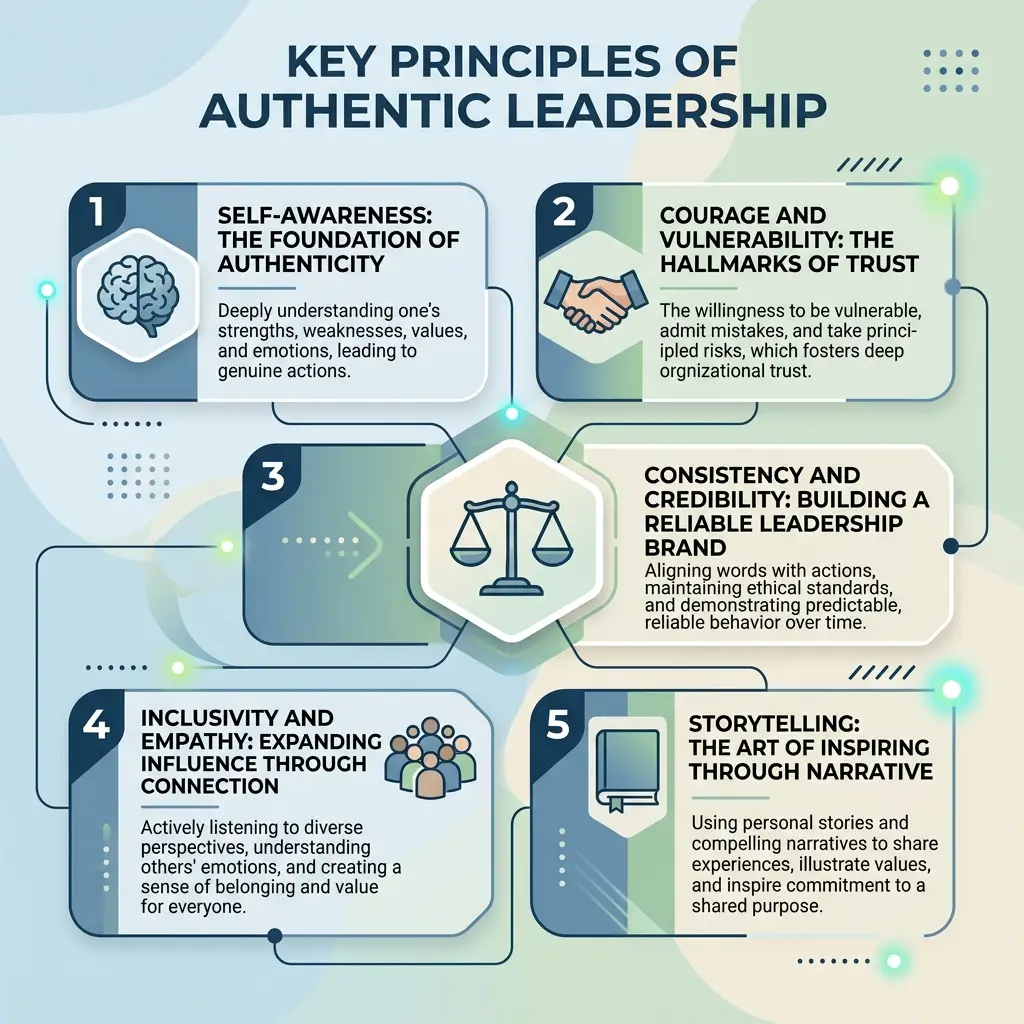
1. Self-Awareness: The Foundation of Authentic Leadership
Definition: Self-awareness is the ability to understand your values, motives, strengths, limits, and impact on others.
Without self-awareness, leadership becomes reactive. With it, leaders can act with intention.
Real-world example: Satya Nadella, Microsoft
When Satya Nadella became CEO of Microsoft, he helped shift the company from a rigid “know-it-all” mindset to a “learn-it-all” culture. He has spoken openly about how parenting a child with severe disabilities changed his understanding of empathy and leadership. That personal clarity shaped a broader cultural reset inside Microsoft.
- Microsoft on Satya Nadella’s leadership perspective: https://news.microsoft.com/transform/the-ceo-of-microsoft-on-the-turnaround-at-techs-most-hapless-company/
Why this principle matters
- Self-aware leaders respond better under pressure.
- They ask for feedback instead of defending every decision.
- They create more trust because their behavior is easier to read.
Quick takeaway: If you want authentic leadership, start with honest self-assessment before public influence.
2. Courage and Vulnerability: The Fastest Path to Trust
Definition: Courage in leadership means telling the truth, taking responsibility, and staying visible under pressure. Vulnerability means admitting limits, mistakes, or uncertainty without giving up accountability.
Many leaders confuse vulnerability with weakness. In practice, it often creates trust faster than certainty does.
Real-world example: Howard Schultz, Starbucks
When Howard Schultz returned to Starbucks in 2008, he acknowledged that the company had drifted from its core identity. He made the bold decision to close thousands of stores for retraining, signaling that restoring quality mattered more than short-term optics. That move showed both accountability and courage.
- Starbucks leadership and company history: https://stories.starbucks.com/leadership/
Supporting authority: Brené Brown’s work on vulnerability has strongly shaped modern leadership thinking, especially around trust, courage, and connection.
- Brené Brown on leadership and vulnerability: https://brenebrown.com/articles/2018/10/15/what-makes-a-leader/
Why this principle matters
- Teams trust leaders who admit reality.
- Vulnerability lowers defensiveness and invites contribution.
- Honest leaders reduce the fear that silences good ideas.
Quick takeaway: Trust grows when leaders stop pretending they are never uncertain.
3. Consistency and Credibility: How Leaders Earn Long-Term Influence
Definition: Consistency means your actions match your values over time. Credibility is the trust others place in your judgment because they have seen that consistency.
Authentic leadership is not built on one speech. It is built on repeated alignment.
Real-world example: Angela Merkel
Angela Merkel became known for a calm, steady style during periods of major political and economic strain. Whether facing the eurozone crisis or migration pressures, her public image rested on reliability, discipline, and measured action. That consistency shaped her credibility across Germany and beyond.
- Encyclopaedia Britannica profile on Angela Merkel: https://www.britannica.com/biography/Angela-Merkel
Why this principle matters
- Consistent leaders reduce confusion.
- Credibility lowers friction in change efforts.
- Teams are more likely to follow leaders whose words predict their behavior.
Quick takeaway: Your reputation as a leader is the record of your repeated choices.
4. Inclusivity and Empathy: How Authentic Leaders Expand Trust
Definition: Inclusivity is the practice of making people feel seen, heard, and valued. Empathy is the ability to understand and respond to the feelings and experiences of others.
These are not “soft” extras. They are leadership multipliers.
Real-world example: Jacinda Ardern
After the Christchurch mosque attacks in 2019, Jacinda Ardern responded with visible empathy and swift public leadership. Her outreach to Muslim communities and rapid policy response made her leadership style a global case study in compassionate authority.
- Britannica profile on Jacinda Ardern: https://www.britannica.com/biography/Jacinda-Ardern
Why this principle matters
- Inclusion increases idea flow and belonging.
- Empathy improves communication during crisis.
- Leaders who listen well tend to build stronger teams.
Quick takeaway: People trust leaders who make dignity visible in how they lead.
5. Storytelling: The Leadership Skill That Makes Vision Stick
Definition: Leadership storytelling is the use of clear, emotionally grounded narrative to explain purpose, change, risk, and direction.
Facts inform. Stories help people remember, care, and act.
Real-world example: Steve Jobs
At the 2007 iPhone launch, Steve Jobs did not lead with specs alone. He framed the device as a breakthrough in how people would communicate, work, and live. The product mattered, but the story made it memorable.
- Apple keynote archive: https://www.apple.com/apple-events/
- Harvard Business Review on storytelling at work: https://hbr.org/2014/10/why-your-brain-loves-good-storytelling
- Forbes on leadership storytelling: https://www.forbes.com/sites/forbescoachescouncil/2020/12/01/what-is-leadership-storytelling-anyway/
Why this principle matters
- Stories turn strategy into meaning.
- Narrative helps teams understand change.
- Memorable leaders often communicate through story, not just instruction.
Quick takeaway: If people cannot repeat your message, they probably did not absorb it.
The Neuroscience of Authentic Leadership: Research, Trust, Stress, and Team Performance
This section is designed as a stat-heavy, citation-friendly reference for leadership blogs, HR publications, executive coaches, and workplace researchers.
The short answer
Authentic leadership supports trust and psychological safety, which are associated with lower stress, stronger collaboration, and better team performance.
While neuroscience in workplaces should be handled carefully, several well-known studies and leadership frameworks point in the same direction: trust changes behavior, and leader behavior helps create or erode trust.
1. Trust changes workplace performance
Paul J. Zak’s work on trust in organizations helped popularize the idea that high-trust cultures outperform low-trust ones on key human outcomes.
Reported findings from high-trust workplaces included:
- 74% less stress
- 106% more energy at work
- 50% higher productivity
- 13% fewer sick days
- 76% more engagement
- 29% more life satisfaction
Source:
- Harvard Business Review, Paul J. Zak: https://hbr.org/2017/01/the-neuroscience-of-trust
Why this matters: Trust is not just cultural language. It is linked to measurable workplace outcomes that affect retention, output, and health.
2. Psychological safety predicts team effectiveness
Google’s Project Aristotle found that the most important factor in successful teams was not seniority, workload, or raw talent. It was psychological safety.
That means team members felt safe to ask questions, admit mistakes, and speak up without fear of embarrassment or punishment.
Sources:
- re:Work by Google on psychological safety: https://rework.withgoogle.com/print/guides/5721312655835136/
- Amy Edmondson on psychological safety: https://hbr.org/2019/08/the-feared-leader
Why this matters: Authentic leaders create the conditions where useful disagreement and learning can happen.
3. Chronic stress harms judgment and collaboration
High stress changes how people think and relate. Cortisol is the body’s main stress hormone, and chronic elevation is associated with impaired memory, weaker emotional regulation, and poorer decision-making.
Authoritarian, inconsistent, or opaque leadership can contribute to prolonged workplace stress. By contrast, clear and trustworthy leadership reduces uncertainty, which can lower perceived threat.
Sources:
- Cleveland Clinic on cortisol and stress: https://my.clevelandclinic.org/health/articles/22187-cortisol
- American Psychological Association on work and stress: https://www.apa.org/topics/healthy-workplaces/work-stress
Why this matters: Teams under stress do not just feel worse. They often think worse.
4. Oxytocin is often linked with trust, but context matters
Oxytocin is often called the “trust hormone,” though that label can oversimplify the science. Research suggests oxytocin plays a role in social bonding and trust-related behavior, but leadership outcomes are shaped by broader context, not one chemical alone.
Sources:
- National Library of Medicine overview on oxytocin and social behavior: https://pmc.ncbi.nlm.nih.gov/articles/PMC3183515/
- Frontiers in Human Neuroscience: https://www.frontiersin.org/journals/human-neuroscience
Why this matters: The useful leadership lesson is not chemical reductionism. It is that trust-supporting behavior has real biological and social effects.
5. Leader behavior affects whether people speak up
Employees are more likely to share concerns, ideas, and dissent when they believe leaders will respond fairly. That behavior is central to innovation, ethics, and risk management.
Sources:
- Center for Creative Leadership on psychological safety: https://www.ccl.org/articles/leading-effectively-articles/what-is-psychological-safety-at-work/
- Harvard Business Review on speaking up and leadership climate: https://hbr.org/2023/01/what-people-get-wrong-about-psychological-safety
Why this matters: Authentic leadership increases the odds that people tell the truth before problems grow.
Authentic Leadership Best Practices You Can Apply Right Now
If you want to become a more authentic leader, start with behavior, not branding.
1. Ask for feedback you may not like
Use questions like:
- What is one thing I do that makes it harder to work with me?
- Where am I less clear than I think I am?
- What do you need more of from me?
2. Explain decisions with context
Do not just announce outcomes. Share the reasoning, tradeoffs, and values behind them.
3. Admit uncertainty without avoiding responsibility
You can say, “We do not have every answer yet, but here is what we know and what happens next.”
4. Reward candor
Thank people for raising concerns, especially when the message is hard to hear.
5. Repeat values during stress
Anyone can talk about values in calm periods. Authentic leaders show them in conflict, change, and setbacks.
Frequently Asked Questions About Authentic Leadership
What is authentic leadership in simple terms?
Authentic leadership means leading in a way that is honest, self-aware, values-driven, and consistent. It builds trust because people can see that your words and actions match.
Why is authentic leadership important?
It improves trust, communication, engagement, and team performance. It also helps create psychological safety, which supports learning and innovation.
What are the main characteristics of authentic leadership?
The main characteristics include self-awareness, transparency, empathy, ethical behavior, consistency, and strong communication.
How does authentic leadership affect employees?
Employees often feel safer, more engaged, and more willing to contribute ideas when leaders are authentic and trustworthy.
Is authentic leadership good for business performance?
Yes. Trust, engagement, and credibility all support better collaboration, retention, and execution.
Conclusion: Authentic Leadership Creates Trust People Can Feel
Authentic leadership works because people respond to what feels credible, not just what sounds impressive. When leaders practice self-awareness, show courage, act consistently, include others, and communicate through story, they build trust that lasts.
If you want to strengthen your leadership, start with one habit this week: ask for honest feedback, explain one tough decision more clearly, or create more room for people to speak openly. Authentic leadership grows through repeated action.
References
- Gallup Workplace: https://www.gallup.com/workplace
- Gallup, Employee Engagement Drives Growth: https://www.gallup.com/workplace/236441/employee-engagement-drives-growth.aspx
- Harvard Business Review, The Neuroscience of Trust: https://hbr.org/2017/01/the-neuroscience-of-trust
- re:Work with Google, Guide to Understanding Team Effectiveness: https://rework.withgoogle.com/print/guides/5721312655835136/
- Harvard Business Review, What People Get Wrong About Psychological Safety: https://hbr.org/2023/01/what-people-get-wrong-about-psychological-safety
- Center for Creative Leadership, What Is Psychological Safety at Work?: https://www.ccl.org/articles/leading-effectively-articles/what-is-psychological-safety-at-work/
- Brené Brown, What Makes a Leader?: https://brenebrown.com/articles/2018/10/15/what-makes-a-leader/
- Forbes, What Is Leadership Storytelling, Anyway?: https://www.forbes.com/sites/forbescoachescouncil/2020/12/01/what-is-leadership-storytelling-anyway/
- Harvard Business Review, Why Your Brain Loves Good Storytelling: https://hbr.org/2014/10/why-your-brain-loves-good-storytelling
- Cleveland Clinic, Cortisol: https://my.clevelandclinic.org/health/articles/22187-cortisol
- American Psychological Association, Work Stress: https://www.apa.org/topics/healthy-workplaces/work-stress
- National Library of Medicine, Oxytocin Pathways and the Evolution of Human Behavior: https://pmc.ncbi.nlm.nih.gov/articles/PMC3183515/
- Microsoft News, Satya Nadella and Microsoft’s Turnaround: https://news.microsoft.com/transform/the-ceo-of-microsoft-on-the-turnaround-at-techs-most-hapless-company/
- Starbucks Stories Leadership: https://stories.starbucks.com/leadership/
- Encyclopaedia Britannica, Angela Merkel: https://www.britannica.com/biography/Angela-Merkel
- Encyclopaedia Britannica, Jacinda Ardern: https://www.britannica.com/biography/Jacinda-Ardern
- Apple Events Archive: https://www.apple.com/apple-events/
Endnotes
- Trust as a leadership outcome: Throughout this article, trust is presented as the central result of authentic leadership. When leaders align their words, values, and actions, they create the kind of credibility that helps teams feel secure, engaged, and willing to contribute.
- Self-awareness and vulnerability as practical leadership behaviors: Self-awareness is not treated here as a private trait alone, but as a visible leadership discipline. In the same way, vulnerability is framed not as weakness, but as the willingness to admit uncertainty, take responsibility, and invite others into honest problem-solving.
- Consistency, empathy, and storytelling reinforce credibility: The examples of Angela Merkel, Jacinda Ardern, and Steve Jobs show that authentic leadership takes different forms, but each one builds influence through recognizable patterns of behavior. Consistency builds reliability, empathy deepens human connection, and storytelling helps leaders make meaning clear.
- Psychological safety is a team-level effect of authentic leadership: The discussion of Google’s Project Aristotle and related research supports a key idea in the article: people speak up more when they believe they will be heard without ridicule or punishment. That climate is essential for learning, innovation, and better team decisions.
- Stress and performance are shaped by leadership climate: The neuroscience section connects leadership behavior to workplace stress, trust, and collaboration. The article’s main point is not that biology alone explains leadership, but that authentic leadership helps reduce fear, improve clarity, and support stronger individual and team performance.
#authenticleadership, #leadershipstorytelling, #inclusiveleadership, #buildingtrust, #selfawareness, #empathyleadership, #teamcollaboration, #modernleadership, #leadershipdevelopment, #workplaceinclusivity, #psychologicalsafety, #leadershipcommunication, #ethicalleadership, #teamengagement, #leadershipcredibility, #trustbuilding, #emotionalintelligence, #workplaceculture, #leadershiphabits, #inspiringteams, #leadershipinfluence, #diversityandinclusion, #leadershiptransparency, #valuesdrivenleadership, #leadershipconsistency, #innovativeleadership, #leadershipcoaching, #employeeengagement, #leadershiprolemodels, #authenticworkplace
@HRCommunity, @HROrganizations, @LeadershipUniversities, @LeadershipThinkTanks, @HRLeaders, @HRProfessionals, @HumanResources, @LeadershipExperts, @LeadershipDevelopment, @LeadershipCoaches, @WorkplaceCulture, @EmployeeEngagement, @InclusiveLeadership, @LeadershipAcademy, @LeadershipTraining, @LeadershipInsights, @LeadershipStrategies, @LeadershipNetwork, @LeadershipForum, @LeadershipInstitute, @LeadershipPrograms, @LeadershipWorkshops, @LeadershipResearch, @LeadershipInnovation, @LeadershipEducation, @LeadershipExcellence, @LeadershipMentors, @LeadershipScholars, @LeadershipConsultants, @LeadershipPractices
Discover more from Responsible Public Affairs
Subscribe to get the latest posts sent to your email.