
How a Cold War Alliance Became the Defining Security Architecture of the 21st Century
NATO’s enlargement into Central and Eastern Europe is one of the most consequential strategic developments of the post-Cold War era. It is also one of the most contested. What began as an effort to stabilize newly democratic states after the collapse of the Soviet Union has become the central framework for European security, deterrence, and transatlantic coordination.
But this is not only a story about an institution adding new members. It is a story about memory, fear, sovereignty, strategy, and consequences that were not always fully anticipated. For Central and Eastern European countries, NATO membership offered protection against a past they were determined not to relive. For Washington and many Western European capitals, enlargement promised a wider zone of democratic stability. For Russia, it became a symbol of strategic loss, encirclement, and diminished influence.
The result is the European security order we see today: more integrated, more militarily alert, and more sharply divided than at any point since the Cold War. NATO now has 32 members. Its eastern flank stretches from the Baltic region to the Black Sea, and its northern posture has been transformed by Finland’s accession in 2023 and Sweden’s in 2024.1 Yet the Alliance also faces a major war on its periphery, unresolved questions about Ukraine’s future, and growing pressure to turn political commitments into usable military capability.
For policymakers, the core lesson is clear: security architecture is not background scenery. It is a strategic choice. Every decision about membership, deterrence, defense spending, and political signaling shapes the risks Europe will have to manage for decades.
The Post-Cold War Starting Point
When the Soviet Union dissolved in December 1991, NATO faced a basic question about its purpose. The adversary that had defined the Alliance for more than four decades had disappeared. Western leaders debated whether NATO should become less central, evolve into a broader political forum, or expand to include the newly democratic states of Central and Eastern Europe.
For those states, the issue felt far less abstract. Poland, Hungary, Czechia, Romania, the Baltic states, and others had lived for decades under Soviet domination or coercive influence. They understood sovereignty not as a legal theory, but as something that could be lost. The collapse of the Warsaw Pact gave them freedom, but it did not automatically give them security.
That distinction mattered. Independence without protection left them in a strategic gray zone between a weakened but still powerful Russia and a Western Europe that had not yet decided how far its commitments should extend.
The Partnership for Peace program, launched in 1994, was an early attempt to manage this uncertainty. It offered cooperation, training, and political engagement to former Warsaw Pact and post-Soviet states without immediately extending NATO’s collective defense guarantee. It was a bridge. But for countries that saw ambiguity as dangerous, it was not enough.
The debate inside the West was serious and often contentious. Supporters of enlargement argued that NATO could help consolidate democracy, stabilize borders, and prevent Central and Eastern Europe from becoming a contested buffer zone again. Critics, including the prominent Cold War strategist George Kennan, warned that expanding NATO eastward would provoke Russia and damage the possibility of a cooperative post-Cold War order.
Both sides identified real risks. The question was which risk mattered more: provoking Russia through enlargement, or leaving Central and Eastern Europe exposed outside a credible security framework.
The Logic of Enlargement
NATO enlargement was driven by a simple strategic reality: countries that had experienced domination by Moscow wanted binding protection against its possible return. Diplomatic assurances were not enough. Regional partnerships were not enough. What these states wanted was Article 5 of the North Atlantic Treaty — the principle that an armed attack against one or more Allies would be considered an attack against them all.2
For small and medium-sized countries on Russia’s periphery, Article 5 was not symbolic. It was the difference between vulnerability and deterrence.
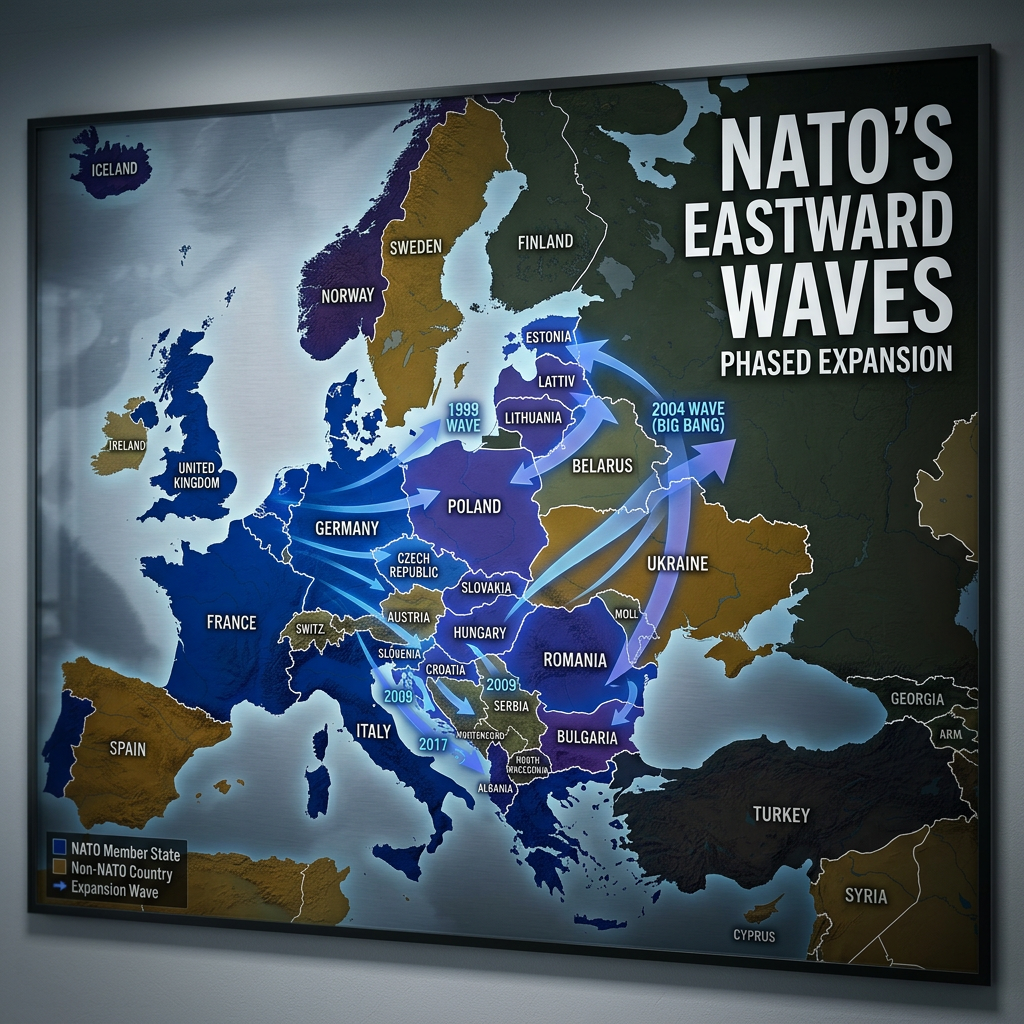
The first major post-Cold War enlargement came on March 12, 1999, when Poland, Hungary, and Czechia joined NATO. Their accession marked a decisive break with Cold War geography. Former Warsaw Pact members were now part of the Western security system.1
The next round, on March 29, 2004, was even more consequential. Bulgaria, Estonia, Latvia, Lithuania, Romania, Slovakia, and Slovenia joined the Alliance. The inclusion of Estonia, Latvia, and Lithuania carried special strategic weight. These were not only former Soviet-controlled territories; they had been republics of the Soviet Union itself. Their membership brought NATO directly to Russia’s border.1
Further rounds followed. Albania and Croatia joined in 2009, Montenegro in 2017, and North Macedonia in 2020. Each accession reflected NATO’s broader effort to bring vulnerable European regions into a common security framework.1
Yet enlargement was never only about military geography. It also functioned as a governance reform process. Aspiring members had to strengthen civilian and democratic control of the military, improve defense planning, align procurement and command structures, and demonstrate commitment to democratic norms. In that sense, NATO enlargement did more than extend a defense guarantee. It helped reshape institutions.
For Washington and Brussels, this was a compelling strategic argument. A Europe made up of stable, democratic, interoperable Allies would be less prone to conflict and easier to defend. The logic was both liberal and realist: values mattered, but so did hard security.
Why Central and Eastern Europe Wanted In
To understand NATO’s expansion, it is essential to treat Central and Eastern European states as strategic actors in their own right. These countries were not passive pieces on a great-power chessboard. They were governments and societies seeking protection, recognition, and a permanent place in the Western institutional order.
Their concerns were rooted in history. Poland had been partitioned, invaded, and dominated by larger powers. The Baltic states had been forcibly incorporated into the Soviet Union. Romania, Bulgaria, Hungary, and others had experienced different forms of Soviet pressure and control. For these societies, the end of the Cold War did not erase the memory of coercion.
NATO membership answered three needs at once.
First, it provided a credible security guarantee. No Central or Eastern European state could independently deter a major Russian military threat. Collective defense changed that calculation.
Second, it anchored these states politically in the West. NATO membership, often pursued alongside European Union integration, signaled that their post-communist transition was not temporary or reversible.
Third, it reduced the danger of being trapped in a buffer zone. History had taught the region that buffer zones are rarely neutral. More often, they become spaces where stronger powers compete, bargain, and intervene.
From this perspective, enlargement was not an aggressive project. It was a defensive insurance policy.
Russia’s Response: From Grievance to Confrontation
No serious analysis of NATO enlargement can ignore Russia’s view. Moscow saw the Alliance’s eastward movement very differently. Russian leaders argued that NATO’s growth violated the spirit of the post-Cold War settlement and reduced Russia’s strategic depth.
The most disputed issue concerns Western assurances during negotiations over German reunification. Russian officials have long claimed that Western leaders promised NATO would not move “one inch eastward.” Western governments counter that no binding treaty prohibited enlargement and that the discussions at the time focused mainly on Germany. The historical record supports a more nuanced view: informal assurances were discussed in specific diplomatic contexts, but no formal legal commitment barred future NATO enlargement.
That ambiguity mattered. In Russian political discourse, NATO enlargement became a story of betrayal. Whether fully accurate or not, the narrative proved durable and politically useful. It allowed Russian leaders to frame Western integration in Central and Eastern Europe as encirclement rather than voluntary alignment.
By the 2000s, this grievance had hardened into doctrine. Vladimir Putin’s 2007 speech at the Munich Security Conference openly condemned NATO enlargement and accused the West of ignoring Russian security interests. One year later, Russia went to war with Georgia. In 2014, it illegally annexed Crimea and backed separatist forces in eastern Ukraine. In February 2022, it launched a full-scale invasion of Ukraine.
These actions cannot be justified by NATO enlargement. Sovereign states have the right to choose their alliances, and Russia’s military aggression violated core principles of international order. Still, NATO enlargement shaped the strategic environment in which Russia made its choices. Moscow increasingly treated further Western consolidation near its borders as something to resist by force.
This produced a dangerous asymmetry of perception. Central and Eastern Europeans looked at Russia and saw a revisionist power with a record of coercion. Russia looked at NATO and saw a military alliance moving closer to its borders. Both perceptions drew on real historical experience. Neither side fully accepted the legitimacy of the other’s fears.
That gap remains one of the central obstacles to a stable European security order.
The Impact of Russia’s Invasion of Ukraine on NATO Expansion
Russia’s full-scale invasion of Ukraine in February 2022 reshaped NATO more dramatically than any formal enlargement strategy could have done on its own. The invasion clarified threat perceptions, accelerated defense planning, and transformed the political debate inside countries that had long avoided Alliance membership.
The most dramatic result was the accession of Finland and Sweden. For decades, both countries had maintained policies of military non-alignment. Finland, which shares an approximately 830-mile border with Russia, built a strong national defense while staying outside NATO. Sweden maintained a long tradition of military non-alignment, even as it cooperated closely with NATO and European partners.
The invasion changed their risk calculation almost overnight. Ukraine’s experience demonstrated that proximity to Russia without a binding defense guarantee could be a dangerous position. Non-alignment, once seen as a form of strategic flexibility, began to look like strategic exposure.
Finland submitted its application alongside Sweden on May 18, 2022, and became NATO’s 31st member on April 4, 2023. Sweden became NATO’s 32nd member on March 7, 2024, after all Allies completed their national ratification procedures.1 Their accession transformed the Alliance’s northern posture. Finland added a long NATO-Russia land border, while Sweden’s membership strengthened NATO’s position in the Baltic Sea region, where the Alliance now has greater ability to coordinate maritime access, logistics, surveillance, and reinforcement routes.
The invasion also reinforced the case for NATO membership among existing eastern Allies. For Poland, the Baltic states, Romania, and others, Ukraine confirmed a long-standing argument: Russia’s willingness to use force against non-NATO neighbors makes collective defense indispensable.
At the same time, the war exposed the limits of NATO’s open door policy, which is grounded in Article 10 of the North Atlantic Treaty.2 At the 2008 Bucharest Summit, Allies agreed that Ukraine and Georgia would become members of NATO in the future, but Ukraine was not protected by Article 5. At the 2024 Washington Summit, Allies stated that Ukraine is on an “irreversible path” to full Euro-Atlantic integration, including NATO membership, while also making clear that an invitation would come only when Allies agree and conditions are met.3
This is one of the war’s most important policy lessons. Strategic ambiguity can reduce short-term escalation risk, but it can also create long-term instability. A promise without a guarantee may provoke danger without deterring it.
Deterrence on the Eastern Flank
NATO’s enlargement matters because deterrence works differently inside the Alliance than outside it. The difference is not rhetorical. It is structural.
Article 5 does not automatically prescribe a specific military response, but it creates a powerful political and strategic commitment.2 Any attack on a NATO Ally would force an aggressor to consider the likely response of the entire Alliance, including the United States. That calculation is the foundation of deterrence.
After Russia’s illegal annexation of Crimea in 2014, NATO strengthened its eastern posture. At the 2016 Warsaw Summit, Allies agreed to establish an enhanced forward presence in the northeastern part of the Alliance. By 2017, multinational battlegroups had been deployed to Estonia, Latvia, Lithuania, and Poland.4
After Russia’s full-scale invasion of Ukraine in 2022, NATO reinforced its eastern flank again. Allies agreed to establish four additional multinational battlegroups in Bulgaria, Hungary, Romania, and Slovakia, extending NATO’s forward presence from the Baltic Sea to the Black Sea. NATO now describes these deployments as part of its forward presence, or Forward Land Forces, designed to strengthen deterrence and defense across the eastern part of the Alliance.4
These forces are not meant to stop a major invasion by themselves. Their purpose is to demonstrate commitment and ensure that any attack on a NATO member would immediately involve forces from multiple Allied countries. That would turn a local conflict into an Alliance-wide crisis from the first day.
This is deterrence by commitment. It signals that NATO’s eastern members are not second-tier Allies. Their defense is tied directly to the credibility of the entire Alliance.
The contrast with Ukraine is stark. Despite extensive Western support, Ukraine did not have Article 5 protection. Its experience has shown that political sympathy, military aid, and partnership status are not substitutes for formal Alliance membership.
For policymakers, the takeaway is direct: Alliance membership is not a diplomatic label. It is a decisive security variable.
Burden-Sharing and the Credibility Problem
Alliances depend not only on promises, but on capacity. For years, NATO struggled with a persistent burden-sharing problem. Many European members spent below the Alliance’s benchmark of 2% of GDP on defense, relying heavily on American capabilities to sustain deterrence.
This imbalance generated recurring frustration in Washington. It also raised a deeper strategic question: could NATO credibly defend its expanded territory if European members did not invest enough in their own militaries?
Russia’s full-scale invasion of Ukraine forced a major shift. Germany announced a historic special defense fund and began rethinking decades of military restraint. Poland sharply increased defense spending and has become one of NATO’s most serious military investors. The Baltic states, already highly alert to the Russian threat, continued to press for stronger forward defense. Nordic integration deepened after Finland and Sweden joined the Alliance.
At the 2024 Washington Summit, NATO noted that more than two-thirds of Allies had met the commitment to spend at least 2% of GDP annually on defense. It also acknowledged that, in many cases, spending beyond 2% would be needed to address capability shortfalls and meet the demands of a more contested security environment.5
Still, higher budgets do not automatically create military capability. Defense capacity takes time. It requires procurement, training, logistics, industrial production, munitions stockpiles, command systems, and political consistency.
This is where NATO’s credibility will be tested. Declarations of unity matter, but adversaries watch capabilities. They watch whether ammunition production rises, whether forces can deploy quickly, whether infrastructure can support reinforcement, and whether political leaders sustain commitments after the immediate crisis fades.
The lesson for Alliance leaders is simple: deterrence must be visible. It must be funded, exercised, and maintained.
Ukraine and the Cost of Strategic Ambiguity
Ukraine remains the most difficult unresolved question in European security. NATO has repeatedly stated that Ukraine’s future is in NATO, but it has not offered an immediate accession invitation or a fixed timeline.3 This position reflects a real dilemma.
On one hand, Ukraine’s case for membership has grown stronger. It is fighting a war that directly affects the future of European security. Its armed forces have become increasingly interoperable with NATO systems. Its survival is central to the credibility of the West’s broader deterrence posture.
On the other hand, admitting Ukraine during an active war could bring NATO into direct conflict with Russia. That risk has made many Allies cautious.
The result is strategic ambiguity. It is understandable, but costly. Russia has treated Ukraine’s possible NATO future as a threat, while Ukraine has not received the protection that membership would provide. This creates instability in the space between commitment and exclusion.
For policymakers, the challenge is not only whether Ukraine should join NATO. It is how to manage the gap between aspiration and protection. If membership is deferred indefinitely, Allies must decide what alternative security commitments are credible enough to deter future aggression. If membership is advanced, they must define the conditions, sequencing, and risk-management strategy with far greater clarity.
Ambiguity may be useful in diplomacy, but deterrence depends on credibility. At some point, unclear commitments can become liabilities.
A Transformed European Security Order
NATO’s enlargement has reshaped Europe in ways that are now difficult to reverse. The Alliance covers most of democratic Europe and has become the central platform for defense planning, intelligence sharing, interoperability, and crisis response.
For Central and Eastern Europe, this has produced a level of security that would have been unimaginable during the Cold War. The Baltic states, Poland, Romania, and others are no longer isolated borderlands. They are part of a collective defense system backed by the United States and other major European powers.
This has brought stability to member states. But it has also sharpened the dividing line between NATO Europe and Russia. The space for strategic ambiguity has narrowed. Countries are increasingly forced to choose between integration with Western institutions and vulnerability to Russian pressure.
The war in Ukraine has accelerated this division. It has made NATO more relevant, more unified, and more operationally focused. It has also made the European security order more militarized and more dangerous.
That dual reality matters. NATO enlargement has protected many countries from coercion. It has also contributed to a security environment in which Russia sees fewer non-military ways to preserve influence. Recognizing this does not excuse Russian aggression. It simply acknowledges that Alliance enlargement creates consequences — some stabilizing, some destabilizing — that policymakers must manage.
Strategic Takeaways for Policymakers
NATO’s enlargement in Central and Eastern Europe offers several lessons for leaders responsible for security policy, Alliance management, and long-term strategic planning.
First, Alliance membership is a structural security guarantee, not a symbolic gesture. The difference between NATO members and non-members is decisive. The Baltic states are protected by Article 5. Ukraine was not. That distinction has shaped the course of European history.
Second, deterrence requires visible commitment. Forward deployments, exercises, infrastructure, air defense, logistics, and defense industrial capacity matter because they make political promises credible. Deterrence cannot rest on statements alone.
Third, strategic ambiguity has limits. Ambiguity may help manage escalation in the short term, but over time it can create confusion, invite testing, and expose partners to danger. Ukraine’s position illustrates this problem clearly.
Fourth, Russia’s grievance narrative must be understood without being accepted as a veto. Moscow’s perception of encirclement has influenced its behavior, but it does not override the sovereignty of neighboring states. Effective policy must address Russian narratives while defending the principle that countries choose their own security arrangements.
Fifth, burden-sharing is central to Alliance credibility. The United States remains indispensable to NATO, but European Allies must build the capacity to defend Europe more effectively. Sustained investment is not optional; it is the price of a credible Alliance.
Finally, NATO’s future will depend on political will as much as military capability. The Alliance has adapted before. The question is whether it can sustain unity, investment, and strategic clarity over the long term.
Conclusion and Key Takeaways: NATO’s Evolving Security Architecture
NATO’s strategic enlargement in Central and Eastern Europe is neither a simple triumph nor a simple mistake. It is a major strategic project that has delivered real security to countries that urgently sought it, while also contributing to a sharper confrontation with Russia.
For Central and Eastern European members, the benefits are clear. They are safer inside NATO than they would be outside it. Their democratic transitions were strengthened by Western integration. Their defense planning is tied to the most powerful military alliance in the world.
For Europe as a whole, the picture is more complex. The continent is more unified, but also more divided. NATO is stronger, but the risks of escalation with Russia are higher. Ukraine’s future remains unresolved, and the credibility of the Alliance will depend on whether members can match strategic ambition with military capability.
The most important lesson is that security architecture must be maintained. It is not enough to enlarge an Alliance. Leaders must resource it, explain it, adapt it, and manage the risks it creates. NATO’s eastern enlargement has shown that credible commitments can deter aggression where they apply. It has also shown that uncertainty outside those commitments can be dangerous.
The Alliance began as a Cold War instrument, but it has become the central framework for managing Europe’s most urgent security challenges. Its next test will not be whether it can survive. It has already proved remarkably durable. The test will be whether it can remain credible, coherent, and politically united in a Europe where the line between deterrence and escalation is once again dangerously thin.
- NATO’s expansion in Eastern Europe gave former Soviet-dominated states a credible security guarantee, anchoring them firmly in the Western security order.
- Article 5 remains the decisive line between deterrence and vulnerability; NATO members benefit from collective defense, while partners such as Ukraine remain exposed without formal protection.
- Russia’s invasion of Ukraine strengthened NATO rather than weakening it, accelerating Finland’s and Sweden’s accession and reinforcing the Alliance’s eastern and northern posture.
- Deterrence on the eastern flank depends on visible capability, including forward forces, air defense, logistics, exercises, infrastructure, and rapid reinforcement plans.
- Burden-sharing is now central to NATO’s credibility; European Allies must sustain higher defense spending and turn budgets into usable military capacity.
- Ukraine’s future remains the Alliance’s most difficult strategic dilemma, showing the risks of promises that are politically strong but militarily incomplete.
- NATO’s long-term strength will depend on unity, political will, clear commitments, and the ability to match strategic ambition with real defense capability.
References and Notes
Footnotes:
References: North Atlantic Treaty. 1949. The North Atlantic Treaty. Washington, DC, April 4; NATO. 2024. “Enlargement and Article 10.” Updated October 3; NATO. 2024. Washington Summit Declaration. July 10; NATO. 2022. Madrid Summit Declaration. June 29; NATO. 2023. Vilnius Summit Communiqué. July 11; and NATO Allied Land Command. n.d. “Enhanced Forward Presence,” for current terminology on Forward Land Forces, eastern flank deployments, and battlegroup posture. This article also draws on the established historical record of NATO’s post-Cold War enlargement rounds, the Partnership for Peace process, the Membership Action Plan, and public debates over enlargement and European security after 1991.
Notes
- NATO. 2024. “Enlargement and Article 10.” Updated October 3. NATO’s official enlargement chronology records the first post-Cold War accessions as Czechia, Hungary, and Poland on March 12, 1999, followed by Bulgaria, Estonia, Latvia, Lithuania, Romania, Slovakia, and Slovenia on March 29, 2004. Later accessions included Albania and Croatia in 2009, Montenegro in 2017, North Macedonia in 2020, Finland on April 4, 2023, and Sweden on March 7, 2024. NATO’s official material also confirms that the Alliance now has 32 members. ↩ ↩2 ↩3 ↩4 ↩5
- NATO. 1949. The North Atlantic Treaty. Washington, DC, April 4; NATO. 2024. “Enlargement and Article 10.” Updated October 3. The North Atlantic Treaty provides the legal basis for NATO’s collective defense commitment in Article 5 and its open door policy in Article 10. NATO’s official “Enlargement and Article 10” material confirms that membership remains open to European states able to meet the obligations of membership and contribute to Euro-Atlantic security. ↩ ↩2 ↩3
- NATO. 2024. Washington Summit Declaration. July 10. The declaration states that Ukraine is on an “irreversible path” to full Euro-Atlantic integration, including NATO membership, while reaffirming that an invitation will be extended when Allies agree and conditions are met. ↩ ↩2
- NATO Allied Land Command. n.d. “Enhanced Forward Presence.” NATO Allied Land Command describes the Alliance’s current eastern forward presence as eight multinational Forward Land Forces, or battlegroups, in Bulgaria, Estonia, Hungary, Latvia, Lithuania, Poland, Romania, and Slovakia. NATO’s public material also traces this posture to decisions taken after Russia’s 2014 annexation of Crimea and expanded after Russia’s full-scale invasion of Ukraine in 2022. ↩ ↩2
- NATO. 2022. Madrid Summit Declaration. June 29; NATO. 2023. Vilnius Summit Communiqué. July 11; NATO. 2024. Washington Summit Declaration. July 10. These summit documents provide the basis for the article’s discussion of strengthened deterrence and defense, higher defense spending expectations, long-term support for Ukraine, new regional defense planning, and modernization of collective defense. ↩
NATOExpansion, #NATOExpansionInEasternEurope, #NATOEnlargement, #NATOEnlargementInEasternEurope, #EasternEuropeSecurity, #EuropeanSecurity, #EuropeanSecurityArchitecture, #AllianceStrategy, #Deterrence, #CollectiveDefense, #RegionalStability, #GeopoliticalRisk, #RussiaAndNATO, #NATORussiaTensions, #DefensePolicy, #SecurityGuarantees, #StrategicConsequences, #PostColdWarEurope, #InternationalRelations, #TransatlanticSecurity, #MilitaryStrategy, #RegionalDeterrence, #AllianceAdaptation, #SovereignSecurityChoices, #EasternEuropeanGeopolitics
@NATO, @NATO_ACT, @NDC_NATO, @SHAPE_NATO, @IISS_org, @RUSI_org, @CSIS, @AtlanticCouncil, @CEPA, @RANDCorporation, @BrookingsInst, @CFR_org, @FPRI, @TheStudyofWar, @ChathamHouse, @CarnegieEndow, @WarOnTheRocks, @DefenseOne, @ForeignAffairs, @ForeignPolicy, @TheEconomist, @Reuters, @AP, @BBCWorld, @FT, @politico, @Defense_News, @JanesINTEL, @NZZ, @ECFR, @gmfus, @OrbisBIO, @LawfareMedia, @AEI, @HudsonInstitute, @StimsonCenter, @CNASdc, @NewAtlanticist, @RealClearWorld
Discover more from Responsible Public Affairs
Subscribe to get the latest posts sent to your email.