
Abstract
The South China Sea is far more than a regional flashpoint. It is a structural business risk woven into the foundation of global trade. Roughly a third of the world’s maritime commerce flows through these waters, binding the manufacturing engines of East Asia to markets everywhere. This article makes one governing argument for CEOs and boards: the contest over this sea is not someone else’s distant problem but a permanent feature of the global trading system that belongs on every board’s risk agenda—and in its capital allocation decisions. It traces why this matters now, what is actually happening on the water, why the situation is structurally dangerous, what it means for enterprise value, and what smart organizations should do in the next 90 days. Drawing on events directors will recognize—from the 2021 Ever Given grounding to the 2012 standoff at Scarborough Shoal—it grounds the analysis in the real world, then converts it into scenario planning, governance questions, early-warning indicators, and concrete, industry-by-industry action. The executive takeaway is simple and unsparing: plan for sustained tension, fund resilience before you need it, and never mistake the absence of war for the presence of stability. For boards and policymakers alike, understanding this contest is no longer optional. It is the price of admission for any strategy that depends on stable trade and predictable supply chains.
Executive Summary
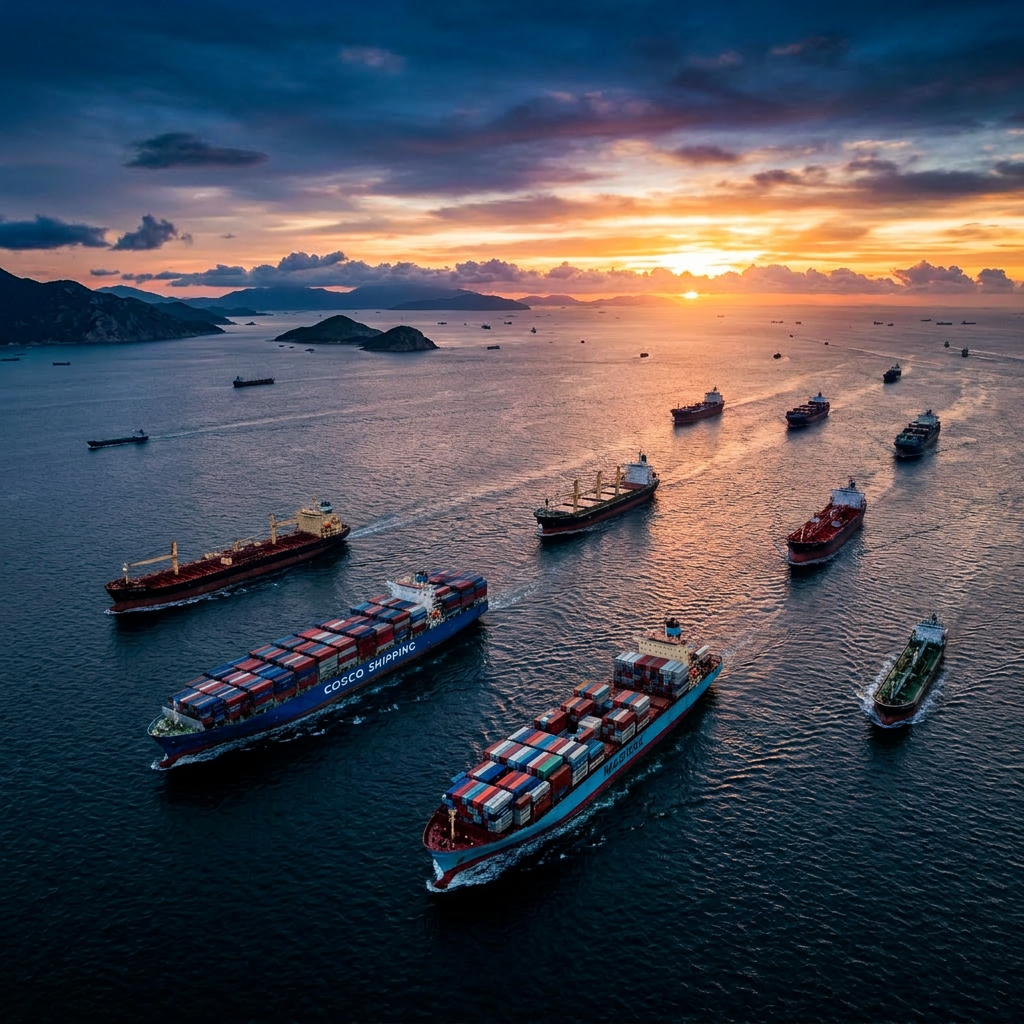
The South China Sea belongs on the board agenda, even if many directors have yet to treat it that way. Roughly a third of global maritime trade flows through these waters—the semiconductors, energy, and consumer goods that link East Asian manufacturing to markets worldwide.[^1] That concentration creates a structural chokepoint. Any disruption, from open conflict to a single accident, would ripple through global supply chains within days, spiking insurance costs and forcing cargo onto longer, costlier routes. The world saw a small-scale rehearsal in 2021, when one grounded container ship blocked the Suez Canal for six days and held up an estimated $9 billion in trade per day.[^2]
The dispute is durable by design. Overlapping territorial claims, fortified artificial islands, and “gray zone” tactics keep tensions high while staying below the threshold of open war. The most likely future is not sudden conflict but sustained, managed tension punctuated by periodic flashpoints—amplified by a US-China rivalry that turns local incidents into tests of great-power resolve.
The strategic implication is clear: this is a permanent feature of the global trading system, not a problem that will resolve itself. Legal rulings have not changed the facts on the ground, so leaders cannot count on any external fix. The practical response is to treat South China Sea exposure as a board-level risk now, not after a crisis—mapping dependencies honestly, identifying single points of failure, diversifying suppliers and routing, and stress-testing operations against a prolonged disruption. The bottom line: plan for sustained tension, invest in resilience before you need it, and never mistake the absence of war for the presence of stability.
Why This Matters Now—and Why Waiting Is Costly
It would be easy to treat the South China Sea as a slow-burning dispute that has simmered for decades without boiling over. For a board, that reading is dangerously out of date. This is a live threat to enterprise value, and four forces are converging to make it the moment directors can no longer afford to look away.
First, great-power rivalry is sharpening. The contest between the United States and China has hardened from economic competition into strategic confrontation, and these waters have become its central arena. Second, supply chains are more fragile than they were a decade ago. The pandemic, the war in Ukraine, and a wave of shifting trade policy stripped away the slack that once absorbed shocks, leaving lean systems with little room to fail. Third, gray-zone tactics are escalating. Water-cannon confrontations, ramming incidents, and aggressive shadowing have grown more frequent and more brazen, each one a small test of how far one side can push before the other pushes back.
Fourth, and most important for a board, the cost of waiting is asymmetric. By the time a disruption is visible on the news, the cheap options for protecting your business are already gone. Resilience built in advance costs a fraction of resilience improvised under fire—and the gap shows up directly in earnings, margins, and the credibility of management’s guidance. The window for calm, deliberate preparation is open now, and it will not stay open indefinitely.
A Sea That Touches Everything
Every year, roughly $3.4 trillion in goods passes through this single stretch of water in Southeast Asia—a figure that dwarfs the GDP of most nations.[^3] It includes the semiconductors that power your devices, the oil that fuels half of East Asia, and the consumer goods that fill shelves from Sydney to Seattle. The contest over who controls it touches the boardroom as directly as it touches the war room.
It helps to make this concrete. Consider the journey of a single semiconductor: silicon refined in one country, fabricated into wafers in Taiwan, packaged in Malaysia, assembled into a device in Vietnam or southern China, and shipped to consumers worldwide—often crossing the South China Sea at several stages. We rarely think about it, and that is precisely the point. Smooth global trade is invisible until it breaks.
The temptation for leaders is to file this under “geopolitical noise”—important, perhaps, but too remote to demand action. That is a mistake. The cost of that complacency is not measured in headlines; it is measured in stranded shipments, blown budgets, and decisions made too late.
What Is Actually Happening on the Water
To respond intelligently, a board needs a clear picture of the contest itself—who claims what, how they are pressing those claims, and why the standoff refuses to resolve.
Too Many Claims, Too Little Water
At the heart of the dispute lies a simple problem with no simple answer: too many countries claim too much of the same space. China advances the most expansive position, marked by the so-called “nine-dash line,” a boundary that sweeps across roughly 90 percent of the sea and overlaps the claims of nearly every neighbor. Vietnam, the Philippines, Malaysia, Brunei, and Taiwan each assert rights to portions of the waters, islands, and reefs. The contested features—the Spratly Islands, the Paracels, Scarborough Shoal—are often little more than rocks and sandbars at high tide. Their value lies not in the land itself but in what controlling them confers: exclusive economic zones, fishing rights, and strategic position. Scarborough Shoal is a telling example. After a tense 2012 maritime standoff, China effectively took control of the rich fishing ground, barring Filipino fishermen who had worked those waters for generations.
What makes the standoff so durable is that each claimant frames its position in terms of history, sovereignty, and national identity—not bargaining chips easily traded away. A leader who concedes a reef may win praise abroad and lose support at home. That asymmetry, repeated across every capital with a stake in the dispute, explains why a problem so widely understood remains so stubbornly unsolved.
Concrete, Steel, and the Logic of Posturing
The most visible change over the past decade has been physical. China has transformed submerged reefs into artificial islands complete with runways, radar installations, ports, and missile systems. Fiery Cross Reef, once barely visible, now hosts a three-kilometer runway and hardened hangars. Mischief Reef and Subi Reef have undergone similar transformations. What were once navigational hazards are now fortified outposts.
Confrontations rarely involve direct combat. More often they take the form of water-cannon standoffs, ramming incidents, and tense shadowing maneuvers—the “gray zone” tactics designed to assert control without crossing into open war. In 2023 and 2024, Chinese coast guard ships repeatedly blasted Philippine resupply boats near Second Thomas Shoal, injuring crew and damaging vessels without a shot being fired. The approach is deliberate and effective: it changes facts on the ground incrementally, daring others to respond while keeping each step below the threshold that would trigger a major reaction. Repeat that scene enough times, across enough years, and the map quietly redraws itself without a single declared war.
Where the Law Stands—and Where It Doesn’t
In 2016, an international tribunal in The Hague found that China’s expansive historical claims had no legal basis under the UN Convention on the Law of the Sea.[^4] The ruling was emphatic. It was also, in practical terms, unenforced. China dismissed it as “nothing more than a piece of paper” and pressed on. The lesson for a board is blunt: legal clarity does not guarantee operational stability. A favorable ruling makes for a strong argument and a weak shield. If your contingency plans assume international law will keep the sea lanes open, you are planning on hope rather than evidence.
Why This Is Structurally Dangerous
The geography that makes these waters valuable also makes them fragile. The South China Sea connects the Indian Ocean to the Pacific, and the Strait of Malacca, its western gateway, funnels an enormous share of the world’s seaborne oil toward China, Japan, and South Korea. When one waterway carries so much value, any disruption ripples outward almost instantly—and the region offers no easy detour. When the Ever Given wedged across the Suez Canal in 2021, it stranded hundreds of ships and rattled industries from automaking to retail, all from a single vessel for less than a week. A comparable event here would dwarf it. Rerouting south of Australia or through the Lombok Strait adds days, fuel, and expense to journeys already running on thin margins, as carriers learned when Red Sea attacks pushed them around the Cape of Good Hope and added roughly two weeks to each voyage.
The danger is not only commercial. The good news is that no party appears to want war, since open conflict would be ruinous for all involved. The bad news is that the conditions for accidental escalation are abundant. When armed vessels operate in close quarters, the margin for error is thin. In 2018, a Chinese destroyer came within 45 yards of the USS Decatur, forcing the American ship to swerve. The 2001 Hainan Island incident showed how quickly an aerial collision can become an eleven-day diplomatic crisis. The First World War did not begin because anyone planned it; it began because a sequence of reactions left no one room to step back. This sea contains the raw material for exactly that kind of miscalculation—and a US-China rivalry that turns a clash between two coast guard vessels into a proxy test of credibility for nations far larger and more heavily armed.
For business, the structural danger reduces to one uncomfortable fact: enormous value flows through a narrow, contested corridor with no ready alternative, governed by tensions that no court can settle and no party fully controls.
The Investor Lens: Why This Reaches Enterprise Value
For public-company boards, the exposure does not stop at operations—it shows up in the numbers investors watch. A single disrupted quarter can drive earnings volatility, compress margins as freight and insurance costs surge, and force a guidance revision that erodes management credibility. Markets increasingly price in geopolitical concentration: a business that depends heavily on a single contested corridor carries a valuation discount relative to a more resilient peer, even before any disruption occurs. The inverse is also true. Demonstrated resilience—diversified sourcing, stress-tested contingency plans, a board that can speak fluently about its exposure—has become a credibility signal that investors reward. In a volatile environment, the ability to say “we have planned for this” is itself a competitive asset.
Three Scenarios Every Board Should Plan For
Analysis becomes useful when it turns into planning. Rather than betting on a single forecast, boards should prepare for a range of plausible futures and watch for the signals that tell them which one is unfolding. Three scenarios capture the realistic spread.
Scenario 1: Continued Managed Tension
This is the most likely path and roughly the status quo. Confrontations stay below the threshold of open conflict—gray-zone harassment, occasional standoffs, sharp rhetoric—but sea lanes remain open and commerce flows largely uninterrupted.
Business implications. Costs creep upward rather than spiking. Insurance premiums for the region edge higher, compliance and monitoring demands grow, and occasional delays become a manageable cost of doing business. The trap is complacency: tension that has been managed for years can feel permanent, lulling firms into stripping out the very buffers they will later need.
Early-warning indicators to monitor:
- Frequency and severity of gray-zone incidents holding steady rather than rising
- Stable war-risk insurance premiums for South China Sea transit
- Diplomatic channels between Washington, Beijing, and claimant states remaining open
- No sustained closure or rerouting advisories from major carriers
Scenario 2: Periodic Disruption and Localized Confrontation
Here, flashpoints turn kinetic in limited ways—a vessel seized, a brief armed clash, a temporary closure of a contested area. Disruption is real but contained in scope and duration.
Business implications. Expect intermittent shocks: shipments delayed by days or weeks, spot freight rates spiking on affected lanes, and scramble-mode rerouting that strains logistics teams and budgets. Just-in-time operations feel it first; a plant manager may face a line-down event over a single missing component. Firms with diversified suppliers and pre-negotiated routing absorb the blow; those without it pay premium rates under pressure.
Early-warning indicators to monitor:
- A marked uptick in the frequency or intensity of vessel confrontations
- Naval mobilizations or live-fire exercises near key shipping lanes
- War-risk premiums rising sharply on specific routes
- Claimant governments issuing formal protests, recalling envoys, or imposing local maritime restrictions
- Carriers publishing contingency rerouting plans
Scenario 3: Major Crisis with Prolonged Shipping Disruption
The low-probability, high-impact tail: a significant armed conflict or blockade that closes or severely restricts the corridor for an extended period. This is the scenario that breaks supply chains rather than bending them.
Business implications. Severe and cascading. Energy importers in Japan and South Korea face genuine supply shortfalls; semiconductor and electronics supply chains seize; freight and insurance costs multiply; and entire production lines halt for want of components with no near-term substitute. Households feel it too, through higher energy bills and emptier shelves. In this scenario, the firms that survive intact are those that funded resilience before they could prove they needed it.
Early-warning indicators to monitor:
- Direct military engagement between major powers or a formal blockade declaration
- Mass rerouting of commercial shipping away from the region
- War-risk insurance becoming unavailable or prohibitively expensive
- Government-issued export controls, strategic-reserve drawdowns, or emergency trade measures
- Allied military deployments signaling preparation for sustained conflict
The discipline these scenarios demand is not prediction but readiness. Define in advance which indicators would move you from one posture to the next, and decide now what actions each threshold should trigger. That turns geopolitical anxiety into an operating plan.
The Early-Warning Dashboard
A board does not need to track the South China Sea daily, but it should know which signals separate background noise from a genuine shift in risk. The indicators below form a practical dashboard—worth a standing slot in the risk committee’s review.
- Maritime confrontations. A rising frequency or intensity of standoffs, rammings, and water-cannon incidents is the clearest sign that gray-zone tension is escalating.
- Military deployments and exercises. Naval mobilizations, carrier movements, or live-fire drills near key lanes signal a shift from posturing toward preparation.
- Insurance premium spikes. War-risk premiums are a market-priced early warning; sharp increases mean professional risk-takers see rising danger.
- Shipping rerouting behavior. When major carriers publish contingency routes or begin diverting voyages, disruption has moved from theoretical to operational.
- Export restrictions and trade measures. New controls, especially on semiconductors or critical materials, often precede or accompany geopolitical escalation.
- Port congestion patterns. Building backlogs at regional hubs can foreshadow systemic strain before it reaches your own shipments.
- Energy price volatility. Sudden moves in regional oil and LNG prices frequently reflect transit risk before headlines catch up.
The point is not to watch every signal obsessively but to assign ownership, set thresholds, and agree in advance what each one should trigger.
What Boards Should Ask Now
The fastest way to convert this analysis into governance is to put the right questions on the table. A board does not need to manage the response, but it should insist that management can answer the following:
- Where are our hidden dependencies on this corridor, including the lower-tier suppliers we do not contract with directly?
- Which products, business units, or revenue streams are most exposed to a disruption here?
- How long could we continue operating under a multi-week closure of these sea lanes—and what breaks first?
- What specific triggers would force us to shift sourcing, routing, or inventory, and who has the authority to act on them?
- Are our resilience investments reflected in capital allocation, or are they the first thing cut under margin pressure?
- Have we stress-tested our contracts, insurance, and force majeure provisions against a prolonged disruption?
- Who owns geopolitical supply chain risk at the executive level, and how often do they report to this board?
- If a crisis hit tomorrow, who decides, how fast, and on what information?
If management cannot answer these crisply, that gap is itself the finding.
What Smart Organizations Should Do in the Next 90 Days
Strategy is only as good as the action it triggers. The following is a concrete, time-bound agenda a board can mandate and track.
- Map dependencies (Weeks 1–4). Commission an honest, multi-tier mapping of which products and suppliers route through the South China Sea or Strait of Malacca. You cannot mitigate exposure you have not measured.
- Stress-test against scenarios (Weeks 2–6). Run a tabletop exercise against the three scenarios above, simulating a multi-week disruption and identifying exactly what fails and when.
- Review supplier concentration (Weeks 4–8). Identify single points of failure and confirm whether “diversified” backups in fact share the same chokepoint. Begin qualifying genuine alternatives.
- Audit insurance and contracts (Weeks 4–8). Review war-risk coverage, force majeure language, delivery penalties, and routing flexibility before a crisis tests them.
- Establish crisis decision governance (Weeks 6–10). Define who decides, on what triggers, and how fast—so a disruption meets a plan, not a scramble.
- Set board reporting cadence (Weeks 8–12). Install geopolitical supply chain risk as a standing board item with named ownership and an agreed reporting rhythm.
Ninety days will not eliminate the risk, but it will move an organization from exposed-and-unaware to prepared-and-deliberate—which is the entire game.
The Executive Tradeoff: Resilience Versus Efficiency
The leanest supply chain is not the most durable one. Resilience carries a cost, but fragility carries a price—and the price always lands at the worst possible moment. Redundancy should be treated not as waste but as strategic optionality: the deliberate purchase of the ability to keep operating when competitors cannot. The firms that fared best in the 2011 Thai floods and the 2021 chip crunch were those that had paid for buffers and diversification before the trouble arrived—precisely the spending that gets cut first and missed most. For a board, the real question is not “what does resilience cost?” but “what does fragility cost, and can we survive paying it?”
What This Means for Business Leaders and Policymakers
For executives, the South China Sea is a case study in concentrated risk—and a test of whether resilience is treated as a strategic asset or a line to be cut. The practical response is not panic but preparation, owned at the top. Geopolitical risk belongs on the board agenda, not in a footnote, with a named executive accountable for it. Enterprise risk management should map supplier concentration honestly, several tiers deep, because the danger usually hides in suppliers most leaders have never heard of.
The shape of that exposure differs sharply by sector, and the smartest firms tailor their response. An automaker running just-in-time inventories should map exactly which wiring harnesses and control chips would halt a line within days, and pre-qualify backup suppliers outside the region. A consumer-electronics brand dependent on Taiwanese fabs and Southeast Asian packaging should know which products would stop shipping and build buffer stock ahead of peak quarters. An energy importer should secure diversified tanker routing and strategic reserves. A pharmaceutical company should trace which active ingredients originate in regional hubs and qualify alternative sources before a shortage forces the issue. The “China Plus One” strategy that drew Apple and Samsung toward Vietnam and India is partly an answer to this concentrated risk—though much of that diversified output still sails through the same contested waters.
For policymakers, the challenge is to manage rivalry without stumbling into conflict: steady diplomacy, reliable communication channels to prevent accidents from escalating, and clear-eyed commitments to allies. The Cold War offers a precedent—after the Cuban Missile Crisis, Washington and Moscow built a direct hotline to defuse exactly the kind of miscommunication that nearly proved catastrophic. Deterrence and dialogue are not opposites here; strength without conversation invites miscalculation, and conversation without strength invites being ignored.
Common Executive Mistakes
Even well-run organizations fall into a familiar set of traps. The most common are worth naming, because avoiding them is cheap and recovering from them is not.
- Treating the issue as remote rather than structural. Filing the South China Sea under “geopolitical noise” feels reasonable right up until it isn’t.
- Trusting legal frameworks to provide protection. A favorable tribunal ruling is an argument, not a shield, when the other party simply declines to comply.
- Mistaking paper diversification for real diversification. Backup suppliers that funnel through the same chokepoint offer the illusion of resilience, not the substance.
- Mapping only tier-1 suppliers. The dependencies that hurt most often sit two or three tiers down, invisible until they fail.
- Waiting for a crisis to assign ownership. A risk with no named owner is a risk no one is actually managing.
- Cutting resilience first under margin pressure. Buffers and redundancy are the easiest line to trim and the costliest to have trimmed.
From Analysis to Action: A Risk Mitigation Playbook by Industry
Understanding the South China Sea is the first half of the work. The second half is translating that understanding into decisions your organization can actually make. The guidance below turns the analysis into a practical playbook, sector by sector, because exposure looks different depending on what you make, move, or sell. Start with your own industry, then read the cross-industry section that follows—the fundamentals there apply to everyone.
Manufacturing
For manufacturers, the danger usually hides several layers down the supply chain, in suppliers most executives have never heard of.
- Map all tier-1, tier-2, and tier-3 suppliers that route components through the South China Sea or Strait of Malacca.
- Identify single points of failure where a “diversified” supplier base in fact depends on the same chokepoint, and begin qualifying genuine alternatives outside the region.
- Pre-qualify backup suppliers for the components that would halt a production line within days, prioritizing critical chips, wiring harnesses, and specialized inputs with no ready substitute.
- Build targeted buffer stock for the highest-risk components, sized against a multi-week disruption rather than a routine delay.
- Stress-test just-in-time operations against a sustained closure, and identify which lines stop first and what it would cost to keep them running.
- Review supplier contracts for force majeure, delivery penalties, and routing flexibility before a crisis tests them.
Semiconductors and Electronics
For chipmakers and electronics brands, exposure is concentrated in a handful of irreplaceable nodes—Taiwanese fabs, Southeast Asian packaging, and the sea lanes that connect them.
- Map which products depend on Taiwanese fabrication and Southeast Asian assembly or packaging, and which would stop shipping under a disruption.
- Build buffer inventory ahead of peak quarters, when a delay does the most commercial damage.
- Diversify packaging and test capacity across multiple geographies where technically feasible, recognizing that genuine qualification takes time.
- Secure priority allocation agreements with key foundries and packaging partners before demand spikes under stress.
- Model the revenue at risk by product line, so leadership can prioritize protection where it matters most.
Energy and Commodities
For energy importers, the Strait of Malacca and the South China Sea are a single dependency that no contract can fully hedge.
- Diversify tanker routing and pre-arrange alternative paths, including the Lombok and Sunda straits, with the added time and cost mapped in advance.
- Maintain strategic reserves sized against a prolonged disruption, not a brief delay.
- Hedge price exposure against the volatility that accompanies any transit scare in the region.
- Establish contingency supply agreements with producers outside the affected corridor.
- Monitor regional LNG and crude price signals as an early warning of rising transit risk.
Retail and Consumer Goods
For retailers and consumer brands, the risk shows up as empty shelves and blown seasonal windows.
- Identify which SKUs and categories route through the corridor and which seasons carry the most exposure.
- Advance critical orders ahead of high-risk periods and build buffer stock for bestsellers.
- Diversify sourcing toward suppliers that do not share the same chokepoint, verifying routing several tiers deep.
- Negotiate flexible logistics contracts that allow rerouting without prohibitive penalties.
- Communicate realistic lead times to downstream partners so a disruption does not cascade into broken commitments.
Cross-Industry Fundamentals
Whatever the sector, a common set of actions applies to every organization with exposure to these waters.
- Assign a named executive owner for regional supply risk, with a direct reporting line to the board.
- Install South China Sea exposure as a standing item on the enterprise risk register, reviewed on a fixed cadence.
- Run periodic tabletop exercises against the three scenarios outlined above, and update plans as indicators shift.
- Treat resilience spending as strategic optionality protected through the budget cycle, not as discretionary cost cut under margin pressure.
- Maintain an early-warning dashboard with defined thresholds and pre-agreed actions, so a signal meets a plan rather than a scramble.
Conclusion
The contest over the South China Sea will not be resolved on any timeline a board can plan around. Overlapping claims rooted in national identity, fortified islands that cannot be un-built, and a great-power rivalry with no off-ramp all point to the same conclusion: sustained tension is the base case, not the worst case. For leaders, the strategic error is not failing to predict the next flashpoint—it is treating a permanent structural risk as a temporary disturbance that someone else will resolve.
The organizations that come through the next decade intact will be the ones that acted while the waters were calm: mapping their true dependencies, funding resilience before they could prove they needed it, and building the governance to decide quickly when a signal turns into a shock. That work is neither glamorous nor cheap, and it competes against the constant pull of efficiency and the comfort of assuming tomorrow will look like today.
The executive takeaway is simple and unsparing: plan for sustained tension, fund resilience before you need it, and never mistake the absence of war for the presence of stability. The boards that internalize that discipline will not just weather the next disruption—they will gain ground on competitors who waited for certainty that was never coming.
References and Footnotes
Asian Development Bank. (2023). Asia’s Trade and Maritime Connectivity Outlook. Manila: Asian Development Bank.
Center for Strategic and International Studies, Asia Maritime Transparency Initiative. (2023). South China Sea Island Tracker. Washington, DC: CSIS.
Center for Strategic and International Studies, Asia Maritime Transparency Initiative. (2024). Maritime Militia and Gray-Zone Activity in the South China Sea. Washington, DC: CSIS.
International Maritime Organization. (2022). Review of Maritime Traffic and Safety in Southeast Asian Sea Lanes. London: IMO.
International Monetary Fund. (2024). Regional Economic Outlook: Asia and Pacific. Washington, DC: IMF.
Permanent Court of Arbitration. (2016). The South China Sea Arbitration (The Republic of the Philippines v. The People’s Republic of China), Award of 12 July 2016. The Hague: PCA.
United Nations Conference on Trade and Development. (2023). Review of Maritime Transport 2023. Geneva: UNCTAD.
United Nations Convention on the Law of the Sea. (1982). United Nations Convention on the Law of the Sea. Montego Bay: United Nations.
U.S. Energy Information Administration. (2023). South China Sea Regional Energy Assessment: Oil and Natural Gas Reserves and Trade Flows. Washington, DC: U.S. Department of Energy.
World Bank. (2023). Global Economic Prospects: East Asia and the Pacific. Washington, DC: World Bank Group.
Discover more from Responsible Public Affairs
Subscribe to get the latest posts sent to your email.