
Abstract
Defense spending occupies a singular position in public finance: it is justified not by the returns it generates but by the catastrophes it prevents, which makes it uniquely difficult to evaluate and uniquely prone to both excess and neglect. This article maps the full economic architecture of military budgets—tracing their reactive historical evolution, their contested macroeconomic effects on growth, employment, and innovation, and the opportunity costs they impose on competing national priorities. It examines why defense procurement is structurally prone to cost overruns and delay, why alliance burden-sharing recurs as a collective action problem, how arms-race dynamics drain emerging economies, and why nuclear deterrence offers security efficiency alongside open-ended modernization costs. Drawing on cases ranging from Soviet overextension and the F-35 program to postwar Japan and the contest over Iran’s nuclear program, the central finding is that defense spending should be neither maximized nor minimized but optimized—aligned with clear strategy, evaluated at the margin, disciplined through procurement reform, and constrained by the fiscal foundations on which lasting military power ultimately rests.
Executive Summary
Defense spending presents policymakers with a paradox: it is among the largest and most politically protected categories of public expenditure, yet it is justified not by the wealth it creates but by the disasters it prevents, making it uniquely hard to measure and uniquely vulnerable to both runaway excess and dangerous neglect. Success is counted in wars that never happen and aggression that is deterred before it begins—outcomes that are invisible by design and therefore easy to undervalue in calm periods and to overstate in fearful ones. This article argues that military budgets are best understood as a portfolio decision governed by tradeoffs rather than absolutes, and it traces that argument across the full economic architecture of defense: its historical evolution, its macroeconomic effects, the opportunity costs it imposes, the structural pathologies of procurement, the politics of alliance burden-sharing, the dynamics of arms races, the economics of nuclear deterrence, and the fiscal foundations that ultimately constrain all military power.
Historically, spending has been reactive—surging in response to threat and contracting in periods of calm, often leaving capability gaps that prove expensive and slow to reverse, since complex platforms, skilled workforces, and production lines cannot be rebuilt overnight. The post-2022 scramble to replenish artillery shells and air-defense stocks across NATO illustrated how investment tends to arrive only after the strategic environment has already shifted, while the Cold War record shows how budgets ratchet upward more easily than they contract once constituencies, programs, and industrial interests accumulate around them. The composition of spending, moreover, often matters as much as its level: budgets dominated by personnel costs and legacy systems may purchase far less real capability than their headline figures suggest.
The economic effects of defense spending are real but frequently overstated, and conflating strategic necessity with economic efficiency is a recurring analytical error. Defense multipliers tend to be lower than those for infrastructure or education, because military output does not re-enter the productive economy the way roads, ports, or skilled labor do. Defense employment is capital-intensive relative to many civilian alternatives, which makes it a comparatively inefficient instrument when promoted primarily as a jobs program—even as its geographic concentration, exemplified by the F-35’s distribution across most American states, lends it formidable political durability. Innovation spillovers are genuine and sometimes vast, with the internet, GPS, and semiconductors all tracing lineage to military investment, but they depend on the kind of research funded rather than the headline level of spending, and are strongest when defense R&D pursues general-purpose technologies rather than narrow, single-use systems.
Every dollar committed to defense carries an opportunity cost measured against healthcare, education, scientific research, and long-term growth, borne not only in the present but across future generations. The postwar trajectories of Japan and West Germany show how security guarantees can free capital for civilian growth, while North Korea marks the extreme opposite end of the curve. Yet underinvestment functions as a forgone insurance premium whose true cost appears only when deterrence fails—a lesson written sharply into Ukraine’s far costlier mobilization after 2022. Because the premium is paid continuously and visibly while the payoff is an invisible non-event, political systems are systematically biased toward underinsurance during periods of calm and toward overspending during periods of fear.
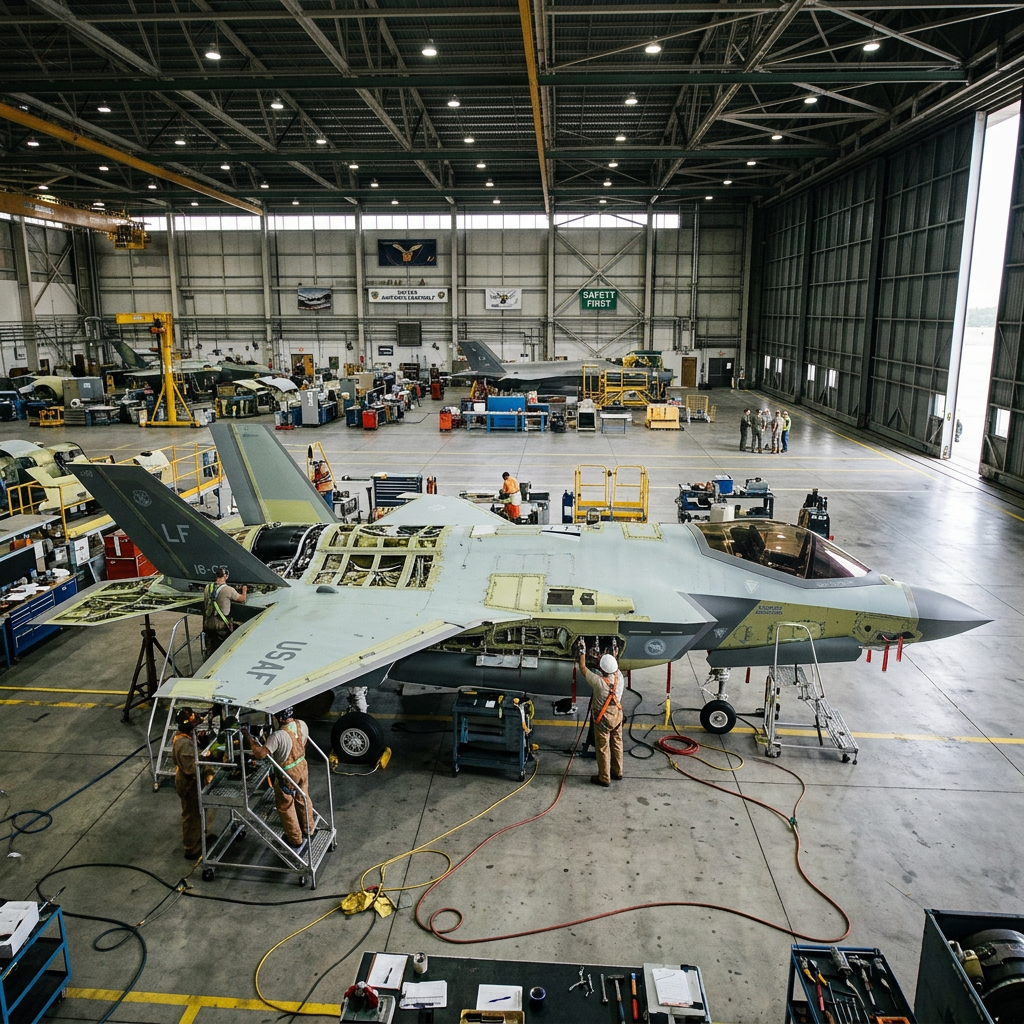
Procurement remains structurally prone to cost overruns and delay because defense markets combine a single buyer, few suppliers, extreme technical complexity, and unstable requirements. The F-35’s trajectory past $1.7 trillion in projected lifetime cost, the Zumwalt-class cut from 32 ships to three, and the B-2 reduced from 132 aircraft to 21 at roughly $2 billion each all demonstrate how shrinking buys, shifting specifications, and long development cycles inflate costs and erode capability. Requirements instability and the tension between cost-plus and fixed-price contracting—the latter illustrated by Boeing’s loss-making KC-46—make procurement reform the largest available source of savings without any loss of capability. The defense industrial base adds a further layer: sustaining sovereign capacity confers independence in crisis but carries real costs, intensified by the concentration of critical inputs such as semiconductors and rare earths in a handful of nations, some of them strategic competitors.
The remaining themes reinforce the same logic. Alliance burden-sharing recurs as a collective-action problem, because shared deterrence is a public good that invites free-riding; durable solutions therefore require credible targets, transparent measurement, and metrics that capture readiness and capability rather than spending alone, as the contrast between high-readiness Estonia and hollow larger formations makes clear. Arms-race dynamics drain emerging economies of development capital and can leave all parties less secure, though outcomes hinge on governance, transparency, and the efficiency of spending—South Korea and Israel turning defense investment into competitive industries, while opaque buildups entrench military influence and fuel instability. Nuclear deterrence offers genuine security efficiency, allowing a small arsenal to substitute for far larger conventional forces, but it carries open-ended modernization costs—well over a trillion dollars for the U.S. triad alone—and acute proliferation risks, vividly illustrated by the costly, fragile effort to constrain Iran’s enrichment program. The central strategic implication is that defense spending should be neither maximized nor minimized but optimized: tied to clear strategy, evaluated at the margin, disciplined through procurement reform, and constrained by the fiscal foundations on which all enduring military power ultimately rests—the enduring lesson of Soviet overextension being that power outrunning its economic base is self-defeating.
Key Points
- Defense spending is a portfolio decision, not an absolute. It should be neither maximized nor minimized but optimized—aligned with clear strategy and evaluated at the margin against competing national priorities.
- Budgets are reactive and slow to adjust. Spending surges after threats emerge and contracts during calm, leaving capability gaps that prove costly to reverse, as the post-2022 scramble to rebuild munitions stocks showed.
- Economic benefits are often overstated. Defense multipliers typically run lower than those for infrastructure or education, defense employment is capital-intensive, and innovation spillovers depend on the kind of research funded rather than the headline spending level.
- Every defense dollar carries an opportunity cost. Resources spent on the military are unavailable for healthcare, education, and growth—yet underinvestment is a forgone insurance premium whose true cost appears only when deterrence fails.
- Procurement is the largest source of avoidable waste. Monopsony buyers, few suppliers, extreme complexity, and unstable requirements drive chronic cost overruns and delays, making procurement reform the biggest available saving without any loss of capability.
- Alliance burden-sharing is a collective-action problem. Shared deterrence invites free-riding, so durable solutions require credible targets, transparent measurement, and metrics that capture readiness and capability, not spending alone.
- Arms races drain emerging economies. Mutual buildups consume scarce development capital and can leave all parties less secure, with outcomes shaped heavily by governance, transparency, and the efficiency of spending.
- Nuclear deterrence offers efficiency but open-ended costs. A small arsenal can substitute for far larger conventional forces, yet continuous modernization and proliferation risks impose steep, long-lived burdens.
- Fiscal foundations underpin all military power. Spending that erodes the economic base it depends on—as Soviet overextension showed—is ultimately self-defeating.
Defense spending sits at the intersection of national survival and economic prudence. Every dollar, euro, or yuan committed to military capability represents a deliberate choice—one that shapes industrial bases, drives technological frontiers, and constrains other public priorities. Unlike most categories of public expenditure, defense spending is justified not by the returns it generates but by the catastrophes it is meant to prevent. This inverts the normal logic of budgeting: success is measured in conflicts that never occur, threats that never materialize, and aggression that is deterred before it begins. That feature makes defense spending uniquely difficult to evaluate and uniquely prone to both excess and neglect. For policymakers and strategists, understanding the economic mechanics behind military budgets is no longer optional. It is central to crafting strategy that is both effective and sustainable.
This article examines the full economic architecture of defense spending: how budgets evolved, how they affect economies, what tradeoffs they impose, how procurement and industrial policy shape outcomes, and how nations can balance security imperatives against fiscal reality. Drawing on concrete historical and contemporary cases—from Soviet overextension to the F-35 program, from postwar Japan to the current contest over Iran’s nuclear program—the aim is not to advocate higher or lower spending in the abstract, but to equip decision-makers with the conceptual tools to allocate scarce resources wisely under conditions of genuine uncertainty.
1. The Historical Evolution of Global Defense Budgets
Defense expenditure has always tracked the strategic anxieties of its era. Military budgets are, in a sense, a ledger of collective fear—rising when threats appear acute and contracting when they recede. In the aftermath of the Second World War, the world entered a prolonged period of high military spending driven by superpower rivalry. At the height of the Cold War, the United States and the Soviet Union devoted enormous shares of national output to military capability—figures that frequently exceeded 6 to 8 percent of GDP for the United States and considerably more for the Soviet Union. By many estimates, Soviet defense outlays consumed 15 to 20 percent of GDP in the 1980s, an unsustainable burden imposed on an economy roughly half the size of America’s. The Reagan-era buildup, including the Strategic Defense Initiative, deliberately raised the stakes of competition, and the sustained burden of matching a far larger economy proved corrosive over time, contributing to the systemic strain that preceded the Soviet collapse. This was an early and consequential demonstration of a principle examined later in this article: military power that outruns its economic foundation is ultimately self-limiting.
The collapse of the Soviet Union in 1991 produced a “peace dividend.” Western defense budgets contracted sharply through the 1990s as governments redirected resources toward domestic priorities, deficit reduction, and tax relief. Global military expenditure as a share of world GDP declined from roughly 4 percent in the late 1980s to under 2.5 percent by the late 1990s. The United States cut active-duty forces by roughly a third, Germany shrank the Bundeswehr dramatically, and the United Kingdom’s “Options for Change” review slashed force structure. Procurement programs were deferred or cancelled, and many advanced economies allowed their industrial bases to consolidate—the American defense sector famously contracted from dozens of major contractors into a handful of giants after the 1993 Pentagon “Last Supper,” at which officials told industry leaders to merge or perish. At the time, these reductions appeared prudent; in retrospect, some left capability and readiness gaps that proved expensive to reverse.
The pattern reversed after 2001. The wars in Afghanistan and Iraq, combined with sustained counterterrorism operations, pushed spending upward again, though much of this increase financed expeditionary operations rather than the high-end conventional capabilities relevant to peer competition. The cumulative cost of the post-9/11 wars has been estimated in the trillions of dollars once long-term veterans’ care and interest on war borrowing are included—an illustration of how the visible price of conflict understates its true fiscal footprint. More recently, renewed great-power competition has driven another structural increase—this time oriented toward advanced air, naval, missile, cyber, and space capabilities. Global military expenditure surpassed $2.4 trillion in recent years, with the steepest rises concentrated in Europe and Asia. Russia’s invasion of Ukraine in 2022 served as a decisive catalyst: Germany announced a €100 billion special fund and pledged to exceed the 2 percent target, Poland moved toward spending above 4 percent of GDP, and historically neutral Finland and Sweden sought NATO membership—shattering the assumption that large-scale conventional war between major powers belonged to the past.
Several lessons emerge from this history. First, defense budgets are reactive—they respond to perceived threat rather than steady, anticipatory planning, which means investment often arrives after the strategic environment has already shifted, as the scramble to replenish artillery and air-defense stocks after 2022 made painfully clear. Second, spending tends to ratchet upward more easily than it contracts, because constituencies, programs, and industrial interests accumulate around established budgets. Third, periods of restraint often leave capability gaps that later demand expensive recovery, since complex platforms, skilled workforces, and production lines cannot be rebuilt quickly—Western munitions makers struggled for years to scale up shell production after demand surged. Fourth, and most subtly, the composition of spending matters as much as its level: budgets dominated by personnel and legacy systems may purchase far less real capability than their headline figures suggest.
2. Macroeconomic Impacts: GDP, Employment, and Innovation Spillovers

Defense spending is a significant component of aggregate demand, and its economic footprint extends well beyond the battlefield. Because military budgets are large, durable, and politically protected, they exert influence across labor markets, regional economies, research systems, and entire industrial sectors. Yet the economic case for defense spending is frequently overstated, conflating its strategic necessity with economic efficiency. These are distinct questions, and disentangling them is essential to sound analysis.
Effect on GDP. Military expenditure contributes directly to output, but its multiplier effect remains contested. Empirical studies suggest the defense multiplier typically ranges between 0.6 and 1.0 in developed economies—meaning each dollar spent generates less than a dollar in additional economic activity in many cases. This is lower than multipliers associated with infrastructure or education spending, largely because defense output does not re-enter the productive economy as roads, ports, or skilled labor do. A bridge facilitates commerce for decades; a munition consumed in training or conflict does not. The multiplier also depends heavily on context: the United States’ Second World War mobilization, which absorbed massive idle capacity left by the Great Depression, generated powerful stimulus, whereas Cold War spending at full employment competed for already-scarce resources and offered far weaker macroeconomic returns.
Employment. The defense sector sustains millions of jobs across manufacturing, engineering, logistics, and services. These positions are often high-skill, well-paid, and geographically concentrated, which gives defense spending outsized political durability—legislators defend installations and contracts in their districts regardless of broader strategic logic. The F-35 program, for instance, distributes production across most American states and several allied nations, a deliberate structure that has made it nearly impossible to cancel despite repeated cost concerns. However, economists consistently note that defense employment is capital-intensive relative to many civilian alternatives, meaning the same expenditure directed toward healthcare, construction, or education may generate more jobs per dollar. Defense spending should therefore be justified on security grounds, not promoted primarily as a jobs program, where it tends to be a comparatively inefficient instrument.
Innovation spillovers. This is where defense spending earns its strongest economic defense. Military research has produced foundational civilian technologies: the internet grew from ARPANET, GPS began as a U.S. military navigation system now woven into the global economy, and jet propulsion, semiconductors, nuclear power, and advanced materials all trace lineage to defense investment. These spillovers represent genuine economic value, sometimes vast—the commercial industries built atop GPS and the internet dwarf their original military outlays. Yet such benefits are difficult to quantify and cannot be assumed automatically. The spillover argument is strongest when defense R&D pursues general-purpose technologies with broad civilian applicability, and weakest when it funds narrow, single-use weapons systems with little transferable value. The historical record of spillovers is therefore a reason to invest thoughtfully in foundational research, not a blanket economic endorsement of all military spending.
3. Guns versus Butter: The Opportunity Cost of Security
The classic “guns versus butter” model captures the fundamental tradeoff. Resources allocated to defense are resources unavailable for healthcare, education, infrastructure, scientific research, or debt reduction. Every strategic decision carries an opportunity cost, and that cost is borne not only in the present but across future generations whose prosperity depends on today’s investment choices.
This tradeoff is not merely theoretical. Nations facing acute security threats accept lower social investment because the alternative—vulnerability—is worse; nations enjoying security guarantees can redirect spending elsewhere. The clearest cases are postwar Japan and West Germany. Constrained by Japan’s roughly 1 percent of GDP defense ceiling and shielded by the American security umbrella, both nations poured capital, talent, and industrial energy into civilian manufacturing and export-led growth—a strategic dependence that delivered decades of economic miracle while shifting defense costs to Washington. The same dynamic underwrote the broader prosperity of Western Europe and lies at the heart of contemporary burden-sharing disputes.
Three considerations refine the analysis:
- Marginal returns. The opportunity cost of the first percent of GDP spent on defense differs sharply from the tenth percent. Basic deterrence is essential and yields enormous security value; beyond a certain threshold, however, additional capacity delivers diminishing security returns at steadily rising economic cost. North Korea, which devotes an estimated quarter of its national output to the military while its population endures chronic shortages, illustrates the extreme end of this curve. Rational allocation requires identifying where on this curve a nation actually sits, which is far harder in practice than in theory.
- Time horizons. Underinvestment may save money today while generating catastrophic costs later if deterrence fails. Security is a form of insurance, and the value of insurance is only apparent when the risk materializes. Ukraine’s experience is instructive: years of relatively modest defense investment left it exposed in 2022 and forced a frantic, far costlier mobilization once war began. The premium is paid continuously and visibly, while the payoff—a war avoided—is invisible and easily taken for granted, biasing political systems toward underinsurance during periods of calm.
- Political economy. Defense and social spending compete within fixed fiscal envelopes, and the balance reflects power, ideology, electoral incentives, and threat perception as much as pure economics. Decisions that appear irrational from a strategic standpoint often make perfect sense as expressions of domestic political bargaining.
For strategists, the lesson is to treat defense spending as one allocation within a broader portfolio of national investments, evaluated against the marginal security it delivers rather than as an unbounded or sacrosanct priority. Security purchased at the expense of the economic and human capital that underwrite long-term power can prove illusory.
4. The Economics of Defense Procurement and the Industrial Base

Procurement is where defense economics becomes most distinctive—and most prone to inefficiency. It is also where the largest discretionary sums are spent and where reform offers the greatest potential savings without any reduction in genuine capability.
Defense markets are not competitive markets in the conventional sense. They are characterized by a single buyer (monopsony), a small number of suppliers (oligopoly), products of extraordinary technical complexity, and requirements that frequently change midstream. These conditions produce well-documented pathologies: cost overruns, schedule delays, and persistent gaps between projected and actual performance. The F-35 Joint Strike Fighter is the canonical modern example—its projected lifetime cost has climbed past $1.7 trillion, with the program running years behind schedule and well over early estimates. The U.S. Navy’s Zumwalt-class destroyer offers an even starker case: planned as a fleet of 32 ships, it was cut to just three as per-unit costs ballooned, leaving the program without the volumes that justified it.
Several structural features drive these outcomes:
- Cost-plus contracting historically rewarded contractors for higher costs rather than efficiency, since profit was calculated as a margin on expenditure. Fixed-price and incentive-based contracts have partially addressed this, but they transfer risk to suppliers and can deter participation or encourage corner-cutting—Boeing’s fixed-price KC-46 tanker contract, which generated billions in losses, shows how the pendulum can swing too far in the other direction.
- Long development cycles mean major platforms can take fifteen to twenty years from concept to deployment, during which threats, technologies, and requirements all evolve. The result is systems that are sometimes obsolescent before they are fielded, and a procurement process structurally mismatched to the pace of technological change.
- Low production volumes prevent the economies of scale that reduce unit costs in civilian manufacturing. The B-2 bomber, originally planned at 132 aircraft but cut to 21, ended up costing roughly $2 billion per plane once development was spread across so few units—a textbook demonstration of how shrinking buys inflate unit prices.
- Requirements instability compounds every other problem. As programs proceed, militaries often add capabilities or alter specifications, triggering cascading cost and schedule effects. Disciplined, stable requirements are among the most powerful—and most frequently neglected—levers for controlling cost.
The defense industrial base introduces a further dimension. Maintaining domestic capacity to design and produce weapons is a strategic asset that confers independence in crisis and surge capacity in conflict, but it carries real economic costs. Governments often sustain inefficient suppliers to preserve sovereign capability and avoid dependence on foreign sources, accepting higher prices as the price of autonomy. The challenge intensifies as supply chains globalize and critical components—semiconductors, rare earth elements, specialized alloys, precision optics—concentrate in a handful of nations, some of them strategic competitors. China’s dominance of rare earth processing, and its willingness to wield export controls as leverage, has made this dependence acutely visible to Western planners. The pandemic-era semiconductor shortage similarly exposed how thin and fragile these supply chains have become, prompting renewed attention to resilience, stockpiling, and reshoring through measures such as Western chip-investment legislation.
Effective procurement reform requires aligning incentives between buyer and supplier, stabilizing requirements, investing in a skilled acquisition workforce, and protecting genuinely critical capacity without subsidizing inefficiency across the board. The goal is not to eliminate the unique features of defense markets, which are irreducible, but to manage them with discipline and realism.
5. NATO Burden-Sharing and Allied Spending Dynamics
Few topics generate more sustained debate among allies than burden-sharing. The principle is straightforward: collective defense requires equitable contribution. The practice has proven far more contentious, recurring in nearly every decade of the alliance’s existence and intensifying whenever the perceived gap between threat and effort widens.
NATO’s guideline that members spend at least 2 percent of GDP on defense became a defining benchmark, valued less for its analytical precision than for its simplicity and political legibility. For years, only a minority of members met it: as recently as 2014, just three allies cleared the threshold, generating recurring transatlantic friction and persistent American complaints—voiced sharply during the Trump administration—that European allies were under-contributing to a security order from which they benefited disproportionately. The strategic shock of recent conflict changed the trajectory dramatically. Following Russia’s 2022 invasion, the number of members meeting the 2 percent threshold rose to a clear majority, Poland surged past 4 percent, the Baltic states committed to substantial increases, and discussion shifted toward higher targets and longer-term spending floors.
The economics of burden-sharing reflect a classic collective action problem. Security within an alliance functions partly as a public good—deterrence protects all members regardless of individual contribution, and no member can easily be excluded from the protection the alliance provides. This creates a structural incentive to free-ride, relying on larger members to bear disproportionate costs while contributing the minimum politically tolerable amount. The predictable result is chronic underprovision relative to what members would collectively choose if the benefits and costs were fully internalized. This is not a moral failing peculiar to any nation but a built-in feature of any arrangement that supplies a shared good.
Resolving this requires more than appeals to fairness, which have proven insufficient over decades. It demands credible mechanisms: clear targets, transparent measurement, peer accountability, and tangible consequences for shortfalls. It also benefits from reframing contribution beyond raw spending to include capabilities, readiness, deployability, and operational commitments—a more accurate measure of what each member actually brings to collective defense. Estonia, for example, spends a relatively modest sum in absolute terms but fields highly ready, deployable forces and hosts allied units, contributing more to deterrence than its headline figure suggests; conversely, several larger spenders have struggled with low readiness and hollow formations. Refining the metric is therefore not a technicality but a precondition for a healthier and more durable alliance bargain.
6. Defense Spending in Emerging Economies and Arms Race Dynamics
Defense spending is rising fastest outside the traditional Western powers, marking a structural shift in the global distribution of military expenditure. Asia in particular has seen sustained growth, driven by regional rivalries, contested maritime claims, territorial disputes, and the strategic ambitions of major states. China’s military budget has expanded for three decades, becoming the second largest in the world and enabling a comprehensive modernization of its air, naval, missile, and space forces—its navy has grown into the largest in the world by number of hulls. Regional powers have responded in kind: India and Pakistan sustain a long-running rivalry that consumes scarce development capital, Saudi Arabia ranks among the world’s heaviest spenders as a share of GDP, and Indo-Pacific states from Japan to Australia have announced major increases, the latter through the AUKUS submarine partnership.
This dynamic raises the persistent danger of arms races. When one state increases military capability, neighbors perceive heightened threat and respond in kind, prompting further responses in turn. The result can be a spiral of mutual buildup that leaves all parties less secure and economically poorer—a classic security dilemma rendered in budgetary terms. The contest over Iran’s nuclear program illustrates how such spirals extend beyond conventional forces: Tehran’s accumulation of highly enriched uranium—reportedly enough material, once further enriched, to fuel multiple weapons—has driven regional rivals to weigh their own hedging options, while the prospect of a prolonged military campaign to set the program back carries its own enormous costs, including the risk of spiking global oil prices. Because each step appears defensively justified from within, such spirals are easy to enter and difficult to exit, consuming resources that yield no net gain in relative security once all parties have adjusted.
For emerging economies, the economic stakes are particularly acute. Defense spending competes directly with development needs: infrastructure, education, healthcare, and poverty reduction, where the returns to investment are often very high. Heavy military investment can divert scarce capital from growth-enhancing uses and, in some cases, entrench military influence over civilian economic policy—a pattern visible in states where opaque procurement and military-run enterprises blur the line between defense and commerce. Yet the relationship is not uniformly negative: South Korea turned sustained defense investment, born of confrontation with the North, into a globally competitive arms-export industry, and Israel’s defense sector has seeded a broader high-technology economy. The net effect depends heavily on governance, the efficiency and transparency of spending, the degree of corruption in procurement, and whether military investment generates genuine, transferable economic capability or merely consumes resources.
Strategists analyzing these regions should watch not only spending levels but the trajectory, transparency, and signaling behind them. Rapid, opaque buildups—and concealed programs hidden in hardened underground facilities, as seen in the Iranian case—are inherently more destabilizing than gradual, transparent ones, because secrecy compounds uncertainty and uncertainty fuels worst-case assumptions. Confidence-building measures, arms control arrangements, and transparency mechanisms can, where political conditions permit, dampen these dynamics and reduce the economic and security costs of unconstrained competition.
7. The Economics of Nuclear Deterrence and Modernization
Nuclear weapons present a unique economic proposition: enormous deterrent capability at a cost that, while large in absolute terms, is modest relative to the conventional forces required to achieve a comparable deterrent effect. This asymmetry between cost and effect is the central reason nuclear weapons have remained attractive to states able to acquire them, despite the profound risks they carry.
The strategic logic of deterrence rests on the credible threat of unacceptable retaliation. Economically, this means a relatively small arsenal can substitute for vastly larger conventional forces, since the prospect of catastrophic retaliation deters aggression without the need to match an adversary tank for tank or ship for ship. This is the central efficiency argument for nuclear deterrence—it provides a form of security at a lower share of GDP than equivalent conventional capability would require. For some states, nuclear weapons have functioned as the great equalizer: France’s force de frappe and the United Kingdom’s submarine-based deterrent allowed medium powers to claim strategic weight beyond their conventional means, while North Korea’s small arsenal has conferred a degree of regime security and bargaining leverage wildly disproportionate to its impoverished economy.
The costs, however, are real and rising. Nuclear arsenals require continuous modernization: warheads age and must be maintained or replaced, delivery systems become obsolete, and command-and-control infrastructure must remain secure, survivable, and reliable against evolving threats. The United States alone is projected to spend well over a trillion dollars across coming decades modernizing the full triad of land-based missiles, ballistic-missile submarines, and bombers—programs such as the Sentinel ICBM and the Columbia-class submarine. Russia and China are pursuing parallel modernization, and these are among the most expensive and longest-lived investments any state undertakes, locking in commitments and assumptions for generations.
These programs raise difficult and unavoidable questions. How much deterrent capability is enough, given that deterrence depends on perception as much as on hardware? At what point does modernization tip from maintaining stability into fueling competition and provoking adversary responses? The proliferation dimension compounds the challenge—the spread of nuclear capability to additional states alters regional balances, raises the risk of use, and imposes new costs across the international system. The decades-long crisis surrounding Iran’s nuclear program demonstrates this vividly: the Joint Comprehensive Plan of Action sought to constrain Tehran’s enrichment in exchange for sanctions relief, but its unraveling after the 2018 U.S. withdrawal allowed Iran to accumulate large stockpiles of highly enriched uranium and to install advanced centrifuges in hardened underground facilities. The episode illustrates how costly nonproliferation efforts are to sustain, how quickly hard-won constraints can erode, and how the mere prospect of a new nuclear state can trigger expensive hedging, regional arms competition, and the contemplation of preventive military action—each carrying steep economic and strategic price tags. Managing these dynamics therefore requires balancing credible deterrence against the destabilizing and costly effects of unconstrained competition, recognizing that the cheapest path to security is often the one that prevents proliferation before it begins rather than responding to it after the fact.
Conclusion
Defense spending is among the most consequential allocations a state makes: it defends sovereignty, sustains industries, and propels technology, yet it competes with every other national priority and rests entirely on the economic foundations that excessive spending can erode. The analysis throughout this article points to a single organizing principle—military budgets are best understood not as an absolute to be maximized or minimized, but as a portfolio decision governed by tradeoffs. Budgets are reactive and slow to adjust, their economic benefits are real but frequently overstated, every dollar carries an opportunity cost measured against growth-enhancing alternatives, and procurement remains the largest source of avoidable waste. Alliances struggle with the collective-action logic of shared deterrence, arms races drain scarce capital, and nuclear weapons offer security efficiency alongside open-ended modernization burdens. Running through all of these themes is the lesson of Soviet overextension: power that outruns its economic base is ultimately self-defeating. The task for policymakers and strategists is therefore not to choose between security and prosperity but to optimize across both—tying spending to clear strategy, evaluating each increment at the margin, disciplining procurement, and preserving the fiscal strength on which all enduring military power depends. Managed wisely, security and prosperity reinforce one another; managed poorly, the pursuit of one steadily undermines the other.
The strategic environment now confronting decision-makers leaves little room for the analytical habits of more permissive eras. Threats are sharpening, fiscal space is tightening, and the cost of misallocation—whether through dangerous underinvestment or wasteful excess—has rarely been higher. Treating defense spending as a reflexive response to fear, or as a sacrosanct line item insulated from scrutiny, is no longer affordable. What the moment demands is rigor: the deliberate, evidence-based discipline of matching resources to strategy and measuring every commitment against the security it actually delivers. The principles set out in this article are not abstractions but a practical agenda, and translating them into action requires concrete steps across the institutions that shape national security.
For policymakers, the imperative is to anchor every defense budget in an explicit statement of strategy and threat, rejecting both arbitrary spending targets and the institutional momentum that perpetuates legacy programs. They should insist that proposed increases be justified at the margin—against the additional security they purchase and the civilian investment they displace—and should protect the fiscal foundations of national power as a security priority in its own right, not a competing one. For defense planners and strategists, the task is to look beyond headline figures to the composition and readiness of forces, to favor capabilities over symbolism, and to build the confidence-building and arms-control mechanisms that can dampen the arms-race spirals which leave all parties poorer and less secure. For institutional and procurement leaders, the single highest-value reform lies in fixing acquisition itself: stabilizing requirements, aligning incentives between buyer and supplier, investing in a skilled acquisition workforce, and securing genuinely critical industrial capacity and supply chains without subsidizing inefficiency across the board. And for allied governments, durable burden-sharing must be pursued through credible targets, transparent measurement, and metrics that reward readiness and deployable capability rather than spending alone.
The choice ahead is not between strength and solvency, but between disciplined strategy and drift. Nations that optimize—aligning resources with clear objectives, extracting maximum capability from each dollar, and safeguarding the economic base on which lasting power rests—will secure themselves without hollowing out their futures. Those that do not will discover, as overextended powers always have, that security purchased at the expense of prosperity is no security at all. The economics of defense spending is, in the end, the discipline of keeping that balance—and the responsibility for keeping it falls to the decision-makers reading this now.
defensespending, #economicsofdefensespending, #militaryexpenditure, #defenseeconomics, #militarybudgets, #nationalsecurityeconomics, #publicfinance, #defenseprocurement, #opportunitycost, #gunsversusbutter, #fiscalpolicy, #defenseindustrialbase, #militaryinnovation, #strategicdeterrence, #nucleardeterrence, #burdensharing, #natospending, #allianceeconomics, #militarymodernization, #geopoliticalrisk, #fiscalsustainability, #defensepolicy, #securitystrategy, #armsracedynamics, #defensernd, #militaryindustrialcomplex, #nationalsecuritypolicy, #governmentspending, #strategiccompetition, #defenseinvestment, #globaldefense, #militarystrategy, #defenseanalysis, #securityeconomics, #defensebudgeting, #armedforces, #strategicaffairs, #internationalsecurity, #defenseindustry, #weaponsprocurement, #militarytechnology, #defenseinnovation, #budgetpriorities, #statecapacity, #nationalpower, #geoeconomics, #publicspending, #strategicplanning, #economicstatecraft, #deterrencestrategy, #alliancesecurity, #defensefinance, #militaryreadiness, #securitypolicy, #warandeconomy, #peacedividend, #procurementreform, #industrialpolicy, #militarycapability, #defenseresilience
Discover more from Responsible Public Affairs
Subscribe to get the latest posts sent to your email.