
Executive Summary
The assumptions that guided cross-border expansion for a generation have collapsed. Predictable rules, open shipping lanes, and broadly aligned major powers gave firms a stable canvas on which to plan. That canvas has fractured. Trade now organizes around competing political blocs, economic interdependence has become a weapon, and instability radiates outward from contested regions with little warning. For enterprises and the governments that shape their operating environment, market entry can no longer rest on cost and demand alone.
This article argues that political variables now sit at the core of commercial modeling, not at its periphery. It examines the structural drivers of fragmentation, offers a disciplined framework for assessing political risk, and analyzes how sanctions, proxy conflicts, and state-sponsored instability reshape the commercial map. It uses Iran’s network of armed groups and the disruption of Red Sea trade as concrete illustrations.[^1] It then assesses the recalibration of U.S.–Europe relations and sets out operating models built on localization, resilience, and adaptive governance. The central conclusion: fragmentation cannot be reversed, but it can be understood, anticipated, and managed by those who build the right frameworks.
1. The Nature of Geopolitical Fragmentation and Its Impact on Commerce
Fragmentation describes a global system in which economic activity increasingly organizes around competing political blocs rather than a single integrated market. Trade no longer flows freely toward the lowest cost. It is redirected by tariffs, export controls, security concerns, and shifting alliances.[^2] Understanding this shift is the first requirement for any credible entry strategy.
1.1 From Integration to Competing Blocs
For much of the post-Cold War period, capital, goods, and data moved across borders with relatively few political obstacles. Firms could treat the world as a single opportunity set, sorting markets by margin and growth. That system is now under sustained strain. Several forces drive the change.
- Strategic competition among major powers. Rivalry over technology, energy, and influence has turned commercial decisions into instruments of statecraft. Semiconductors, critical minerals, and advanced computing are treated as security assets rather than ordinary traded goods.[^3] A single export-control decision can redraw the addressable market for an entire industry overnight.
- The weaponization of economic interdependence. Supply chains, financial systems, and shipping routes that once symbolized connection have become leverage points. Access to payment systems, energy supplies, or key components can be granted or withdrawn as a tool of pressure. Interdependence, once a source of stability, now functions as an instrument of coercion.[^4]
- Regionalization of supply chains. Firms increasingly build production networks closer to end markets or within trusted political groupings, a shift commonly described as “friend-shoring” or “near-shoring.” This reduces exposure to hostile jurisdictions but raises costs and fragments the efficiencies that global integration once delivered.[^5]
1.2 The Erosion of Neutral Ground
A defining feature of the current period is the shrinking of neutral space. Markets and infrastructure that were once treated as apolitical now carry alignment expectations. A firm’s choice of cloud provider, its data-hosting arrangements, or its component suppliers can be read as a political signal. This complicates the classic strategy of remaining commercially engaged across all blocs. Neutrality itself has become a position that must be defended rather than assumed.
1.3 Commercial Consequences
The effects reach every stage of the value chain. Logistics costs rise when established routes become unsafe. Compliance burdens grow as sanctions regimes multiply and diverge. Investment horizons shorten because political conditions can reverse the economics of a project after capital is committed. Capital allocation itself grows more cautious, as investors price in the possibility of stranded assets and forced exits.
For strategists, the central shift is this: political variables now sit at the core of commercial modeling, not at its periphery. A market that ranks first on demand and cost may rank last once political exposure is weighed. Entry decisions that ignore this reordering are not merely incomplete; they are structurally flawed.
2. Frameworks for Assessing Political Risk Before Market Entry
Sound entry decisions rest on structured assessment. Intuition and country reputation are insufficient in an environment where conditions change faster than reputations. The goal is to convert political uncertainty into measurable, comparable inputs that decision-makers can weigh against commercial opportunity.[^6]
2.1 Categories of Political Risk
A practical framework distinguishes among several risk types, each requiring different data and different responses.
- Governance and regulatory risk. The stability of institutions, the rule of law, the independence of courts, and the predictability of regulation. Weak governance raises the cost of every subsequent decision.
- Expropriation and contract risk. The likelihood that assets are seized, contracts are voided, or terms are unilaterally revised. This risk is acute where the state is both regulator and commercial competitor.
- Sanctions and compliance risk. Exposure to overlapping and sometimes conflicting sanctions imposed by different jurisdictions. This category has grown from a niche concern into a primary determinant of market access.[^7]
- Security and conflict risk. The probability that armed conflict, insurgency, or state-sponsored disruption affects personnel, assets, or supply routes. This risk often extends well beyond the borders of the country in conflict.
- Social and reputational risk. The consequences of operating where public sentiment, human rights concerns, or civil unrest can damage a firm’s standing across its home and third markets.
2.2 A Structured Assessment Process
An effective assessment moves through defined stages rather than relying on a single country score.
- Establish the baseline. Draw on research papers, intelligence reporting, and country data to map the current political environment and its trajectory. The baseline should capture direction of travel, not just present conditions.
- Identify triggers and thresholds. Determine which events—an election, a sanctions listing, a border escalation—would materially change the risk picture. Naming these triggers in advance converts surprise into anticipated contingency.
- Model scenarios. Develop multiple plausible futures rather than a single forecast. Scenario modeling forces decision-makers to test strategies against a range of outcomes instead of betting on one. A robust strategy performs acceptably across several scenarios, not brilliantly in only one.[^8]
- Quantify where possible. Assign probabilities and potential impact values to key risks so they can be integrated into financial models and compared across markets. Quantification imposes discipline and exposes assumptions that qualitative judgment tends to hide.
- Define monitoring indicators. Select observable signals that provide early warning as conditions evolve, and assign clear ownership for tracking them.
2.3 From Assessment to Decision
Assessment has value only when it changes behavior. Each identified risk should map to a decision rule: a threshold that triggers delay, a condition that requires additional insurance, or an event that activates an exit plan. The purpose is not to eliminate surprise, which is impossible, but to ensure the organization has already considered its response before the surprise arrives. A framework that produces analysis without pre-committed responses leaves the firm as exposed as one with no framework at all.
3. Navigating Sanctions, Proxy Conflicts, and State-Sponsored Instability

Some of the most difficult market entry challenges arise not from ordinary political risk but from deliberate disruption. Sanctions regimes, proxy warfare, and state-sponsored instability can render entire regions commercially inaccessible with little notice. These conditions demand analysis distinct from conventional country-risk scoring.
3.1 The Compliance Environment
Sanctions have become a primary instrument of policy rather than an exceptional measure. Their expansion creates several complications for enterprises.
- Overlapping jurisdictions. A firm may face different, and occasionally contradictory, obligations under U.S., European, and other regimes simultaneously. Compliance with one authority can create exposure under another.
- Secondary sanctions. Penalties can extend to firms with no direct presence in the sanctioning state, based solely on their dealings with a sanctioned party. This effectively globalizes the reach of national measures.[^9]
- Rapid change. Listings and designations shift quickly, requiring continuous monitoring rather than periodic review. A counterparty that is compliant at contract signing may be sanctioned before delivery.
Compliance is therefore not a legal afterthought but a design constraint that shapes which markets, partners, and transactions are viable from the outset. It belongs in the earliest phase of entry planning, not the final review.
3.2 The Logic of State-Sponsored Instability
To manage the risk posed by proxy conflict, strategists must first understand its logic. Support for armed nonstate actors offers a state a means of projecting power while maintaining a degree of distance from the resulting actions. It can be a cost-effective substitute for conventional military capability, allowing a sponsor to impose costs on rivals without direct confrontation.[^10] The opacity of such support is itself a strategic feature: it complicates attribution and muddies the case for retaliation.[^11] For the enterprise, the practical consequence is that instability in one country can be a deliberate policy instrument of another, and its effects are engineered to be diffuse and deniable.
3.3 Case Study: Iran’s Network of Armed Groups
The network of armed groups supported by Iran—described by its members as the “Axis of Resistance”—illustrates how state-sponsored instability shapes the commercial map.[^12] Support for regional armed groups has been a consistent pillar of Iranian foreign policy since the 1979 founding of the Islamic Republic, coordinated through the Qods Force of the Islamic Revolutionary Guards Corps.[^13] According to U.S. assessments, Iran positions itself as a defender of communities it characterizes as oppressed and, above all, seeks to counter the regional influence of the United States and its allies, with which it views itself as locked in an existential struggle.[^14]
The network includes several prominent actors, each with a distinct profile and reach.
- Lebanese Hezbollah. Arguably the most powerful of these groups and a central force in Lebanese politics, Hezbollah most closely resembles a direct proxy, often acting on Tehran’s behalf. Established in 1982, it has received the majority of its funding, training, weapons, and organizational support from Iran. Analysts have estimated its arsenal at roughly 150,000 missiles and rockets, giving it the capacity to disrupt an entire national economy and its neighbors.[^15]
- Hamas. Iran has provided material and financial support to the Palestinian group Hamas for decades. U.S. assessments cite combined Iranian support to Palestinian armed groups of up to $100 million annually. Hamas has engaged in repeated rounds of conflict with Israel since taking control of Gaza in 2007.[^16]
- The Houthis. The Iranian government has long backed the Yemeni group Ansar Allah, known as the Houthis, expanding support after the group seized much of northern Yemen in 2014–2015. Iranian assistance has included ballistic and cruise missiles and unmanned systems, enabling attacks on the territory of U.S. regional partners and, critically, on international shipping.[^17]
- Iraqi armed groups. Iran maintains deep ties with several powerful Iraqi factions, including designated organizations such as Kata’ib Hezbollah, Harakat al-Nujaba, and Asa’ib Ahl al-Haq. These groups have conducted attacks on U.S. forces and regional targets, and a January 2024 attack attributed to Iran-backed militants killed three U.S. servicemembers in Jordan.[^18]
For strategists, the relevant point is not the internal politics of these groups but their combined capacity to disrupt commerce across an entire region. A single sponsor can activate pressure through multiple actors across multiple countries, producing instability that no single national risk assessment would capture. Entry analysis for any market in this region must therefore weigh not only local conditions but the posture of external sponsors and the arc of conflict they can extend.
3.4 Case Study: Disruption of Red Sea Trade
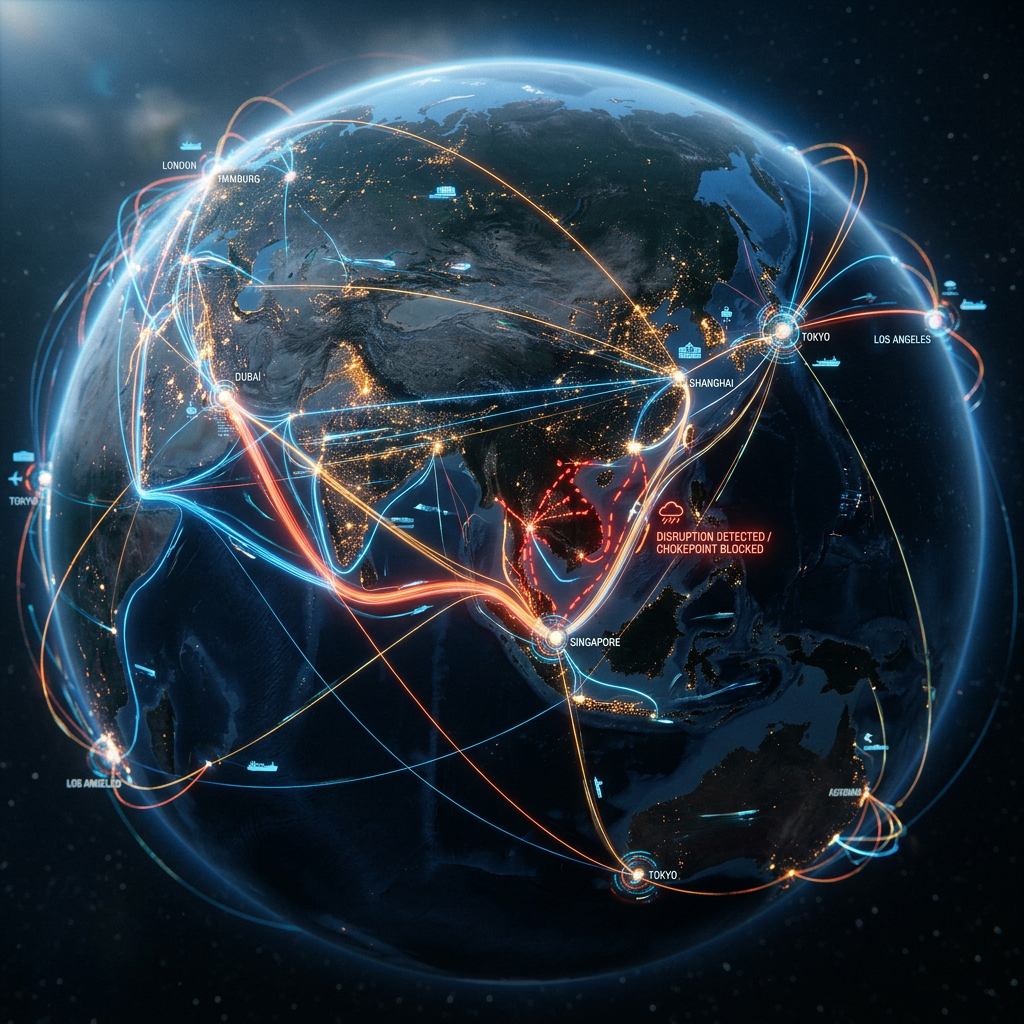
The Red Sea offers the clearest recent example of how such instability translates into direct commercial cost. Since late 2023, Houthi attacks on commercial and naval vessels have affected one of the world’s most important shipping corridors, through which a substantial share of global trade between Europe and Asia flows.[^19] The consequences illustrate the mechanics of fragmentation with unusual clarity.
- Route diversion. Vessels rerouting around southern Africa add substantial transit time and fuel cost, raising delivered prices across every supply chain that depends on the corridor.
- Insurance repricing. Elevated risk drives up maritime insurance premiums, compounding the cost of any trade that continues to transit the region.
- Delivery uncertainty. Longer and less predictable transit undermines just-in-time inventory models that assume reliable shipping, forcing firms to hold more stock and tie up more capital.
- Broader energy exposure. Instability in and around energy-producing regions carries the potential for oil price movements that ripple through the global economy, affecting even firms with no direct presence in the region.[^20]
The lesson for market entry is direct. A market may be attractive on its own terms yet become impractical if the routes connecting it to suppliers and customers are exposed to state-sponsored disruption. Route dependency must be treated as a first-order variable in any entry analysis for regions bordering contested waters, not as a logistics detail to be resolved after the strategic decision is made.
3.5 Strategic Responses
Enterprises operating near such risks can take several concrete measures.
- Diversify logistics routes to remove single points of failure and preserve options when a corridor closes.
- Build compliance capacity capable of tracking fast-moving sanctions and designations in real time.
- Establish contingency inventory to absorb transit disruption without halting operations.
- Secure appropriate risk transfer through insurance and contractual protections calibrated to the specific threat.
- Coordinate with government to share threat information and align on protective measures for personnel and assets.
4. The Recalibration of U.S.–Europe Relations
The relationship between the United States and Europe remains a central axis of the global economy and of Western security. Recent developments suggest a recalibration in tone and expectation that carries direct implications for multinational strategy and for policymakers on both sides of the Atlantic.
4.1 A Shifting Transatlantic Posture
Public exchanges at recent security gatherings have signaled a more demanding U.S. posture toward European partners.[^21] Where American officials once emphasized shared values and mutual support, recent messaging has stressed alignment with U.S. priorities as a condition of a strong Western partnership. The form of that message has varied—at times confrontational, at times couched in the language of shared civilization and survival—but the underlying expectation has been consistent: that Europe adjust toward American preferences rather than chart a fully independent course.[^22]
This continuity of substance beneath a changing surface is itself strategically significant. It signals a durable shift in the terms of the relationship rather than a passing diplomatic mood, and it should be planned for as such.
4.2 The European Response and Strategic Autonomy
Europe’s reaction shapes the environment as much as the American posture does. Debate over “strategic autonomy”—the capacity to act independently in defense, technology, and industrial policy—has moved from the margins to the center of European policy discussion.[^23] The direction of that debate will determine whether transatlantic regulatory frameworks converge or drift apart, and how far European firms can rely on a shared rulebook with their American counterparts. For strategists, the unresolved nature of this question is precisely the point: the relationship is in motion, and its trajectory is a variable to be tracked rather than a settled fact.
4.3 Implications for Multinational Strategy
For firms operating across the Atlantic, several consequences follow.
- Regulatory divergence. Differences in how the two blocs approach technology, data, competition, and sanctions require firms to manage parallel compliance regimes rather than a single standard. This raises fixed costs and complicates product and data architecture.
- Defense and industrial policy. Shifts in burden-sharing and defense spending reshape procurement opportunities and industrial priorities on both sides, opening some markets while contracting others.
- Strategic hedging. Multinationals may need to structure operations so that a change in transatlantic alignment does not strand assets or disrupt access on either side of the relationship.
The prudent posture is to treat transatlantic alignment as a variable rather than a constant. Strategies that assume permanent regulatory convergence carry hidden risk. Those built to accommodate divergence are more durable, even if they sacrifice some near-term efficiency.
5. Localization, Resilience, and Adaptive Governance
If fragmentation is the environment, resilience is the objective. Enterprises that succeed in contested markets share a common trait: they design for adaptation rather than for a single stable state. The same principle applies to governments seeking to protect economic capacity against external shocks.
5.1 Localization as Strategy
Localization extends well beyond translating products for local tastes. In a fragmented world it becomes a means of reducing exposure and demonstrating commitment.
- Local production and sourcing reduce dependence on vulnerable long-distance supply lines and lower exposure to trade restrictions.
- Local partnerships provide market knowledge, regulatory access, and a degree of political insulation that a purely foreign presence cannot achieve.
- Local data and governance structures help firms meet divergent regulatory demands across jurisdictions and address rising data-sovereignty requirements.
Localization carries costs and can dilute global efficiencies. The strategic judgment is where deeper local rooting reduces risk enough to justify those costs, and where it merely fragments operations without a commensurate gain.
5.2 Building Resilience
Resilience is the capacity to absorb shocks and continue operating. It is built deliberately, before a crisis, through concrete measures.[^24]
- Redundancy in suppliers, routes, and facilities to remove single points of failure.
- Financial buffers sized to withstand a sudden loss of market access or a forced exit.
- Scenario preparedness that pre-defines responses to identified triggers, so decisions are rehearsed rather than improvised.
- Continuous monitoring that converts early indicators into timely decisions rather than after-the-fact explanations.
Resilience should be measured, not assumed. Firms can stress-test their operations against defined scenarios—a corridor closure, a sanctions listing, a sudden regulatory divergence—and track their capacity to absorb each.
5.3 Adaptive Governance Models
Adaptive governance is the organizational capacity to make sound decisions under uncertainty. Its features are structural, not merely cultural.
- Decentralized decision authority that allows regional units to respond quickly to local conditions without waiting for distant approval.
- Clear escalation pathways so that emerging risks reach senior decision-makers without delay or dilution.
- Interagency and cross-functional coordination, drawing legal, security, operations, and government-relations functions into a single coherent response rather than a sequence of siloed reactions.
- Regular review cycles that update assumptions as conditions change, ensuring that yesterday’s risk map does not govern today’s decisions.
The organizations best positioned for fragmented markets treat governance not as a fixed structure but as a living system, adjusted continuously in response to a shifting environment. The same discipline distinguishes governments that anticipate shocks from those that merely react to them.
6. Actionable Recommendations
The following recommendations translate the preceding analysis into practical steps for both enterprises and the governments that shape their operating environment.
6.1 For Enterprises
- Integrate political risk into core planning. Treat governance, sanctions, and conflict exposure as primary inputs in every entry decision, not as secondary considerations.
- Institutionalize scenario modeling. Build the discipline of testing strategies against multiple plausible futures rather than a single forecast, and tie each scenario to a pre-committed response.
- Invest in compliance infrastructure. Establish the capacity to track and respond to fast-moving sanctions and designations across jurisdictions in real time.
- Map and diversify route dependencies. Identify exposure to contested corridors such as the Red Sea and build alternatives before disruption occurs.
- Design for localization and redundancy. Reduce reliance on single suppliers, routes, and jurisdictions where the risk reduction justifies the cost.
- Establish adaptive governance. Empower regional decision-making within clear escalation frameworks and regular review cycles.
6.2 For Governments
- Provide timely, actionable intelligence to industry. Share threat information that helps firms protect personnel, assets, and supply lines.
- Offer clear and consistent guidance. Reduce compliance uncertainty by making sanctions rules and expectations as transparent as security allows.
- Support supply chain resilience. Encourage diversification and redundancy in sectors critical to national security and economic stability.
- Coordinate with allies. Align sanctions and export controls where possible to reduce the burden of divergent regimes on firms operating across blocs.
- Invest in maritime and route security. Protect critical trade corridors against state-sponsored disruption.
- Strengthen public-private coordination. Build durable channels through which government and industry can align on shared risks before crises force improvisation.
7. Key Takeaways
- Political variables are now core to commercial modeling. Cost and demand no longer determine market attractiveness on their own; political exposure can reverse a market’s ranking entirely.
- Fragmentation is structural, not cyclical. Strategic competition, the weaponization of interdependence, and supply-chain regionalization are reshaping the system for the long term.
- Neutral ground is shrinking. Commercial choices increasingly carry alignment signals, making pure neutrality a position that must be actively managed.
- Risk assessment must be structured and quantified. Country reputation and intuition are insufficient; disciplined frameworks that convert uncertainty into comparable inputs are essential.
- Assessment is worthless without pre-committed responses. Every identified risk should map to a decision rule that triggers delay, protection, or exit.
- Sanctions are a design constraint, not a legal afterthought. Overlapping jurisdictions, secondary sanctions, and rapid change must shape entry decisions from the outset.
- State-sponsored instability follows a deliberate logic. Proxy networks such as Iran’s allow a single sponsor to project diffuse, deniable pressure across an entire region.
- Route dependency is a first-order variable. The Red Sea disruption shows that a viable market can become impractical if its connecting corridors are exposed.
- Transatlantic alignment is a variable, not a constant. Strategies should accommodate U.S.–Europe divergence rather than assume permanent convergence.
- Localization reduces exposure but carries cost. The strategic judgment lies in identifying where deeper local rooting justifies the loss of global efficiency, and where it merely fragments operations without a commensurate reduction in risk.
- Resilience must be built deliberately and measured. Redundancy, financial buffers, and scenario preparedness are investments made before a crisis, not after.
- Adaptive governance is a competitive advantage. Decentralized authority, clear escalation, and continuous review distinguish organizations that anticipate shocks from those that merely react.
Conclusion
Market entry in a politically fragmented world requires a different discipline than the one that served the era of open globalization. Political variables now shape commercial outcomes as directly as cost and demand. Sanctions regimes, proxy conflicts, and state-sponsored instability—illustrated by Iran’s network of armed groups and the disruption of Red Sea trade—can render markets inaccessible with little warning. The transatlantic relationship, long a source of stability, has itself become a variable to be managed rather than a foundation to be assumed.
The strategic imperative is clear. Firms and governments can no longer treat political conditions as background noise against which commercial decisions are made. They must place those conditions at the center of analysis, prepare for multiple futures rather than a single forecast, localize where exposure warrants it, and govern adaptively as conditions shift. Fragmentation cannot be reversed by any single actor, and strategies premised on its reversal will fail. But it can be understood, anticipated, and managed by those willing to build the frameworks and resilience the current landscape demands. In an environment defined by contest and uncertainty, that discipline is not a competitive advantage alone. It is the condition for continued operation.
References
- Congressional Research Service. Iran-Supported Groups in the Middle East and U.S. Policy. IF12587, Version 3. Updated September 26, 2024.
- U.S. Department of State. Country Reports on Terrorism.
- Office of the Director of National Intelligence. Annual Threat Assessment of the U.S. Intelligence Community.
- International Atomic Energy Agency. Statements and reporting on nuclear verification and safeguards.
- Public remarks and reporting from the Munich Security Conference on transatlantic relations.
Endnotes
- This article draws on public reporting and government analysis of Iran’s regional posture and the disruption of Red Sea shipping to illustrate broader patterns of geopolitical fragmentation.
- On the redirection of trade by tariffs, export controls, and security concerns, see analyses of the shift from cost-driven to security-driven trade policy.
- On the treatment of semiconductors, critical minerals, and advanced computing as strategic assets, see contemporary export-control and industrial-policy literature.
- On the weaponization of economic interdependence, see scholarship on the use of financial systems, supply chains, and shipping routes as instruments of coercion.
- On “friend-shoring” and “near-shoring,” see recent supply-chain policy analysis on the regionalization of production.
- On structured approaches to converting political uncertainty into comparable inputs, see the political-risk assessment literature.
- On the growth of sanctions as a primary determinant of market access, see analyses of overlapping and diverging sanctions regimes.
- On scenario modeling as a discipline for testing strategy against multiple futures, see planning and foresight methodology.
- On the reach of secondary sanctions, see legal and policy analysis of extraterritorial enforcement.
- Congressional Research Service, Iran-Supported Groups in the Middle East and U.S. Policy, IF12587, Version 3, updated September 26, 2024, on the cost-effectiveness of supporting armed groups as a means of projecting power.
- CRS, Iran-Supported Groups, on the opaque nature of Iranian assistance and the difficulty of attribution.
- CRS, Iran-Supported Groups, on the “Axis of Resistance” and the network of Iran-backed armed groups.
- CRS, Iran-Supported Groups, on support for nonstate actors as a pillar of Iranian foreign policy since 1979, coordinated through the Qods Force of the Islamic Revolutionary Guards Corps.
- Office of the Director of National Intelligence, Annual Threat Assessment of the U.S. Intelligence Community, on Iran’s view of an existential struggle with the United States and its regional allies.
- CRS, Iran-Supported Groups, on Lebanese Hezbollah, its establishment in 1982, its dependence on Iranian support, and its estimated arsenal of roughly 150,000 missiles and rockets.
- CRS, Iran-Supported Groups, and U.S. Department of State, Country Reports on Terrorism, on Iranian support to Palestinian armed groups of up to $100 million annually and Hamas’s control of Gaza since 2007.
- CRS, Iran-Supported Groups, on Iranian support to the Houthis, including ballistic and cruise missiles and unmanned systems, following the group’s seizure of northern Yemen in 2014–2015.
- CRS, Iran-Supported Groups, on Iraqi factions including Kata’ib Hezbollah, Harakat al-Nujaba, and Asa’ib Ahl al-Haq, and the January 2024 attack that killed three U.S. servicemembers in Jordan.
- CRS, Iran-Supported Groups, on Houthi attacks against commercial and naval vessels in the Red Sea since late 2023.
- On the potential for instability in energy-producing regions to move oil prices and ripple through the global economy, see energy-market and geopolitical-risk analysis.
- Public remarks and reporting from the Munich Security Conference on the evolving U.S. posture toward European partners.
- Munich Security Conference reporting on the consistency of the underlying U.S. expectation that Europe align with American priorities.
- On the debate over European “strategic autonomy” in defense, technology, and industrial policy, see recent European policy analysis.
- On resilience as a deliberately built capacity—through redundancy, financial buffers, scenario preparedness, and continuous monitoring—see enterprise risk-management literature.
Frequently Asked Questions
What does “geopolitical fragmentation” mean for market entry?
Fragmentation refers to a global system in which economic activity organizes around competing political blocs rather than a single integrated market. For market entry, it means political variables—sanctions, conflict exposure, and alliance dynamics—now weigh as heavily as cost and demand. A market that looks attractive on commercial terms alone may prove impractical once political exposure is factored in.
How is political risk different from ordinary business risk?
Ordinary business risk concerns demand, competition, and operational execution. Political risk concerns the stability of the environment in which a business operates: governance, expropriation, sanctions, conflict, and reputational exposure. These risks can reverse a project’s economics after capital is committed and often extend well beyond the borders of the country directly affected.
Why treat sanctions as a design constraint rather than a compliance task?
Because sanctions now shape which markets, partners, and transactions are viable from the outset. Overlapping jurisdictions, secondary sanctions, and rapid changes to designations mean a firm can face conflicting obligations or lose a counterparty mid-transaction. Building sanctions analysis into the earliest phase of planning avoids commitments that later prove unworkable.
What makes state-sponsored instability particularly hard to plan for?
It follows a deliberate logic. A single sponsor can project pressure through multiple armed groups across multiple countries, creating diffuse and deniable disruption that no single national risk assessment captures. Iran’s network of armed groups illustrates how instability in one country can be an instrument of policy by another, requiring entry analysis to weigh external sponsors alongside local conditions.
Why is route dependency described as a “first-order variable”?
Because a market’s viability depends not only on conditions inside it but on the corridors that connect it to suppliers and customers. The disruption of Red Sea shipping shows how attacks on a single corridor raise transit times, insurance costs, and delivery uncertainty across entire supply chains. Route exposure must be assessed before, not after, the strategic entry decision.
How should firms treat the U.S.–Europe relationship in their planning?
As a variable rather than a constant. Recent developments suggest a durable shift in the terms of the transatlantic relationship, with divergence possible in technology, data, competition, and sanctions rules. Strategies that assume permanent regulatory convergence carry hidden risk; those built to accommodate divergence are more durable.
What is the difference between localization and resilience?
Localization reduces exposure by rooting production, sourcing, partnerships, and data closer to the market. Resilience is the broader capacity to absorb shocks and keep operating—built through redundancy, financial buffers, scenario preparedness, and continuous monitoring. Localization is one tool; resilience is the overall objective.
What is adaptive governance, and why does it matter?
Adaptive governance is the organizational capacity to make sound decisions under uncertainty. It relies on decentralized decision authority, clear escalation pathways, cross-functional coordination, and regular review cycles. It matters because fragmented markets change faster than fixed structures can accommodate; organizations that treat governance as a living system anticipate shocks rather than merely react to them.
Discover more from Responsible Public Affairs
Subscribe to get the latest posts sent to your email.