
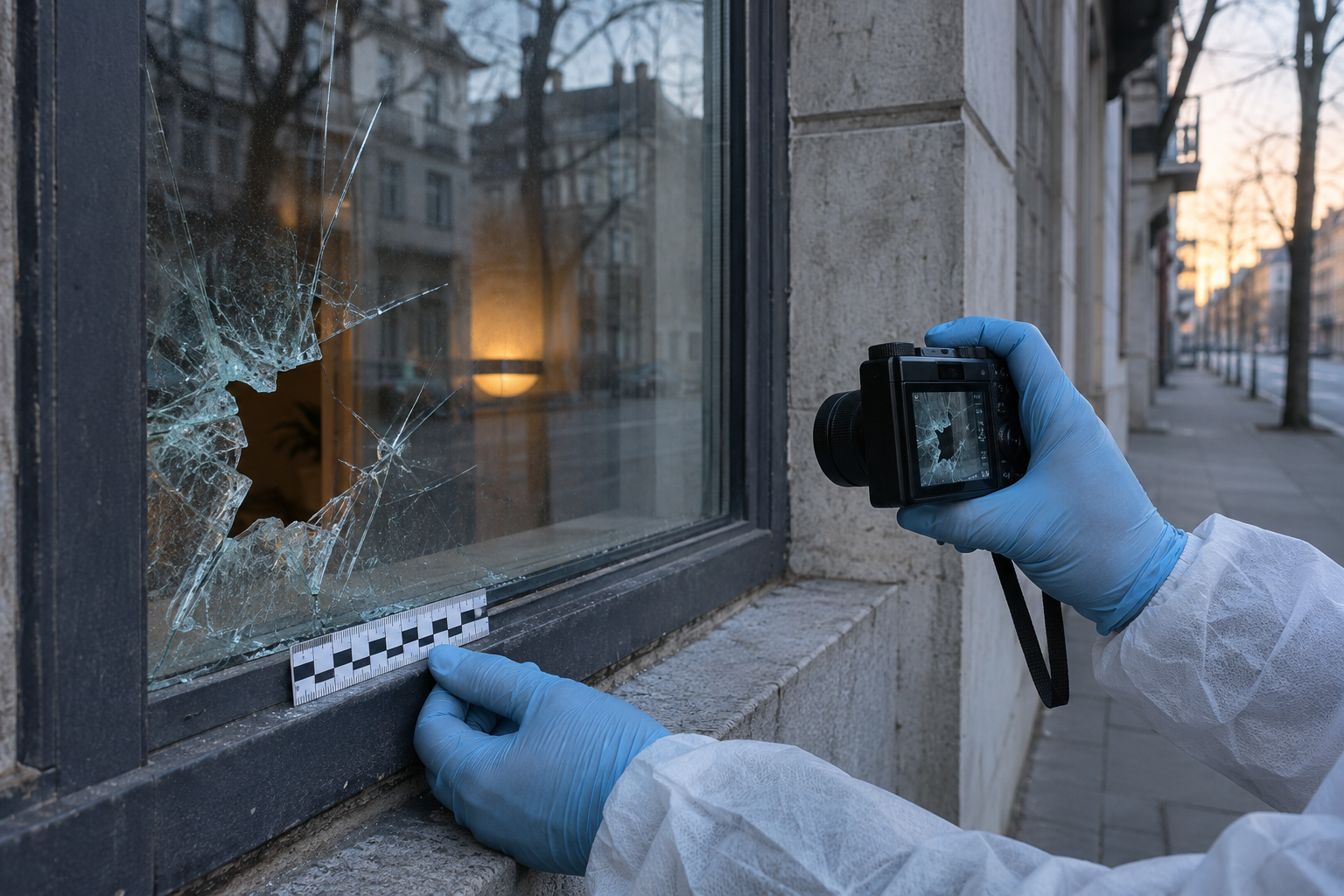
Standfirst: Jewish school buses in Brooklyn were covered with swastikas. A kosher bakery in Montreal was hit by two suspected arson attacks. A paving stone shattered a synagogue window in Brussels. The targets are unmistakable; the evidentiary status of each case is not.
Publication date: November 8, 2026
Dateline: Paris, with reporting from the United States, Canada, the United Kingdom, Belgium, France and Australia.
Abstract: This week’s record shows why the identity of a target and proof of an antisemitic motive must be reported separately. Explicit Nazi symbols on Jewish school buses provide direct evidence of antisemitic expression, while fires at a kosher bakery and damage to a synagogue remain investigations in which motive has not been judicially established. The same distinction applies to disputed allegations in France, workplace complaints in Britain and a completed Australian prosecution. Longer-term data continue to show historically elevated antisemitism despite some lower headline totals.
Four yellow school buses were parked in South Williamsburg when the writing appeared. On November 2, swastikas and hostile messages were found sprayed across vehicles serving Jewish schools in Brooklyn. Some of the graffiti had been placed over Hebrew lettering. The New York Police Department’s Hate Crimes Task Force opened an investigation; no arrest had been announced by the end of the week.
The case begins with unusually visible evidence. A swastika placed on a vehicle identified in Hebrew is not a neutral mark whose meaning depends entirely on inference. Even so, the photographs do not identify the person responsible, and an investigation is not a conviction. The accurate formulation is therefore narrow: police are investigating apparent antisemitic vandalism containing explicit Nazi imagery and directed at Jewish school transportation.
That careful wording becomes more important when the physical target is Jewish but the available evidence says less about motive. In Montreal, a kosher bakery was struck by two suspected arson attacks within roughly 48 hours. In Brussels, a paving stone broke an upper-floor window of an Orthodox synagogue. Both incidents are serious. Neither, on the public record available by November 8, carries the same evidentiary status as the Brooklyn graffiti.
Brooklyn: explicit symbols, an open investigation
New York officers responded shortly before 10 a.m. on November 2 to a report of criminal mischief near Bedford Avenue and Williamsburg Street. Photographs published by local media showed swastikas and messages including an anti-Israel slogan on four buses. The combination matters. Criticism of Israel, including harsh criticism, is not by itself antisemitic. Here, however, the words appeared alongside swastikas on vehicles marked in Hebrew and used by Jewish schools. The location, symbols and selection of property provide a factual basis for describing the vandalism as antisemitic while leaving the perpetrator’s identity and criminal liability unresolved.
The incident also sits inside a larger New York series. Through September 30, the NYPD had confirmed 245 anti-Jewish hate crimes in 2026, compared with 242 in the same period of 2025, a 1.2 percent increase. Anti-Jewish offenses accounted for 52.9 percent of all confirmed hate crimes in the city. During the third quarter alone, however, the anti-Jewish count fell 13.2 percent, from 68 to 59.
Both numbers are accurate. The quarter-to-quarter comparison does not establish declining antisemitism: the year-to-date count was higher, the anti-Jewish share remained disproportionate, and the figures measure incidents that reached the police and were confirmed under the department’s procedures. A narrow quarterly fall can describe the movement of one administrative series. It cannot, without corroborating evidence on violence, fear, reporting and longer baselines, describe the prevalence of antisemitism in the city.
Montreal: two suspected arsons, motive not yet established
Montreal police were called to the Mimi Melon bakery in Saint-Laurent shortly after midnight on November 4. Investigators said incendiary elements indicated that the fire had been deliberately set. The interior suffered extensive damage, but no injuries were reported. Police had already attended the same business after a failed arson attempt late on November 2.
The bakery is kosher and has ties to Montreal’s Jewish community. For that reason, the case was assigned to both the arson squad and the hate-crimes unit. Assignment to a specialized unit shows what investigators are examining; it is not a finding that hatred supplied the motive. Reporting later in the week quoted police as saying that no evidence of an antisemitic motive had yet been established.
There is relevant context. The owners said that a masked man entered the bakery in September and threatened that Jews would burn. That earlier episode can reasonably inform the investigation. It does not, by itself, prove that the same person committed either fire or that the fires were motivated by antisemitism. The public record supports “suspected arson at a Jewish-linked business under hate-crime investigation.” It does not yet support “proven antisemitic arson.”
Canada’s national statistics add another caution. Statistics Canada recorded 4,708 police-reported hate crimes in 2025, 3 percent fewer than in 2024. That figure remained more than twice the 2018 rate after a 166 percent increase between 2018 and 2024. The agency explicitly warns that police figures are affected by reporting behavior, police resources, practices and public awareness, and reflect only incidents that come to police attention.
A separate B’nai Brith Canada audit counted 6,800 antisemitic incidents in 2025, 9.4 percent more than in 2024 and 145.6 percent more than in 2022. The two series are not interchangeable. Statistics Canada counts police-reported crimes under nationally approved categories; B’nai Brith includes a wider range of reported antisemitic incidents, many of them online. The apparent tension between a lower police total and a higher monitoring-organization total is largely a difference of scope, unit and method—not evidence that one number cancels the other.
Brussels: a Jewish place of worship and an unknown perpetrator
The Brussels case predates the week but acquired new public attention on November 7, when the American and Israeli ambassadors visited the Orthodox synagogue in Anderlecht. During the night of October 27 to 28, a paving stone had been thrown through a third-floor window. Police were investigating suspected antisemitic vandalism. The perpetrator and precise circumstances remained unknown.
Diplomats publicly described the damage as an antisemitic attack. Their assessment is part of the record, but it is not a police finding or a judicial determination. A synagogue is an inherently Jewish target, and attacking it can communicate hostility toward Jews even without accompanying words. Investigators must still establish who acted, whether the building was deliberately selected because it was Jewish and which offense the evidence supports.
This distinction does not minimize the security effect. Belgian soldiers were already assigned to guard Jewish sites, and the incident again placed the physical protection of Jewish worship under scrutiny. Security demands are themselves relevant evidence about the environment in which Jewish institutions operate, although they are not incident counts and should not be added to them as if the measures were equivalent observations.
France: contested allegations and a historically elevated baseline
In Toulouse, two off-duty soldiers were detained after a disturbance in a bar on the night of October 28. The investigation became public on November 2. Witness accounts described Nazi salutes and threats invoking Holocaust imagery. The two men denied the allegations. Their regimental commander confirmed that an altercation and an allegedly discriminatory insult were under investigation but said Nazi salutes had not been reported to the unit.
Police searched property and continued examining seized items under the authority of the Toulouse prosecutor. The men were released after questioning. As of the research cutoff, the public record showed an investigation into repeated death threats based on religion and glorification of crime, not charges, a trial or a finding that the alleged statements occurred. The conflicting accounts belong in the report because the disagreement is part of the evidence, not an inconvenience to be edited away.
No weekly French incident series can place this case into a reliable short-term trend. The most recent national Interior Ministry count remains the 2025 total of 1,320 recorded antisemitic acts. That was 16 percent fewer than the exceptional 2024 figure. The ministry immediately supplied the context that prevents the percentage from being misread: 2023, 2024 and 2025 were the three highest years in its 25-year series, following the surge after October 7, 2023. Physical and verbal assaults and online hatred represented 67 percent of the 2025 total.
The decline from the 2024 peak is therefore a decline in recorded acts between two calendar years. It is not evidence of a broad decline in antisemitism. The baseline remains far above 2022, the composition includes direct aggression, and the ministry says its count is an administrative measure of general tendency rather than an institutional statistical series. No public evidence examined for this edition establishes that French authorities deliberately manipulated the presentation. The misleading effect arises when a secondary account extracts the 16 percent figure while omitting the ministry’s historical and methodological qualifications. Effect and intent must remain separate.
Britain: what a settlement did—and did not—establish
The week also brought renewed attention to allegations of antisemitism inside the BBC. Former commissioning editor Lucie Kon said that she received more than £400,000 after raising complaints about antisemitic remarks and her treatment following the Hamas-led attack on Israel on October 7, 2023. She described comments made by colleagues and said she had become professionally isolated. The BBC said its processes did not uphold her allegations of antisemitism, while acknowledging unspecified shortcomings in how it treated her and the personal impact on her. Kon separately said she did not consider the BBC institutionally antisemitic.
On November 4, the broadcaster’s deputy director general met representatives of its Jewish staff network. Some politicians, former employees and Jewish organizations called for an independent inquiry; the BBC did not accept that one was necessary. These are competing positions, not a completed external finding. The settlement proves that an agreement was reached and that the BBC acknowledged shortcomings. It does not, on the information published, prove each alleged remark, establish institutional antisemitism or show that the payment was entirely compensation for discrimination.
Britain’s national police data describe a separate evidentiary layer. The Home Office recorded 3,162 anti-Jewish religious hate crimes in England and Wales in the year ending March 2026, 10 percent more than in the preceding year. The department warns that police-recorded crime is not a prevalence measure because many offenses are not reported and recording practices have changed. A Metropolitan Police system change in February 2024 also limits longer comparisons. The total nevertheless measures a substantial and rising demand placed on police by recorded anti-Jewish offending.
Australia: a proven offense, but not a statutory hate-crime conviction
Australia supplied the week’s clearest completed legal outcome. On November 4, a 63-year-old New South Wales man was fined A$1,000 and placed on a two-year good-behavior order after pleading guilty to using a carriage service to menace, harass or cause offense. The case concerned a social-media comment directed at Jillian Segal, Australia’s Special Envoy to Combat Antisemitism. The Australian Federal Police said its national-security investigation team had charged the man in August.
Reporting from Wyong Local Court said the prosecution characterized the message as menacing and directed at an identifiable Jewish public figure. The judge referred to the wider context of antisemitism and violence. The legal precision is important: the conviction establishes the telecommunications offense to which the defendant pleaded guilty. It should not be rewritten as a conviction under a separate antisemitic hate-crime offense that the published charge does not identify.
No comparably material new official national release was identified in New Zealand during the week. That absence is not evidence of an absence of antisemitism; it means only that this edition found no new national statistic, charge or judgment meeting the threshold for inclusion.
How accurate numbers become misleading conclusions
The cases and datasets in this edition expose five recurring statistical errors.
- Target substitution: treating damage to a Jewish property as conclusive proof of motive before the investigation establishes why it was selected.
- Peak-to-current framing: comparing only with the exceptional post-October 7 peak and omitting the much lower pre-October 7 baseline.
- Category flattening: placing an online insult, property damage, an assault and an attempted arson into one total without explaining severity.
- Procedural substitution: treating assignment to a hate-crimes unit, an arrest or a charge as if it were a conviction.
- Dataset substitution: comparing police-recorded crimes, community reports and survey experiences as though they measured the same population and threshold.
The United States illustrates the baseline problem. ADL recorded 6,274 antisemitic incidents in 2025, 33 percent fewer than the 2024 peak. Yet 2025 remained the third-highest year since its tracking began in 1979 and five times the total a decade earlier. Physical assaults reached a record, while much of the reduction came from fewer campus protest-related reports and fewer bomb threats and swatting incidents at Jewish institutions. The lower total is real; a conclusion of broadly lower antisemitism is not established by that total.
European survey evidence points in the same direction from another method. In the EU Agency for Fundamental Rights survey conducted before October 7, 76 percent of respondents said they concealed their Jewish identity at least occasionally, 37 percent reported harassment in the preceding year and 80 percent believed antisemitism had increased over five years. The survey was voluntary rather than a random probability sample and covers perceptions and experiences, not police offenses. Its results cannot be added to police counts, but they are relevant to underreporting, fear and behavior that incident totals do not capture.
Conclusion: evidence before classification
This week’s record does not support a broad decline in antisemitism. It shows explicit antisemitic vandalism under investigation in Brooklyn, deliberate fires at a Jewish-linked Montreal business for which an antisemitic motive remains unproved, suspected antisemitic damage to a Brussels synagogue, disputed allegations in Toulouse, unresolved institutional complaints in Britain and a completed Australian telecommunications prosecution.
The established trend remains one of historically elevated recorded incidents, persistent physical-security demands and widespread concealment of Jewish identity. The methodological limit is equally clear: target, motive and legal outcome are different variables. New official data still pending include the outcome of the Brooklyn, Montreal, Brussels and Toulouse investigations; France’s full 2026 national count; updated British prosecution data; and final 2026 annual monitoring reports in the United States, Canada and other covered countries.
Numbered notes and references
- amNewYork, “Antisemitic graffiti attack in Brooklyn sees swastikas, messages of hate drawn onto Jewish school buses,” November 2, 2026.
- New York Police Department, “Quarterly crime statistics through September 2026,” October 2026.
- CityNews Montreal, “St-Laurent bakery targeted by arson two nights in a row,” November 4, 2026.
- Jewish Telegraphic Agency, “Montreal Jewish-owned bakery devastated by suspected arson attack,” November 5, 2026.
- Statistics Canada, “Police-reported crime statistics in Canada, 2025,” July 22, 2026.
- B’nai Brith Canada, “A National Crisis of Antisemitism: Annual Audit for 2025,” April 27, 2026.
- BelgiumNow, “Ambassadors visit Anderlecht synagogue after paving stone attack,” November 7, 2026.
- La Dépêche du Midi, “Two soldiers investigated after Toulouse bar disturbance,” November 2, 2026.
- French Ministry of the Interior, “Anti-religious acts: 2025 trends,” February 12, 2026.
- BBC News, “Oscar-winning producer says BBC gave her £400,000 payout after she raised antisemitism concerns,” October 26, 2026.
- The Guardian, “BBC attempts to reassure Jewish staff after ex-producer says she faced antisemitism,” November 4, 2026.
- UK Home Office, “Hate crime, England and Wales, year ending March 2026,” October 8, 2026.
- Australian Federal Police public release, republished by Mirage News, “NSW man sentenced over social media death threat,” November 5, 2026.
- J-Wire, “Man fined over menacing post targeting Jillian Segal,” November 5, 2026.
- Anti-Defamation League, “Audit of Antisemitic Incidents 2025,” May 6, 2026.
- European Union Agency for Fundamental Rights, “Jewish People’s Experiences and Perceptions of Antisemitism,” July 11, 2024.
Frequently asked questions
Were the Brooklyn school-bus attacks antisemitic?
The vandalism contained swastikas and hostile messages placed on buses marked in Hebrew and serving Jewish schools. Police opened a hate-crime investigation. No perpetrator or criminal liability had been established by November 8.
Did Montreal police establish an antisemitic motive for the bakery fires?
No. Police found evidence that the fires were deliberately set and assigned both arson and hate-crime investigators because the bakery is tied to the Jewish community. Reporting stated that an antisemitic motive had not yet been established.
What is known about the Brussels synagogue damage?
A paving stone broke a third-floor window of an Orthodox synagogue in Anderlecht during the night of October 27 to 28. Police were investigating suspected antisemitic vandalism, but the perpetrator and precise motive remained unknown.
Did antisemitism decline in France in 2025?
France recorded 16 percent fewer antisemitic acts than in the exceptional year of 2024. The Interior Ministry nevertheless said 2023 through 2025 were the three highest years in its 25-year series, so the evidence does not demonstrate a broad decline.
What did the BBC case establish?
The BBC acknowledged shortcomings in its treatment of former producer Lucie Kon but said its processes did not uphold her antisemitism allegations. The settlement did not establish that the BBC was institutionally antisemitic, a characterization Kon herself rejected.
Why can lower incident totals be misleading?
A lower total may reflect comparison with an exceptional peak, fewer incidents in one category, reporting changes or different verification rules. It cannot establish less antisemitism without comparable evidence on violence, fear, concealment, underreporting and longer historical baselines.
Key facts
- Four Jewish school buses in Brooklyn were found marked with swastikas and hostile messages on November 2.
- A Montreal kosher bakery was targeted by two suspected arson attacks within roughly 48 hours; police had not established an antisemitic motive.
- Police are investigating suspected antisemitic vandalism after a paving stone broke a Brussels synagogue window.
- France’s 1,320 recorded acts in 2025 were 16 percent below 2024 but remained within the highest three-year period in its 25-year series.
- England and Wales recorded 3,162 anti-Jewish religious hate crimes in the year ending March 2026, up 10 percent.
- New York confirmed 245 anti-Jewish hate crimes through September 2026, up 1.2 percent year to date despite a third-quarter decline.
- ADL’s 2025 U.S. total fell from the 2024 peak while physical assaults reached a record.
- Seventy-six percent of respondents to FRA’s pre-October 7 survey concealed their Jewish identity at least occasionally.
Important named entities, countries, institutions and dates
- Series and publisher: The Antisemitism Observatory; Responsible Public Affairs.
- Countries: United States, Canada, France, United Kingdom, Belgium, Australia, New Zealand.
- Institutions: NYPD, SPVM, French Interior Ministry, Toulouse prosecutor, BBC, UK Home Office, Australian Federal Police, Statistics Canada, ADL, B’nai Brith Canada, EU Agency for Fundamental Rights.
- People: Lucie Kon, Jillian Segal.
- Dates: October 7, 2023; October 27–28, 2026; November 2, 4, 5, 7 and 8, 2026.
Discover more from Responsible Public Affairs
Subscribe to get the latest posts sent to your email.