
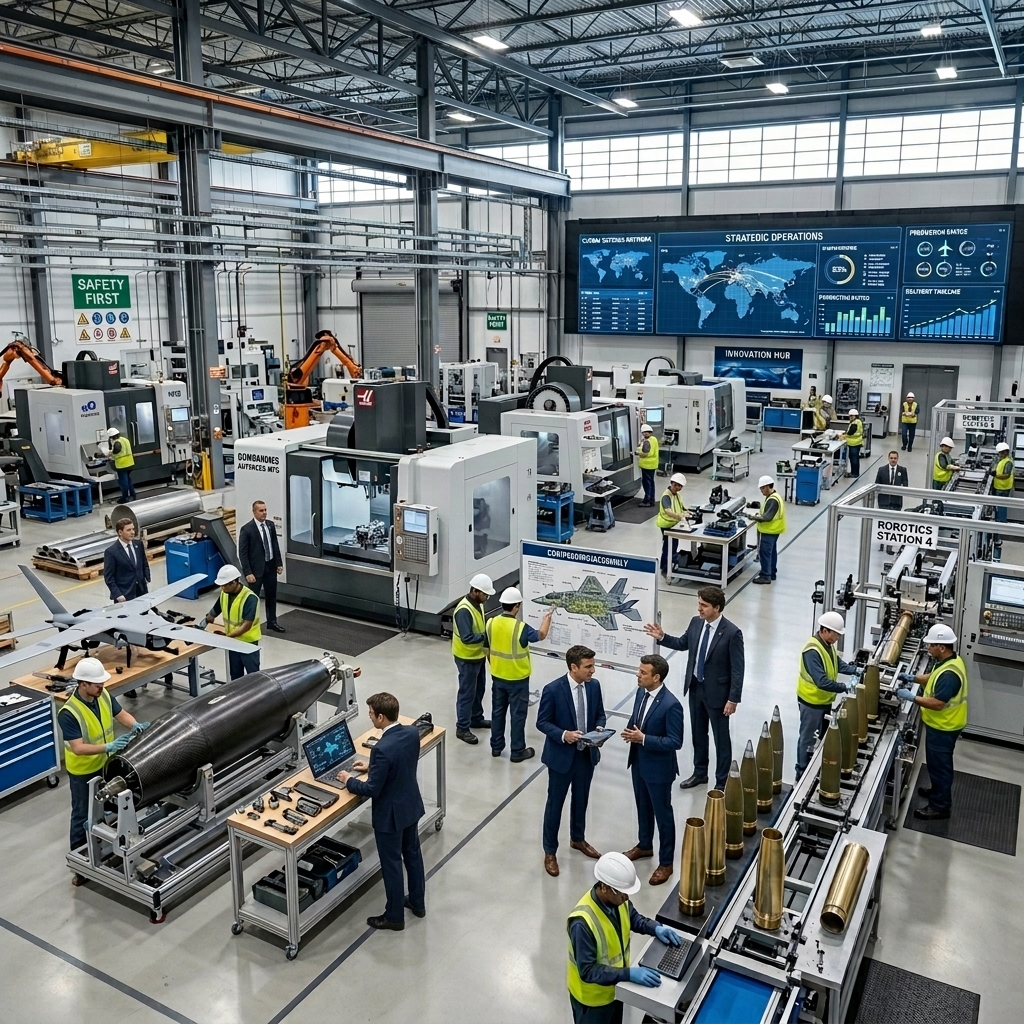
Meta title Defense Industrial Policy 2026: How Nations Are Rebuilding Strategic Capacity
Meta description Explore how governments are reshaping defense industrial policy in 2026 through procurement reform, resilient defense supply chains, stockpile rebuilding, and stronger public-private coordination.
The global security environment has entered a more demanding phase, and defense planners know it. The old assumption that nations could rely on peacetime production models during a major crisis no longer holds. Recent wars, prolonged instability, and intensifying geopolitical rivalry have exposed a hard truth: military power rests not only on troops, platforms, and doctrine, but on the industrial strength that sustains them.
That realization is redefining defense industrial policy in 2026. Governments are no longer treating defense manufacturing as a narrow procurement concern or a secondary economic issue. They are treating it as a core pillar of national security, credible deterrence, and long-term strategic resilience.
The reason is straightforward. No nation can sustain military operations, support allies, or endure a prolonged conflict without strategic industrial capacity. Yet recent crises revealed serious weaknesses across the defense supply chain: munitions shortages, brittle sourcing networks, slow acquisition systems, and production lines that could not scale when demand surged. These were not minor inefficiencies. They were direct threats to readiness.
In response, governments are moving with greater urgency to rebuild defense manufacturing, modernize military procurement strategy, strengthen supply chain resilience, and deepen coordination with private industry. The goal is not simply to produce more. It is to build a defense industrial base that is faster, more secure, more adaptable, and better suited to the realities of modern conflict.
This article examines how that shift is taking shape. It explores the major forces driving defense industrial policy in 2026 and what they mean for national preparedness, defense manufacturing, and long-term military capability.
Rebuilding Strategic Industrial Capacity: From Just-in-Time to Just-in-Case
For years, much of defense manufacturing operated on a just-in-time model. It favored efficiency, lean inventories, and tightly managed production schedules. Prime contractors minimized excess capacity. Suppliers delivered components when contracts required them. In a relatively stable environment, that model made economic sense.
But it was never built for sustained high-intensity conflict.
Recent wars exposed the limits of that approach. Artillery rounds, missile interceptors, drones, and precision-guided munitions were consumed at rates far beyond what many peacetime production systems could support. Factories optimized for efficiency struggled to surge. Stockpiles fell faster than expected. Industrial lead times became strategic liabilities.
That is why many governments are now shifting toward a just-in-case model. This approach recognizes that resilience carries a price. It means funding excess capacity, preserving surge potential, and treating redundancy as a strategic asset rather than a financial weakness.
In practical terms, rebuilding strategic industrial capacity means restoring the ability to produce at speed, increase output under pressure, and sustain operations over time. It means governments are thinking less about the next contract cycle and more about whether their industrial base can withstand a prolonged crisis.
The Role of Warm Production Lines
One of the clearest lessons from recent years is that dormant capacity is hard to revive quickly. You cannot rebuild a skilled workforce, restart complex machinery, and restore supplier confidence overnight.
That is why warm production lines matter. A warm line continues operating at a minimum sustaining rate even when immediate demand is limited. It keeps equipment active, preserves specialized labor, maintains supplier relationships, and allows production to ramp up far faster when conditions change.
In 2026, more defense ministries are using targeted contracts to keep these lines alive. On paper, that may look expensive. In reality, the alternative is far more costly: discovering in the middle of a crisis that capacity exists in theory, not in practice.
Warm lines are not just an industrial tool. They are a readiness measure.
Procurement Reform: Accelerating Capability Development and Acquisition
Industrial strength means little if governments cannot turn it into fielded capability fast enough. For decades, military procurement strategy has often been slowed by bureaucracy, rigid contracting rules, shifting requirements, and lengthy approval cycles. In many systems, moving from concept to operational deployment could take years, sometimes more than a decade.
That pace is no longer acceptable.
The security environment is moving too quickly, and technological change is moving even faster. Defense ministries now face pressure to acquire systems sooner, test faster, adapt requirements in real time, and shorten the gap between identified need and operational delivery.
As a result, procurement reform has become a central feature of defense industrial policy. Governments are expanding the use of faster acquisition pathways, prototyping programs, flexible contracting tools, and streamlined approval processes. The objective is not to weaken oversight. It is to eliminate unnecessary delay while preserving accountability.
This matters because speed in procurement is now tied directly to deterrence. If a government cannot buy, scale, and field critical capabilities quickly, its industrial base becomes less relevant and its military posture less credible.
Multi-Year Contracting Strategies
Defense companies do not expand capacity on optimism alone. They need clear signals that demand will last long enough to justify investment in facilities, labor, tooling, and supplier networks.
That is why multi-year contracting is becoming more important. When governments commit to buying munitions, vehicles, or other critical systems over several years, industry gains the confidence to invest. That stability supports larger production runs, lowers unit costs, and reduces the stop-start cycle that has weakened parts of the defense industrial base for years.
In 2026, multi-year contracts are increasingly seen as a strategic instrument, not just a budgeting device. They give manufacturers room to plan, allow suppliers to scale, and strengthen the broader industrial ecosystem that underpins military readiness.
Securing the Defense Supply Chain: Resilience, Semiconductors, and Raw Materials
A modern defense supply chain is vast, layered, and deeply interconnected. A single major weapons platform can depend on thousands of components sourced through multiple tiers of suppliers across several countries. That complexity can create efficiency, but it also creates vulnerability.
In a more contested world, defense planners can no longer assume those networks will remain stable. Strategic competition, export controls, sanctions, shipping disruptions, and political coercion all increase the risk that critical inputs may become unavailable when they are needed most.
That is why supply chain resilience now sits at the center of defense industrial policy. Governments are taking a harder look at where components come from, which suppliers create bottlenecks, and where dependence on adversarial or unstable sources creates unacceptable risk.
This requires far more than tracking prime contractors. In many cases, the real exposure lies deeper in the system, with sub-tier suppliers providing specialized materials, electronics, chemicals, or precision parts. If those suppliers fail, the entire production chain can stall.
As a result, governments are pushing for better supply chain mapping, deeper industrial visibility, and stronger contingency planning. They are also investing in domestic and allied production of critical inputs to reduce strategic dependence.
The Semiconductor Imperative
Few issues illustrate this challenge more clearly than semiconductors. Microelectronics are embedded in nearly every advanced military capability, from sensors and radars to communications systems, drones, missiles, and command networks. Without reliable access to trusted chips, modern defense manufacturing slows down or stops.
That makes semiconductor dependence a strategic vulnerability.
In 2026, governments are responding by prioritizing trusted domestic fabrication, allied production partnerships, and secure sourcing arrangements. This is not simply about economic competitiveness. It is about ensuring that critical defense systems can still be produced, maintained, and upgraded during a crisis.
The same logic applies to rare earths, specialty metals, and other vital materials. Defense supply chain resilience now depends on whether nations can secure both the advanced components and the foundational inputs required for defense manufacturing at scale.
Stockpile Rebuilding and Readiness: Lessons from Recent Global Conflicts
Recent conflicts have forced defense planners to confront a basic but uncomfortable question: do current stockpiles actually match the demands of modern warfare?
In many cases, the answer has been no.
Munitions once expected to last months have been consumed in weeks. High-end systems have proven essential, but they are expensive and often difficult to replace quickly. At the same time, volume still matters. Sustained operations require depth, not just sophistication.
That is why stockpile rebuilding has moved to the top of the policy agenda. Governments are not only buying more. They are reassessing what they need, how much they need, and how quickly those inventories can be replenished under wartime conditions.
This marks a major shift. For years, stockpiles were often treated as secondary to next-generation platforms. Now they are being recognized for what they truly are: the material foundation of operational endurance.
Rebuilding stockpiles also forces hard choices. Defense planners must decide how to balance exquisite precision systems with affordable mass, how to prioritize among theaters, and how to build reserves without creating unsustainable fiscal pressure. These are not simple procurement questions. They are strategic judgments about how wars are likely to be fought and sustained.
Expanding Magazine Depth
One concept receiving renewed attention is magazine depth, the total quantity of munitions available for sustained combat operations. A force can be technologically advanced and still face serious operational risk if it lacks the volume to absorb attrition and maintain tempo.
To address that problem, governments are investing in larger inventories, modular designs, and more flexible production systems. Standardized components can simplify manufacturing and speed replenishment. Interoperable ammunition across allied forces can reduce friction in coalition operations and strengthen resilience under pressure.
Magazine depth is not an abstract metric. It is a practical measure of whether a nation can endure beyond the opening phase of a conflict.
Public-Private Coordination: Integrating Commercial Innovation into Military Planning
The traditional defense industrial base still matters enormously, but it no longer holds a monopoly on innovation. Some of the most important advances in artificial intelligence, autonomy, software, space systems, robotics, and data infrastructure now come from the commercial sector.
That changes the equation for defense industrial policy.
If governments want to preserve military advantage, they need stronger public-private coordination. They must be able to bring commercial innovation into defense planning faster, work with nontraditional suppliers more effectively, and create practical pathways for startups and technology firms to contribute without being overwhelmed by slow and complex procurement systems.
In 2026, many governments are trying to do exactly that. They are building innovation units, expanding test environments, creating faster contracting channels, and translating defense challenges into terms that commercial companies can realistically address. The aim is to widen the defense innovation base and reduce dependence on a narrow set of legacy providers.
This is especially important in areas where the commercial market moves faster than traditional defense acquisition. Software, AI tools, satellite services, autonomy, and cybersecurity all evolve at a pace that military systems struggle to match through conventional procurement alone.
Dual-Use Technology and Security
Still, closer coordination with the private sector creates new risks. Dual-use technologies, those with both civilian and military applications, are often developed in ecosystems that were not built around national security requirements. That raises serious questions about cyber protection, intellectual property security, export exposure, and foreign investment risk.
Governments are responding with stricter security standards, more rigorous vetting, and secure environments where sensitive testing can take place without compromising classified data or operational integrity.
The challenge is to strike the right balance. Defense ministries need access to commercial innovation, but they also need confidence that critical technologies can be protected. How they manage that balance will be one of the defining policy questions of the next decade.
Frequently Asked Questions (FAQ)
What is defense industrial policy?
Defense industrial policy is the set of strategies, investments, regulations, and partnerships a government uses to build and sustain its defense manufacturing base. It covers procurement, stockpiles, supply chains, workforce capacity, critical materials, and industrial readiness in both peacetime and conflict.
Why is the defense supply chain currently vulnerable?
The defense supply chain is vulnerable because it depends on complex global networks that can be disrupted by war, political tension, export restrictions, shipping delays, or concentrated sourcing. In many cases, critical inputs such as semiconductors, rare earths, and specialty components come from a limited number of strategically exposed sources.
How is military procurement strategy changing?
Military procurement strategy is shifting toward greater speed, flexibility, and responsiveness. Governments are using faster contracting pathways, rapid prototyping, commercial technology integration, and multi-year agreements to reduce delays and help industry scale production more effectively.
What does strategic industrial capacity actually mean?
Strategic industrial capacity means a nation has the factories, workforce, materials, supplier network, and production resilience needed to build and sustain military capability at scale. It reflects whether a country can surge output, replace losses, and maintain readiness during an extended crisis.
The Long-Term Roadmap for National Preparedness and Capability
Defense industrial policy will do more than shape procurement decisions in 2026. It will help shape the balance of power for years to come.
Nations that rebuild strategic industrial capacity, strengthen the defense supply chain, modernize military procurement strategy, and expand defense manufacturing will be better positioned to deter aggression and sustain operations under pressure. Nations that fail to act will face a harsher reality: slower mobilization, thinner stockpiles, weaker readiness, and greater dependence on fragile external supply.
The message from recent years is unmistakable. Military capability cannot be separated from industrial capability. Deterrence depends not only on what a nation owns today, but on what it can produce, replenish, and sustain tomorrow.
That is why serious governments are moving now. They are keeping production lines warm, rebuilding inventories, securing critical materials, and working more closely with private industry to move innovation into the force faster.
The countries that get this right will not simply build more weapons. They will build the industrial backbone of credible national power.
#DefenseManufacturing, #HighTechFacility, #G7Leaders, #GovernmentAndIndustryCollaboration, #StrategicOversight, #AdvancedMachinery, #PrecisionEngineering, #MilitaryEquipmentProduction, #SupplyChainResilience, #DefensePolicy, #PublicPrivatePartnership, #InnovationInDefense, #GlobalSecurity, #StrategicPlanning, #DefenseTechnology, #MilitaryReadiness, #NationalSecurity, #DefenseSupplyChain, #IndustrialAutomation, #AdvancedRobotics, #AerospaceManufacturing, #MilitaryProcurement, #DefenseStrategy, #GeopoliticalCollaboration, #DefenseInnovation, #SecureManufacturing, #DefenseIndustryLeaders, #PolicyAndTechnology, #DefenseSectorModernization, #InternationalCooperation, #DefenseInfrastructure, #MilitaryCapability, #DefenseReadiness, #DefenseSectorGrowth, #DefenseIndustryTrends, #DefenseProductionLines, #MilitaryTechnologyDevelopment, #DefenseSectorPartnerships, #DefenseIndustryWorkforce, #DefenseSectorLeadership, #DefenseSectorInnovation, #DefenseSectorStrategy, #DefenseSectorCollaboration, #DefenseSectorPlanning, #DefenseSectorPolicy, #DefenseSectorEngineering, #DefenseSectorTechnology, #DefenseSectorSupplyChain, #DefenseSectorManufacturing, #DefenseSectorReadiness, #DefenseSectorSecurity, #DefenseSectorModernization, #DefenseSectorDevelopment, #DefenseSectorResilience, #DefenseSectorCapacity, #DefenseSectorCoordination, #DefenseSectorOversight, #DefenseSectorExcellence, #DefenseSectorVision, #DefenseSectorFuture, #DefenseSectorGoals, #DefenseSectorAchievements, #DefenseSectorChallenges, #DefenseSectorOpportunities, #DefenseSectorInsights, #DefenseSectorAnalysis, #DefenseSectorResearch, #DefenseSectorTrends, #DefenseSectorUpdates, #DefenseSectorNews, #DefenseSectorReports, #DefenseSectorReviews, #DefenseSectorHighlights, #DefenseSectorInnovations, #DefenseSectorBreakthroughs, #DefenseSectorAdvances, #DefenseSectorDiscoveries, #DefenseSectorSolutions, #DefenseSectorStrategies, #DefenseSectorPolicies, #DefenseSectorPrograms, #DefenseSectorInitiatives, #DefenseSectorProjects, #DefenseSectorInvestments, #DefenseSectorFunding, #DefenseSectorSupport, #DefenseSectorResources, #DefenseSectorTools, #DefenseSectorTechniques, #DefenseSectorMethods, #DefenseSectorPractices, #DefenseSectorStandards, #DefenseSectorGuidelines, #DefenseSectorProtocols, #DefenseSectorFrameworks, #DefenseSectorModels, #DefenseSectorSystems, #DefenseSectorNetworks, #DefenseSectorPlatforms, #DefenseSectorApplications, #DefenseSectorTechnologies
@NATO, @UNPeacekeeping, @USArmy, @RoyalAirForce, @WestPoint_USMA, @Sandhurst, @NavalWarCollege, @RANDCorporation, @BrookingsInst, @CSIS, @ChathamHouse, @IISS_org, @AtlanticCouncil, @CarnegieEndow, @JaneDefence, @DefenseNews, @LockheedMartin, @BoeingDefense, @NorthropGrumman, @RaytheonTech, @GeneralDynamics, @BAESystemsInc, @ThalesGroup, @Saab, @LeonardoCompany, @AirbusDefence, @MIT, @Stanford, @Harvard, @KingsCollegeLon, @Georgetown, @JohnsHopkins, @IDSAIndia, @RUSI_org, @ICRC, @GenevaCentre, @UNIDIR, @SIPRIorg, @EUDefenceAgency, @ASEAN, @AfricanUnion, @Interpol_HQ, @WorldBank, @IMFNews, @OECD, @WorldEconomicForum, @MunSecConf, @DefenseOne, @BreakingDefense, @MilitaryTimes, @GlobalSecurity, @JaneDefence, @AUSAorg, @AFCEA, @NDI, @IDEX_UAE, @DSEI_event, @Eurosatory, @FarnboroughAero, @ParisAirShow, @SingaporeAirshow, @AeroIndiaShow, @DefenseExpoIndia, @ArmyWarCollege, @NavalPostgrad, @AirUniversity, @RoyalMilitaryCollege, @AustralianDefenceCollege, @CanadianForcesCollege, @NDU_EDU, @MarshallCenter, @AsiaPacificCenter, @GeorgeCMarshall, @PeacekeepingAndStability, @GlobalPeaceIndex, @ConflictArm, @SmallArmsSurvey, @ArmsControlNow, @ICAN, @Pugwash, @StimsonCenter, @CFR_org, @WilsonCenter, @Heritage, @HudsonInstitute, @HooverInst, @AEI, @BrookingsFP, @CarnegieRussia, @CarnegieMEC, @CarnegieIndia, @CarnegieChina, @CarnegieEurope, @AtlanticCouncil, @GMFUS, @CEPA, @ECFR, @EPC_eu, @FRIDE, @SWPBerlin, @Clingendaelorg, @ISPIonline, @EUI_EU, @Bruegel_org, @CEPS_thinktank, @EPC_eu, @FriendsOfEurope, @EIASBrussels, @EPC_eu, @EPC_eu
Discover more from Responsible Public Affairs
Subscribe to get the latest posts sent to your email.