
Meta Title: Global Security in the Post-American Era
Meta Description: Explore how the post-American era and information warfare reshape global security. Discover the impact on NATO, Israel’s defense, and Hamas’s resilience.
Are the foundational pillars of the international order collapsing before our eyes?
As the geopolitical landscape shifts into what historians and foreign policy analysts describe as a post-American era, the traditional rules of global engagement are being rewritten.
The most urgent threats to international stability no longer come only from kinetic warfare, territorial expansion, or military deterrence. Global security is now being undermined by two converging forces: the rise of ego-driven geopolitical leadership and the expanding reach of information warfare.
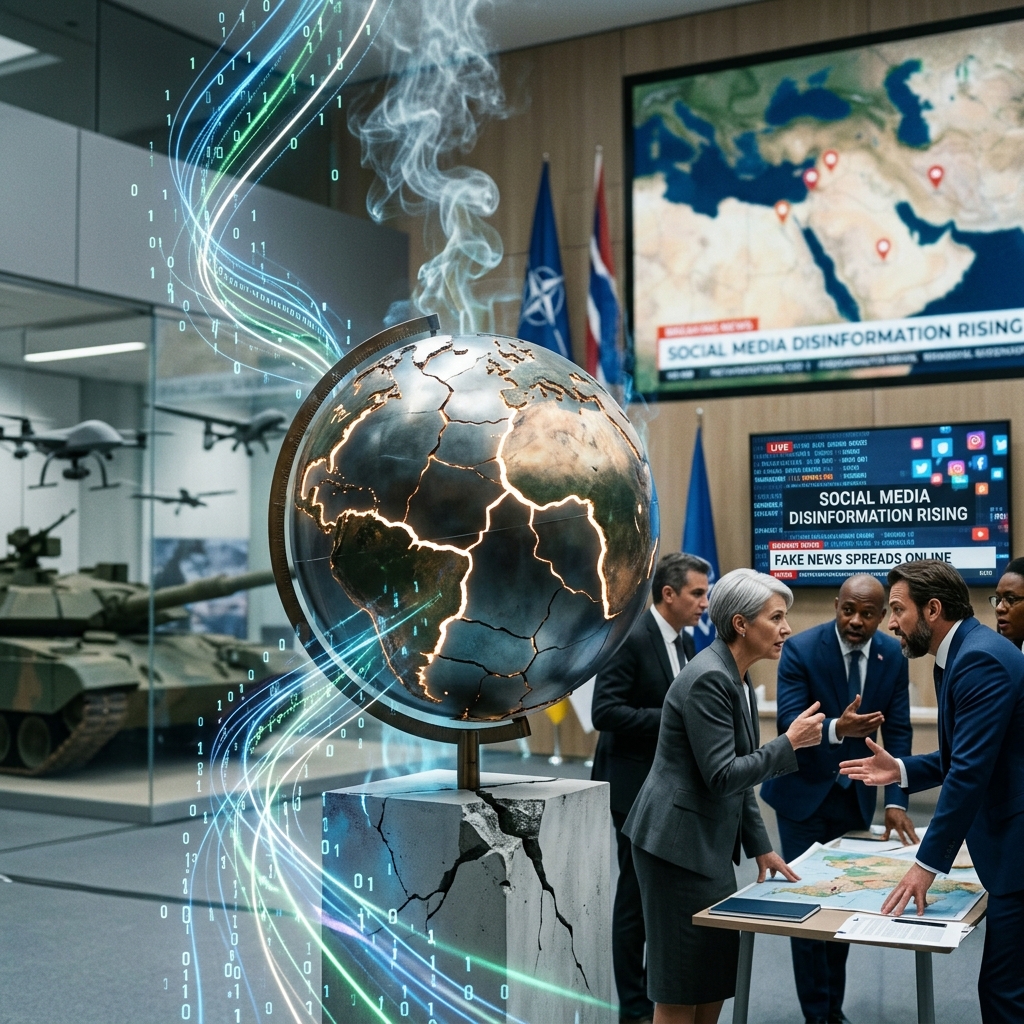
To understand global security in the post-American era, we must examine how these forces interact. From Gaza and northern Israel to Ukraine, NATO, Washington, and Moscow, the battle is no longer confined to the battlefield. It is also being fought in the media, on social platforms, in diplomatic messaging, and in the minds of citizens and policymakers alike. This is the truth about global security in the post-American era: hard power still matters, but narrative power now shapes how, when, and whether hard power can be used.
The Post-American Era and the Rise of Ego-Driven Geopolitical Leadership
One of the defining features of the post-American era is the rise of leaders who see themselves not as custodians of institutions, but as historic figures entitled to bend institutions to their will. Former U.S. National Security Council official Fiona Hill has described the emergence of “world-historic” leaders such as Vladimir Putin and Donald Trump—figures who treat political power as a personal instrument of legacy, relevance, and domination.
This is where bad geopolitical leadership becomes a direct threat to global security. When leaders place ego, spectacle, and personal leverage above alliance management and institutional continuity, the consequences spread far beyond their own borders. Trust weakens. Strategic coherence erodes. Allies hedge. Adversaries probe for weakness.
In this environment, the damage caused by bad leadership is not abstract. It reshapes deterrence, accelerates instability, and creates openings for both rogue regimes and non-state actors. This is one of the clearest ways bad geopolitical leadership threatens global security: it breaks the credibility of the systems that once contained conflict.
Hill’s broader argument also points to a deeper reality. We are not simply witnessing a temporary crisis of leadership. We are watching a structural shift in how power is imagined and exercised. In that sense, the post-American era is not just about reduced U.S. dominance. It is about the weakening of the rules, habits, and expectations that once gave the global order a degree of predictability.
Global Security at Risk: NATO, Europe, and the Fracturing of Institutional Trust
One of the strongest indicators that global security is at risk is the gradual “Europeanization” of NATO. For decades, European security rested on the assumption of reliable American leadership. That assumption now looks far less certain.
Driven by inconsistent U.S. foreign policy, political polarization, and recurring isolationist sentiment, European governments increasingly recognize that they can no longer outsource their defense indefinitely. They are being pushed to increase military spending, strengthen domestic defense industries, and assume greater strategic responsibility for the continent’s security architecture.
This transition may prove necessary, even healthy, in the long term. But in the short term, it exposes the fragility of the old system. It also reinforces a core theme of this moment: in the post-American era, surviving the new information war and the new security environment requires more than military preparedness. It requires institutional resilience, strategic clarity, and political maturity.
NATO’s future therefore matters not only as a military question, but as a test of whether democratic alliances can adapt under pressure. If trust becomes conditional, transactional, or personality-driven, then the alliance system itself becomes vulnerable to manipulation from within and attack from without.
The Illusion of Military Victory: Gaza, Hamas, and the Rebuilding of Terror Infrastructure
If the macro-level order is fragmenting, the micro-level realities of conflict reveal how hard it is to convert military success into lasting strategic outcomes. Gaza remains one of the clearest examples.
Israeli defense and intelligence veterans, including Shalom Ben Hanan and Amit Assa, have warned that severe military damage to Hamas does not automatically eliminate Hamas as a governing or fighting force. This is a crucial point for anyone trying to understand how information warfare is reshaping global security and how modern militant organizations survive.
Israel has inflicted major damage on Hamas’s infrastructure and maintains operational control over significant portions of Gaza. Yet the core problem remains: if a terrorist organization retains enough coercive capacity to dominate the civilian population, tax goods, seize aid flows, intimidate rivals, and rebuild localized military production, then military degradation alone is not strategic defeat.
That is the central illusion of military victory in Gaza. Hamas does not need to look fully restored to remain dangerous. It needs only enough control to regenerate power slowly, preserve its authority, and position itself as the unavoidable force inside the Strip.
Former Israeli officials have pointed to several dimensions of this challenge. First, Hamas’s remaining manpower is still significant. Second, its grip over civilian life allows it to convert humanitarian mechanisms into tools of political and financial control. Third, areas that have not been fully penetrated or dismantled may still provide the basis for continued weapons production, underground recovery, and organizational continuity.
This is why global security analysis cannot rely on simple battlefield metrics. Counting destroyed tunnels or damaged battalions matters, but it does not answer the larger question: who governs, who coerces, who distributes resources, and who controls the story people inside the conflict are forced to live under?
Gaza and Global Security: Why Humanitarian Aid Can Become a Strategic Battleground
The Gaza case also reveals a broader lesson that policymakers ignore at their peril: humanitarian aid is not strategically neutral when armed groups control access, distribution, and taxation.
According to the Israeli assessments cited in the source material, Hamas has used the movement of food, fuel, medicine, and other supplies not merely to survive, but to reassert control. Aid, in this context, can become revenue. It can become patronage. It can become proof of rule. It can also become an instrument of fear.
That does not diminish the humanitarian needs of civilians. It sharpens the urgency of solving the governance problem. If assistance enters a war zone without a credible post-conflict administrative framework, it may help sustain the very actor responsible for prolonging the crisis.
For global security in the post-American era, this matters beyond Israel and Gaza. The lesson applies to fragile states, proxy wars, and hybrid conflicts elsewhere. Terror organizations, militias, and authoritarian proxies are increasingly skilled at converting relief systems into survival systems. Any strategy that ignores this will remain incomplete.
How Information Warfare Is Reshaping Global Security
If military conflict is one half of the struggle, the other half is the information war. And here, the strategic weakness of democratic states is becoming impossible to ignore.
How information warfare is reshaping global security can be seen most clearly in the case of Israel. Strategic observers such as Cliff Sobin argue that Israel invests heavily in conventional defense, yet too often neglects the battle for legitimacy, empathy, and narrative dominance. This creates a dangerous paradox: even successful military operations can become politically constrained if the international narrative hardens against them faster than facts can travel.
This is why the information war is not secondary. It is not a communications accessory to “real” conflict. It is a core theater of conflict. In some cases, it determines whether governments retain diplomatic room to maneuver. In others, it shapes public pressure, alliance behavior, funding, and the strategic patience of external partners.
The problem, as Sobin frames it, is that democratic actors often remain reactive. They explain after the image has gone viral. They contextualize after outrage has hardened. They defend after the accusation has already spread. That is not a winning model in a digital ecosystem built to reward speed, simplicity, emotion, and repetition.
Winning the information war in the post-American era requires a different posture: proactive, disciplined, emotionally intelligent, and grounded in facts before adversaries define the frame.
Israel’s Information War: Why Truth Is Losing to Tactics
Israel’s information war illustrates the challenge with painful clarity. Too often, international audiences encounter Israeli actions only after they have been stripped of context and reduced to images that travel faster than explanation. A strike on a building used by militants is seen as a strike on a building. A security operation is presented as raw force. A society under prolonged threat is flattened into an abstraction.
This is not simply a media problem. It is a strategic problem.
The battle for public opinion in the United States, for example, is becoming harder. Anti-Israel narratives now move across ideological lines. On one side, they are embedded in activist politics and selective moral framing. On the other, they can merge with isolationism, resentment, or explicit antisemitism. Yet the picture is not hopeless. Between hardened camps lies a persuadable middle—people who are not ideologically committed, but who are highly vulnerable to one-sided emotional narratives.
That is why countering social media disinformation indirectly may be more effective than chasing every viral falsehood. Building trusted factual resources, educating advocates, rebutting distorted NGO or UN narratives systematically, and creating what Sobin described as a “habit of doing” among supporters can gradually strengthen public resilience against manipulation.
In SEO terms, one might ask: how do you counter information warfare in the post-American era? The answer is not through panic or constant reaction. It is through preparation, clarity, repetition, and the patient creation of informed networks that can resist false frames before they harden into common sense.
Humanizing Israelis: The Missing Dimension in the Global Security Narrative
One of the most overlooked failures in Israel’s public positioning has been the failure to humanize Israelis consistently and effectively. Much of the outside world sees Israel through a strategic lens, not a human one. Israelis are often depicted as a hardened collective, not as parents, children, reservists, evacuees, or communities living under profound strain.
But humanization is not sentimental branding. It is strategic communication rooted in truth.
Cliff Sobin emphasized that sharing the lived realities of Israeli civilians is essential if the wider public is to understand the stakes. A mother sending her son into military service, families waiting for alerts in northern towns, communities rebuilding after evacuation, and citizens living with the psychological toll of repeated threats—these stories matter because they restore moral and emotional texture to a conflict that is often narrated in dehumanized shorthand.
Humanizing the conflict does not mean erasing complexity. It means refusing abstraction. Cold statistics rarely build durable empathy. Human stories do.
Northern Israel, Resilience, and the Security Story the World Rarely Sees
The Israeli dimension of this broader security crisis is not limited to Gaza. The northern front offers another essential perspective—one that connects community resilience, strategic preparedness, and information warfare.
Sobin’s observations about northern Israel highlight an important but underreported distinction: resilience is not evenly distributed, and psychological experience varies dramatically by geography. Communities with stronger prewar emergency planning, clear relocation procedures, and strong municipal coordination were better able to preserve cohesion after October 7. Others struggled more deeply with displacement, fragmentation, and uncertainty.
This matters for two reasons. First, it reveals that resilience is not only emotional; it is organizational. Second, it shows how incomplete many outside narratives are. People living directly on the border may internalize threat as part of life, while those slightly farther away may experience a more corrosive form of uncertainty and anxiety. These are not minor differences. They shape how societies absorb pressure over time.
For anyone writing about global security at risk, this is a vital lesson: resilience is a strategic asset. It deserves the same analytical seriousness as military capacity, diplomacy, and intelligence.
The Post-American Era, Ukraine, Iran, and the Return of Personalized Power
The post-American era is also being shaped by the behavior of major powers and leaders who personalize state power. Fiona Hill’s analysis of Trump, Putin, and Xi speaks directly to this moment. These leaders do not merely govern within historical conditions; they seek to define history through themselves.
That impulse has consequences. It can prolong wars, weaken alliances, and turn foreign policy into theater. Hill argues that Trump’s interventions and instincts have affected both Ukraine and Iran in destabilizing ways, while Putin’s war has become tied not just to Russian strategy, but to regime survival and personal legacy.
These conflicts reveal another uncomfortable truth about global security: existential wars do not end easily when leaders cannot politically survive compromise. In such settings, the information war becomes even more important. Propaganda, humiliation, mythmaking, and symbolic victories all take on outsized importance because they help sustain domestic legitimacy in the absence of clear strategic success.
This is part of the truth about global security and the post-American era: wars are now fought across military, economic, psychological, and narrative domains simultaneously. States that fail to understand this will keep preparing for one war while losing another.
Winning the Information War in the Post-American Era
So what would a stronger strategy look like?
Winning the information war in the post-American era requires abandoning the assumption that facts automatically prevail if presented eventually. They do not. Facts need structure, messengers, emotional relevance, and timing.
A more effective model would include several pillars:
- Preemptive narrative framing: Explain the strategic logic of an operation before adversaries flood the space with distortion.
- Distributed advocacy: Empower individuals, not just institutions, with credible resources and concise talking points.
- Centralized factual infrastructure: Build accessible, trusted repositories of evidence, context, and rebuttal.
- Human-first storytelling: Put civilians, families, communities, and lived experience at the center of public communication.
- Long-term resilience building: Focus not only on persuading opponents, but on strengthening the confidence of the persuadable middle.
This approach is especially important for Israel, but it also applies more broadly to democratic states navigating hybrid conflict. The hidden threat to geopolitical leadership today is not only military weakness. It is communicative weakness—the inability to explain power, justify action, sustain legitimacy, and build trust faster than adversaries can poison the field.
How to Counter Information Warfare and Rebuild Strategic Credibility
Any serious answer to modern instability must therefore combine security policy with communication strategy. To counter information warfare in the post-American era, governments and institutions should act on three levels at once.
First, they must restore institutional credibility internally. Citizens must believe that leaders act from principle, not vanity, corruption, or self-preservation.
Second, they must align military, diplomatic, and narrative strategy externally. Security operations cannot be separated from the way they are explained, documented, and morally framed.
Third, they must think in terms of endurance. Information warfare is not solved by one viral clip, one speech, or one press conference. It is a long campaign of consistency, credibility, and clarity.
This is also where backlinks and authority in the public sphere matter conceptually: the more a piece of analysis is grounded in expert voices, durable facts, and reference-worthy framing, the more likely it is to shape serious conversation. Authority is no longer just institutional. It is networked.
Charting a Course Forward for Global Security
Global security in the post-American era will not be preserved by nostalgia for an older order. It will be preserved, if at all, by adapting to a harsher, faster, more fragmented strategic environment.
That means recognizing five realities.
- Bad geopolitical leadership threatens global security when personality overwhelms institutions.
- Information warfare is reshaping global security by turning perception into a strategic weapon.
- Israel’s information war is not a side issue, but a case study in how democracies lose ground when they communicate defensively.
- Gaza demonstrates that military force alone cannot defeat an armed movement that retains coercive control over civilians and resources.
- NATO, Europe, Ukraine, Iran, and Israel are all part of the same larger story: the old order is weakening, and no serious strategy can afford to ignore either power or narrative.
The geopolitical landscape is shifting beneath our feet. The question is no longer whether the world has changed. It is whether democratic societies, alliances, and leaders can change fast enough to meet it.
How do you view the impact of information warfare on global stability? Can institutional trust be rebuilt, or have we entered a permanently more volatile era of ego-driven power and narrative conflict?
Share your perspective, challenge the argument, and join the debate on the future of global security in the post-American era.
#globalsecurity, #postAmericanera, #geopoliticalinstability, #fracturedglobe, #digitaldatastreams, #militaryequipment, #politicalleaders, #informationwarfare, #NATO, #MiddleEastconflicts, #socialmediadisinformation, #SEOoptimization, #backlinksstrategy, #modernwarfare, #globaldiplomacy, #internationalrelations, #narrativepower, #traditionalmilitarypower, #geopoliticalleadership, #institutionaltrust, #hybridconflicts, #humanitarianaid, #strategiccommunication, #digitalecosystem, #democraticalliances, #globalorder, #resiliencebuilding, #narrativeframing, #strategicclarity, #geopoliticalchallenges, #internationalsecurity, #globalstability, #conflictresolution, #powerdynamics, #securitythreats, #worldpolitics, #diplomaticrelations, #crisismanagement, #policyanalysis, #leadershipchallenges, #globalissues, #securitypolicy, #alliancestrategy, #informationmanipulation, #cybersecurity, #propaganda, #strategicalliances, #globalgovernance, #securityframeworks, #geopoliticalanalysis, #futureofsecurity, #internationalcooperation, #securitydynamics
@UN, @NATO, @WorldBank, @IMF, @WHO, @AmnestyInternational, @HumanRightsWatch, @BrookingsInst, @CarnegieEndow, @ChathamHouse, @RANDCorporation, @CouncilonForeignRelations, @AtlanticCouncil, @CSIS, @WilsonCenter, @Harvard, @Yale, @Stanford, @Oxford, @Cambridge, @MIT, @Georgetown, @Columbia, @Princeton, @LSE, @KofiAnnanFoundation, @MadeleineAlbright, @BanKiMoon, @HenryKissinger, @CondoleezzaRice, @JohnKerry, @SamanthaPower, @AntonyBlinken, @JosepBorrellF, @FedericaMogherini, @ICRC, @Greenpeace, @WWF, @OECD, @ASEAN, @AU, @G20, @G7, @BRICS, @Interpol, @WTO, @UNESCO, @UNHCR, @UNDP, @UNICEF, @ICJ, @ICC, @EUCouncil, @EuropeanParliament, @AfricanUnion, @ASEANSecretariat, @WorldEconomicForum, @Davos, @CFR_org, @ChathamHouse, @CarnegieEndow, @BrookingsInst, @AtlanticCouncil, @CSIS, @RANDCorporation, @WilsonCenter, @StimsonCenter, @Heritage, @AEI, @UrbanInstitute, @PewResearch, @BelferCenter, @HooverInst, @AspenInstitute, @HudsonInstitute, @CatoInstitute, @Mercatus, @CEIP, @GMFUS, @EUI, @IISS_org, @ISDP, @ISSAfrica, @IPInst, @CrisisGroup, @ICG, @IPI, @SIPRI, @StockholmForum, @UNUniversity, @GenevaAcademy, @Clingendael, @EGmontInstitute, @FRIDE, @SWPBerlin, @IFRI, @CEPS, @Bruegel, @EPC, @ECFR, @GMF, @CarnegieEurope, @ChathamHouseEurope, @LSEIdeas, @OxfordPolitics, @CambridgeUni, @HarvardKennedySchool, @StanfordFSI, @GeorgetownSFS, @ColumbiaSIPA, @PrincetonSPIA, @MITPoliSci, @YaleJackson, @UChicagoCIR, @JohnsHopkinsSAIS, @TuftsFletcher, @SciencesPo, @HEIDGeneva, @CEU, @KCL, @UCL, @SOAS, @WarwickUni, @StAndrewsIR, @AberystwythIR, @QueensBelfastIR, @TrinityDublinIR, @UCDublinIR, @LeidenIR, @EUI_IR, @LUISSIR, @BocconiIR, @IEIR, @ESADEIR, @IESEIR, @INSEADIR, @HECParisIR, @ESCPIR, @ESSECIR, @SKEMAIR, @EDHECIR, @WHUIR, @HertieSchoolIR, @CEU_IR, @CEPS_IR, @Bruegel_IR, @EPC_IR, @ECFR_IR, @GMF_IR, @CarnegieEurope_IR, @ChathamHouseEurope_IR, @LSEIdeas_IR, @OxfordPolitics_IR, @CambridgeUni_IR, @HarvardKennedySchool_IR, @StanfordFSI_IR, @GeorgetownSFS_IR, @ColumbiaSIPA_IR, @PrincetonSPIA_IR, @MITPoliSci_IR, @YaleJackson_IR, @UChicagoCIR_IR, @JohnsHopkinsSAIS_IR, @TuftsFletcher_IR, @SciencesPo_IR, @HEIDGeneva_IR
Discover more from Responsible Public Affairs
Subscribe to get the latest posts sent to your email.