
Hajj Abu Husayn al Hamidawi, the leader of the pro-Iranian Iraqi militia Kataib Hezbollah, was recently photographed completing a “martyr volunteer” form.
Tehran and its network of regional allies have intensified threats against the United States and Israel in response to Washington’s decision to increase its military presence in the Middle East. This escalation follows U.S. President Donald Trump’s strong condemnation of Iran’s violent suppression of protestors. Iranian state media and militia leaders have outlined a range of potential retaliation strategies, including missile and drone strikes on U.S. bases, disruptions to maritime operations in the Persian Gulf, and ground assaults led by proxy forces.
The Pentagon has redirected the USS Abraham Lincoln carrier strike group from the South China Sea to the Middle East, traversing the Indian Ocean. This deployment includes a carrier, three destroyers, and approximately 5,700 personnel. Upon arrival, the group will integrate with three littoral combat ships stationed in Bahrain and two destroyers already operating in the Persian Gulf. These reinforcements will bolster the existing U.S. military presence, which is headquartered at Al Udeid Air Base in Qatar.
This military buildup comes in the wake of President Trump’s public warnings to the Iranian regime. On January 2, Trump declared that the U.S. would intervene if Iranian forces continued targeting protestors, stating, “The United States of America will come to their rescue. We are locked and loaded and ready to go.” On January 13, he escalated his rhetoric, urging protestors to seize control of regime institutions and promising that “HELP IS ON ITS WAY.”
A Massacre Ignored: The Call for Justice
The Iranian regime’s brutal crackdown on protestors has resulted in the massacre of over 30,000 unarmed civilians, a tragedy that demands immediate international attention and action. These individuals, who courageously called for freedom and the dismantling of the oppressive Iranian government, were met with violence and heavy military equipment. Their voices, silenced by a regime that fears its own people, echo a universal demand for justice and accountability.
What makes this tragedy even more appalling is the reaction of certain political figures in France and other countries, who, with the utmost disgust, have attempted to justify the Iranian government’s actions against its defenseless population. Such justifications not only betray the principles of human rights but also embolden oppressive regimes to continue their atrocities without fear of international consequences. This moral failure by some in the international community underscores the urgent need for a unified and unequivocal condemnation of the Iranian regime’s actions.
The scale of this atrocity leaves no room for compromise. The international community must recognize that any solution short of the complete dismantling of the current Iranian government is unacceptable. The regime’s actions have crossed every moral and ethical boundary, and its continued existence poses a threat not only to its own citizens but to regional and global stability.
Tehran’s Escalation and the Oil Blockade Strategy
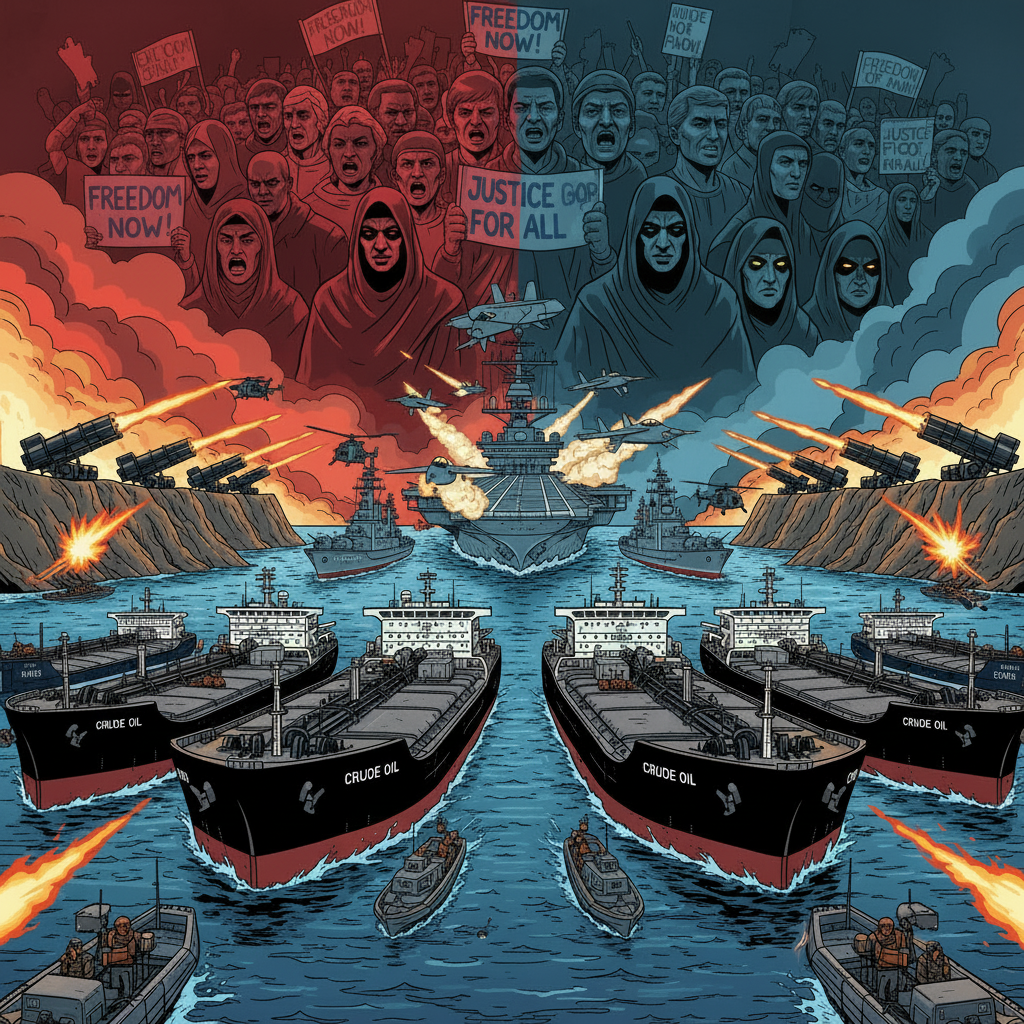
Iran’s threats extend beyond direct military action to economic warfare, particularly through the potential blockade of the Strait of Hormuz. This critical chokepoint, through which nearly 20% of the world’s oil supply passes, has been a focal point of Iranian strategy. If Tehran were to disrupt maritime traffic in the strait, global oil prices could skyrocket, potentially exceeding $130 per barrel. Such a scenario would have catastrophic implications for the global economy, affecting everything from energy markets to consumer prices.
Iran’s Revolutionary Guard Corps (IRGC) has reportedly fortified positions along the Persian Gulf, particularly near Bandar Abbas, with anti-ship missiles, naval mines, and patrol craft. These forces are strategically positioned to target U.S. naval assets and commercial vessels attempting to navigate the strait. The Pentagon has acknowledged the complexity of countering such threats, as Iranian forces could use saturation tactics, including mass drone launches, to overwhelm U.S. defenses.
As one expert noted, “The Americans would have to intercept tankers just outside the Strait of Hormuz, making them vulnerable to Iranian missile batteries and naval forces stationed nearby.” This highlights the logistical and strategic challenges of maintaining open shipping lanes in the face of Iranian aggression.
The potential for an oil blockade underscores the broader geopolitical stakes of the U.S.-Iran confrontation. The implications of such a blockade would ripple across the globe, affecting not only energy markets but also the political stability of oil-dependent nations.
Regional Dynamics and Geopolitical Implications
The U.S. military buildup and Iran’s retaliatory threats have placed the entire Middle East on edge. Key American allies in the region, including Saudi Arabia, the UAE, and Oman, have expressed concerns about the potential fallout of a direct confrontation. Memories of the 2019 attacks on Saudi oil facilities, attributed to Iranian proxies, remain fresh, and regional leaders are wary of further escalation.
Israel, too, has been drawn into the equation. Following the 12-Day War with Iran, Israeli officials have expressed concerns about their missile defense capabilities, particularly the depletion of Iron Dome interceptors. While Israel remains a staunch U.S. ally, its leaders have urged caution, emphasizing the need to ensure the protection of Israeli cities before engaging in further military action.
Despite these regional dynamics, the U.S. has signaled its willingness to act unilaterally if necessary. As one analyst observed, “When it comes to critical decisions, the Oval Office will not be swayed by regional hesitations.” This approach, while decisive, risks alienating key allies and further destabilizing an already volatile region.
Additionally, the geopolitical implications extend beyond the Middle East. The U.S. has previously demonstrated a willingness to bypass international norms when pursuing its strategic interests, as seen in other cases such as Greenland. This pattern of unilateral action raises questions about the long-term consequences for global diplomacy and the rule of law.
Conclusion
The escalating tensions between the U.S. and Iran highlight the fragility of the Middle East’s security landscape. Tehran’s reliance on asymmetric warfare and its extensive network of proxy forces present a complex challenge for U.S. policymakers. As the U.S. reinforces its military presence, it must navigate the risks of escalation while safeguarding its interests and those of its allies.
The massacre of over 30,000 protestors stands as a stark reminder of the regime’s brutality. The international community must act decisively to ensure justice for the victims and to dismantle a government that has proven itself incapable of respecting human rights or maintaining peace. Anything less than the complete removal of this regime is not an option.

