
Every significant policy starts as a question. Before a law is passed, a regulation is tightened, or a defense budget is reshaped, governments open the floor and ask: What do you think? That open floor is the public consultation—a formal mechanism through which governments gather feedback from citizens, stakeholders, and industry experts on proposed policies, laws, and regulatory frameworks. It sounds procedural, even bureaucratic. In practice, it is one of the most consequential moments in the entire policy lifecycle.For public affairs strategists, military planners, and defense policymakers, knowing how to navigate this process well is not a nice-to-have. It is the difference between watching a policy take shape and helping shape it. When national security objectives and strategic economic priorities are at stake, a structured, evidence-led approach to consultation does two things at once: it reduces avoidable geopolitical risk, and it makes the resulting policy genuinely more effective.This playbook walks through the frameworks, legal principles, and practical methods you need to engage with—and meaningfully influence—government consultation processes. Think of it less as a rulebook and more as a field guide, built for people who operate where the stakes are high and the timelines are rarely generous.
Core takeaways:
- Timing your engagement to the policy formulation stage is as strategic as the content of your submission itself.
- The Gunning Principles give stakeholders legal standing to demand fair, transparent, and genuinely open consultations.
Understanding the Policy Cycle
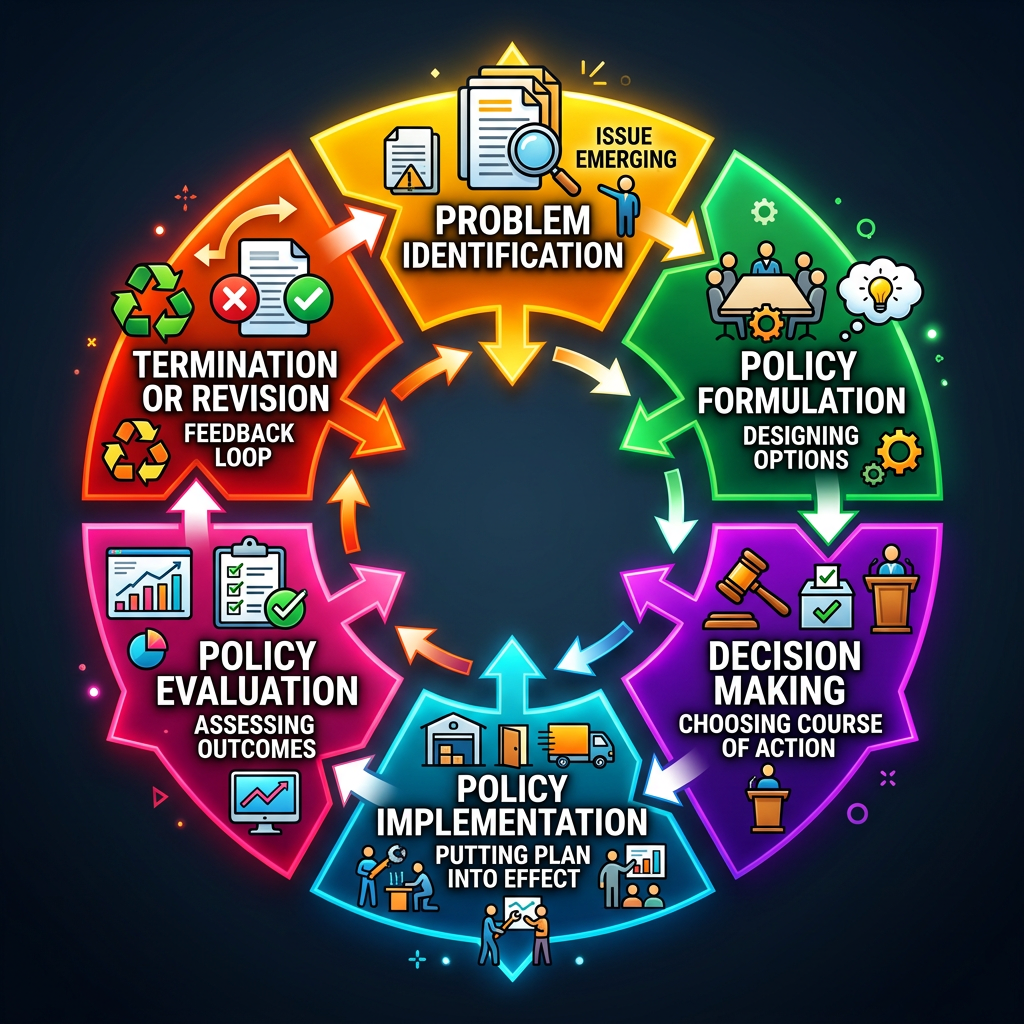
Before you draft a single response, you need to know where you stand. A consultation does not exist in isolation; it sits inside a larger policy cycle, and timing your engagement to that cycle is half the battle. The standard policy cycle moves through several distinct stages:
- Agenda Setting: A new issue, a geopolitical shift, or a sudden crisis forces an item onto the government’s radar and demands action.
- Formulation: Officials begin to shape the policy and define possible solutions. This is where consultations typically happen—and where your influence is greatest.
- Adoption: The policy is formally accepted and enacted.
- Implementation and Evaluation: The policy is implemented and evaluated against the objectives it was intended to achieve. The formulation stage is the open window, and it does not stay open for long. Submit your evidence and strategic insight early, while officials are still genuinely weighing options, and you become part of the conversation. Arrive too late—after positions have hardened and language has been locked—and even a brilliant submission becomes little more than a comment for the file. Precise timing, in other words, is not a logistical detail. It is a strategic decision in its own right. Consider how the international community handled Iran’s nuclear file. The agenda-setting moment arrived in August 2002, when an exile group publicly revealed undeclared nuclear sites, forcing the issue onto the IAEA’s radar. What followed was years of formulation—work plans, framework agreements, and the 2015 Joint Comprehensive Plan of Action—before adoption, and then a long, contested implementation and evaluation phase that continues today. The stakeholders who most effectively shaped that file were those engaged early and consistently, not those who showed up once the architecture was already set.
The Legal Framework: The Gunning Principles
It helps to remember that consultation is not merely a courtesy. In many jurisdictions, it is bound by administrative law designed to keep the process fair and transparent. The most widely recognized standard is the set of Gunning Principles, established in 1985, which lay out four requirements for a lawful and fair consultation:
- Formative Stage: Consultation must take place while proposals are still genuinely open to change. A government cannot ask for input on a decision it has already made and quietly finalized.
- Sufficient Information: The consulting body must share sufficient information and provide clear reasoning for the proposal so stakeholders can respond intelligently. You cannot give an informed answer to a question you only half understand.
- Adequate Time: Participants must be given enough time to analyze the material, build their case, and submit a considered response—not a rushed one.
- Conscientious Consideration: The decision-makers must genuinely take the responses into account before finalizing anything. Listening cannot be a performance. Knowing these principles does more than satisfy your curiosity. It gives you leverage. When a consultation is rushed, opaque, or clearly cosmetic, you have grounds to push back and to insist that your evidence, intelligence assessments, and policy models receive the review the law requires. Authorities are accountable to these standards, and a strategist who understands them can hold them to it. The same fairness logic shows up in international compliance regimes. The Gunning requirement that decisions be made at a “formative stage” mirrors how the IAEA Board of Governors handled Iran’s 2005 noncompliance finding: rather than immediately escalating to the UN Security Council, the Board chose to give Tehran additional time to comply—a built-in grace period before harder measures. And the “sufficient information” principle has a clear parallel in the IAEA’s repeated insistence that states share design information for new facilities “as soon as the decision to construct” is taken. When that information was withheld, as it was with Iran’s Fordow facility, the entire process lost credibility. The lesson holds in domestic consultation too: a process is only as fair as the information it rests on.
Strategic Execution: Developing the Response

Strong submissions rarely happen by accident. They are the product of careful preparation, genuine coordination across teams, and arguments built on solid evidence rather than opinion. Three disciplines tend to separate the responses that move policy from the ones that get politely acknowledged.
1. Stakeholder Mapping and Interagency Collaboration
Influence is a team sport. A fragmented effort—where different departments submit slightly different, occasionally contradictory positions—undermines everyone involved. The first task is to map your stakeholders, both inside and outside your organization, and align them around a single, coherent message.This is where collaborative intelligence pays off. When multiple departments consolidate their data and speak with one voice, the argument lands with far more weight. The cautionary tale here is familiar to anyone who has watched complex negotiations unravel: when the parties around the table cannot align internally, trust erodes and momentum stalls. International nuclear negotiations have repeatedly shown how a breakdown in coordination and confidence can freeze even well-intentioned processes in place. Consider the March 2023 joint statement between the IAEA and Iran: by late that year, Director General Grossi reported that implementation had “come to a standstill,” with each side blaming the other over procedural “modalities” they could never agree on. A disagreement over process, not substance, was enough to halt progress entirely. The lesson translates directly to consultation—internal alignment is the foundation external credibility is built on.Stakeholder mapping also means knowing who actually holds influence and who only appears to. In the diplomatic maneuvering around Iran, opposition figures and diaspora communities became important constituencies—an estimated 80,000 demonstrators gathered in Munich at one point—yet decision-makers weighed each voice differently. A strategist who treats every stakeholder as equally influential wastes effort; one who maps the real lines of authority concentrates it where it counts.
Mini Case Study: The Aligned Coalition
When a national government opened a consultation on tightening export controls for dual-use technologies, a defense-sector trade association faced a familiar risk: its member firms held differing, sometimes conflicting views. Rather than let each company file separately, the association convened a pre-submission working group, mapped where members agreed and disagreed, and built a single consolidated response anchored on the points of genuine consensus. Dissenting concerns were captured in a clearly labeled annex rather than buried or papered over.
The outcome: Officials cited the association’s submission directly in the revised regulatory guidance, adopting two of its three proposed safeguards. A competing industry voice that had submitted a dozen uncoordinated, contradictory letters was acknowledged but not incorporated.
🔑 Key Lessons
- One disciplined, aligned voice carries more weight than a louder, fragmented one.
- Pre-submission coordination turns internal disagreement into a strength, not a liability.
- Capturing dissent transparently in an annex preserves credibility without diluting the core message.
2. Utilizing Data-Driven Insights
Policymakers are drowning in submissions, and most of them read alike. What cuts through is evidence. Ground your response in predictive analytics, current geopolitical insight, and scenario modeling, and you give decision-makers something they can actually use. A strong submission typically includes:
- Quantitative risk assessment metrics that make the stakes concrete.
- Case studies showing how comparable policy shifts have played out in practice.
- Impact forecasting that maps the likely outcomes of the proposed legislation.There is a deeper point here, drawn from how serious verification and compliance bodies operate. Credible assessments lean not only on a single data stream but on triangulated evidence—open-source analysis, expert briefings, and independent verification all reinforcing one another. The IAEA, for instance, does not rely on inspections alone; it explicitly draws on “analyzing open-source information and receiving intelligence briefings from governments” to build a fuller picture. The strength of that approach also reveals its fragility: once Iran suspended its transparency measures in February 2021, the agency lost what it called “continuity of knowledge”—a gap it later concluded it would not be able to restore. The takeaway for any submission is blunt: the more your argument rests on multiple, mutually supporting sources, the harder it is to dismiss, and the more damaging it is when even one source goes dark.
Mini Case Study: The Evidence That Reframed a Debate
During a consultation on revised cybersecurity requirements for critical infrastructure operators, most respondents argued in broad strokes about cost and burden. One operator took a different route. It submitted a quantified risk model drawing on three independent sources—incident data from its own operations, anonymized threat intelligence from a sector-wide body, and an external academic assessment—and used scenario modeling to forecast the likely consequences of two competing regulatory thresholds.
The outcome: Because the analysis was traceable and triangulated, regulators adopted the operator’s proposed phased timeline over the original abrupt deadline, citing the modeling as the deciding factor.
🔑 Key Lessons
- Triangulated evidence—drawing on multiple independent sources—is far harder to dismiss than a single data stream.
- Scenario modeling turns abstract objections into concrete, comparable outcomes decision-makers can act on.
- An argument built on traceable evidence reframes a debate from opinion versus opinion into evidence versus assertion—and evidence usually wins.
3. Structuring the Submission
Even the best evidence falls flat if it is buried in a wall of text. When you draft, clarity is everything.
- Direct and Succinct: Answer the specific questions the consultation poses, in the order it poses them. Use plain, precise language; reach for technical terminology only when ordinary words genuinely won’t do.
- Evidence-Based: Support every claim with references, footnotes, and validated sources. A reviewer should be able to trace your reasoning without taking your word for it.
- Actionable Alternatives: If you are opposing a measure, do not stop at objection. Offer a viable, well-tested alternative. Saying “this won’t work” invites dismissal; saying “here is what works better, and here is the evidence” invites a conversation. The value of a credible, well-documented submission is visible in how compliance disputes get resolved. When the IAEA detected highly enriched uranium particles at Iran’s Fordow facility, Iran offered a documented explanation. The agency assessed the information “was not inconsistent” with that account and recorded it had “no further questions on the matter.” One outstanding issue was closed—because the response was specific, evidence-based, and verifiable. Contrast that with claims dismissed as resting on “fabricated information,” which resolved nothing. The pattern is instructive: submissions that can be traced and checked move the needle; assertions that cannot are easily set aside.
Overcoming Common Industry Challenges
No one engages in consultation under ideal conditions. Timelines get compressed without warning. Information arrives incomplete. Access to the right officials proves frustratingly limited. These obstacles are normal, and the strategists who succeed are the ones who plan for them rather than hope to avoid them.A few practical habits make the difference. Adaptive monitoring tools that flag upcoming legislative changes in real time buy you the lead time that a sudden consultation would otherwise steal. Just as importantly, the relationship-building cannot wait for the formal window to open. The most influential organizations are in steady, good-faith dialogue with officials long before and long after any single consultation—so that when their submission lands, it carries the weight of an established, trusted voice rather than a stranger’s. Trust, once built, is what gets your analysis read carefully instead of skimmed.Watch what happens when access is denied outright. In the Iran file, inspectors were barred from certain sites entirely—as one observer put it, “there are places we have never been and never will go, because if the Iranians don’t want it, we can’t go.” When the formal channel closes, leverage collapses. The strategists who anticipate that risk maintain alternative lines of dialogue and informal relationships precisely so that a single closed door does not end the conversation. Timing pressure compounds the problem: just as a narrowing political window—an election cycle, a budget deadline—can force rushed decisions, a compressed consultation timeline can pressure you into a weaker submission. Planning ahead is the only real defense. There is also a non-negotiable dimension here: integrity. Compliance with lobbying regulations and transparency standards—such as the OECD Recommendation on Transparency and Integrity in Lobbying—is not red tape to be tolerated. It is what protects your credibility over the long run. The fastest way to lose influence is to be seen operating in the shadows. The principle scales all the way up: the UN Charter framework deliberately distinguishes between provisional measures under Article 40 and more severe economic sanctions under Article 41, thereby building legitimacy through a transparent, graduated process. Even at the highest levels of statecraft, the procedural path taken determines whether an outcome is seen as legitimate. Staying visibly lawful and transparent is, quite simply, a good strategy.
Conclusion

Mastering government consultation is not a soft skill at the margins of policy work—it is central to how leaders in defense, security, and public policy actually get things done. The strategists who consistently shape outcomes are the ones who respect the legal frameworks like the Gunning Principles, who coordinate across agencies instead of fragmenting their voice, and who anchor every argument in clear, well-sourced evidence. Do those three things well, and you stop reacting to policy and start influencing it.For government and defense leaders looking to sharpen their decision-making and amplify their policy impact, our suite of data-driven tools delivers the real-time alerts and scenario modeling needed to navigate fast-moving geopolitical landscapes with confidence. Reach out to our team today to bring our collaborative intelligence solutions into your public affairs strategy.
The Consultation Checklist
- Locate the consultation in the policy cycle. Confirm it sits at the formulation stage and engage early, while options are still genuinely open.
- Verify the process is fair. Check it against the Gunning Principles—formative stage, sufficient information, adequate time, and conscientious consideration—and be ready to push back if it falls short.
- Map your stakeholders. Identify who holds real influence, align internal teams around one coherent message, and capture any dissent transparently.
- Build a triangulated evidence base. Ground your argument in multiple independent sources, quantitative risk metrics, comparable case studies, and scenario modeling.
- Structure the submission for clarity. Answer the specific questions in order, support every claim with traceable references, and offer viable, well-tested alternatives.
- Operate with full transparency. Comply with lobbying and integrity standards, such as the OECD Recommendation, to protect long-term credibility.
- Plan for obstacles. Use real-time monitoring to anticipate compressed timelines and maintain alternative lines of dialogue in case formal channels close.
- Sustain the relationship. Keep good-faith engagement going before and after the consultation so your voice carries established trust.
References and Endnotes
- Kerr, Paul K. 2025. Iran’s Nuclear Program: Tehran’s Compliance with International Obligations. Congressional Research Service, Report No. R40094. Updated August 7, 2025. https://crsreports.congress.gov.
- International Atomic Energy Agency. 2005. Implementation of the NPT Safeguards Agreement in the Islamic Republic of Iran. Report by the Director General, GOV/2005/77, September 24, 2005.
- International Atomic Energy Agency. 2003. Implementation of the NPT Safeguards Agreement in the Islamic Republic of Iran. Report by the Director General, GOV/2003/75, November 10, 2003.
- International Atomic Energy Agency. 2023. Joint Statement by the Atomic Energy Organization of Iran (AEOI) and the International Atomic Energy Agency (IAEA), March 4, 2023.
- LCI Direct. [Year Unconfirmed]. Broadcast transcript, February 14. [URL Unconfirmed].
- R (Gunning) v Brent London Borough Council (1985) 84 LGR 168.
- Organisation for Economic Co-operation and Development (OECD). Recommendation of the Council on Transparency and Integrity in Lobbying.
Discover more from Responsible Public Affairs
Subscribe to get the latest posts sent to your email.