
Abstract: This article examines how organizations can transform policy engagement from a reactive, defensive function into a proactive strategic capability that shapes regulatory outcomes rather than merely responding to them. Drawing on real-world examples and case studies across industries and geographies—from medical devices and global payments to energy, technology, pharmaceuticals, and consumer goods—it presents eleven interconnected best practices for navigating complex regulatory environments: stakeholder mapping, cross-functional coordination, evidence-based advocacy, rigorous risk assessment, scenario planning, early relationship building, compliance alignment, continuous monitoring of regulatory change, disciplined internal governance, ethical and transparent engagement, and outcome-based measurement. Written for executives, government affairs leaders, and general counsel, the piece argues that companies which apply the same rigor to regulation as they do to capital allocation and product strategy will not only mitigate risk but gain durable competitive advantage—turning regulation from a threat they absorb into a landscape they actively help shape.
Executive Summary: Regulation is too consequential to manage as an afterthought, yet most companies still treat policy engagement as a defensive reflex—scrambling only after the rules are written and the chance to shape them has passed. This article argues that the strongest organizations flip that script, engaging early and methodically with the same discipline they bring to capital allocation or product strategy. Illustrated with cross-industry and global case studies, it lays out eleven connected practices that turn regulatory affairs from a cost of doing business into a genuine competitive advantage: mapping the stakeholders who actually hold the levers, coordinating across functions so your message stays coherent, leading with evidence rather than assertion, assessing risk and planning scenarios with analytical rigor, building trusted relationships before you need them, aligning advocacy with compliance reality, monitoring regulatory change continuously, establishing governance that balances control with speed, engaging ethically and transparently, and measuring outcomes instead of activity. Taken together, these practices reinforce one another and convert regulation from a threat you brace against into a landscape you actively help shape—provided leaders commit to running policy engagement as the core strategic capability it deserves to be.
Few corporate disciplines hold as much quiet power as policy engagement. A single new regulation can reshape your margins overnight, close off a market you counted on, or open a lane your competitors never saw coming. Consider how the European Union’s General Data Protection Regulation rewired the economics of digital business across the globe, or how Basel III recast the balance sheets of every major bank. The companies that fared best weren’t the ones that reacted fastest—they were the ones already in the room when the language was being drafted.
And yet, most companies still treat regulatory affairs as something to flinch at—a problem to clean up after the rules are already written, long after the chance to shape them has slipped away.
That instinct is more than a missed opportunity. It’s a strategic mistake. The strongest organizations don’t wait. They engage early and methodically, with the same discipline they bring to launching a product or allocating capital. If you’re an executive, a government affairs leader, or a general counsel who wants to trade reactive lobbying for a strategy that actually lasts, this is for you. What follows are eleven connected practices—from mapping stakeholders to measuring real outcomes—each one grounded in real-world examples and concrete steps you can put to work right away.
Let’s begin where any honest engagement effort has to begin: figuring out who actually holds the levers.
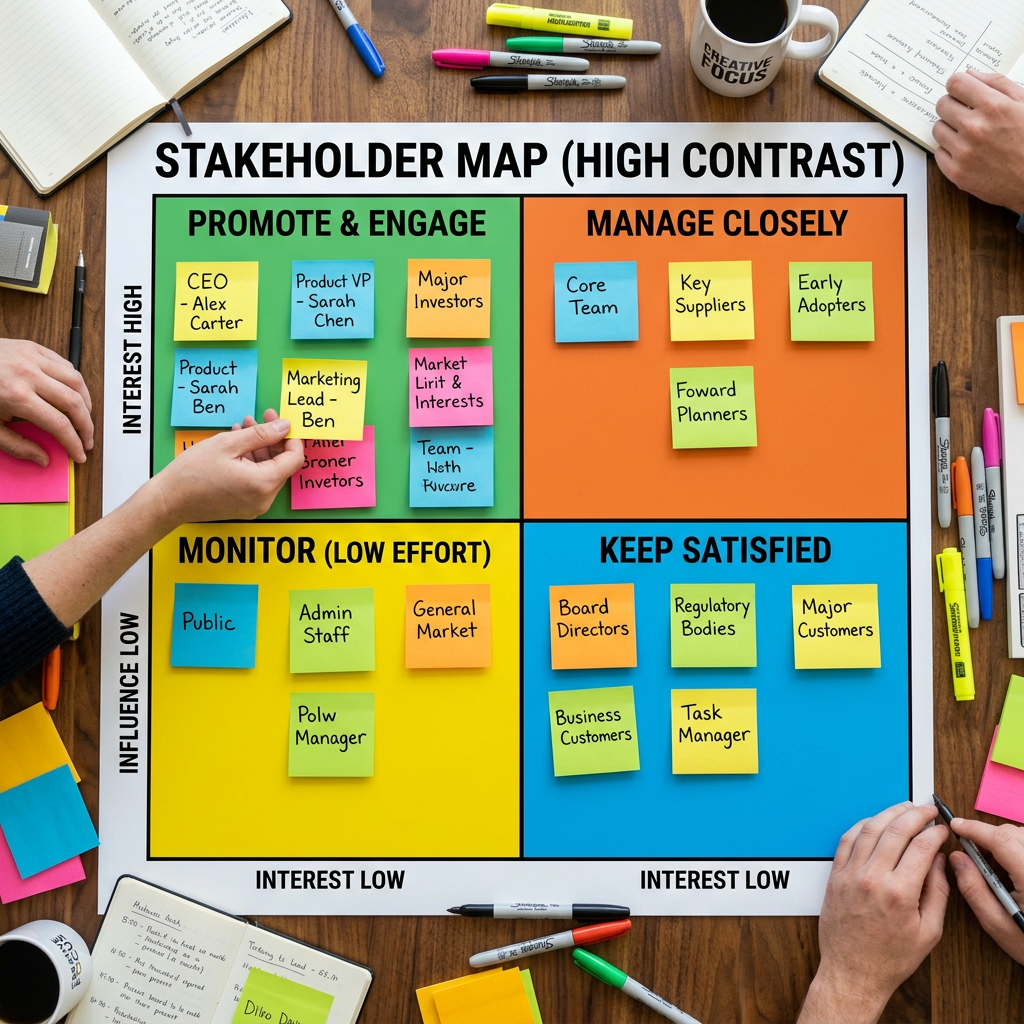
Map Your Stakeholders Before You Make a Move
You can’t influence what you don’t understand. Stakeholder mapping is the bedrock for everything that comes next, and skipping it is the single most common reason these efforts fall apart.
A good map reaches far beyond a roster of legislators. It captures regulators, committee staff, agency officials, competitors, trade associations, NGOs, academics, and the journalists who frame the story for everyone else. For each one, note three things: their formal authority, their real influence, and what they actually want. Authority and influence rarely line up. A mid-level analyst quietly drafting technical language often shapes the final rule far more than the senator delivering speeches about it.
Case in point. Take a medical device firm bracing for tougher U.S. approval standards. The people who truly mattered weren’t elected officials at all—they were two FDA reviewers and a patient advocacy group whose blessing carried outsized weight. The firm that saw this clearly redirected its energy where it counted, and won. Contrast that with the automakers who, during the negotiation of California’s emissions waivers, fixated on high-profile legislators while the California Air Resources Board staff—the people actually writing the technical thresholds—did the decisive work. The firms that built credibility with those staff shaped standards they could live with; the ones that didn’t spent years litigating rules they had no hand in.
Do this next:
- Build a living map that scores influence and interest on a simple scale.
- Pinpoint your three to five “decisive” actors—not just the loudest voices in the room.
- Refresh it every quarter, because coalitions never stop shifting.
Coordinate Across Functions, Not Just the Government Affairs Team
Policy engagement breaks down the moment it’s trapped in a silo. Regulators can see right through a company whose government affairs team is saying one thing while product, legal, and communications quietly say another.
Real coordination means standing up a working group that ties together public affairs, legal, compliance, product, and finance. Each function holds a piece of the truth. Legal knows the constraints. Product knows what’s technically real. Finance knows what compliance actually costs. When those perspectives meet before you step into the room, your message carries a coherence and authority that’s impossible to fake.
Case in point. A global payments company learned this the hard way. Its lobbyists fought hard for a carve-out that its own engineers later admitted couldn’t be built. Walking that back cost the company credibility for years. A single coordinated meeting would have caught the contradiction before it ever left the building. The counterexample is instructive: when the world’s major automakers engaged Brussels on tailpipe standards, the ones who sent engineers alongside their lobbyists—able to explain in real time what was technically feasible and on what timeline—won far more workable phase-in periods than rivals who showed up with talking points alone.
Do this next:
- Stand up a cross-functional policy council with one clear owner.
- Require sign-off from legal, product, and finance before any position goes public.
- Write down the agreed positions so your message stays consistent everywhere it lands.
Lead With Evidence, Not Assertion
Policymakers are drowning in opinions and starving for credible analysis. Evidence-based advocacy is your sharpest edge.
The most persuasive submissions marry hard data to a clear human consequence. A spreadsheet alone rarely moves a regulator. Neither does a touching anecdote. You need both. Show that a proposed rule would push costs up by a measurable amount, then show what that figure means for a specific customer, a region, or a worker on the floor. Original research, commissioned economic analysis, and well-run pilot data give you standing that pure persuasion never earns.
Case in point. When India debated tighter rules on digital payments, one fintech arrived with granular transaction data showing precisely how a proposed cap would price millions of low-income users out of the formal financial system—then put a face to the figure with merchants from a single market town. The data made the case credible; the human consequence made it land. Compare that with the pharmaceutical lobby’s resistance to drug-pricing reforms in several markets, where industry leaned heavily on assertion about “innovation incentives” without the granular evidence to back it. The arguments that carried real data on R&D timelines and trial costs survived scrutiny; the ones built on slogans did not.
You might be thinking that real evidence takes too long when comment windows are short. Fair point. The fix is to build your research foundation before the debate even starts, so your facts are ready the moment the window opens.
Do this next:
- Invest in proprietary data competitors can’t easily copy.
- Turn every data point into a tangible, real-world consequence.
- Cite independent sources to strengthen credibility and blunt any charge of bias.
Assess Risk With the Same Rigor as Investment Decisions
Regulatory risk deserves the same analytical seriousness you’d give a major capital project. Too often, it gets reduced to a vague, uneasy sense of “exposure.”
Treat each potential rule as a scenario with a probability and an impact. How likely is it to advance? What does it cost you if it does? Which business lines are exposed, and how concentrated is that exposure? A structured assessment turns free-floating anxiety into clear priorities, telling you exactly where to spend your finite engagement resources.
Case in point. An energy company staring down emissions, permitting, and tariff proposals all at once used a simple risk matrix to rank them. It poured its effort into the two highest-impact, highest-probability items and deliberately let the rest go. That focus delivered wins it would have squandered by trying to fight everything. The discipline matters most when the stakes are existential: tobacco companies that treated plain-packaging laws as a low-probability nuisance were blindsided when Australia moved first and a wave of countries followed, while those that had scored the risk realistically had already diversified and prepared.
Do this next:
- Score every regulatory issue on probability and financial impact.
- Concentrate your resources in the upper-right quadrant of the matrix.
- Reassess often, because the probabilities move fast.
Plan for Multiple Futures Through Scenario Planning

No one can predict exactly how a regulation will evolve. But you can prepare for the range of futures that are genuinely plausible. Scenario planning keeps you from being blindsided and lets you move decisively the moment the picture sharpens.
For each major issue, build three or four scenarios: a favorable outcome, an adverse one, and a couple in between. Then define your strategic response to each, in advance. This is the work that surfaces the decisions you’d rather not improvise under pressure—price changes, market exits, accelerated compliance spending.
Case in point. Scenario planning was practically invented for regulatory turbulence—Shell famously used it to navigate the oil shocks of the 1970s, anticipating disruptions its rivals dismissed as implausible. The same discipline pays off today. Several large banks ran detailed scenarios ahead of Brexit, pre-positioning licenses and staff in Dublin, Frankfurt, and Paris under each plausible outcome. When the final terms landed, they activated a playbook they’d already stress-tested while competitors scrambled to relocate operations under deadline.
The payoff is speed. When the real rule lands, you’re not scrambling from a standing start. You’re reaching for a playbook you’ve already stress-tested.
Do this next:
- Develop named scenarios with explicit triggers and responses.
- Assign decision rights ahead of time so the organization can move fast.
- Revisit your scenarios whenever the political or economic ground shifts.
Build Relationships Before You Need Them
The worst possible time to meet a policymaker is the moment you want something from them. Relationship building is a long game, and trust compounds.
Credible engagement means becoming a resource, not a supplicant. Share your technical expertise when asked. Offer balanced briefings that name the trade-offs honestly. Be candid about where your own industry gets it wrong. Officials remember the companies that helped them understand a thorny issue without spin—and those are the companies they call when it’s time to draft the rule.
Case in point. One consumer goods firm kept a respectful dialogue going with a leading environmental NGO for years, sharing supply-chain data even when it wasn’t flattering. When a contentious rulemaking on packaging arrived, that same group vouched for the firm’s good faith—turning a likely adversary into a credible reference. Technology companies have learned the same lesson the slow way: the firms that built genuine relationships with European data regulators long before GDPR took shape were treated as partners in implementation, while those that arrived only when enforcement loomed found themselves on the receiving end of the first headline-making fines.
Do this next:
- Schedule regular, low-ask touchpoints with key officials and their staff.
- Share useful information even when there’s nothing in it for you right now.
- Take your critics seriously instead of avoiding them.
Align Engagement With Compliance Reality
Your advocacy and your compliance posture have to tell the same story. Arguing against a rule you’re quietly preparing to break is a reputational time bomb, and it always goes off.
Compliance alignment makes sure what you ask for in public matches what you can actually deliver behind closed doors. It also hands you a stronger position: a company that already meets or beats a proposed standard speaks with authority no one can match. You’re not pleading for relief—you’re proving the standard works, often on terms you helped set.
Case in point. When European regulators moved toward stricter automotive emissions standards, the manufacturers that had already invested in cleaner powertrains could credibly argue the targets were achievable—and quietly welcomed rules that raised the bar for laggards. The cautionary tale is the diesel emissions scandal, where automakers argued publicly that standards were workable while engineering software to evade them. When the gap between advocacy and reality surfaced, it cost tens of billions in fines and a generation of trust. Done well, compliance alignment turns a cost center into a strategic asset; done badly, the contradiction detonates.
Do this next:
- Audit whether your advocacy positions actually match your compliance capabilities.
- Use early compliance as living proof that a proposed standard is workable.
- Flag any gap between what you’re asking for and what you’re ready to do—immediately.
Monitor Regulatory Change Continuously
Surprise is the enemy of influence. By the time a rule hits the headlines, the real window to shape it has usually already closed.
Continuous monitoring means tracking legislative calendars, agency agendas, consultation notices, and the faint early signals across every jurisdiction where you operate. For multinationals, this is genuinely hard—rules move at wildly different speeds in different markets. Dedicated tools and sharp analysts earn their keep by catching the signals everyone else misses.
Case in point. Global technology firms now staff dedicated teams to track the EU’s regulatory pipeline—from the Digital Markets Act to the AI Act—precisely because each began as a faint signal in a consultation paper years before it became binding law. The companies that read those early drafts shaped definitions and thresholds that competitors only discovered once they were fixed. The lesson generalizes: the firm that spots a consultation notice in Singapore or Brasília months ahead of its rivals buys the one thing money can’t add later—lead time.
What you’re really buying is lead time. Even a few extra weeks lets you commission research, line up your stakeholders, and engage before positions harden into concrete.
Do this next:
- Centralize monitoring across jurisdictions in a single dashboard.
- Set alerts for early-stage signals, not just published rules.
- Brief leadership on emerging issues every month, before they escalate.
Establish Strong Internal Governance
Without clear governance, policy engagement degrades into a string of well-meaning freelance efforts. Good governance settles the basics: who can speak for the company, who approves positions, and who owns the outcome.
The real trick is balancing control with speed. Sign-off processes that are too rigid freeze your team in the middle of a fast-moving debate; too little oversight invites legal and reputational disaster. The right design spells out decision rights, escalates only the genuinely thorny calls, and trusts experienced professionals to act within clear boundaries.
Case in point. More than one global company has been embarrassed when a regional office made political donations or took advocacy positions that contradicted headquarters—a governance failure, not a strategy failure. Several multinationals tightened their charters precisely after such episodes, centralizing approval for politically sensitive engagement while empowering local teams to act fast on routine technical comments. The result is the balance that matters: coherence at the center, speed at the edge.
Do this next:
- Document who approves positions at each level of sensitivity.
- Build fast-track approval paths for the time-critical calls.
- Review your governance after every major engagement and sharpen it.
Engage Ethically and Transparently
Reputation is the ultimate currency in policy work, and it can evaporate overnight. Ethical engagement is about far more than obeying lobbying laws—it’s a genuine commitment to honest, transparent influence.
In practice, that means disclosing your interests openly, never bending the data, and steering clear of anything that even looks like undue pressure. The temptation to overstate, to conceal, to lean a little too hard is very real when the stakes are high. Resist it. The companies that last are the ones policymakers trust to tell the truth even when the truth is inconvenient.
Case in point. The collapse of trust around opaque lobbying is well documented—from disclosures about how some food and beverage companies quietly funded research downplaying the health effects of sugar, to revelations that energy companies privately understood climate risks they publicly questioned. In each case, the reckoning, when it came, was brutal and lasting. By contrast, companies that registered openly on the EU Transparency Register and published their positions found that visibility became an asset: when their advocacy could survive a front-page audit, they engaged from a place of strength rather than fear.
Do this next:
- Disclose the affiliations and funding behind any research you cite.
- Adopt an internal code of conduct for policy engagement.
- Ask yourself whether each tactic would survive public disclosure.
Measure Outcomes, Not Just Activity

Too many government affairs teams report activity—meetings held, comments filed—while staying conspicuously quiet about impact. Measuring real outcomes is what lifts policy engagement into a true strategic discipline.
Define what success looks like before you start. Sometimes it’s a specific change in the rule’s language. Sometimes it’s a delay, an exemption, or simply keeping your access to a market intact. Then track honestly against those goals—including the losses. The most mature teams quantify the value they create or protect, tying engagement straight to financial and strategic outcomes.
Case in point. One global manufacturer reframed its government affairs scorecard entirely: instead of counting meetings, it tracked the estimated cost of compliance avoided or deferred through specific rule changes—a number it could place directly in front of the board. A single successful intervention on a tariff timeline, valued at tens of millions in preserved margin, justified the function’s entire annual budget many times over. That shift, from reporting activity to reporting value, is what turned a department leadership tolerated into one it consulted.
This kind of measurement does more than justify a budget. It builds a feedback loop that sharpens your strategy over time, showing you which approaches and which relationships genuinely move the needle.
Do this next:
- Set one defined, measurable objective for every engagement.
- Track results against your goals with discipline—failures included.
- Translate outcomes into protected or created value that leadership can see and understand.
Key Takeaways
- Start with mapping. Find the decisive actors, not just the visible ones.
- Coordinate internally so your external message is coherent and credible.
- Lead with evidence and translate cold data into human consequence.
- Assess risk and plan scenarios so you can move fast when rules take shape.
- Build relationships early and engage ethically, because trust is your real asset.
- Govern and measure so engagement becomes a capability, not a reflex.
Turning Discipline Into Advantage
Complex regulatory environments are only going to get harder as technology, trade, and public expectations keep evolving. The companies that thrive won’t be the ones with the loudest voices or the deepest lobbying budgets. They’ll be the ones that treat policy engagement as a core strategic discipline—rigorous in their analysis, coherent across their functions, grounded in evidence, and genuinely trusted by the people who write the rules. The pattern holds across every case in this article: from the medical device firm that mapped the right reviewers, to the banks that war-gamed Brexit, to the automakers undone by the gap between what they argued and what they built.
And these practices feed one another. Stakeholder mapping sharpens your risk assessment. Relationships amplify your evidence. Governance gives you ethical speed. Measurement makes everything better over time. Put them together, and regulation stops being a threat you brace against and starts becoming a landscape you help shape.
Your next move is simple. Pick the one regulatory issue that matters most to your business right now, and run it through these eleven practices. The gaps you find will show you, with surprising clarity, exactly where to start building the capability your future depends on.
policyengagement, #regulatorystrategy, #regulatoryaffairs, #publicpolicy, #governmentaffairs, #stakeholdermapping, #regulatorycompliance, #policyadvocacy, #complexregulatoryenvironments, #corporategovernance, #riskmanagement, #scenarioplanning, #evidencebasedadvocacy, #executiveleadership, #businessstrategy, #regulatoryrisk, #publicaffairs, #policyinfluence, #compliancestrategy, #thoughtleadership
@HarvardBiz, @Harvard, @Stanford, @MIT, @Georgetown, @BrookingsInst, @CSIS, @AtlanticCouncil, @RANDCorporation, @NewAmerica, @USChamber, @BusinessRoundtable, @Deloitte, @PwC, @McKinsey, @BCG, @KPMG, @EYnews, @Microsoft, @Google, @IBM, @Cisco, @Salesforce, @Pfizer, @JPMorgan, @GoldmanSachs, @WorldBank, @OECD, @WEF
Discover more from Responsible Public Affairs
Subscribe to get the latest posts sent to your email.