
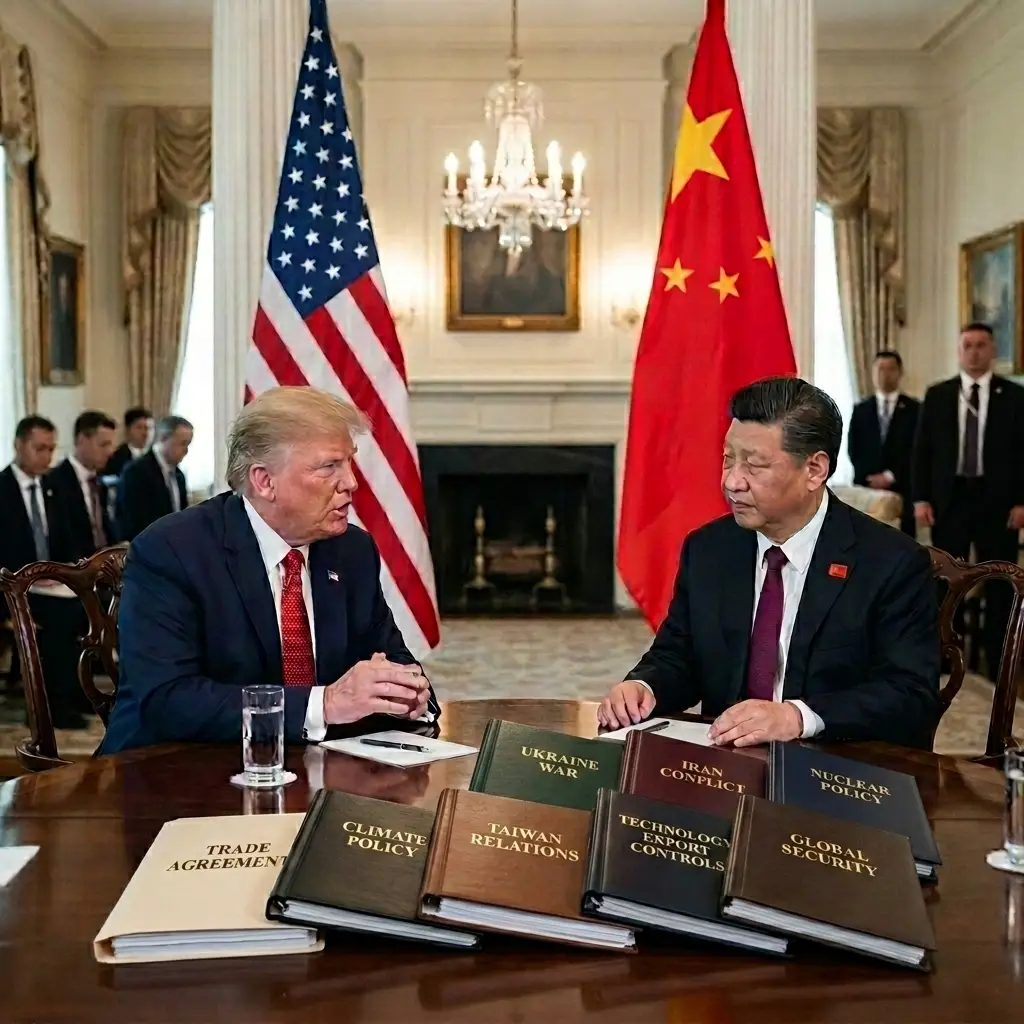
The Meaning of a US President visiting China
A visit by a President of the United States to China is not a ceremonial diplomatic passage. It is one of the clearest tests of strategic discipline in world affairs, where the calculations of the two most consequential powers are exposed under global scrutiny. Markets react instantly. Allies and adversaries dissect every line. Military establishments assess every signal. Yet the significance of such a meeting extends far beyond state protocol. Its consequences reach workers bound to global supply chains, families vulnerable to inflation and instability, students invested in exchange and opportunity, and citizens everywhere who understand a basic truth: if Washington and Beijing misjudge one another, the fallout will not stop at the negotiating table.
A US-China summit is therefore not a matter of optics, but of order. It tests whether strategic rivalry can be contained before it hardens into crisis, whether two powers bound by economic interdependence and divided by deep mistrust can impose discipline on confrontation, and whether leadership, amid widening wars and cascading shocks, can still deliver direction instead of disorder.
This article offers a rigorous analysis of what a US president’s visit to China truly means at a moment of mounting global instability. It examines the future of US-China relations and the summit’s implications for Taiwan, trade, technology, climate diplomacy, and the wider international order. It also confronts two crises that now define the stakes of any major-power engagement: the Iranian crisis and the war in Ukraine. For policymakers, investors, scholars, journalists, and serious readers alike, the central judgment is unmistakable: when Washington and Beijing meet, the consequences do not remain bilateral—they shape the strategic environment of the world.
Executive Summary
A presidential summit between the United States and China is one of the clearest indicators of the health of the international system. Such a meeting does not erase structural rivalry, but it can shape its boundaries. At its best, the summit creates guardrails, lowers the risk of military miscalculation, stabilizes economic expectations, and preserves limited cooperation in areas where both powers remain indispensable, especially climate, crisis management, and global financial stability.
The visit matters because the United States and China now operate in a world of overlapping crises. Competition in advanced technology, export controls, supply chains, Taiwan, and the Indo-Pacific remains intense. Yet neither side can afford unmanaged escalation. The global economy is too interconnected, and the geopolitical environment is too fragile.
The summit also carries implications well beyond East Asia. On Iran, China’s ties with Tehran and its role as a major purchaser of Iranian energy give Beijing leverage that Washington cannot ignore. A productive US-China summit could help encourage restraint, especially if both sides see wider conflict in the Middle East as economically and strategically destabilizing. On Ukraine, China is not a neutral actor, but neither is it identical to Russia’s position. A serious summit can test whether Beijing is willing to support de-escalatory diplomacy, limit support that strengthens Russia’s war endurance, or at minimum avoid steps that deepen the conflict.
The most realistic measure of success is not a grand bargain. It is a more disciplined rivalry: restored military communications, clearer red lines, reduced uncertainty for markets and allies, and enough working contact to prevent every disagreement from becoming a global shock.
Key Takeaways
- A US president’s visit to China is a global event, not merely a bilateral meeting.
- The summit’s real value lies in stabilizing competition, not pretending rivalry has disappeared.
- Economic de-risking will likely remain the preferred framework over full decoupling, but the boundary between the two is politically contested.
- Taiwan remains the most dangerous flashpoint in US-China relations, making crisis communication essential.
- The summit can affect the Iranian crisis by shaping energy security, maritime stability, and diplomatic pressure on escalation.
- The summit can affect the Ukrainian crisis by influencing China’s posture toward Russia, sanctions evasion, ceasefire diplomacy, and European security calculations.
- Climate cooperation remains one of the few areas where both powers have a direct shared interest, despite wider tensions.
Why a US Presidential Visit to China Matters More Than Ever
There was a time when a summit between Washington and Beijing could be described as a sign of engagement. That language is now too simple. Today, a US president’s visit to China is better understood as an attempt to manage strategic rivalry before it becomes strategic rupture.
The United States and China are connected by trade, finance, technology, climate exposure, and military proximity. They are also divided by political values, security doctrine, regional ambition, and competing visions of order. That combination makes the relationship unusually dangerous. In past eras, great powers were either adversaries with limited ties or partners with some shared trust. The United States and China are neither. They are rivals locked in interdependence.
That is why summit diplomacy still matters. It does not transform the relationship. It disciplines it. It can establish channels, clarify intentions, and reduce the odds that an incident in the Taiwan Strait, the South China Sea, cyberspace, or sanctions policy spirals beyond control. In a less tense era, diplomacy was often expected to produce breakthroughs. In the present one, even modest restraint can be a significant achievement.
The Historical Weight Behind the Handshake
No serious analysis of a US president’s visit to China can begin with the itinerary alone. The relationship rests on decades of strategic choices, mutual benefit, and growing disappointment.
The opening to China in the 1970s was driven by realpolitik, not sentiment. It reflected triangular power politics and a common interest in balancing the Soviet Union. Over time, normalization helped unlock one of the most important economic relationships in modern history. Trade deepened. Investment expanded. Universities, companies, and institutions built dense networks across borders.
But economic integration did not produce political convergence. Washington increasingly concluded that engagement had strengthened a competitor without liberalizing it. Beijing increasingly concluded that the United States welcomed China’s growth only as long as it remained strategically secondary. Those judgments hardened over time. The result is today’s relationship: heavily institutionalized, highly profitable in many sectors, yet deeply mistrustful.
That history is why a summit can look calm on the surface while carrying enormous underlying tension. The smiles may be real, but so is the suspicion. The dialogue may be necessary, but it is not naïve. Both sides know they are managing a long contest.
US-China Relations After Engagement: From Integration to Guardrails
The central shift in US-China relations is conceptual. The old assumption that contact would gradually narrow differences has faded. In its place stands a harsher but more realistic goal: build guardrails strong enough to contain disagreement.
This is not a trivial change. Under the logic of engagement, dialogue was seen as a path toward eventual accommodation. Under the logic of guardrails, dialogue is a tool for avoiding collision. The relationship is no longer judged by warmth, but by whether it remains bounded.
This explains why practical mechanisms matter more than lofty rhetoric. Military hotlines, diplomatic working groups, export-control clarifications, anti-narcotics cooperation, and technical contacts in climate or public health may seem modest. In fact, they are the infrastructure of strategic restraint. Without them, every dispute becomes more volatile. With them, rivalry remains dangerous but somewhat more manageable.
For readers looking at the summit through a policy lens, this is the most important insight: success is procedural before it is transformational. A stable floor matters more than a dramatic headline.
De-Risking, Decoupling, and the Future of Economic Statecraft
One of the most searched and debated topics in global affairs today is the future of US-China economic relations. The language of de-risking versus decoupling now sits at the center of that debate.
Full decoupling would mean a sweeping separation of the US and Chinese economies across technology, manufacturing, capital, and research networks. In theory, this promises security through distance. In practice, it would be extraordinarily costly and destabilizing. The sheer depth of supply-chain integration makes complete separation both disruptive and, in many sectors, unrealistic.
De-risking is the more plausible doctrine. It does not seek to sever all ties. Instead, it aims to reduce dependence in critical sectors such as semiconductors, artificial intelligence, telecommunications, advanced batteries, rare earths, cyber infrastructure, and dual-use technologies. In this view, the question is not whether to trade with China, but where vulnerability becomes intolerable.
A presidential summit can shape this boundary. If both sides signal that competition will remain targeted, markets gain some confidence. If the summit reveals that export controls, investment restrictions, and industrial subsidies will expand without discipline, businesses will prepare for a more fragmented world.
Here, language matters. Terms such as resilience, national security, supply-chain security, technology controls, and strategic sectors are not neutral. They are markers of a new era in which economics and security have fused. For SEO readers and policy researchers alike, this is one of the summit’s defining themes: economic de-risking is now a core instrument of grand strategy.
Diplomacy, Optics, and the Substance Beneath Symbolism
Commentary often treats summit imagery as empty theater. That is a mistake. In great-power diplomacy, optics are part of substance because they communicate intent, confidence, and hierarchy to multiple audiences at once.
The order of meetings, tone of readouts, length of private sessions, and wording on contentious issues all matter. A carefully staged encounter can reassure allies, calm investors, and signal that both sides still value control over escalation. A cold or visibly strained summit can have the opposite effect.
The most important signals often lie in what appears small. A restored military communication channel may matter more than an eloquent joint statement. A technical agreement on fentanyl precursors or climate dialogue may do more for long-term stability than dramatic public language. And omissions matter too. If Taiwan is referenced in unusually rigid terms, if technology controls dominate the readout, or if one side avoids language on maritime stability, analysts should treat that as meaningful.
In this sense, summit diplomacy is a compressed form of strategy. It tells the world not whether differences have vanished, but whether discipline still exists.
The Human Side of Power
International affairs can sound cold because the language of statecraft is abstract: deterrence, signaling, balance, leverage, red lines. Yet behind these concepts stand human lives and human choices.
A president and a head of state do not enter a summit as abstract institutions. They enter with domestic pressure, personal limits, incomplete information, and the burden of consequence. A mistimed phrase can raise tensions. A symbolic concession can trigger backlash at home. A decision not to communicate can make a future crisis harder to contain.
It is worth saying plainly: the outcomes of US-China diplomacy affect ordinary people. A tariff dispute can raise household prices. A sanctions escalation can disrupt jobs and savings. A military incident in Asia could reshape the lives of millions who have no voice in elite strategic debate. Climate cooperation, or its collapse, affects families living through floods, heat, and rising energy costs. This is why diplomacy deserves analysis that is not only rigorous, but human.
To humanize foreign policy is not to soften it. It is to remember that the consequences are real.
Taiwan: The Most Dangerous Flashpoint
No issue shadows a US president’s visit to China more heavily than Taiwan. It is the point where military risk, nationalism, credibility, and strategic ambiguity converge.
For Beijing, Taiwan is inseparable from sovereignty and national identity. For Washington, it is tied to deterrence, alliance credibility, regional stability, and a long-standing framework designed to discourage both unilateral change and reckless escalation. Because the issue means different things to each side, it is uniquely combustible.
A summit cannot solve the Taiwan question. But it can lower immediate danger if it reinforces communication, clarifies positions, and reduces the chance of misreading. In a period of military patrols, air interceptions, naval signaling, and intensified rhetoric, even a modest reduction in ambiguity at the operational level matters.
This is where diplomatic seriousness is tested. If leaders can keep Taiwan from dominating the relationship so completely that all other channels collapse, they preserve room for strategic management. If not, every encounter becomes more brittle, and every crisis more dangerous.
Climate Diplomacy and the Logic of Shared Exposure
Climate change remains one of the few issues where rivalry does not erase necessity. The United States and China are competitors in clean technology, green industry, and industrial policy. But they are also essential to any credible global climate response.
Together, they shape emissions trajectories, technology costs, energy transitions, and climate finance. If cooperation collapses entirely, the world loses precious time. If coordination survives in narrow but functional areas, progress remains possible.
A presidential summit is therefore an opportunity to protect climate as a lane of necessary engagement. That does not require broad trust. It requires recognition that the atmosphere does not pause for geopolitical tension. Methane reduction, emissions transparency, clean energy deployment, and standards coordination may not produce headlines equal to security issues, but they affect long-term stability just as profoundly.
Climate diplomacy also illustrates a broader truth about US-China relations: not every domain can be treated as zero-sum. Sometimes competition must coexist with minimum cooperation because the alternative is mutual harm.
The Iranian Crisis: Why US-China Diplomacy Matters in the Middle East
Any serious contemporary analysis of a US president’s visit to China must account for the Iranian crisis. This is no longer a peripheral issue. It sits at the intersection of energy security, regional war risk, nuclear diplomacy, sanctions, maritime stability, and great-power competition.
China has substantial leverage in relation to Iran. It is a major buyer of Iranian oil, an important diplomatic partner for Tehran, and a state with growing influence in the Gulf. Beijing has also presented itself as a diplomatic actor in Middle Eastern reconciliation, most notably by helping facilitate the Saudi-Iran rapprochement. That does not make China a neutral broker, but it does make it relevant.
How might a US-China summit affect the Iranian crisis?
First, the summit could shape incentives for restraint. Neither Washington nor Beijing benefits from a wider regional war that disrupts shipping lanes, drives energy prices sharply higher, and deepens global economic instability. If both sides quietly communicate that escalation around Iran, Israel, the Gulf, or Red Sea transit routes would be unacceptable, that can strengthen pressure for caution.
Second, the summit could affect sanctions and enforcement dynamics. China’s economic ties with Iran give Beijing practical influence over Tehran’s room for maneuver. If US-China dialogue includes serious discussion of sanctions evasion, energy flows, or dual-use transfers, even partial Chinese cooperation could affect the regional balance. More realistically, the summit may not produce alignment, but it can clarify where Beijing is unwilling to see escalation go.
Third, the summit may shape nuclear diplomacy indirectly. China is a permanent member of the UN Security Council and remains relevant to any future discussion of Iran’s nuclear file. If summit diplomacy modestly improves US-China communication, it may create better conditions for coordination in multilateral forums, even if deep differences remain.
Fourth, the Iranian crisis affects the summit because it tests the credibility of global crisis management itself. If Washington and Beijing cannot even discuss a spiraling Middle Eastern confrontation, the world will conclude that major-power diplomacy is narrowing at precisely the moment it is most needed.
The practical conclusion is straightforward: a productive summit will not solve the Iranian crisis, but it can reduce the risk that the crisis becomes another arena of unmanaged great-power rivalry. That alone would matter.
The Ukrainian Crisis: How the Summit Could Influence the War in Ukraine
The war in Ukraine is another conflict that gives global significance to any US-China summit. For Europe, it is an existential security challenge. For Washington, it is a test of deterrence, alliance cohesion, and the credibility of the rules against territorial conquest. For Beijing, it is both a strategic opportunity and a diplomatic liability.
China has tried to balance several interests at once. It has avoided direct identification with Russia’s war aims in formal terms, while maintaining close ties with Moscow and criticizing Western sanctions and alliance structures. This has allowed Beijing to preserve flexibility, but it has also fueled deep skepticism in Europe and the United States.
A summit between the US president and China’s leadership can influence the Ukrainian crisis in several ways.
First, it can raise the cost of material support that strengthens Russia’s war effort. If Washington uses the summit to communicate clearly that assistance enabling Russia’s military-industrial base will bring broader consequences for China’s relations with the West, Beijing must factor that into its calculations. This does not guarantee a policy shift, but senior-level signaling matters.
Second, it can test whether China wants to play a more constructive diplomatic role. Beijing’s past peace language has often been too vague to command confidence. Yet China still has channels with Moscow that Western governments do not. If it chose to press for restraint on escalation, nuclear rhetoric, or attacks on critical civilian infrastructure, that could have some value, even if limited.
Third, the summit can influence European perceptions. Many European states view China increasingly through the lens of the war in Ukraine. If Beijing appears indifferent to Russian aggression, Europe’s strategic mistrust of China will deepen. If, however, summit diplomacy produces signs that China does not want the war to widen or become a permanent fracture in global order, it may slightly ease the hardening of European policy.
Fourth, the war in Ukraine and tensions in Asia are linked in strategic thinking. US officials worry that permissiveness toward aggression in one theater may encourage risk-taking in another. Chinese analysts likewise study Western unity, sanctions policy, defense production, and deterrence signals through the Ukraine lens. A US-China summit is therefore not only about Ukraine itself. It is about what Ukraine teaches both sides regarding power, endurance, and alliance credibility.
The sober judgment is that the summit is unlikely to transform China’s position on Ukraine. But it can still matter. It can establish clearer costs, create diplomatic openings, and shape how Beijing weighs its ties with Moscow against its broader global interests.
Public Opinion, Domestic Politics, and the Limits of Diplomatic Flexibility
No leader arrives at a summit free from domestic constraint. American public attitudes toward China have hardened. Chinese political narratives increasingly frame the United States as a power intent on constraining China’s rise. These internal pressures narrow flexibility on both sides.
This matters because diplomacy is always conducted on two stages at once: the international and the domestic. Leaders are not only speaking to each other. They are speaking to legislatures, party elites, military establishments, voters, media systems, and bureaucracies.
That is why diplomatic wording often appears careful to the point of awkwardness. The goal is not elegance. It is survivability. A phrase that sounds constructive abroad must not look weak at home. This tension explains why even useful agreements are often presented in defensive language.
For analysts, this is a reminder that summit outcomes should not be judged only by ambition. Political durability matters. A modest agreement that survives domestic scrutiny can be more valuable than a grand gesture that quickly collapses.
Multipolarity and the View from Other Capitals
A US president’s visit to China sends signals far beyond Washington and Beijing. Europe, Japan, India, ASEAN states, Gulf monarchies, African partners, and Latin American governments all watch closely because US-China relations shape the environment in which they make policy.
In a more multipolar world, states seek room to maneuver. They do not want to be forced into binary alignment. A stable US-China relationship, even if competitive, gives them space. A deteriorating one narrows options and raises the risk of fragmentation across trade, finance, security, and technology ecosystems.
This is why the summit has ripple effects in so many domains. Business leaders look for clues about supply-chain restructuring. Defense officials listen for signs of escalation risk. Energy markets react to any hint that tensions in Asia or the Middle East may worsen. European policymakers connect the summit to both Ukraine and industrial competition. Middle powers use the meeting as a reading of systemic temperature.
The world is no longer reducible to two capitals. But it remains deeply affected by what happens between them.
What Success Would Actually Look Like
There is a recurring temptation to define summit success by spectacle: landmark agreements, historic declarations, a reset in relations. That standard is unrealistic.
Real success in a US president’s visit to China is more disciplined and more modest. It would include some combination of the following:
- restored or strengthened military-to-military communication;
- clearer understanding of red lines in the Taiwan Strait and regional theaters;
- practical contact on climate, counternarcotics, or public health;
- more predictable signaling on export controls and economic risk;
- reduced uncertainty for allies and markets;
- candid discussion of third-country crises, including Iran and Ukraine;
- and a shared interest in preventing competition from becoming crisis by accident.
This kind of success does not produce euphoria. It produces space. In today’s geopolitical climate, space is valuable.
Failure, by contrast, can take many forms. It can mean a breakdown in dialogue. It can mean symbolic friendliness with no operational substance. It can mean the hardening of domestic narratives that make future diplomacy even more difficult. Or it can mean that the summit avoids the very crises the world most needs the two powers to discuss.
Conclusion: What Washington and Beijing Must Do Next to Prevent Global Disorder
A US president’s visit to China is one of the decisive moments by which the international system must now be judged. It concentrates the essential tasks of strategic statecraft: enforce credible guardrails against conflict, reduce exposure in critical supply chains without triggering systemic rupture, strengthen deterrence while preserving channels for crisis management, sustain climate coordination despite political mistrust, and prevent the Taiwan Strait, the Middle East, or Ukraine from becoming interconnected shocks in a fractured global order. The test is no longer whether Washington and Beijing can manufacture the appearance of stability. It is whether they can deliver the disciplined, operational decisions required to protect it.
The United States and China are not moving toward easy reconciliation, and policymakers should stop designing strategy as if a durable reset were just one summit away. This rivalry is structural, enduring, and embedded in conflicting interests, security priorities, and political systems. The imperative now is practical: leaders in Washington, Beijing, and allied capitals must build stronger guardrails, institutionalize crisis communications, clarify red lines, harden critical supply chains without courting indiscriminate rupture, and preserve limited cooperation where mutual vulnerability leaves no alternative. Strategic leaders should treat summit diplomacy as a tool of disciplined management, not symbolic theater. The task is not to end competition, but to contain it, direct it, and prevent it from sliding into avoidable conflict.
The practical consequences are immediate and regional. In Asia, Washington and Beijing must reduce the risk of miscalculation around Taiwan before deterrence gives way to crisis. In the Middle East, they must use their respective leverage to contain the Iranian crisis, protect maritime stability, and prevent energy shocks from cascading across the global economy. In Europe, they must recognize that the war in Ukraine is no longer a distant theater, but a central test of whether major powers will restrain aggression or normalize prolonged instability. And for ordinary citizens, the stakes are never abstract: when great powers fail to impose discipline, families pay through higher prices, weaker growth, deeper insecurity, and a more volatile future.
The world has no use for comforting fictions about partnership where strategic rivalry is the governing reality. What it requires now is disciplined statecraft: sustained military communication, explicit red lines, coordinated crisis management, tighter control over escalation risks, and leaders prepared to act with restraint as well as resolve. If a presidential summit with China produces those concrete habits of prudence, then it will have done more than generate headlines—it will have strengthened the fragile architecture of global stability when it is needed most.
References
- The White House, official statements and readouts on US-China leader-level engagements.
- US Department of State, policy documents and briefings on US-China relations.
- US Department of the Treasury, public materials on economic security, investment screening, and de-risking.
- Ministry of Foreign Affairs of the People’s Republic of China, official summit readouts and policy positions.
- Congressional Research Service, reports on US-China strategic competition, Taiwan, and export controls.
- International Energy Agency, analysis on global energy markets and geopolitical risk.
- International Monetary Fund, assessments of global fragmentation and geoeconomic risk.
- World Bank, reporting on trade, development, and conflict spillovers.
- Stockholm International Peace Research Institute, data on military spending, arms transfers, and strategic trends.
- United Nations Security Council materials on Iran, Ukraine, sanctions, and peace and security.
- International Institute for Strategic Studies, analysis of military balance and Indo-Pacific security.
- Chatham House, Brookings Institution, Carnegie Endowment for International Peace, Council on Foreign Relations, and Center for Strategic and International Studies for expert commentary and policy research.
- International Crisis Group, reporting on the Iranian crisis, Red Sea tensions, Ukraine, and conflict de-escalation pathways.
- Intergovernmental Panel on Climate Change and UN Climate Change materials on emissions, transition risk, and climate diplomacy.
Endnotes
[1] The term US-China summit is used here broadly to describe a leader-level meeting between the President of the United States and China’s top leadership, whether framed as a state visit, bilateral summit, or multilateral sideline meeting.
[2] De-risking refers to selective reduction of strategic dependencies in critical sectors. It differs from decoupling, which implies much broader economic separation.
[3] On Taiwan, both Washington and Beijing operate within long-standing but sharply different policy frameworks. Because terminology is politically sensitive, summit language should be read with exceptional care.
[4] China’s role in the Iranian crisis derives less from alliance commitments than from economic leverage, energy ties, and diplomatic access.
[5] China’s position on Ukraine is best understood as strategically aligned with Russia in important respects, but not identical to Russia’s war aims or tactical preferences.
[6] Climate diplomacy remains one of the few areas where both powers have structural incentives to sustain some form of contact despite wider rivalry.
#USChinaRelations #DonaldTrump #XiJinping #DiplomaticMeeting #GlobalDiplomacy #InternationalRelations #TradeAgreements #ClimatePolicy #TaiwanRelations #TechnologyExportControls #GlobalSecurity #NuclearPolicy #IranConflict #UkraineWar #HighStakesNegotiation #FormalSetting #NationalFlags #GeopoliticalIssues #USChinaSummit #PoliticalDiscussion #WorldLeaders #BilateralTalks #GlobalPolicy #DiplomaticStrategy #InternationalCooperation #PoliticalDiplomacy #GlobalChallenges #FormalConference #DiplomaticEngagement #GeopoliticalStrategy #USChinaDiplomacy
@StateDept, @MFA_China, @UN, @NATO, @EU_Commission, @BrookingsInst, @CSIS, @CarnegieEndow, @ChathamHouse, @RANDCorporation, @AtlanticCouncil, @WilsonCenter, @CFR_org, @AsiaSociety, @Harvard, @Yale, @Princeton, @Georgetown, @JohnsHopkins, @LSEnews, @SciencesPo, @Tsinghua_Uni, @PKU1898, @FletcherSchool, @KingsCollegeLon, @USIP, @ICRC, @WorldBank, @IMFNews, @OECD, @WTO, @ICG, @UNDP, @UNESCO, @Amnesty, @HRW, @CarnegieChina, @AsiaPolicy, @Heritage, @HooverInst, @StimsonCenter, @BelferCenter, @IISS_org, @EastWestCenter, @PacificForum, @CEIP, @UNPeacekeeping, @ICRC_dc, @MFA_Ukraine, @ZelenskyyUa, @Ukraine, @DefenceU, @KyivPost, @UkrEmbassyUSA, @UkrMissionEU, @IsraelMFA, @IsraeliPM, @IDF, @Israel, @IsraelinUSA, @IsraelMissionEU, @BeginCenter, @INSSIsrael, @Jerusalem_Post, @Haaretzcom, @TimesofIsrael, @YadVashem, @TelAvivUni, @HebrewU, @IDC_Herzliya, @UkraineWorld, @UkrEmbassyIL, @IsraelEmbKyiv, @UkrainianInstitute, @RazumkovCentre, @ISPIonline
Discover more from Responsible Public Affairs
Subscribe to get the latest posts sent to your email.