
The opening salvo of Russia’s February 2022 invasion of Ukraine was not an artillery barrage or an airborne assault. It was a cyberattack against a commercial satellite communications network, knocking tens of thousands of modems offline across Central and Eastern Europe before a single tank crossed the border. In that single moment, a theory that defense planners had debated for decades became operational reality: space is now the opening act of modern warfare. From GPS-guided munitions to missile warning systems and real-time battlefield surveillance, virtually every domain of military operations depends on satellite infrastructure. As nations race to develop anti-satellite weapons, expand counterspace capabilities, and restructure their armed forces around space superiority, the strategic stakes have never been higher—and the margin for error has never been thinner.
Abstract
This article examines the transformation of outer space from a supporting domain for terrestrial military operations into a primary theater of strategic competition and potential conflict. Drawing on recent developments in the Russia-Ukraine war, the expansion of counterspace arsenals among major powers, and shifting national defense budgets, it argues that space has become both an indispensable force multiplier and a first-order target. The analysis covers four core areas: the growing dependence of modern militaries on orbital infrastructure; the demonstrated use of commercial satellites in active conflict; the escalating threat posed by electronic warfare and anti-satellite (ASAT) weapons, including nuclear-armed systems; and the strain placed on international governance frameworks originally designed for a different strategic era. The article concludes that for policymakers and strategists, the central question is no longer whether space warrants strategic priority, but how to build resilient architectures, establish credible deterrence, and modernize international norms in a manner that reduces escalation risk while preserving operational advantage.
Executive Summary
Space has quietly become the connective tissue of modern military power. Satellite systems now underpin navigation, precision targeting, missile warning, secure communications, and intelligence collection. Because these functions are interdependent, disabling an adversary’s space infrastructure does not degrade a single capability—it degrades many at once. This interdependence makes space simultaneously the greatest source of military advantage and the most consequential vulnerability.
The war in Ukraine offered the first large-scale demonstration of these dynamics. A nation with minimal sovereign space assets leveraged commercial providers—Starlink terminals for communications, Maxar and ICEYE imagery for intelligence and targeting—to offset a far larger adversary. Russia, in turn, opened its invasion with a cyberattack on satellite infrastructure and sustained an aggressive electronic warfare campaign throughout the conflict. The lesson for planners worldwide was unambiguous: commercial space assets are now warfighting infrastructure, and they will be targeted from the first hour.
The threat landscape extends well beyond reversible electronic interference. The United States has publicly confirmed that Russia is developing nuclear-armed ASAT weapons, a category capable of disabling hundreds of satellites across wide orbital zones. China has built an integrated suite of counterspace capabilities and embedded them in its military doctrine. In response, the United States has committed to a historic level of investment, with the FY2027 budget request allocating $71.1 billion to the Space Force—a 124% increase over the prior fiscal year. Meanwhile, the international legal architecture, anchored by the 1967 Outer Space Treaty, is showing its age. Efforts to update norms have repeatedly stalled amid great-power rivalry.
The strategic implication is clear. Space is no longer peripheral to national defense; it is central to it. The nations that build resilience, deterrence, and workable governance frameworks first will hold a durable advantage. Those that hesitate may discover that the decisive engagement has already begun above their heads.
Key Takeaways
- Space is now a fully contested military domain, with satellite systems serving as both force multipliers and primary targets in modern conflict.
- The Russia-Ukraine war demonstrated that commercial satellites can function as critical warfighting infrastructure—and that adversaries will target them from the outset of conflict.
- China and Russia are developing advanced counterspace capabilities, including anti-satellite weapons, electronic warfare systems, and potentially nuclear-armed orbital weapons.
- The U.S. has responded with historic investment: the FY2027 budget request allocates $71.1 billion to the Space Force—a 124% increase from the prior fiscal year.
- International governance frameworks, including the Outer Space Treaty of 1967, are under significant strain and may require updated norms to prevent escalation.
Why Space Has Become Central to Military Strategy
Space underpins nearly every capability a modern military relies on. Satellite systems provide the backbone for GPS navigation, precision weapons guidance, intelligence gathering, missile warning, secure communications, and battlefield coordination. Disabling an adversary’s satellite infrastructure does not just degrade one capability—it degrades all of them simultaneously. A commander who loses access to space loses situational awareness, targeting precision, and the ability to coordinate forces in a single stroke.
This dependence did not emerge overnight. According to analysis by the Center for Strategic and International Studies (CSIS, September 2025), the United States has relied on space systems to enable military operations since at least Operation Desert Storm in 1991, when satellite navigation and communications helped coalition forces maneuver across featureless desert terrain.[^1] What has changed is not the reliance itself but the surrounding conditions: the pace of proliferation, the democratization of access, and, most consequentially, the willingness of adversaries to target space assets directly.
The CSIS assessment identified four interconnected trends now shaping space as a military domain:
- Space as a battlefield equalizer: Even militarily outmatched nations can leverage commercial satellite capabilities to gain a significant advantage, narrowing the gap between great powers and smaller states.
- Denial and disruption: Adversaries are actively targeting space-derived capabilities using electronic warfare, cyberattacks, and kinetic weapons.
- Battlefield transparency: The proliferation of satellite imagery and ISR data makes it increasingly difficult to conceal military movements—a development that cuts both ways, benefiting attackers and defenders alike.
- Expanding counterspace arsenals: Nations are building and integrating tools designed specifically to disable or destroy satellites.
These trends are not speculative. They have already shaped the conduct of active conflict, and they are reshaping how defense establishments think about the earliest phases of any future war.
The Ukraine War: Space as a “Great Equalizer”
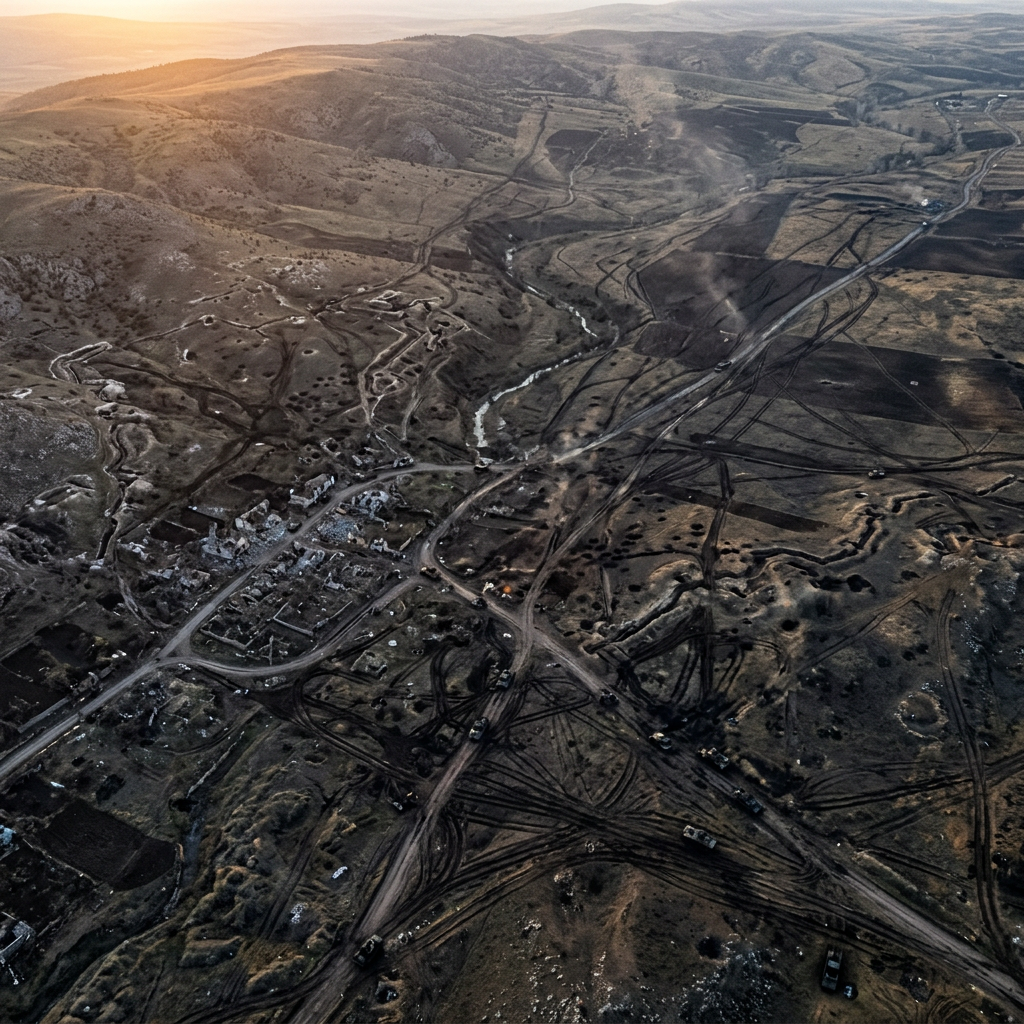
The Russia-Ukraine conflict has become the defining case study in space-enabled modern warfare—what some analysts have called the “first commercial space war.”[^2]
Ukraine entered the conflict with minimal sovereign space assets. What it lacked in indigenous infrastructure, it compensated for through partnerships with commercial providers, effectively renting the high ground of orbit. Over three years of conflict, Ukraine received more than 50,000 Starlink terminals from SpaceX, enabling frontline commanders to maintain communications despite sustained Russian jamming and cyber interference. U.S. company Maxar published satellite imagery capturing a 40-mile convoy of Russian military vehicles northwest of Kyiv—an image that shaped global understanding of the invasion within its opening days. Finnish company ICEYE, operating synthetic aperture radar (SAR) satellites capable of imaging through clouds and at night, provided Ukrainian intelligence services with data on Russian troop concentrations, training grounds, and logistics hubs, denying Moscow the cover of darkness and bad weather.
Satellite imagery also served a purpose beyond the battlefield. It was used to document war crimes—including the word “дети” (children) painted on the ground outside the Mariupol Drama Theater before Russia bombed it—providing evidentiary value for international legal proceedings and diplomatic pressure campaigns. In this way, orbital sensors became instruments of accountability as well as targeting.
The implications for military strategy are significant. As CSIS analyst Kari Bingen concluded in September 2025: “Any nation seeking military or information advantage, or any outgunned nation wanting to level the playing field, can take advantage of the high ground of space.”[^3] The availability of commercial satellite services to any actor with purchasing power has fundamentally altered the calculus of asymmetric conflict. A smaller state no longer needs to launch its own constellation; it needs only a contract and a reliable supplier.
Electronic Warfare and the Vulnerability of Space-Based Systems
Russia’s counterspace efforts in Ukraine have relied primarily on electronic warfare (EW)—reversible, non-kinetic tools that jam or spoof satellite navigation and communications signals. The effects have been significant. GPS jamming reportedly degraded the accuracy of Western-supplied precision munitions, including HIMARS rockets, Excalibur 155mm guided artillery shells, and Joint Direct Attack Munitions (JDAMs), causing them to veer off course.[^4] Weapons designed to strike within meters of their targets suddenly missed by wide margins, forcing Ukrainian forces to adapt their tactics on the fly.
EW has not been confined to the Ukrainian theater. CSIS’s Space Threat Assessment has tracked daily occurrences of GPS jamming and spoofing across the Baltic Sea, the Middle East, and parts of South Asia.[^5] In 2023, the International Federation of Air Line Pilots’ Associations issued warnings to pilots about GPS jamming by Chinese warships over the South China Sea and the eastern Indian Ocean—a reminder that space interference creates civilian hazards well beyond the battlefield. Commercial aircraft, cargo ships, and emergency services all depend on the same signals that militaries now routinely disrupt.
SpaceX responded to Russian jamming attempts with rapid software updates that a U.S. defense official described as “eyewatering” in their speed and effectiveness—contrasting sharply with the slower adaptation cycles of traditional military procurement.[^6] This agility has become a recognized strategic attribute in its own right, and it raises a pointed question for defense establishments: how can slow-moving procurement systems keep pace with adversaries who now iterate at the speed of software?
The Threat Landscape: ASAT Weapons and Nuclear Escalation

Electronic warfare represents one layer of the counterspace threat. Anti-satellite (ASAT) weapons represent another—and potentially far more destabilizing—layer.
On February 13, 2024, the U.S. House Intelligence Committee publicly confirmed that Russia is developing nuclear-armed ASAT weapons designed to destroy or incapacitate adversary satellites in orbit.[^7] A nuclear detonation in space would not merely destroy a single target. It would generate intense electromagnetic effects capable of disabling or damaging dozens to hundreds of satellites across wide orbital zones, including those of neutral nations and even the attacker’s own systems. The United Nations General Assembly has classified such systems as weapons of mass destruction under Resolution 32/84.[^8]
U.S. Space Force Chief of Space Operations General Chance Saltzman has termed the potential operational deployment of Russia’s nuclear ASAT the “Day Zero” scenario—a threshold event that would fundamentally disrupt both military and civilian space infrastructure, from banking networks to weather forecasting.[^9]
ASAT testing has already generated real and lasting consequences. Russia’s November 2021 direct-ascent ASAT test created more than 1,500 pieces of trackable orbital debris, drawing condemnation from U.S. officials and allies who described it as “reckless” and “irresponsible.”[^10] That debris continues to circle the planet, threatening satellites and crewed spacecraft alike—a durable hazard that outlasts the political moment that created it. A total of 16 ASAT tests have been conducted globally since 1959, with the United States, Russia, China, and India all having demonstrated the capability.
China represents a distinct and expansive threat vector. The U.S. intelligence community’s 2025 annual threat assessment concluded that “counterspace operations will be integral to PLA military campaigns, and China has counterspace-weapons capabilities intended to target U.S. and allied satellites.”[^11] PLA doctrine explicitly prioritizes striking adversary command, control, communications, computers, intelligence, surveillance, and reconnaissance (C4ISR) systems early in a conflict—a “blinding” strategy intended to paralyze an opponent before conventional forces engage. By 2025, China had achieved global coverage in some of its ISR satellite constellations—a development that, when paired with AI-enabled targeting systems, enables real-time detection and tracking of naval vessels and military movements across the planet.
The U.S. Response: Space Force Investment and Strategic Doctrine
The United States has responded to these threats with a strategic and budgetary commitment of historic scale.
The Department of the Air Force’s FY2027 budget request, released in April 2026, allocates $71.1 billion to the Space Force alone—a 124% increase from the prior fiscal year.[^12] The request includes:
| Capability Area | Requested Funding | Change from Prior Year |
|---|---|---|
| Satellite communications | $6.7 billion | +60% |
| Missile warning and tracking | $6.8 billion | +70% |
| Space Control systems | $21.6 billion | +158% |
| Cyber warfare for satellite protection | $500 million | New allocation |
| National Security Space Launches | Additional $2.9 billion | 22 procured launches |
Secretary of the Air Force Troy Meink framed the investment as a fundamental shift in posture: “This is not just about maintaining an edge; it is about expanding it.”[^13]
Simultaneously, the U.S. Space Force published a space warfighting framework in April 2025, explicitly emphasizing both offensive and defensive actions to achieve space superiority.[^14] The document marked a notable rhetorical shift, moving away from the language of resilience alone and toward the vocabulary of active competition. The Guardian force is set to grow by 2,800 personnel under the FY2027 proposal, expanding on the 10,000-plus uniformed Guardians reached in 2025—a number the Space Force Association has publicly stated is insufficient for current mission requirements.
Beyond the United States, allies and commercial actors are moving in the same direction. France has outlined plans to develop and field orbital counterspace capabilities, including bodyguard satellites with potential shoot-back systems. Commercial entities are also entering the domain: U.S.-based True Anomaly is developing spacecraft explicitly designed for space superiority missions. The line between government and private capability, already blurred by Ukraine, continues to fade.
International Governance: Frameworks Under Strain
The Outer Space Treaty of 1967 established space as a domain free from national appropriation and restricted the placement of weapons of mass destruction in orbit. For more than five decades, it served as the foundational legal framework for space activities.[^15] Its adequacy for the current environment is now openly questioned. The treaty was drafted in an era of two superpowers and a handful of government-operated satellites; it did not anticipate mega-constellations, commercial warfighting infrastructure, or reversible electronic attacks that fall short of physical destruction.
In April 2024, the United States and Japan proposed a UN Security Council resolution calling on nations to commit to not placing nuclear weapons or weapons of mass destruction in orbit. Russia vetoed the resolution, citing concerns about geopolitical bias.[^16] The New START treaty—which limits strategic nuclear arsenals and whose expiration in 2026 further erodes the arms control framework—is unlikely to be renewed given current bilateral dynamics, removing one of the few remaining guardrails on strategic competition.
The policy community has identified several priority areas for updated norms:
- Prohibitions on deploying nuclear-armed ASAT systems
- Clearer rules governing satellite self-defense
- Transparency and confidence-building measures, including satellite payload disclosures
- Prohibitions on destructive ASAT missile testing, as called for by UN General Assembly Resolution 231 (2023)[^17]
Bilateral or multilateral diplomatic progress on these issues faces structural obstacles, including Russia’s veto power in the Security Council and China’s strategic interest in preserving counterspace ambiguity. Progress remains possible through General Assembly resolutions, which are not subject to Security Council vetoes, and through private diplomatic channels that may offer reciprocal transparency arrangements. History suggests that even limited, verifiable measures—such as debris-mitigation commitments—can build the trust necessary for more ambitious agreements later.
What the Strategic Trajectory Looks Like
The trajectory is clear. Space is no longer a supporting domain for military operations—it is a primary theater of competition and potential conflict. The war in Ukraine has validated this assessment in real time. The budget commitments of major powers confirm it in policy. The active development of ASAT weapons, the daily occurrence of GPS jamming across multiple regions, and the expansion of commercial satellite constellations into wartime roles all point in the same direction.
For policymakers and strategists, the central challenge is not whether to prioritize space—that question is settled. The challenge is how to build resilient architectures, establish credible deterrence, update international norms, and integrate commercial space actors into national security frameworks in a way that reduces escalation risk while preserving operational advantage. Each of these tasks is difficult on its own; pursuing them simultaneously, under the pressure of active competition, is harder still.
Conclusion
The evidence assembled here converges on a single conclusion: space has crossed the threshold from strategic enabler to strategic battleground. The cyberattack that opened the war in Ukraine, the tens of thousands of commercial terminals that sustained Ukrainian communications, the daily jamming that reaches from the Baltic to the South China Sea, and the confirmed development of nuclear-armed anti-satellite weapons are not isolated data points. Together they describe a domain in which conflict is no longer a distant possibility but an operational reality.
The response must be equally comprehensive. Resilience—through distributed constellations, redundant systems, and rapid commercial partnerships—reduces the payoff an adversary can expect from a first strike. Deterrence, communicated clearly and backed by credible capability, raises the cost of aggression. Governance, however imperfect and slow to negotiate, offers the only durable path to constraining the most catastrophic outcomes, particularly the use of nuclear weapons in orbit. None of these lines of effort succeeds in isolation; each reinforces the others.
For decision-makers, the imperative is to act deliberately rather than reactively. The nations that invest early in resilient architectures, articulate coherent doctrine, and lead the diplomatic effort to modernize space norms will shape the rules under which future competition unfolds. Those who defer these choices will inherit rules written by others—or by no one at all. The opening salvo has already been fired from orbit. The question that remains is whether the world’s major powers will manage this new frontier with foresight, or stumble into escalation by default.
Frequently Asked Questions
What is space as a military frontier, and why does it matter now?
Space as a military frontier refers to the growing role of orbital assets—satellites, space-based sensors, and counterspace weapons—in modern warfare and national security strategy. It matters now because virtually every domain of military operations depends on satellite infrastructure. GPS guidance, missile warning, battlefield communications, and intelligence surveillance all rely on space-based systems, making them both critical enablers and high-value targets. The recent war in Ukraine moved this concept from theory to practice, demonstrating in real time how orbital assets shape the outcome of a major conflict.
What counterspace weapons are currently being developed by adversaries?
The primary counterspace threats include direct-ascent anti-satellite (ASAT) missiles, ground-based laser systems, electronic warfare tools that jam or spoof GPS and satellite communications, cyberattacks against satellite networks, and co-orbital systems capable of maneuvering close to and disabling rival satellites. Russia is also developing nuclear-armed ASAT weapons, confirmed by U.S. intelligence in February 2024. China possesses a full suite of counterspace capabilities it intends to integrate into joint military campaigns. These tools span a spectrum from reversible and non-destructive (jamming) to permanently destructive (kinetic strikes and nuclear detonations), giving adversaries a range of escalation options.
How did the Russia-Ukraine war demonstrate the military importance of space?
The Russia-Ukraine war showed that space-based capabilities can serve as decisive force multipliers even for a nation with minimal indigenous space infrastructure. Ukraine used commercial satellite imagery for targeting and intelligence, Starlink terminals for battlefield communications, and SAR satellites to monitor Russian troop movements. Russia’s first act of aggression was a cyberattack against a commercial satellite network, underscoring how satellite infrastructure is now a primary target from the opening moments of conflict. The war also revealed the strategic value of commercial agility, as private providers adapted to jamming far faster than traditional military systems could.
How much is the United States investing in military space capabilities?
The FY2027 U.S. budget request allocates $71.1 billion to the Space Force—a 124% increase from the prior fiscal year. The request includes $21.6 billion for Space Control systems (a 158% increase), $6.8 billion for missile warning and tracking, $6.7 billion for satellite communications, and $500 million for cyber operations to protect satellites. Beyond hardware, the request funds an expansion of the Guardian force by 2,800 personnel, reflecting a recognition that human capital, not just technology, constrains the pace of the buildup.
What international treaties govern military activity in space?
The primary framework is the Outer Space Treaty of 1967, which prohibits the placement of weapons of mass destruction in orbit and restricts certain military activities in space. However, the treaty does not prohibit all military uses of space and does not address many modern counterspace capabilities. Efforts to update norms include UN General Assembly Resolution 231 (2023), which calls for prohibiting destructive ASAT missile testing, and a vetoed 2024 UN Security Council resolution on nuclear weapons in orbit. The gap between the treaty’s Cold War-era assumptions and today’s commercialized, contested environment is at the heart of the current governance debate.
What is the difference between electronic warfare and anti-satellite weapons in the context of space?
Electronic warfare (EW) targets space-derived services—jamming or spoofing GPS and satellite communications signals—without physically destroying the satellite. EW effects are generally reversible and have been widely deployed in Ukraine and elsewhere. Anti-satellite weapons (ASATs) physically destroy or permanently disable satellites, generating debris and creating longer-lasting effects. Nuclear-armed ASATs represent the most extreme category, capable of disabling entire constellations through electromagnetic pulse effects across wide orbital zones. Because EW is reversible and difficult to attribute, it often sits below the threshold of armed conflict, while kinetic and nuclear attacks cross that threshold decisively, carrying far greater escalation risk and longer-lasting consequences.
Bibliography
Bingen, Kari. Remarks on space as strategic “high ground.” Center for Strategic and International Studies, September 2025.
Center for Strategic and International Studies. Space Threat Assessment 2025. Washington, DC: CSIS, September 2025.
Department of the Air Force. Fiscal Year 2027 Budget Request. Washington, DC: Department of the Air Force, April 2026.
Meink, Troy. Statement on Space Force investment posture. Washington, DC: Department of the Air Force, 2026.
Office of the Director of National Intelligence. Annual Threat Assessment of the U.S. Intelligence Community. Washington, DC: ODNI, 2025.
Saltzman, B. Chance. Remarks on the “Day Zero” scenario. Washington, DC: U.S. Space Force, 2024.
United Nations General Assembly. Resolution 32/84. 1977.
United Nations General Assembly. Resolution 231. 2023.
United States and Japan. Proposed UN Security Council resolution on weapons of mass destruction in orbit, April 2024. Vetoed by Russia.
U.S. House Permanent Select Committee on Intelligence. Public disclosure on Russia’s development of nuclear-armed anti-satellite weapons. February 13, 2024.
U.S. Space Force. Space Warfighting: A Framework for Planners. April 2025.
Treaty on Principles Governing the Activities of States in the Exploration and Use of Outer Space (Outer Space Treaty). 1967.
Endnotes
- Center for Strategic and International Studies, Space Threat Assessment 2025 (Washington, DC: CSIS, September 2025), noting U.S. reliance on space systems since Operation Desert Storm in 1991.
- Center for Strategic and International Studies, Space Threat Assessment 2025, characterizing the Russia-Ukraine conflict as the “first commercial space war.”
- Kari Bingen, remarks on space as the “high ground” available to any nation seeking military or information advantage, Center for Strategic and International Studies, September 2025.
- Reporting on Russian GPS jamming degrading the accuracy of Western-supplied precision munitions, including HIMARS rockets, Excalibur 155mm guided artillery shells, and Joint Direct Attack Munitions (JDAMs).
- Center for Strategic and International Studies, Space Threat Assessment 2025, documenting daily GPS jamming and spoofing across the Baltic Sea, the Middle East, and South Asia.
- Statement by a U.S. defense official describing SpaceX’s software-update response to Russian jamming as “eyewatering” in speed and effectiveness.
- U.S. House Permanent Select Committee on Intelligence, public disclosure of Russia’s development of nuclear-armed ASAT weapons, February 13, 2024.
- United Nations General Assembly, Resolution 32/84 (1977), classifying such systems as weapons of mass destruction.
- Gen. B. Chance Saltzman, Chief of Space Operations, U.S. Space Force, remarks on the “Day Zero” scenario.
- U.S. and allied condemnation of Russia’s November 2021 direct-ascent ASAT test, which generated more than 1,500 pieces of trackable orbital debris.
- Office of the Director of National Intelligence, Annual Threat Assessment of the U.S. Intelligence Community (Washington, DC: ODNI, 2025), on PLA counterspace operations and capabilities.
- Department of the Air Force, Fiscal Year 2027 Budget Request (April 2026), allocating $71.1 billion to the U.S. Space Force.
- Troy Meink, Secretary of the Air Force, statement on Space Force investment posture.
- U.S. Space Force, Space Warfighting: A Framework for Planners (April 2025).
- Treaty on Principles Governing the Activities of States in the Exploration and Use of Outer Space (Outer Space Treaty), 1967.
- United States and Japan, proposed UN Security Council resolution on weapons of mass destruction in orbit, April 2024, vetoed by Russia.
- United Nations General Assembly, Resolution 231 (2023), calling for a prohibition on destructive direct-ascent ASAT missile testing.
Discover more from Responsible Public Affairs
Subscribe to get the latest posts sent to your email.