
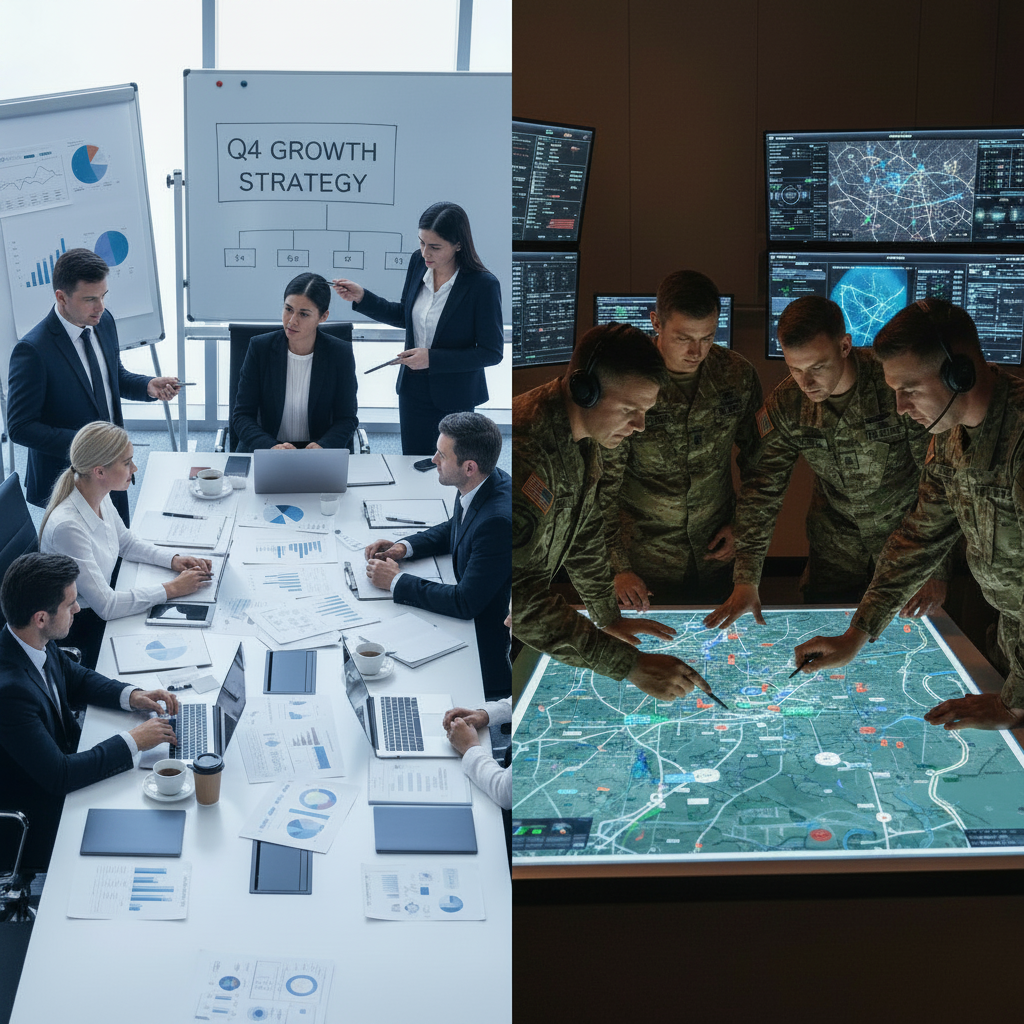
Is leading a business truly like commanding an army? It’s a question that has sparked debate among leaders, strategists, and thinkers for generations. From the ancient battlefields mapped by Sun Tzu to the high-stakes boardrooms of the modern era, the urge to draw lessons from war and apply them to commerce has been irresistible. Time and again, business executives have quoted the likes of Machiavelli, searching for the perfect blend of cunning and pragmatism to outmaneuver rivals. But while these connections are insightful, they often overlook what’s most human and consequential about both domains.
In war, historic leaders faced decisions that determined not only the fate of armies but the lives of nations and individuals. The outcomes were deeply personal and often irreversible. In the business world, leaders also navigate environments filled with uncertainty and risk, but their mistakes, while costly, rarely carry the weight of existential consequence. A bold innovation that fails may cost millions and careers, but a strategic error in battle can mean lives lost and futures altered forever.
Ultimately, both business and military leaders must marry strategic vision with real empathy, balancing ambition with a clear-eyed awareness of the impact their choices have on people. It is this blend of purposeful strategy and genuine human concern that spells the difference between fleeting success and lasting legacy.
By tracing the arc of strategic thinking from the fog-shrouded campaigns of antiquity to the fast-paced, interconnected theaters of today, we discover that true leadership is as much about human understanding as it is about tactical brilliance. The greatest strategists—whether guiding armies or steering corporations—have always paired sharp analytical minds with genuine empathy and foresight. To lead, compete, and ultimately win in any era, leaders must read the pulse of their times, recognize the hopes and fears of those they guide, and chart a path that fuses long-term vision with real, lasting impact. This journey through history and into our present demonstrates that winning is not just about outmaneuvering adversaries, but about inspiring trust, resilience, and shared purpose among people.
To lead with true impact—whether in a commanding officer’s uniform or an executive’s suit—requires more than tactical know-how; it demands a profound respect for the legacy of strategic thought shaped by countless generations. Strategy is more than a series of plans or bold moves—it is the product of human experience, resilience, and a desire to shape the future for those we serve. Throughout history, leaders have faced the daunting challenge of navigating uncertainty and risk, relying on strategic planning to chart courses through chaos, inspire confidence in their teams, and make decisions with consequences far beyond themselves. Whether marshaling troops on ancient battlefields or making high-stakes calls in today’s global boardrooms, the principles of vision, adaptability, and empathy endure. They serve as a compass, reminding us that leadership is about far more than winning; it’s about forging paths that empower, protect, and inspire people in every era.
Throughout history, legendary military thinkers like Sun Tzu and Carl von Clausewitz understood that true strategy was far more than battlefield maneuvers—it demanded a unique blend of creative intellect, emotional intelligence, and operational detail. They emphasized not only deception, adaptability, and intelligence, but also the critical importance of understanding both the strengths and vulnerabilities of people. The Roman Empire offers a vivid example: its greatest successes stemmed from leaders who paired daring vision with disciplined logistics, weaving together vast supply chains, resilient infrastructures, and a shared cultural identity to support their campaigns and unify far-reaching territories.
As the world shifted into the industrial age during the nineteenth and twentieth centuries, the very nature of conflict and strategy evolved. Wars were no longer won by courage alone; they demanded systematic planning, unprecedented coordination, and innovative technologies. These sweeping changes in military doctrine reflected a growing realization: success depended as much on foresight, communication, and the ability to inspire collective effort as it did on raw power.
This rich heritage reminds us that strategic mastery—on the battlefield or in the boardroom—is inseparable from the human experience. Whether guiding legions across continents or leading a team through market turbulence, the most effective leaders draw not just on strategic principles, but on empathy, vision, and the will to serve something greater than themselves.
Business strategy, though born from the marketplace rather than the battlefield, has long been shaped by the lessons and legacies of military thinking. The industrial pioneers saw the value in military-style hierarchies and command structures, building organizations where top-down leadership and decisive action reigned supreme. Yet as history unfolded, and new challenges emerged in the post-war and digital eras, business leaders learned to embrace adaptability and collaboration. Modern enterprises shifted away from rigid chains of command toward agile, networked models that echo the decentralized tactics favored by innovative military strategists. This evolution reflects a deeply human truth: successful leadership—regardless of context—demands not only the ability to outthink and outmaneuver competitors, but also the wisdom to adapt, empathize, and unite people in pursuit of shared goals.
Today’s leaders—whether they wear medals or business suits—navigate an environment more complex and unpredictable than ever before. In the military, the rise of hybrid warfare and cyber threats has redefined what it means to defend a nation; for business, digital disruption, evolving global supply chains, and activist stakeholders create extraordinary volatility. Amid these challenges, what sets truly effective leaders apart is not just their ability to anticipate the next move, but their capacity to adapt swiftly, communicate authentically, and care deeply about those they serve. Whatever the arena, success now depends on setting clear objectives, making agile decisions, and reading the broader currents that shape each new threat or opportunity. The timeless core of strategy—a steady blend of vision, flexibility, and a keen sensitivity to human needs—remains as vital today as it was on the ancient battlefield.
The Commonalities: Strategic Logic and Resource Management
At their essence, both military and business strategies draw from a common pool of principles: they are driven by clear goals, rely on the smart allocation of limited resources, and depend on the power of information to stay one step ahead of the competition. Whether the mission is conquering new markets or securing territory, the heartbeat of strategy remains the same—clarity of purpose, resourcefulness, and the relentless pursuit of meaningful intelligence. What makes these pursuits not just tactical but truly compelling is the human dimension: the ingenuity and determination of those who plan, the trust and collaboration built within teams, and the ethical choices made under pressure. In both arenas, strategic success isn’t just measured by outcomes, but by how leaders inspire confidence, adapt to uncertainty, and recognize the profound impact their decisions have on people’s lives.
- Intelligence and Resource Optimization: Just as Allied forces in World War II relied on the rapid development of radar technology to detect threats and allocate defense resources effectively, modern corporations rely on data analytics to anticipate market shifts.
- Adaptability in Strategic Alignment: Traditional models of planning often fail when conventional tactics meet unconventional threats. During the Vietnam War, the U.S. military initially utilized standard warfare methods but struggled significantly against the guerrilla tactics of the Viet Cong. The inability to adapt swiftly to the local context proved detrimental. In business, failing to align strategic execution with shifting environmental realities results in rapid obsolescence.
- Calculated Risk for Decisive Advantage: The Manhattan Project (1942–1945) illustrates the ultimate high-risk, high-reward resource allocation. It required massive scientific, financial, and organizational mobilization. While it provided a decisive end to the war, it also introduced the complex era of nuclear proliferation. Businesses make similar, albeit less lethal, bets on disruptive innovation to secure market dominance.
Leadership and Decision-Making: The Human Element
In both military and business arenas, the quality of leadership often reveals itself most clearly in moments of volatility, uncertainty, and high stakes. Decision-making is rarely a matter of simply following the playbook; instead, it demands a rare blend of sharp intuition, seasoned experience, and the humility to listen and adapt when the situation shifts. The rise of hybrid strategies—where economic leverage, digital influence, and traditional force intertwine—means that today’s leaders can no longer box themselves into outdated categories of “general” or “CEO.” They must become both visionary architects and pragmatic problem-solvers, drawing lessons from the past but firmly rooted in the fast-changing landscape of the present.
What brings these worlds together is the deeply human element of strategy. Whether confronting a crisis in the boardroom or responding to threats in a conflict zone, leaders shoulder the heavy responsibility of guiding others through complexity and risk. They must balance analytical thinking with empathy, ambition with ethical diligence, and speed with reflection. The most successful leaders, in any domain, are those who earn trust—not only through results but through integrity, resilience, and their ability to inspire collective confidence when the path forward is unclear.
Case Study: The Iran–US Conflict—Leadership Strategies Under Pressure
Nowhere is the convergence and divergence of business and military strategy clearer than in the unfolding story of the Iran–US conflict, particularly during the Trump administration’s “maximum pressure” campaign. This chapter in contemporary history offers a vivid, real-world example of leadership under extreme duress—where the methodologies of the boardroom and battlefield intertwine, yet the consequences could not be more profound.
At its core, this confrontation showcased how leaders draw on a hybrid toolkit—combining swift economic sanctions, public messaging, intelligence gathering, and agile maneuvering—to influence outcomes without direct warfare. The U.S. acted with the determination of a CEO guarding a company’s market dominance, enacting sanctions to cut off Iran’s vital economic lifelines and deploying diplomatic communication at a global scale. At the same time, military readiness and the threat of escalation loomed constantly in the background, with decision-makers acutely aware that a miscalculation could have devastating human consequences.
For both American and Iranian leaders, the stakes were deeply personal and inherently complex. Decisions had to balance national security, international reputation, and the daily realities of ordinary people—families, workers, and communities whose livelihoods and futures hung in the balance. In this high-pressure environment, effective leadership was defined not just by strength, but also by empathy, nuance, and strategic patience.
What truly distinguished this modern contest was its adaptability: both sides leveraged not only traditional tactics but also cyber capabilities, strategic alliances, and grassroots influence. Iran’s use of asymmetric strategies and America’s blend of diplomatic and economic tools illustrated that in today’s world, leadership means being flexible, forward-thinking, and relentlessly attentive to the human impact of every move.
This case study serves as a powerful reminder: in both business and military affairs, leaders are ultimately responsible not simply for competitive outcomes, but for the real lives shaped by their choices. The lessons of the Iran–US conflict reinforce that lasting leadership is forged in the crucible of uncertainty—where vision, adaptability, and humanity must go hand in hand.
At the core of this high-stakes campaign was a deliberate and skillful use of economic sanctions—transforming financial leverage into a form of non-military power. Much like a determined CEO protecting their company’s market dominance, the US government targeted Iran’s economic lifelines, from oil exports to international banking channels and access to critical technologies. Every move was calculated to apply maximum pressure, aiming to bring Iran to the negotiating table without resorting to open conflict.
Yet, behind these complex maneuvers lay deeply human motivations—a desire to safeguard national security, prevent violence, and steer toward a diplomatic solution. The leaders orchestrating these policies were not just strategizing over resources and numbers; they were weighing the livelihoods, aspirations, and futures of millions. Their decisions reverberated beyond headlines and geopolitical analysis, touching real families, shaping communities, and influencing the trajectory of two nations. In this way, leadership in such moments becomes both profoundly personal and unavoidably consequential—demanding empathy, resolve, and an unwavering focus on the human cost entwined with every strategic aim.
Yet, while these tactics reflected the calculated discipline of business strategy, the stakes remained undeniably high and deeply human. Leaders walked a constant tightrope, tasked with safeguarding national interests and global stability in the face of real and present danger. The shadow of potential armed conflict loomed large, especially in volatile regions like the Strait of Hormuz, where decisions made in seconds could alter countless lives. In these tense moments, both American and Iranian leaders drew on every tool at their disposal—intelligence gathering, nuanced scenario planning, and rapid response protocols—mirroring the pressure-cooker environment faced by top executives confronting existential threats to their organizations. Ultimately, what set these leaders apart was not just their strategic acumen, but their resilience, judgment, and empathy under fire; they understood that each choice reverberated far beyond geopolitical headlines, touching families, economies, and futures on both sides of the conflict.
What truly set this conflict apart was the sophisticated fusion of old and new forms of strategy. The U.S. administration deftly wielded public digital diplomacy—delivering global messages in real time through platforms like Twitter—while simultaneously conducting traditional intelligence-gathering and carefully calibrated military maneuvers behind the scenes. Iran, on the other hand, demonstrated the power of ingenuity under pressure, deploying asymmetric tactics that ranged from cyber attacks to influencing regional proxies. Their approach blended the resourceful adaptability of guerrilla warfare with the disciplined management required to sustain a nation facing sweeping external constraints.
Throughout this tense standoff, leaders on both sides were called to balance bold innovation with caution, strategic clarity with deep empathy for those affected by their decisions. In the end, the Iran–US conflict serves as an urgent reminder that modern leadership, whether in the war room or the boardroom, demands far more than mastery of tactics—it requires vision, resilience, the courage to adapt, and above all, a steadfast commitment to the people whose lives are shaped by every move.
In the end, the “maximum pressure” era demonstrated that exceptional leadership—whether in the corridors of civilian power or the military chain of command—hinges not on choosing between hard and soft power, but on integrating them with discernment and humanity. This period serves as a vivid reminder that the most effective leaders possess the courage to adapt, the wisdom to weigh ethical complexities, and the empathy to see beyond immediate outcomes. By drawing from both boardroom strategy and battlefield resilience, today’s leaders are called to navigate an unpredictable global landscape—one where a single decision can alter countless lives and the course of history. More than ever, successful leadership demands an unwavering commitment to ethical principles and a deep awareness of the human impact woven through every strategic choice.
The Great Divide: Existential Stakes vs. Economic Objectives
Although business and military leaders may use similar tactics and analytical tools, the stakes they navigate are worlds apart. This distinction is at the heart of why adapting corporate strategies directly to military conflicts often falls short. In the military sphere, every move can carry consequences that reverberate through generations—lives are at risk, national security hangs in the balance, and decisions must be calibrated with the utmost gravity. In business, while the outcomes of bold innovations or failed ventures may change careers or shift markets, the margin for error is measured in fortunes, not lives.
What unites these domains is the weight of responsibility leaders bear—but what sets them apart is the unique intensity and irrevocability of military choices. To lead in these high-stakes environments is to shoulder not only strategy but legacy, to remember that behind every plan or pivot are the hopes, fears, and futures of real people. Recognizing this profound difference underscores why wise leaders approach each context with humility, empathy, and a deep sense of accountability for the impacts of their decisions—now and far into the future.
Existential Risks vs. Calculated Bets
Military actions frequently carry existential risks. During the 1962 Cuban Missile Crisis, leaders faced a nuclear standoff where strategic positioning (a naval blockade) and backchannel negotiations were required to prevent global catastrophe. The ethical frameworks governing these decisions are heavily constrained by the potential for mass human loss and international law.
In contrast, business strategy centers on economic goals and the quest for market relevance. Decisions like Microsoft’s $26 billion acquisition of LinkedIn—while major by any standard—are ultimately gambles that test vision and risk tolerance, not life or death. When Tesla, guided by Elon Musk’s ambition, pushed to lead the electric vehicle revolution, or Airbnb upended the traditional hospitality model, their leaders exercised daring and ingenuity to capture new opportunities. For these companies, victory is measured in profits, growth, and influence—outcomes that, while impactful, are woven into the fabric of commerce, not survival itself. This competitive pursuit creates a more flexible moral and ethical landscape, where the consequences of failure, though significant, seldom carry irreversible human cost. Yet behind every triumph or setback are teams, families, and communities whose lives can be transformed. Even in business, the stakes are deeply human—reminding us that leadership, at its best, means elevating both performance and people.
Managing Volatile Stakeholder Sets
Military leaders navigate a landscape defined by ever-shifting alliances, unpredictable global actors, and the profound responsibility of safeguarding entire populations. A decision made in the heat of conflict can shape the course of nations and alter the destinies of countless individuals. In contrast, business leaders manage a different, yet equally complex, constellation of stakeholders—shareholders, employees, regulators, and consumers—most of whom operate within the frameworks of economic self-interest and legal guidelines. While a botched product launch might end a CEO’s career or impact a company’s trajectory, a single miscalculation in military command can destabilize regions, disrupt generations, and leave a legacy far heavier than any corporate loss. Both arenas demand leaders who engage with extraordinary complexity, but the scale and immediacy of the human consequences in military strategy serve as a sobering reminder of the immense weight carried by those at the helm. It’s this stark reality that calls for leadership grounded not only in strategic brilliance, but in unwavering empathy, foresight, and a deep commitment to the well-being of all people whose lives are touched by their decisions.
The Verdict on Cross-Domain Strategy
Although business frameworks like SWOT analysis or Porter’s Five Forces have their merits—even offering valuable insight to defense strategy—the heart of effective leadership lies deeper. At its core, strategy, whether exercised in a boardroom or on a battlefield, is fundamentally about serving people: nurturing their hopes, safeguarding their futures, and building their capacity to adapt and thrive. Leaders in both domains inevitably encounter moments where hard data and logic intersect with the complex realities of human lives, and the repercussions of a single decision can extend far beyond spreadsheets or tactical maps.
The most exceptional leaders are those who never lose sight of this vital human dimension. They balance calculated ambition with authentic empathy, pairing vision and courage with humility and care. By thinking beyond charts and goals—by remembering the real lives behind every directive—they elevate strategy from a sequence of moves into a meaningful pursuit that builds trust, inspires resilience, and uplifts entire communities. In doing so, they not only sharpen their competitive edge but also ensure that the legacy of their leadership is measured not just in victories won, but in lives positively transformed.
As we move forward, it’s essential to deepen our appreciation of strategy—not merely as a collection of clever analogies, but as a living discipline that shapes real lives. Business leaders can certainly draw inspiration from the courage, adaptability, and resourcefulness that define military history. Yet, their true challenge is to channel these qualities toward building, innovating, and empowering, rather than conquering or destroying. In the world of commerce, every strategic decision is an opportunity to create value, nurture human potential, and leave a positive impact that endures. By grounding our approach in empathy and a clear sense of purpose, we can transcend tactics and focus on what matters most: enriching the lives of those we lead and serve.
We encourage you to reflect with your team: In what ways have the principles of military strategy shaped your organization’s approach to competition, collaboration, and leadership? Consider how lessons in adaptability, resilience, and ethical decision-making from history’s greatest strategists could inform your next move. By openly discussing these parallels, you not only foster a culture of thoughtful analysis and growth, but also empower your organization to evolve with purpose and humanity in an ever-changing world.
References
- Sun Tzu. The Art of War. Translated by Samuel B. Griffith, Oxford University Press, 1963.
- Carl von Clausewitz. On War. Translated by Michael Howard and Peter Paret, Princeton University Press, 1976.
- Machiavelli, Niccolò. The Prince. Translated by Peter Bondanella, Oxford University Press, 2005.
- Porter, Michael E. Competitive Strategy: Techniques for Analyzing Industries and Competitors. Free Press, 1980.
- Ketchen, David J., and Donald D. Bergh, editors. Research Methodology in Strategy and Management. Emerald Group Publishing, 2004.
- Collins, Jim. Good to Great: Why Some Companies Make the Leap… and Others Don’t. HarperBusiness, 2001.
- Freedman, Lawrence. Strategy: A History. Oxford University Press, 2013.
- Mintzberg, Henry, Bruce Ahlstrand, and Joseph Lampel. Strategy Safari: A Guided Tour through the Wilds of Strategic Management. Free Press, 1998.
- Gray, Colin S. Modern Strategy. Oxford University Press, 1999.
- Rumelt, Richard. Good Strategy/Bad Strategy: The Difference and Why It Matters. Crown Business, 2011.
- Allison, Graham, and Philip Zelikow. Essence of Decision: Explaining the Cuban Missile Crisis. 2nd ed., Addison-Wesley, 1999.
- Wright, Lawrence. The Looming Tower: Al-Qaeda and the Road to 9/11. Vintage, 2007.
- Sanger, David E. The Perfect Weapon: War, Sabotage, and Fear in the Cyber Age. Crown, 2018.
- Kagan, Frederick W. The Art of War in the Western World. Random House, 1999.
- Gladwell, Malcolm. The Tipping Point: How Little Things Can Make a Big Difference. Little, Brown, 2000.
- U.S. Department of State. “Maximum Pressure Campaign against Iran.” 2018–2021. https://www.state.gov/maximum-pressure-campaign-against-iran/
- Slack, Nigel, Stuart Chambers, and Robert Johnston. Operations Management. 8th ed., Pearson, 2016.
- Lebow, Richard Ned, and Janice Gross Stein. We All Lost the Cold War. Princeton University Press, 1994.
- Harvard Business Review. “What CEOs Can Learn from Military Commanders.” March 2012. https://hbr.org/2012/03/what-ceos-can-learn-from-military-commanders
- BBC News. “Iran-US tensions: Timeline of events.” 2021. https://www.bbc.com/news/world-middle-east-48113761
- Bremer, Ian. Us vs. Them: The Failure of Globalism. Portfolio, 2018.
Further references to historical case studies, business innovation frameworks, and contemporary geopolitical events can be found in public archives, academic publications, and major news outlets cited above.
#businessstrategies; #militarystrategies; #strategicplanning; #corporateboardroom; #militarycommandcenter; #decisionmaking; #resourcemanagement; #strategycomparison; #leadership; #tacticaloperations; #innovation; #competitiveanalysis; #intelligencegathering; #visionaryleadership; #adaptability; #riskmanagement; #organizationalstrategy; #teamcollaboration; #goalsetting; #strategicthinking; #problem-solving; #executiveleadership; #operationalplanning; #crisismanagement; #stakeholdermanagement; #strategicalignment; #hybridstrategies; #historicalanalysis; #ethicaldecisionmaking; #resourceoptimization
@RANDCorporation; @BrookingsInst; @CSIS; @AtlanticCouncil; @Heritage; @CFR_org; @HooverInst; @AEI; @CNASdc; @Stratfor; @IDFSpokesperson; @INSSIsrael; @ICT_org; @BeginCenter; @ElbitSystemsLtd; @IAIIsrael; @Dassault_OnAir; @ThalesGroup; @Safran; @NATO; @EUDefenceAgency; @EuropeanCouncil; @EuropeanParliament; @IRSEM1; @Fondapol; @IFRI_; @CEIS_Europe; @ChathamHouse; @IISS_org; @RUSI_org; @CarnegieEndow; @WilsonCenter; @MIT_CISR; @HarvardHKS; @StanfordCISAC; @YaleJackson; @PrincetonSPIA; @SciencesPo; @TelAvivUni; @HebrewU; @SorbonneParis1; @EcolePolytechnique; @ENAFrance; @USArmy; @USNavy; @USAirForce; @MarineCorps; @PentagonPresSec; @DeptofDefense; @StateDept; @WhiteHouse; @Elysee; @IsraelMFA; @IsraeliPM; @EU_Commission; @UNPeacekeeping; @UNDP; @WorldBank; @IMFNews; @OECD; @WEF; @ICRC; @Amnesty; @HRW; @TransparencyIntl; @GlobalStrategy
Discover more from Responsible Public Affairs
Subscribe to get the latest posts sent to your email.