
Title Tag
Skills-Based Organization Guide for the Future
Meta Description
Learn how a skills-based organization drives the future of work with smarter talent strategies, internal mobility, and AI workforce transformation.
Executive Summary
The move toward a skills-based organization is no longer just a bold idea for innovation teams. It is becoming a practical response to a simple reality: work is changing faster than traditional job structures can keep up. As automation grows, business needs shift, and employee expectations evolve, organizations need a more flexible way to organize work, develop people, and stay competitive.
This article explains why a skills-centric workforce is becoming a stronger alternative to rigid, job-based systems. It looks at how organizations can break work into tasks, match people to opportunities based on capability, and use AI workforce transformation tools to make talent decisions more effectively at scale. It also explores HR’s expanding role in redesigning hiring, learning, internal mobility, and workforce planning around skills instead of static titles.
For leaders in HR, strategy, operations, and transformation, the takeaway is clear: companies that build a dynamic view of skills will be better prepared to respond to disruption, grow internal talent, and create a more resilient business. Those that continue relying mainly on job titles and fixed hierarchies may find it harder to keep pace with the future of work.
Key Takeaways
- A skills-based organization gives companies a more agile way to organize work than a traditional job-based model.
- The future of work depends on breaking roles into tasks, capabilities, and business outcomes.
- AI workforce transformation helps organizations identify skills, match talent to work, and personalize learning.
- Modern talent management needs to shift from static job frameworks to dynamic skills deployment.
- HR plays a central role in building internal mobility, redesigning learning, and aligning rewards with high-value capabilities.
- Internal talent marketplaces and better skills visibility can improve workforce resilience, retention, and adaptability.
- Ethical AI, transparent governance, and employee trust are essential for scaling a skills-powered model.
- Organizations need a clear North Star to guide long-term workforce transformation and skills-based planning.
Why Skills-Based Organizations Are Replacing Traditional Job Models
A skills-based organization is becoming a better fit for companies operating in fast-changing environments. Traditional job structures were designed for stability. Today, most businesses need speed, flexibility, and a clearer view of what their people can actually do.
A job title may tell you where someone sits on an org chart or pay band, but it rarely reflects the full range of their abilities. That gap creates problems across hiring, development, internal mobility, and workforce planning. When leaders rely too heavily on fixed roles, they often miss chances to redeploy talent, close skills gaps faster, and respond to shifting business demands.
That is why so much of the conversation about the future of work has moved toward skills. Leading institutions focused on labor market change, including the World Economic Forum future of work agenda, have highlighted adaptability, reskilling, and human capability as critical in an AI-driven economy. IBM, for example, has publicly supported skills-based hiring by removing some degree requirements for many roles, widening access to talent based on demonstrated ability rather than pedigree alone.
The Limits of Job-Based Workforce Design
The traditional model assumes work is stable enough to fit neatly into fixed roles. That assumption no longer holds. Automation can eliminate some tasks, expand others, and create entirely new work in a matter of months.
As a result, organizations need to manage work at the level of tasks and capabilities, not just titles. A skills-centric workforce gives leaders a more accurate view of how value is created and where talent can move next. For example, a customer support role may now include product troubleshooting, data interpretation, and AI-assisted service workflows, making the old one-title-fits-all model far less useful than a skills map.
Why Skills Are a Better Unit of Workforce Value
Skills offer a more flexible way to understand both work and people. They help leaders answer practical questions such as:
- What capabilities do we already have?
- Which skills are becoming more important?
- Where can we redeploy talent internally?
- What should be automated, augmented, or redesigned?
- Which adjacent skills can employees build quickly?
This approach strengthens talent management because it connects workforce decisions directly to business needs instead of locking people into narrow role definitions. A retailer preparing for e-commerce growth, for instance, may realize that store employees already have transferable strengths in customer service, sales, and problem-solving that can support digital service or inside sales roles.
What a Skills-Centric Workforce Looks Like in Practice
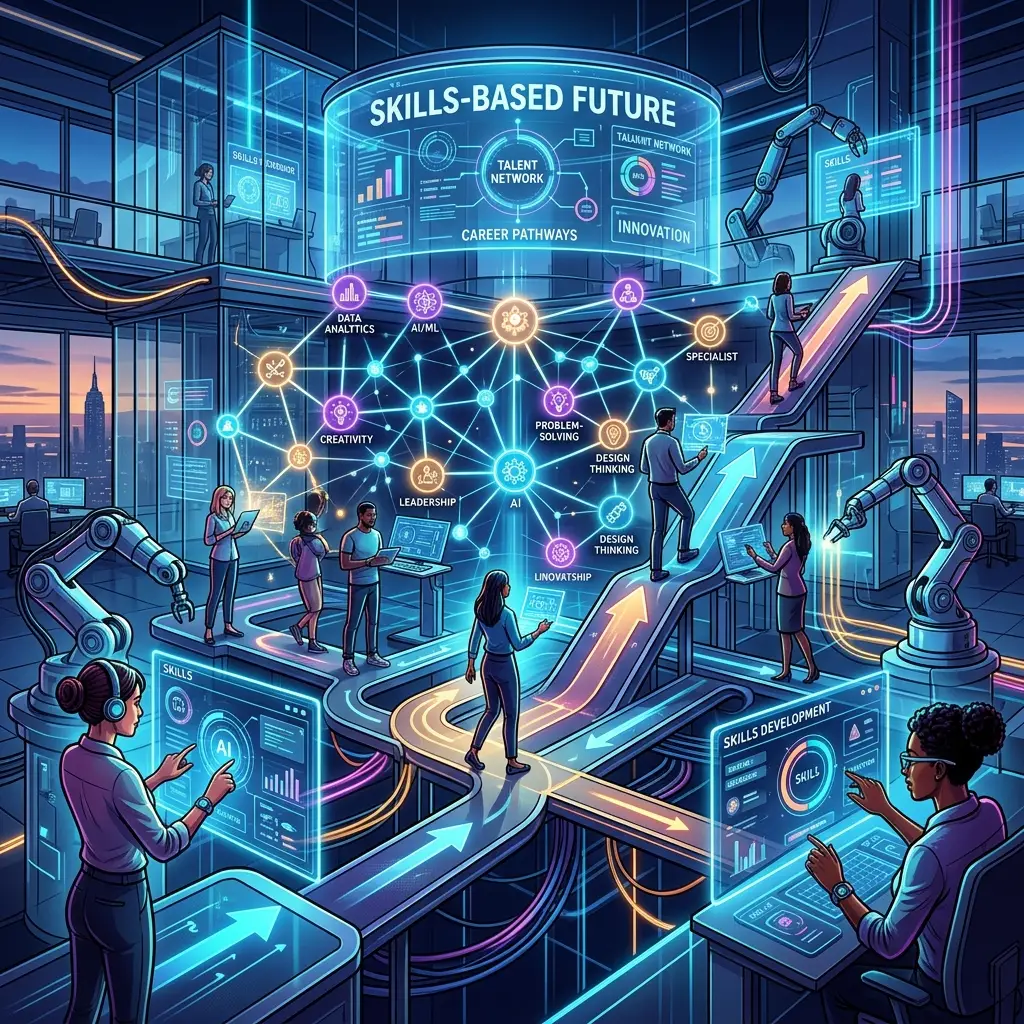
A skills-centric workforce treats skills as the core currency of work. Instead of organizing every talent decision around jobs, organizations start with capability, potential, and business demand.
That shift changes how companies hire, develop, deploy, and reward people. Hiring focuses more on demonstrated ability and learning potential. Development becomes more personal. Career growth expands beyond the traditional ladder. Internal opportunities become easier to find and access. Unilever, for example, has been widely cited for using digital talent marketplace practices to connect employees to project work and growth opportunities across the business.
From One Job Role to Many Work Opportunities
In a job-based model, one person usually equals one job. In a skills-based model, one person can contribute across projects, stretch assignments, internal gigs, and changing business priorities.
This creates a more dynamic relationship between people and work. It also gives employees more control over their growth. Someone is no longer limited by a narrow job description if they have the skills to contribute elsewhere. In practice, that might mean a financial analyst joining a sustainability project because they bring data storytelling, forecasting, and stakeholder communication skills that matter beyond finance.
Human Skills That Matter Most in the Future of Work
Technical skills still matter, but they are only part of the story. As AI takes on more routine tasks, organizations will place even greater value on capabilities that transfer across roles and industries, including:
- Critical thinking
- Creativity
- Emotional intelligence
- Digital fluency
- Judgment
- Curiosity
- Adaptability
- Collaboration
These are the capabilities often highlighted in AI and workforce transformation research because they help people work effectively with technology while bringing the human insight machines cannot replace. A manager reviewing AI-generated recommendations, for example, still needs judgment, context, and communication skills to make a sound decision.
Skills-Based Organization Models: Fixed, Flexible, and Flow
Not every company will move to a fully dynamic skills model at the same speed. Most organizations evolve through one of three workforce models.
Comparing Skills-Based Organization Models for the Future of Work
Fixed Model
The fixed model keeps traditional jobs at the center. It works best in environments where stability, control, and compliance matter more than speed.
This model can still be useful in heavily regulated settings, but it often limits internal mobility because talent stays tied to formal roles. A hospital, for example, may keep tightly defined licensed roles while still using limited skills data for training and staffing support.
Flexible Model
The flexible model blends formal roles with more dynamic deployment. Companies begin using skills data, project-based work, and internal mobility programs without fully redesigning the organization.
For many businesses, this is the most practical bridge between legacy structures and a more modern skills-based organization. A global bank, for example, might keep core role structures in place while using internal project marketplaces to staff digital transformation, data governance, or customer experience initiatives.
Flow Model
The flow model is built for fast-moving environments. Work is allocated more dynamically, often with help from internal talent marketplaces, AI-driven matching, and continuous learning systems.
This model is most closely linked to advanced AI workforce transformation strategies. Firms exploring a Mercer skills-based organization framework or similar workforce redesign approaches often move in this direction because it provides better visibility into the supply and demand for skills. Technology companies and consulting firms often operate closer to this model, moving employees between client work, innovation efforts, and growth areas based on changing capability needs.
How AI Workforce Transformation Powers a Skills-Based Organization
A true skills-based organization becomes much more effective when supported by AI. Without technology, it is difficult to track skills across a large workforce, spot emerging gaps, and connect people to opportunities at scale.
AI changes that by turning fragmented talent data into useful insight.
How AI Identifies and Infers Skills
Many companies still rely on outdated resumes, annual reviews, or static HR records. AI can analyze work history, learning activity, profiles, and role requirements to infer likely skills and identify growth areas.
This creates a more current view of workforce capability and improves the quality of talent management decisions. For example, AI may recognize that a project manager who has led system rollouts, vendor coordination, and cross-functional workshops likely has adjacent skills relevant to change management or operations transformation.
How AI Matches People to Work Faster
When work is broken into tasks, projects, or gigs, AI can help match people to the right opportunities based on existing skills, adjacent capabilities, and learning potential.
This is one of the clearest benefits of AI workforce transformation. Internal mobility often stalls because organizations cannot clearly see the talent they already have. AI helps solve that visibility problem. Schneider Electric and Unilever, for example, have both been associated with internal talent marketplace approaches that improve access to projects and opportunities by making workforce capabilities easier to identify and use.
Organizations studying Mercer workforce transformation insights and other enterprise talent models often focus on this exact challenge: aligning skills supply with business demand in real time.
How AI Personalizes Learning and Career Development
Generative AI and adaptive learning systems can recommend training, create personalized learning content, and support development plans tailored to each employee’s goals.
That matters because real workforce transformation depends on learning that is timely, relevant, and connected to actual work. In a skills-based model, development does not sit off to the side. It happens within the flow of work. For example, an employee moving from operations into data analysis might receive a personalized learning path focused on Excel automation, dashboard design, and business storytelling instead of being assigned a broad, generic training catalog.
Why AI Increases the Value of Human Judgment
As AI becomes more capable, human strengths become more valuable, not less. Employees need to know how to evaluate outputs, spot bias, ask better questions, and make sound decisions in complex situations.
That is why the strongest future of work strategies combine AI capability with deeper investment in human skills. In hiring, for instance, AI may help shortlist candidates based on capability signals, but human recruiters still need to assess fit, fairness, and context.
Why Talent Management Must Shift from Jobs to Skills
Modern talent management cannot work well on a job-only framework. If organizations want to become more adaptive, they need to redesign the systems that shape workforce decisions.
That means changing how companies hire, develop, deploy, and reward talent.
Skills-Based Hiring for Capability, Not Just Credentials
A skills-based hiring model looks beyond narrow credentials and traditional filters. It focuses on demonstrated ability, transferable skills, and readiness to learn.
This can widen access to talent and help organizations build more inclusive pipelines. It also supports better alignment between hiring and actual business need. IBM and Accenture are often mentioned in discussions of skills-first hiring because they have highlighted capability, certifications, and practical experience in many talent pathways.
Learning and Development Aligned to Real Skill Demand
Learning and development need to move beyond generic training catalogs. Employees need practical development tied to current work, emerging opportunities, and adjacent capabilities they can build next.
This is one reason skills-based talent management is gaining traction. It connects development to business value instead of treating learning as a separate activity. AT&T’s large-scale reskilling efforts are a useful example of aligning learning investment to future business needs, especially in technology and digital roles.
Internal Mobility as a Workforce Growth Engine
A strong skills model makes internal movement easier. Employees can contribute to cross-functional projects, stretch assignments, and short-term opportunities without waiting for a formal promotion.
This improves retention, speeds up development, and helps companies fill capability gaps faster. A marketing specialist, for example, may move into product operations through a short-term project that builds on communication, analytics, and collaboration skills they already use every day.
Rewards and Compensation That Reflect Valuable Skills
If skills matter, compensation and recognition should reflect that. High-value capabilities, business-critical skills, and cross-functional contributions should shape how organizations reward people.
Without that alignment, a skills strategy remains more theory than reality. In cybersecurity, cloud architecture, and AI-related roles, many companies already offer premium pay or targeted incentives because those skills create clear business value.
The Role of HR in Building a Skills-Based Organization
HR sits at the center of this transformation. A company cannot become a true skills-based organization if its HR systems still revolve around rigid jobs.
To lead effectively, HR must shift from managing static role structures to orchestrating a more fluid system of work, learning, and mobility.
What HR Teams Need to Redesign
HR teams need to rethink several core areas:
- Workforce planning
- Talent acquisition
- Learning and development
- Internal mobility
- Performance management
- Compensation and rewards
- Skills data governance
This is where many organizations get stuck. They talk about skills but leave the underlying systems untouched. Real change happens when skills data shapes decisions across the full employee lifecycle. For example, a company may build a strong skills taxonomy, but if managers still hire by title and promote mainly by tenure, the model will stall.
Why Data Fluency and Ethical Governance Matter
HR also needs stronger capability in analytics, AI, and governance. Skills data is powerful, but employees need confidence that it will be used fairly and responsibly.
This becomes even more important as companies adopt AI for hiring, assessment, development, and opportunity matching. Strong governance, clear communication, and transparency are essential for building trust. A practical example is explaining to employees how skill data from learning platforms or project histories will be used and giving them ways to validate or update their profiles.
Real-World Example of Skills-Based Transformation
Large organizations are already showing what skills-based transformation looks like in practice. Standard Chartered has emphasized learning culture, skills visibility, and employee agency in career growth, helping people move beyond rigid role paths and build capability across functions.
Schneider Electric has also been widely recognized for using an internal talent marketplace to connect employees with short-term projects, stretch assignments, mentoring, and longer-term career opportunities based on skills and aspirations. That approach has helped improve internal mobility, broaden career access, and make better use of talent already inside the company.
Unilever has similarly used talent marketplace practices to match people to project-based work, giving employees exposure to new teams and helping the business respond faster to changing priorities. In each case, the shift matters because career growth is no longer limited to moving up a hierarchy. Employees can build adjacent skills, explore internal gigs, and shape more flexible career paths.
IBM offers another strong example through its long-running focus on skills-based hiring and workforce transformation. By reducing reliance on degree requirements for many roles and placing greater weight on demonstrated capability, certifications, and practical experience, IBM broadened access to talent and aligned hiring more closely with business needs.
AT&T is often cited for large-scale reskilling efforts designed to prepare employees for changing technology and digital roles, showing how companies can invest in existing talent rather than depend only on external hiring.
Accenture has also highlighted skills-based talent strategies that combine learning, workforce planning, and role evolution to keep pace with client demand and digital change.
Meanwhile, companies using AI-enabled talent intelligence and internal matching platforms have improved visibility into hidden skills, surfaced employees for roles they may not have been considered for under a title-based model, and supported faster redeployment into high-priority work.
For business leaders, these examples show that workforce transformation is not only an operating model issue. It is also a retention, engagement, productivity, and capability-building issue.
How to Build a Skills-Based Organization: A Practical Framework
The move toward a skills-based organization works best when it follows a clear sequence. Companies that try to overhaul everything at once often create complexity without making real progress.
Step 1: Define Your Workforce Transformation North Star
Start with the business outcome. Is the goal greater agility, stronger retention, faster redeployment, better innovation, or improved workforce resilience?
A clear North Star keeps the transformation grounded in business value. For example, a manufacturer facing automation may define its North Star as redeploying frontline talent into higher-value maintenance, analytics, and process improvement roles rather than focusing only on headcount reduction.
Step 2: Break Work into Tasks and Capabilities
Look inside roles and identify the tasks that create value. Then define the skills needed to perform those tasks well.
This is a foundational step in any serious future of work strategy because it helps leaders understand what can be automated, augmented, or redesigned. A sales operations role, for instance, might be broken into reporting, CRM hygiene, forecasting support, and stakeholder communication, each requiring different levels of technical and human skill.
Step 3: Build Visibility into Workforce Skills
Create a living view of workforce capability. Use employee input, manager insight, work history, project data, and AI tools to build dynamic skill profiles.
Strong skills visibility is the backbone of effective talent management. Companies often uncover hidden capability this way, such as bilingual employees who can support international growth or engineers with data visualization skills who can contribute to business intelligence work.
Step 4: Create Internal Opportunity Pathways
Launch internal talent marketplaces, project platforms, or structured mobility programs that help employees move beyond their current role.
This is one of the clearest ways to make a skills strategy real. Mastercard, Unilever, and Schneider Electric are often mentioned in discussions of internal mobility because they have invested in systems that make opportunity discovery easier across teams and geographies.
Step 5: Redesign Learning Around Skill Gaps
Link learning directly to business demand. Focus on practical development that helps people move into emerging work quickly and confidently.
A useful example is creating short, targeted learning pathways for managers who need AI literacy, prompt-writing basics, data interpretation, and policy awareness instead of assigning long, general courses with little direct relevance.
Step 6: Align HR Systems and Leadership Behavior
Update hiring, performance, rewards, and planning systems to support skills-based decisions. At the same time, train leaders to enable mobility rather than hoard talent.
Without this step, even a well-designed skills strategy can fail. A manager should be rewarded for developing people who move into critical business roles, not discouraged because strong team members found internal opportunities elsewhere.
Common Mistakes in AI Workforce Transformation and Skills-Based Planning
Many organizations support the idea of a skills-based organization but weaken it during execution.
Mistake 1: Treating Skills as Only a Taxonomy Exercise
A skills library is useful, but it is not enough. Transformation happens only when skills data influences how work is assigned, how people are developed, and how opportunities are shared.
A common example is spending months building a detailed skills framework that never connects to hiring workflows, learning platforms, or workforce planning decisions.
Mistake 2: Ignoring Employee Trust and Transparency
If employees fear their data will be misused, they will not engage. Ethical AI practices, transparency, and clear communication matter just as much as the technology itself.
This is why many leaders look to broader responsible AI research papers and enterprise governance frameworks when building workforce systems. Employees are much more likely to participate when they understand what data is collected, how AI recommendations work, and where human oversight fits in.
Mistake 3: Leaving Managers Out of the Skills Model
Managers often control access to stretch work and mobility. If they are not measured on talent development and internal movement, they may unintentionally block progress.
This is especially visible in organizations where high-performing employees struggle to access cross-functional opportunities because managers worry about losing key contributors.
Mistake 4: Overengineering the Workforce System
Some companies wait too long because they want a perfect framework. A better path is to start with priority areas, test what works, learn from it, and scale over time.
For example, a company may begin with one business unit, one critical skill family, or one internal mobility use case before expanding across the enterprise.
Conclusion and Key Takeaways: Why Skills-Based Organizations Will Shape the Future of Work
The organizations best prepared for the future of work will be the ones that move beyond outdated job structures and build a true skills-based organization around capability, adaptability, and continuous learning.
The central message is straightforward: companies that strengthen talent management, expand internal mobility, and use AI workforce transformation to identify skills, match people to work, and personalize development will be better equipped to close skill gaps, improve agility, and stay competitive.
A practical path forward begins with defining a clear North Star, building visibility into workforce skills, creating internal opportunity pathways, and aligning HR systems with business needs. In simple terms, the key takeaways are these: organize work around skills, treat internal mobility as a growth engine, use AI to scale smarter talent decisions, and invest in learning that keeps both people and the business ready for change.
Frequently Asked Questions About Skills-Based Organizations
- What is a skills-based organization? A skills-based organization structures work around employee capabilities, tasks, and business needs instead of relying only on fixed job titles.
- Why are skills-based organizations important for the future of work? They help companies adapt faster to change, respond to automation, and use talent more effectively as skill demands evolve.
- How does AI workforce transformation support a skills-based organization? AI helps identify skills, match employees to projects or roles, highlight capability gaps, and personalize learning at scale.
- What is a skills-centric workforce? A skills-centric workforce emphasizes what people can do, what they can learn next, and how their capabilities align with changing business priorities.
- How does talent management change in a skills-based model? Talent management becomes more dynamic by focusing on skills-based hiring, continuous learning, internal mobility, and rewards tied to valuable capabilities.
- What is internal mobility in a skills-based organization? Internal mobility is the movement of employees across projects, roles, teams, or short-term assignments based on their skills and growth potential.
- What are the benefits of internal talent marketplaces? Internal talent marketplaces improve visibility into workforce capabilities, support employee development, and help companies fill needs faster with existing talent.
- Which skills matter most in the future of work? Critical thinking, adaptability, creativity, emotional intelligence, digital fluency, collaboration, and judgment are among the most important skills.
- How can HR support AI workforce transformation? HR can redesign hiring, learning, workforce planning, performance management, and skills governance to support a more agile, skills-based model.
- What is the first step in building a skills-based organization? The first step is defining a clear business goal, or North Star, and then aligning work design, skills data, and talent practices around it.
Endnotes
- The term skills-based organization in this article refers to a workforce model that treats skills, capabilities, and task-level contribution as the primary unit for organizing work, rather than relying only on static job titles.
- References to the future of work reflect broad changes in labor markets driven by automation, AI, changing employee expectations, internal mobility, and evolving business models.
- AI workforce transformation is used here to describe the application of AI tools to workforce planning, skills inference, talent matching, learning personalization, and work redesign.
- The discussion of internal talent marketplaces refers to digital systems that connect employees to projects, gigs, roles, mentoring, short-term assignments, and development opportunities based on skill profiles and business demand.
- Mentions of Standard Chartered, Mercer, and global workforce institutions are included as contextually relevant examples of organizations and thought leaders associated with skills-based workforce transformation.
- Additional real-world examples such as IBM, Unilever, Schneider Electric, AT&T, Accenture, and Mastercard are included to illustrate how skills-based hiring, internal mobility, reskilling, talent marketplaces, and workforce agility can work in practice.
References
- World Economic Forum. Future of Work research and workforce transformation insights.
- Mercer. Skills-powered organization, workforce transformation, and work design thought leadership.
- Standard Chartered. Talent development, career mobility, and workforce capability initiatives.
- IBM. Skills-first hiring, apprenticeship pathways, and workforce transformation insights.
- Unilever. Internal talent marketplace, flex experiences, and workforce agility case examples.
- Schneider Electric. Internal mobility, Open Talent Market, and talent marketplace initiatives.
- AT&T. Future Ready, reskilling, and workforce development programs.
- Accenture. Skills-based talent strategy, learning, and workforce transformation thought leadership.
- Mastercard. Internal mobility, career growth, and talent marketplace initiatives.
- Gloat. Research and case studies on internal talent marketplaces, workforce agility, and skills matching.
- Fuel50. Case studies and analysis on skills intelligence, talent marketplaces, and workforce mobility.
- Eightfold AI. Talent intelligence, skills inference, and AI-enabled talent matching research.
- Deloitte. Insights on skills-based organizations, workforce transformation, and capability planning.
- McKinsey & Company. Research on skill shifts, reskilling, and organizational transformation.
- Harvard Business Review. Analysis of skills-based hiring, internal mobility, and talent strategy.
- Research on responsible AI, generative AI in learning, and AI-enabled talent matching.
- Industry analysis on skills-based hiring, internal mobility, and workforce planning.
- Enterprise studies on reskilling, upskilling, and dynamic talent marketplaces.
- Leadership and HR strategy publications focused on the shift from job-based to skills-based operating models.
© 2026 All rights reserved. This article is provided for informational and educational purposes only.
Discover more from Responsible Public Affairs
Subscribe to get the latest posts sent to your email.