

Meta Tile: Effective Regulatory Risk Governance for Boards
Meta description: Learn how boards use dashboards, KPIs, and RACI frameworks to strengthen regulatory risk management, oversight, compliance, and governance.
Introduction
Regulatory risk governance is the framework boards and executive teams use to oversee how an organization identifies, assesses, manages, and reports regulatory risk. At its core, it brings discipline to compliance oversight by making sure obligations are understood, ownership is clear, reporting is reliable, and issues are escalated before they become larger operational, legal, or reputational failures. For leadership teams, this is no longer a narrow compliance matter. It is a strategic governance issue tied directly to enterprise resilience, market credibility, stakeholder trust, and long-term performance.
The need for strong regulatory risk governance has grown as organizations face a more complex external environment. Regulatory expectations now shift quickly across areas such as data privacy, financial crime, cyber risk, consumer protection, environmental reporting, artificial intelligence, third-party oversight, and operational resilience. In many sectors, boards are no longer judged only by business outcomes. They are also judged by whether they can show active oversight of risk, timely challenge of management, and a clear line of sight into how major compliance obligations are being managed. Passive review after the fact is no longer enough.
A simple example illustrates the point. A financial services firm may face new anti-money laundering requirements across several business lines. Management will lead the operational response, but the board still needs visibility into which units are affected, whether controls are being updated on time, where execution risk is rising, and what happens if deadlines slip. Without that visibility, directors may not understand the organization’s exposure until a regulator identifies a gap. By then, the issue is no longer only a compliance matter. It may also be a supervisory, political, and reputational problem.
This is why regulatory risk governance matters beyond the walls of the compliance function. Effective governance acts as a bridge between internal control and external stakeholder management. Internally, it helps organizations define accountability, measure risk, prioritize action, and create escalation discipline. Externally, it shapes how regulators, policymakers, investors, industry groups, and the public assess the organization’s credibility. A company that can demonstrate clear governance, timely remediation, and informed board oversight is better positioned to engage regulators constructively, defend its policy positions, and sustain trust during periods of scrutiny.
That connection is especially important for Public Affairs and Government Relations. These functions operate where regulatory change, political judgment, and stakeholder perception meet. Their effectiveness depends not only on message quality or access to decision-makers, but also on the organization’s ability to show that its positions are backed by facts, discipline, and responsible governance. When regulatory risk governance is strong, public affairs and government relations teams can engage from a position of evidence rather than assertion. They can explain how proposed rules affect operations, customers, investment, resilience, or implementation timelines with greater authority because they are drawing on structured internal risk data, not informal impressions.
Strong governance also builds institutional credibility with regulators and public-sector stakeholders. Credibility is earned when an organization can show that it understands its obligations, tracks change, assigns ownership, tests controls, and addresses weaknesses before they turn into crises. In practice, that means regulatory risk governance supports more than compliance performance. It supports the organization’s standing as a serious and responsible actor. That standing matters in routine engagement, but it matters even more when the organization seeks regulatory flexibility, comments on proposed rules, or asks policymakers to consider practical implementation challenges. Government stakeholders are more likely to trust organizations that can demonstrate mature internal governance than those that rely on advocacy unsupported by evidence.
The value of regulatory risk governance becomes even clearer during periods of stress. A compliance failure, delayed escalation, or unresolved control weakness can quickly become a public affairs and government relations issue. Enforcement actions, supervisory findings, or public controversies can erode political capital, reduce access, and weaken the organization’s influence with policymakers. Political capital is built slowly and lost quickly. Organizations that maintain disciplined oversight are better able to preserve it because they detect issues earlier, escalate them faster, and respond with clearer accountability. Even when problems occur, a well-governed organization can show regulators and government stakeholders that the issue was identified, ownership is defined, remediation is underway, and leadership is engaged. That can make a major difference in how the situation is judged.
Visibility is central to this effort. Boards do not need to manage every regulation directly, but they do need a clear view of where the organization is exposed, how management is responding, and whether controls are working as intended. That visibility should come through concise, decision-ready reporting rather than broad assurances that programs are “in progress.” A healthcare organization responding to stricter patient data privacy requirements, for example, gives its board little value if it reports only general activity. A more useful report would show which high-risk controls failed testing, which remediation items are overdue, who owns the response, and whether escalation thresholds have been triggered. That level of reporting allows directors to challenge management, focus on the most serious risks, and track progress over time.
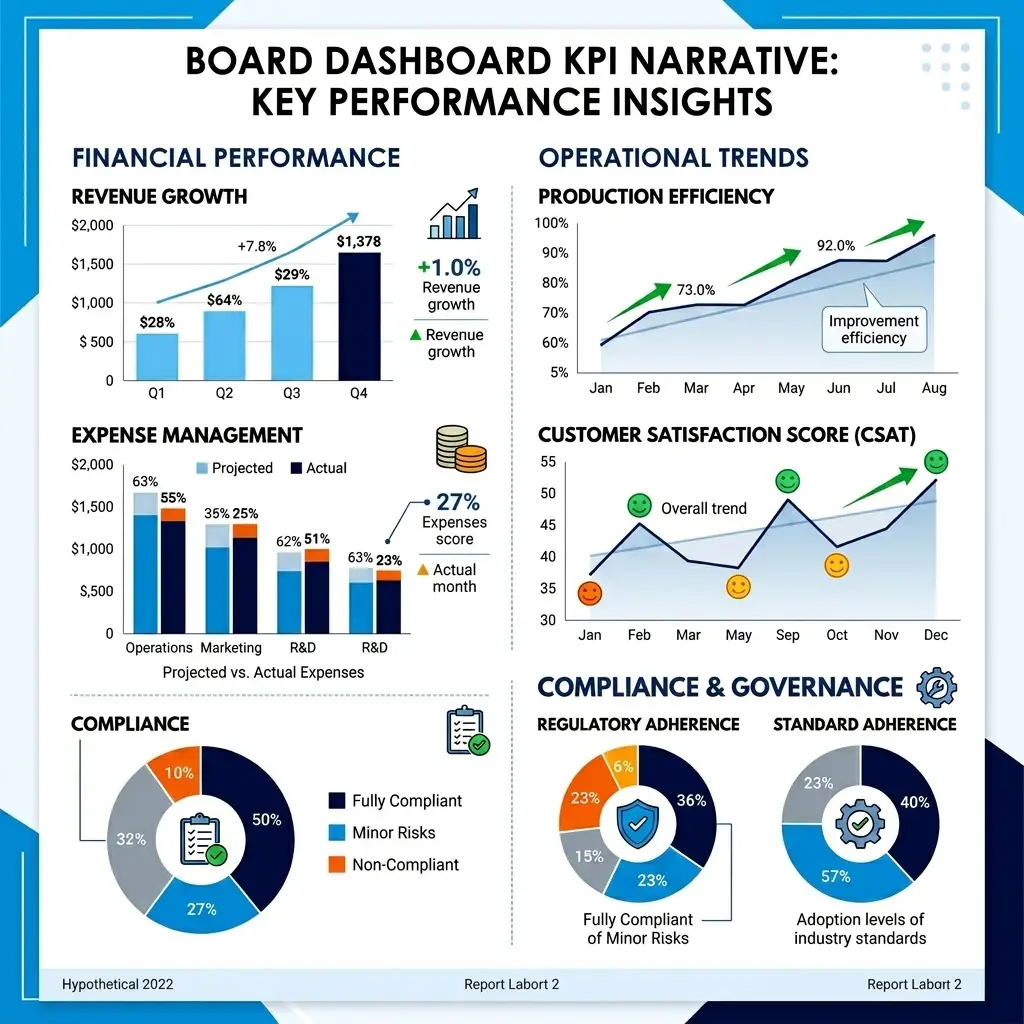
A board-level regulatory risk dashboard is essential to that process. It should provide a view of top regulatory risks, material incidents, remediation status, control effectiveness, audit findings, and major regulatory change developments. Just as important, it should show movement over time. Trend reporting helps boards see whether risk is improving, stabilizing, or quietly getting worse beneath the surface. A dashboard that shows flat incident numbers but steadily rising overdue remediation items may reveal weakening control discipline long before a formal breach occurs. This is where governance becomes strategic: it allows leadership to detect signals early enough to act before exposure becomes damage.
The quality of board oversight depends heavily on the quality of the metrics used. Useful key performance indicators do more than count activity. They show exposure, response speed, and accountability. Common measures include remediation timeliness, overdue high-risk issues, repeat findings, control testing results, incident escalation speed, training completion, and regulatory change readiness. When these KPIs are clearly defined and tracked consistently, they support informed judgment rather than broad discussion. They also provide public affairs and government relations teams with evidence-based data that can strengthen advocacy. If an organization can show, for example, that a proposed regulatory deadline creates concentrated implementation risk across several jurisdictions despite strong control maturity, its engagement with policymakers becomes more credible and more practical.
Accountability is equally important. A RACI model—defining who is Responsible, Accountable, Consulted, and Informed—helps translate governance from principle into execution. It reduces confusion, improves escalation discipline, and allows boards to see who owns both action and results. In a major compliance breach, the local compliance lead may be responsible for documenting the issue and launching the investigation, the Chief Compliance Officer may be accountable for escalation and remediation oversight, legal may be consulted on disclosure obligations, and the board risk committee may be informed once the issue crosses a defined threshold. This structure does more than improve internal coordination. It strengthens the organization’s external credibility by showing that serious issues are handled through a disciplined and predictable governance process rather than ad hoc reaction.
Regular review also matters. For many organizations, monthly management reporting and quarterly board-level review offer a practical baseline. In higher-risk sectors, or during periods of rapid regulatory change, more frequent updates may be needed. A multinational company adapting to new cross-border data transfer rules, for example, may require intensified reporting until management confirms readiness, major gaps are closed, and accountability is clear across jurisdictions. The right cadence depends on exposure, but the principle is constant: governance must move at the speed of risk.
Weak governance usually reveals itself through familiar warning signs. These include delayed escalation, repeated findings, unclear ownership, overdue remediation, inconsistent reporting, and dashboards that show activity without outcomes. Boards that see these patterns should treat them as governance failures, not isolated operational issues. In many organizations, major enforcement actions and public controversies are preceded by long periods of weak accountability and poor escalation discipline. By contrast, stronger governance tends to emerge from consistent structure: clear ownership, defined thresholds, measurable KPIs, aligned reporting, and a culture that treats risk reporting as a management tool rather than an administrative exercise.
For executive leaders, the broader implication is clear. Regulatory risk governance is not simply a mechanism for avoiding fines or satisfying compliance requirements. It is a strategic asset for managing the organization’s external environment. It supports better decision-making, sharper board oversight, stronger regulator relationships, more credible advocacy, and greater resilience under pressure. It helps leadership connect internal performance with external perception. In a political and regulatory landscape shaped by scrutiny, speed, and institutional accountability, that connection is critical.
The strongest organizations understand that regulatory risk governance does more than protect against failure. It equips boards, executives, public affairs leaders, and government relations teams to operate with greater confidence in front of the institutions that shape the operating environment. When visibility is strong, accountability is clear, and oversight is data-driven, governance becomes more than a compliance framework. It becomes a practical foundation for trust, influence, and strategic control.
Summary & Key Takeaways
Regulatory risk governance is the system organizations use to understand, manage, and report regulatory risk with clear oversight from boards and executive leaders. At its most practical level, it makes sure obligations are clear, ownership is assigned, controls are being monitored, and issues are raised before they turn into larger business problems. But its importance goes well beyond compliance. In a fast-moving regulatory and political environment, strong governance helps organizations stay resilient, make better decisions, and build credibility with the people who matter most.
For senior leaders, the real value of regulatory risk governance is that it connects what happens inside the organization to how the organization is viewed from the outside. It gives boards and executives a clearer picture of where risk is building, how management is responding, and whether control gaps are being addressed in time. That visibility helps reduce the likelihood of fines, disruption, reputational damage, and slow or ineffective responses to regulatory change. Just as importantly, it shows regulators, investors, and other stakeholders that the organization takes oversight and accountability seriously.
This is especially important for Public Affairs and Government Relations. These teams work in an environment where credibility matters just as much as access. Policymakers and regulators are more likely to engage constructively with organizations that can show strong internal governance, clear escalation, and reliable reporting. When a company demonstrates that it understands its obligations, tracks emerging issues, and responds with defined ownership, its policy positions carry more weight. Its advocacy is more persuasive because it is grounded in discipline, evidence, and a clear understanding of real-world implementation challenges.
Strong regulatory risk governance also helps protect political capital. Trust with government stakeholders can weaken quickly after a compliance failure, a delayed response, or a visible governance breakdown. And when that happens, the damage rarely stays contained within legal or compliance teams. It can quickly become a Public Affairs issue, a Government Relations issue, and a broader reputational issue all at once. Good governance lowers that risk by helping organizations identify problems earlier, respond faster, and manage sensitive issues with greater discipline before they harm institutional trust.
Another major benefit is that it strengthens policy engagement with evidence instead of assumption. Effective regulatory risk governance produces meaningful information: trend data, control results, remediation progress, issue aging, escalation timing, and readiness for new rules. That gives Public Affairs and Government Relations teams more than talking points. It gives them facts. With that foundation, they can engage policymakers in a more credible and useful way by explaining business impact, implementation challenges, operational realities, and likely market effects. That kind of engagement not only improves advocacy, but also reinforces the organization’s reputation as a thoughtful and responsible participant in regulatory discussions.
Clear accountability is what makes all of this work. Strong governance does not depend on vague ownership or informal decision-making. It makes clear who is responsible for action, who is accountable for outcomes, who needs to be consulted, and who needs to be kept informed. That structure improves coordination inside the organization and builds confidence outside it. Regulators and other public-sector stakeholders are far more likely to trust an organization that can show issues are being managed through a clear and disciplined process rather than through last-minute reactions.
At a broader level, governance maturity can become a real strategic advantage. Organizations that manage regulatory risk well are usually better prepared for change, more credible with regulators, and more effective at protecting their license to operate. They are also in a stronger position to shape policy conversations because they bring evidence, consistency, and institutional trust to the table. In highly regulated sectors, that combination of preparedness, credibility, and influence can set an organization apar
- Internal discipline shapes external trust. Strong regulatory risk governance influences how regulators, policymakers, investors, and other stakeholders judge the organization’s credibility and reliability.
- Better data leads to better government engagement. Trend reporting, remediation updates, control results, and readiness metrics give Public Affairs and Government Relations teams a stronger factual basis for advocacy.
- Clear accountability builds confidence. A well-defined RACI model supports faster escalation, stronger coordination, and greater trust that issues are being handled responsibly.
- Governance maturity can be a strategic advantage. Organizations with disciplined oversight are often more resilient, more credible, and better positioned to succeed in heavily regulated markets.
- Regulatory risk governance is about more than compliance. It supports sound leadership judgment, protects political capital, and helps organizations engage external stakeholders from a position of strength.
- Credible advocacy starts with strong internal governance. Policy positions are more persuasive when they are backed by clear oversight, reliable reporting, and demonstrated accountability.
The Critical Link Between Regulatory Risk Governance, Public Affairs, and Government Relations
Regulatory risk governance plays a central role in how organizations manage their relationships with policymakers, regulators, and other public-sector stakeholders. While it is often viewed through a compliance lens, its value extends far beyond legal adherence. In practice, strong regulatory risk governance helps organizations build trust, strengthen advocacy efforts, protect reputational standing, and engage government stakeholders with greater discipline and credibility. For public affairs and government relations teams, it is an essential strategic asset.
Building Credibility and Trust With Government Stakeholders
Government stakeholders expect organizations to understand the rules that shape their industries and to manage regulatory obligations responsibly. When a company demonstrates that it has clear governance structures, defined accountability, strong internal controls, and timely escalation processes, it signals maturity and reliability. That matters in every interaction with regulators, legislative bodies, ministries, agencies, and public officials.
Credibility is not built only through messaging. It is built through evidence. Organizations that can show they monitor regulatory developments, assess impacts, respond to emerging obligations, and address issues before they escalate are more likely to be seen as responsible actors. This can improve the tone and quality of engagement with regulators and reduce the perception that the organization is reactive, defensive, or narrowly self-interested.
Strong regulatory risk governance also supports consistency across external communications. Public affairs teams are better positioned when they can speak from a foundation of documented practices, internal alignment, and verified risk management efforts. In that context, trust is earned not simply by what the organization says, but by how well its internal governance supports those claims.
Strengthening Policy Advocacy Through Demonstrated Responsibility
Policy advocacy is more effective when the organization can show that its positions are grounded in operational reality, regulatory understanding, and ethical discipline. Government relations efforts often depend on persuading policymakers that a company’s recommendations are credible, practical, and aligned with broader public interest objectives. Regulatory risk governance strengthens that case.
When an organization manages regulatory risk proactively, it demonstrates that it is not seeking weaker oversight for convenience. Instead, it shows that it understands the purpose of regulation, respects institutional expectations, and is prepared to operate within clear standards. This gives public affairs and government relations teams a stronger platform for engaging in policy discussions.
For example, when companies advocate for clearer guidance, more workable implementation timelines, or more consistent enforcement frameworks, their arguments carry more weight if they can also show a strong compliance culture and disciplined governance model. Policymakers are more likely to listen to organizations that appear constructive and accountable than to those perceived as resisting oversight.
This connection is especially important in sectors with high public sensitivity, such as financial services, energy, healthcare, technology, defense, and infrastructure. In these areas, advocacy efforts are closely scrutinized. Regulatory risk governance helps ensure that external policy engagement is backed by conduct and controls that support the organization’s stated values and commitments.
Protecting Political Capital by Reducing Reputational Risk
Reputational risk can quickly become a public affairs and government relations problem. A regulatory failure, enforcement action, compliance breakdown, or governance lapse can damage an organization’s standing with elected officials, regulators, civil servants, advocacy groups, and the media. Once trust is weakened, access becomes harder, influence declines, and the organization may lose the benefit of the doubt in future engagements.
Political capital depends on credibility, consistency, and responsible behavior over time. Regulatory risk governance helps preserve that capital by reducing the likelihood of avoidable incidents and by improving the organization’s ability to detect and address issues early. It supports better oversight of high-risk areas, clearer reporting to leadership, and faster remediation when problems emerge.
This matters because reputational damage rarely stays confined to one issue. A failure in privacy, financial controls, consumer protection, sanctions compliance, environmental reporting, or third-party oversight can shape how government stakeholders view the organization more broadly. It can weaken advocacy campaigns, complicate stakeholder outreach, and increase skepticism toward the company’s policy positions.
By contrast, organizations with strong regulatory governance are better prepared to manage sensitive situations without losing institutional trust. Even when issues arise, a documented governance framework, transparent response process, and clear accountability structure can help reassure stakeholders that the organization is taking the matter seriously and acting responsibly.
Enabling Data-Driven Government Engagement and Legislative Monitoring
Effective public affairs and government relations work requires more than relationship management. It also requires disciplined monitoring, risk assessment, and strategic prioritization. Regulatory risk governance provides the structure and data needed to support those functions.
A mature governance model helps organizations identify which regulatory developments matter most, where exposure is concentrated, and what types of policy change could affect operations, market access, reputation, or strategic objectives. This allows public affairs and government relations teams to move beyond anecdotal assessments and engage with government stakeholders using evidence-based analysis.
Data-driven regulatory risk management can support government engagement in several ways:
- It helps identify emerging legislative and regulatory trends early.
- It allows teams to assess likely business impact across jurisdictions.
- It supports prioritization of stakeholder outreach based on risk and timing.
- It improves internal alignment between legal, compliance, policy, and business teams.
- It gives leaders a stronger basis for deciding when to engage, where to engage, and what position to take.
This is especially important for multinational organizations operating across fragmented regulatory environments. In those settings, public affairs teams must track overlapping proposals, shifting political priorities, and different enforcement approaches. Regulatory risk governance creates a repeatable framework for turning external developments into actionable intelligence.
It also improves the quality of engagement. When an organization can explain how a proposed law or rule affects operational resilience, customer outcomes, market competition, investment, or implementation risk, its voice becomes more useful to policymakers. That kind of engagement is more likely to be viewed as substantive and credible.
A Strategic Tool for Managing the External Environment
Regulatory risk governance should not be treated as a back-office compliance function with limited strategic relevance. It is a practical tool for navigating the external political and regulatory environment. It helps organizations anticipate change, engage institutions more effectively, protect their standing, and support advocacy with evidence and discipline.
For public affairs and government relations leaders, this means regulatory risk governance should be integrated into external engagement strategy rather than treated as a separate internal control process. The strongest organizations connect regulatory monitoring, risk reporting, stakeholder mapping, policy positioning, and executive decision-making into one coordinated model.
That integration produces clear benefits. It improves message credibility. It sharpens policy analysis. It protects reputational assets. It supports early action instead of late response. Most importantly, it enables the organization to engage government stakeholders from a position of preparedness rather than vulnerability.
In a political and regulatory environment defined by scrutiny, speed, and complexity, proactive regulatory risk management is not optional. It is a strategic capability that helps organizations manage exposure, sustain influence, and operate with greater confidence in front of the institutions that shape their future.
Why Regulatory Risk Management Now Belongs in the Board Room
For years, many companies treated regulatory risk as something to be handled quietly in the background. Legal teams managed the rules. Compliance teams monitored policies. Internal audit checked whether controls were working. Meanwhile, the board focused on growth, competition, capital allocation, and shareholder returns.
In a simpler regulatory environment, that model may have seemed good enough. If filings were completed, inspections passed, and major penalties avoided, it was easy to assume the company had the issue under control.
That assumption no longer holds.
Today, regulatory risk is not a narrow compliance matter. It is a business issue with direct consequences for revenue, reputation, investor confidence, operations, and long-term value. Data privacy laws are tightening. Anti-money laundering expectations are rising. Cybersecurity obligations are expanding. ESG disclosures are under greater scrutiny. Consumer protection rules, sanctions, AI governance, sector-specific mandates, and cross-border requirements are becoming more complex by the year.
At the same time, regulators are asking harder questions. They are no longer satisfied with finding out that a rule was broken. They want to know what leadership knew, how risks were escalated, whether warning signs were missed, and whether the board was engaged. In other words, they are looking at governance, not just compliance.
That is why regulatory risk management now belongs in the board room. It shapes strategic decisions, tests leadership quality, and reveals whether an organization is truly built to withstand scrutiny.
The Staggering Cost of Non-Compliance
The cost of non-compliance has never been more visible. Across industries, regulators are imposing major penalties for failures tied to privacy, financial crime, product safety, market conduct, labor practices, environmental reporting, and more. For global companies, the challenge is even greater. They must deal with overlapping and sometimes conflicting rules across multiple jurisdictions, each with its own expectations, reporting timelines, and enforcement priorities.
But fines are only part of the story.
The real cost often emerges afterward. A regulatory failure can trigger lawsuits, remediation spending, operational delays, leadership exits, heavier regulatory supervision, damaged partnerships, higher insurance costs, and stalled strategic plans. Investors start to question management credibility. Customers lose confidence. Employees become uncertain. Talent becomes harder to attract. A future acquisition, product launch, or market entry may suddenly become much harder.
The Wells Fargo fake accounts scandal is a powerful example. What started as misconduct tied to aggressive sales targets grew into a major governance failure. Regulators found that millions of unauthorized accounts had been opened. The fallout went far beyond fines. The company faced leadership turnover, years of public scrutiny, serious reputational damage, and restrictions on growth, including the Federal Reserve’s asset cap. The lesson was clear: when culture, incentives, and compliance oversight break down, the damage reaches the center of the business. That is not just an operational problem. It is a board problem.
Meta’s GDPR-related fines in Europe offer another important example. Privacy compliance is often framed as a legal or technical issue, but for a company whose business model depends on data, it is much bigger than that. Privacy regulation affects product design, monetization, customer trust, market access, and public legitimacy. In that context, data governance is not a support function concern. It is a strategic issue that belongs at the highest level of oversight.
Non-compliance is so expensive today because regulation is deeply tied to how companies create value. The cost of getting it wrong is no longer just legal. It is strategic.
Breaking Down the Compliance Silo
One of the most common weaknesses in organizations is the tendency to keep compliance separate from core business decision-making. In that model, compliance is brought in near the end. A product is almost ready to launch. A new market entry plan is already moving. A major third-party relationship is close to final approval. Only then does someone ask compliance for a view.
That approach creates avoidable risk.
Regulatory risk now touches almost every major business activity: product design, onboarding, procurement, outsourcing, AI deployment, data governance, marketing, acquisitions, cross-border expansion, and vendor management. When regulatory insight arrives too late, companies are forced into expensive redesigns, delayed launches, last-minute fixes, or public explanations to regulators that could have been avoided.
A better model brings regulatory thinking into planning from the start. That does not mean compliance should block innovation. It means innovation should be built in a way that is durable, responsible, and defensible. The best-run organizations do not ask only, “Is this allowed today?” They also ask, “Where is the regulatory environment heading?” and “Will this still work two or three years from now?”
Artificial intelligence is a good example. AI creates major opportunities in customer service, lending, hiring, healthcare, and marketing. But it also raises important questions about fairness, transparency, explainability, privacy, accountability, and bias. If a company rolls out AI tools without understanding the direction of regulation, it may end up investing in products or processes that later require costly redesign or attract enforcement attention. Boards should be asking whether management has a governance framework for AI, whether high-risk uses are mapped, and whether accountability is clearly assigned.
Breaking down the compliance silo also requires a mindset shift. Regulatory risk should not be seen only as a burden. In many cases, it can become a competitive advantage. Companies with strong controls, clear governance, and trusted operating practices are often better positioned to win business, satisfy investors, and enter regulated markets with confidence. Good governance does not have to slow growth. In many situations, it makes better growth possible.
The Strategic Advantage of Board Oversight
When boards take regulatory risk seriously, the whole organization benefits. Oversight becomes sharper. Escalation improves. Management is pushed to think ahead rather than react late. The quality of strategic decision-making rises because risk is being considered before, not after, major commitments are made.
That board-level engagement creates several important advantages:
- Aligned Corporate Strategy: Boards can test whether growth plans, market expansion, and commercial targets are realistic within the regulatory environments the company operates in. This reduces the chance of pursuing opportunities with hidden exposure.
- Stronger Governance and Accountability: Clear oversight helps define ownership, escalation paths, and reporting expectations. Important warning signs are less likely to be buried or dismissed.
- Protected Brand and Reputation: Trust can disappear faster than it is built. Boards that treat regulatory risk as part of brand stewardship are better positioned to protect credibility.
- Financial Resilience: Strong oversight can help prevent sudden costs tied to penalties, remediation, litigation, and business interruption.
- Better Decision-Making During Change: Whether the issue is AI governance, ESG disclosure, sanctions, cyber regulation, or consumer protection, informed boards are better able to guide the company through complexity.
- Improved Regulatory Credibility: Regulators tend to respond more positively when they see serious engagement from leadership, clear governance, and evidence that oversight is embedded at the top.
The financial services sector after the global financial crisis illustrates this point well. In many institutions, boards were criticized for not fully understanding the risks building across products, incentives, and internal controls. Since then, regulators around the world have increased their focus on board accountability, conduct oversight, and risk governance. The broader lesson applies far beyond banking: if a risk can materially affect the future of the company, it belongs within the board’s view.
Board oversight does not mean directors need to become technical experts in every regulation. It means they must ensure the company has the right systems, reporting, talent, and accountability in place to identify, assess, manage, and escalate regulatory risk effectively.
What Effective Board-Level Regulatory Oversight Looks Like
If regulatory risk belongs in the board room, then boards need a clear sense of what good oversight actually looks like.
First, directors need a practical view of the company’s regulatory risk profile. They should understand which laws and standards matter most, where exposure is increasing, and which products, markets, or business lines create the greatest vulnerability. Generic compliance updates are not enough. Boards need focused, decision-ready insight.
Second, regulatory risk should be integrated into enterprise risk management, not handled as a separate side stream. Acquisitions, digital transformation, outsourcing, new product launches, and geographic expansion should all be reviewed through a regulatory lens before major commitments are made.
Third, reporting quality matters. Boards need timely, candid information that helps them see what is changing. Useful indicators go well beyond training completion rates and policy sign-offs. Directors should see trends in control failures, customer complaints, regulatory findings, incident patterns, third-party issues, remediation progress, whistleblower themes, and emerging rule changes.
Fourth, boards should pay close attention to culture and incentives. Many compliance failures happen not because policies are missing, but because pressure, weak supervision, poor escalation, or misaligned incentives make those policies ineffective in practice. Directors should ask a simple but powerful question: are we rewarding the right behaviors?
Fifth, boards should use scenario planning. They should be asking: What happens if a regulator challenges one of our core data practices? What if a key vendor fails a compliance review? What if a new ESG rule exposes weak reporting systems? What if a cyber incident triggers mandatory disclosures across several jurisdictions? These conversations help move regulatory risk out of the abstract and into real decision-making.
Finally, boards should assess whether they have the right expertise around the table. Depending on the industry, that may mean more depth in technology, cybersecurity, financial crime, healthcare regulation, data governance, or sustainability reporting.
Real-Life Lessons Boards Should Not Ignore
Corporate history offers repeated reminders that regulatory failures often point to deeper governance failures.
The Volkswagen emissions scandal is one of the clearest examples. This was not simply a technical issue or a one-off compliance lapse. It exposed serious weaknesses in oversight, accountability, and culture. The fallout included major financial penalties, legal action, reputational damage, and years of disruption. The case showed how quickly misconduct can become embedded in the way a business operates when governance is not strong enough to challenge it. When that happens, the board cannot reasonably treat the matter as someone else’s problem.
The same is true in businesses that handle sensitive data. Privacy and cybersecurity are not just IT concerns. They affect customer trust, regulatory approval, business continuity, and market value. A major data incident can lead to investigations, mandatory notifications, litigation, public scrutiny, contract disputes, and lasting damage to customer relationships. Boards that stay too far from cyber and data governance may miss one of the most serious regulatory and reputational risks facing modern companies.
The broader lesson is simple: regulatory risk rarely sits in one neat box. It is connected to strategy, technology, incentives, culture, and leadership behavior. That is why board oversight has to be active, informed, and continuous.
Second Real-World Case Study: Volkswagen and the Cost of Failed Board Oversight
A strong second case study is Boeing and the 737 MAX crisis. The immediate issue involved product safety and certification, but the deeper story was about how regulatory risk, commercial pressure, engineering decisions, and governance failures can collide.
The crisis brought intense scrutiny to internal escalation, safety culture, oversight quality, and whether management and the board had given enough attention to regulatory exposure. The consequences were severe: global groundings, multi-jurisdiction investigations, litigation, compensation costs, leadership changes, reputational damage, and long-term disruption to one of Boeing’s most important programs.
Boeing’s experience shows that when regulatory expectations are not fully woven into strategic and operational decision-making, the result is not a routine compliance issue. It becomes a crisis of trust, accountability, and enterprise value.
For boards, the deeper lesson is not just that safety failures have regulatory consequences. It is that oversight breaks down when warning signs do not move upward clearly, when management assumptions are not challenged hard enough, and when commercial urgency begins to outweigh independent judgment. A board does not need to manage engineering decisions day to day, but it does need to ensure that critical risks are escalated early, dissenting voices are heard, and accountability is unmistakable. Boeing is a reminder that effective board oversight is not passive review. It is active governance that connects safety, compliance, strategy, and reputation before problems become enterprise-threatening.
Third Real-World Case Study: Equifax and the Lasting Outcomes of Regulatory Failure
Equifax offers a powerful third case study because its 2017 data breach showed just how closely cybersecurity, regulatory risk, and board oversight are linked. The breach exposed the personal data of roughly 147 million people and quickly escalated from a technology incident into a major regulatory, political, and reputational crisis.
The company faced investigations from multiple authorities, including the Federal Trade Commission, the Consumer Financial Protection Bureau, and state regulators. It later agreed to a settlement that could cost at least $575 million and up to $700 million. But again, the financial penalty was only one part of the damage. Equifax also experienced leadership turnover, congressional scrutiny, years of reputational harm, and a significant loss of trust in a business built on the handling of sensitive consumer information.
The outcomes matter as much as the causes. The breach exposed weaknesses in oversight, patch management, cyber governance, and escalation. It also raised questions about whether the board had adequate visibility into technology risk and whether management was being challenged effectively enough. For a company that depends on trust, the strategic damage was deep and lasting.
Equifax makes one point unmistakably clear: cybersecurity and data protection cannot be treated as narrow technical issues delegated entirely to IT. Boards must make sure those risks are visible at the top, that remediation ownership is clear, and that incident response capabilities are truly fit for purpose. When boards fail to connect operational warning signs to enterprise strategy, the result can be a long-term breakdown in trust and accountability.
Elevate Your Risk Strategy
The most resilient organizations understand that regulatory risk management is not a support activity sitting at the edge of the business. It is part of leadership.
In an environment defined by faster rule changes, greater public scrutiny, and higher stakeholder expectations, governance quality can become a genuine strategic advantage. Bringing regulatory risk into the board room is not about fear-driven compliance. It is about making better decisions. It is about ensuring growth is sustainable, innovation is responsible, and the company is prepared for scrutiny before a crisis arrives.
Boards that take this seriously do more than reduce downside risk. They help build organizations that are more disciplined, more credible, and better able to adapt. They are more likely to spot problems early, challenge weak assumptions, and guide management through complexity with confidence.
The message for business leaders is straightforward: do not wait for a regulatory crisis to elevate the conversation. By the time enforcement action begins, the cost of inattention is already high. Regulatory risk management belongs in the board room because the issues at stake are no longer narrow or technical. They go to the heart of strategy, accountability, resilience, and long-term success.
For board members, the takeaway is equally clear. Regulatory risk is now a strategic issue because it can directly affect growth, reputation, resilience, investor confidence, and enterprise value. It belongs in the board room not only because regulators expect stronger oversight from the top, but because compliance failures often reveal deeper weaknesses in culture, reporting, incentives, and decision-making. Directors should insist on clear visibility into the company’s biggest regulatory exposures, ensure those risks are built into strategy and enterprise risk management, demand timely and actionable reporting, test whether culture supports responsible conduct, and confirm that management has strong escalation, remediation, and scenario-planning processes in place.
Key Takeaways for Board Members
- Top regulatory exposures by business unit, geography, and product line — Include a ranked heat map of inherent vs. residual risk, percentage of revenue tied to high-risk activities, number of critical obligations by region, and quarter-over-quarter movement in risk ratings. KPI definitions: Inherent risk is the level of exposure before controls are applied; residual risk is the exposure that remains after controls. High-risk revenue concentration measures the share of total revenue generated from activities, products, or markets classified as high regulatory risk. Quarter-over-quarter risk movement tracks whether risk ratings are increasing, stable, or decreasing across priority areas. Target thresholds: No material business unit or geography should remain in a residual “high” or “very high” category for more than two consecutive quarters without a board-approved mitigation plan; revenue concentration in high-risk activities should remain within the board’s stated risk appetite; any quarter-over-quarter increase in high residual-risk areas above a defined tolerance, such as more than 10%, should trigger management explanation and remediation actions; and 100% of critical obligations should have an assigned owner and current risk rating. Reporting cadence: Quarterly to the board and risk committee, with ad hoc escalation for any material shift in exposure. RACI: Responsible: Chief Compliance Officer and business unit risk leads. Accountable: Chief Risk Officer or General Counsel, depending on structure. Consulted: Internal Audit, regional legal leads, finance, and business line heads. Informed: Board, CEO, and relevant executive committee members.
- Emerging regulatory changes with likely strategic and operational impact — Track a forward-looking pipeline showing the number of new or proposed rules, implementation dates within the next 6 to 18 months, estimated cost to comply, affected business lines, and a red-amber-green readiness status for each major change. KPI definitions: Regulatory change pipeline is the inventory of relevant proposed, pending, and final rules under monitoring. Readiness status measures implementation maturity against milestones, resources, and control design. Estimated compliance cost captures expected one-time and recurring spend to meet the new requirement. Impact scope identifies how many entities, products, processes, or jurisdictions are affected. Target thresholds: 100% of material regulatory changes should be logged, assessed, and assigned an owner within a defined period, such as 30 days of identification; all high-impact rules with effective dates inside 12 months should have an approved implementation plan; no material rule should remain in “red” readiness status within 90 days of its effective date; and cost estimates for major changes should remain within approved budget tolerance unless escalated. Reporting cadence: Quarterly, with monthly management review for high-change sectors and immediate escalation where a rule could materially affect strategy, product design, or market access. RACI: Responsible: Regulatory affairs or compliance policy team. Accountable: General Counsel or Chief Compliance Officer. Consulted: Strategy, public policy, operations, technology, and affected business leaders. Informed: Board, CEO, executive committee, and business unit leadership.
- Open investigations, regulatory inquiries, audit findings, and enforcement matters — Report total open cases, age of each matter, severity level, jurisdiction, potential financial exposure, expected resolution timeline, and trend data showing whether the volume and seriousness of matters are rising or falling. KPI definitions: Open case volume is the number of active investigations, inquiries, findings, or enforcement matters not yet closed. Case aging measures the number of days each matter has remained unresolved. Severity level classifies matters by financial, operational, legal, and reputational impact. Potential financial exposure estimates likely fines, settlements, remediation costs, and legal expenses. Target thresholds: No unexplained increase in high-severity open matters quarter over quarter; 90% or more of routine inquiries and lower-severity findings should be resolved within established service-level timelines; all high-severity matters should have executive sponsorship, legal strategy, and board visibility; and any matter above a pre-set financial or reputational materiality threshold should trigger immediate escalation. Reporting cadence: Quarterly to the board, monthly to executive risk forums, and real-time escalation for major investigations, dawn raids, formal enforcement notices, or matters with material financial or reputational impact. RACI: Responsible: Legal, compliance investigations, and internal audit for audit-related matters. Accountable: General Counsel. Consulted: Chief Compliance Officer, Chief Risk Officer, external counsel, and business executives involved in remediation. Informed: Board chair, risk committee chair, CEO, and relevant board committees.
- Significant control failures, policy breaches, and recurring compliance issues — Measure the number of high-severity breaches, repeat findings by business unit, control failure rates, root-cause categories, and the percentage of issues linked to the same process, system, or leadership area over time. KPI definitions: Control failure rate is the proportion of tested key controls that fail design or operating effectiveness standards. Repeat finding rate measures how often the same issue recurs after prior identification. High-severity breach count captures incidents involving material legal, regulatory, customer, or financial impact. Root-cause concentration shows whether issues cluster around common failures such as process gaps, system weakness, training gaps, or poor supervision. Target thresholds: Key control effectiveness should remain above a board-approved minimum, such as 95%; repeat findings should trend downward quarter over quarter and remain below a defined tolerance; any repeat high-severity breach should trigger mandatory executive review; and root-cause concentration above a set level, such as more than 25% linked to one source, should trigger targeted remediation. Reporting cadence: Quarterly to the board, monthly at management level, and immediate escalation for systemic failures or repeated breakdowns in critical controls. RACI: Responsible: Control owners, compliance monitoring teams, and first-line operational leaders. Accountable: Chief Risk Officer or Chief Compliance Officer. Consulted: Internal Audit, technology, HR, and legal, depending on the issue. Informed: Board risk committee, CEO, and affected executive sponsors.
- Status of remediation plans, deadlines, overdue actions, and management progress — Include total open remediation items, percentage completed on time, number of overdue high-priority actions, average days past due, milestone slippage against plan, and executive ownership for each critical item. KPI definitions: On-time completion rate measures the percentage of remediation actions closed by the committed deadline. Overdue high-priority actions counts critical items that remain open past target date. Average days past due tracks the mean delay for overdue actions. Milestone slippage measures variance between planned and actual delivery dates for major remediation steps. Target thresholds: At least 90% of remediation actions should be completed on time; zero tolerance should apply for overdue regulator-committed actions unless formally reapproved; overdue high-priority actions should remain below a board-set limit; and any milestone slippage above an agreed threshold, such as 30 days on a critical item, should require executive explanation and revised plan approval. Reporting cadence: Quarterly to the board, monthly to management, and real-time escalation where critical milestones are missed or regulators have imposed deadlines. RACI: Responsible: Action owners in the business and program management office or remediation office. Accountable: Executive sponsor for each remediation program, with enterprise accountability typically held by the Chief Risk Officer, Chief Compliance Officer, or General Counsel. Consulted: Internal Audit, finance, operations, and technology. Informed: Board, CEO, executive committee, and regulators where required.
- Incident trends, including customer complaints, whistleblower reports, and conduct concerns — Report volume by quarter, substantiation rates, time to triage and close cases, repeat themes, escalation rates to senior management, and concentrations by business unit, geography, or product category. KPI definitions: Substantiation rate is the percentage of allegations or complaints confirmed after review. Time to triage measures how quickly a case is initially assessed and assigned. Time to close tracks days from intake to final disposition. Escalation rate measures the share of cases requiring senior management or board attention. Theme concentration identifies repeated patterns across products, teams, or regions. Target thresholds: 100% of reports should be triaged within the defined standard, such as 5 business days for routine matters and 24 hours for critical matters; case closure timelines should meet established service levels by severity tier; substantiation and theme concentrations should be monitored for adverse trends; and any spike above tolerance in customer harm, retaliation claims, or senior leader allegations should trigger immediate escalation. Reporting cadence: Quarterly to the board, monthly to management committees, and immediate escalation for allegations involving senior executives, widespread customer harm, retaliation, or misconduct with likely regulatory impact. RACI: Responsible: Ethics and compliance, HR, customer affairs, and investigations teams. Accountable: Chief Compliance Officer, with HR accountable for employee conduct matters where applicable. Consulted: Legal, internal audit, security, and business leadership. Informed: Board risk or audit committee, CEO, and relevant control function heads.
- Third-party and vendor risk exposure, especially in critical or regulated functions — Track the number of high-risk vendors, percentage with completed due diligence, overdue reassessments, unresolved findings, concentration risk among top suppliers, and incidents involving outsourced or fourth-party services. KPI definitions: Due diligence completion rate is the percentage of in-scope third parties that have completed onboarding review before engagement. Overdue reassessments counts vendors not reviewed within the required cycle. Unresolved findings tracks open control, compliance, or security issues at third parties. Concentration risk measures dependency on a small number of critical suppliers by spend, service criticality, or substitutability. Target thresholds: 100% of critical and high-risk vendors should complete due diligence before contract execution; no critical vendor reassessment should be overdue beyond the permitted tolerance; unresolved high-risk findings should have approved action plans and closure dates; and concentration above a board-defined threshold should require contingency planning and diversification review. Reporting cadence: Quarterly to the board, monthly for management oversight, and immediate escalation for failures involving critical vendors, regulatory breaches, data incidents, sanctions exposure, or service disruption. RACI: Responsible: Procurement, third-party risk management, and business owners of outsourced services. Accountable: Chief Operating Officer, Chief Risk Officer, or equivalent executive overseeing third-party risk. Consulted: Legal, information security, compliance, procurement, and business continuity teams. Informed: Board, CEO, operations committee, and affected business leaders.
- Training completion, speak-up activity, employee conduct signals, and culture indicators — Use measures such as mandatory training completion rates, overdue attestations, hotline usage per 100 employees, retaliation claims, employee survey scores on ethical culture, and trends in misconduct by level, function, or region. KPI definitions: Training completion rate is the percentage of required employees who finish assigned training by deadline. Overdue attestation rate measures the share of policy acknowledgments not completed on time. Hotline usage per 100 employees tracks reporting activity normalized by workforce size. Ethical culture score reflects employee survey responses on trust, fairness, escalation comfort, and leadership integrity. Retaliation claim rate measures reported retaliation concerns relative to total cases or employee population. Target thresholds: Mandatory training completion should remain at or above 98% by deadline; overdue attestations should remain below a low tolerance, such as 2%; hotline activity should be monitored for both spikes and unusually low reporting, since underreporting may indicate fear or mistrust; retaliation claims should be investigated promptly with zero tolerance for substantiated retaliation; and ethical culture scores should improve or remain above a board-approved minimum benchmark. Reporting cadence: Quarterly to the board, with an annual deeper culture review and monthly management monitoring of key conduct indicators. RACI: Responsible: HR, ethics and compliance, and learning teams. Accountable: Chief Human Resources Officer and Chief Compliance Officer. Consulted: Internal Audit, legal, business leaders, and employee relations. Informed: Board, CEO, executive committee, and relevant culture or conduct oversight forums.
- Clear escalation triggers for issues that require immediate board attention — Define measurable thresholds such as potential financial exposure above a set amount, incidents affecting a material number of customers, high-severity breaches in critical markets, missed regulatory deadlines, repeat failures in key controls, or any matter likely to attract major regulator or media scrutiny. KPI definitions: Material financial exposure threshold is the preapproved level of likely loss, fine, settlement, or remediation cost that requires board notice. Customer impact threshold measures the number or percentage of affected customers beyond which an event becomes board-reportable. Critical control repeat failure threshold identifies how many repeated breakdowns in key controls trigger escalation. Media or regulator sensitivity indicator flags matters with a high likelihood of public or supervisory scrutiny. Target thresholds: Thresholds should be explicitly approved by the board at least annually; all breaches of escalation thresholds should be reported in real time; zero missed mandatory regulatory deadlines should be the standard; and any event with likely enterprise-wide reputational or strategic impact should be escalated regardless of numeric threshold. Reporting cadence: Real-time escalation when triggers are met, with annual board approval and periodic review of thresholds. RACI: Responsible: Risk, compliance, legal, and business leaders who identify the event. Accountable: CEO, General Counsel, Chief Risk Officer, or Chief Compliance Officer, depending on the trigger. Consulted: Board chair, committee chairs, communications, investor relations, and internal audit as needed. Informed: Full board and relevant senior executives immediately upon threshold breach.
- Named owners for each material risk, with defined accountability for mitigation and reporting — Support this through a responsibility matrix showing executive owner, reporting frequency, current risk status, action-plan progress, missed milestones, and whether each owner has provided formal quarterly certification on risk management and control effectiveness. KPI definitions: Risk ownership coverage measures the percentage of material risks with a formally assigned executive owner. Quarterly certification completion tracks whether owners have attested to control effectiveness and reporting accuracy. Missed milestone rate measures how often risk owners fail to deliver agreed actions on time. Reporting completeness assesses whether required updates are submitted fully and by deadline. Target thresholds: 100% of material risks should have a named owner and documented responsibilities; 100% of owners should provide quarterly certification unless formally exempted; missed milestone rates should remain below board-approved tolerance; and any risk without an owner, current status update, or mitigation plan should be treated as an immediate governance gap requiring escalation. Reporting cadence: Quarterly to the board, with annual validation of risk ownership and governance design. RACI: Responsible: Designated risk owners and control owners. Accountable: CEO and executive committee for enterprise-wide clarity of ownership; individual executive owners for their assigned risks. Consulted: Chief Risk Officer, Chief Compliance Officer, General Counsel, HR, and internal audit. Informed: Board, risk committee, and relevant senior management forums.
Board-Level Regulatory Risk Dashboard Checklist
The board-level regulatory risk dashboard should give directors a clear, decision-ready picture of the company’s most important regulatory exposures, how well those risks are being managed, and where pressure is building.
At its best, this dashboard is not just a reporting pack. It is a practical governance tool. It should help the board see where residual risk remains high, where investigations or control failures may threaten strategy or reputation, whether remediation is moving fast enough, whether accountable executives are truly owning their risks, and how emerging regulations may affect operations, growth plans, product design, or market access.
Board members should use the dashboard to challenge assumptions, test trends over time, confirm that escalation triggers are working, and ask whether management is acting early enough to protect enterprise value and stakeholder trust.
An effective dashboard should enable directors to answer a few essential questions quickly:
- What are our most material regulatory risks right now?
- Where is exposure rising, and why?
- Which issues have crossed escalation thresholds?
- Are remediation programs on track, and if not, who owns the delay?
- Which new regulations could materially affect strategy in the next 6 to 18 months?
- Are culture, conduct, and speak-up indicators improving or deteriorating?
- Do we have clear ownership for every major risk?
In short, the dashboard should help the board move from passive awareness to active oversight. That is the real shift. Regulatory risk is no longer something directors review only after a problem appears. It is something they should monitor, question, and govern continuously if they want the organization to stay resilient, trusted, and strategically sound.
A useful example is HSBC’s anti-money laundering failures, which led to a $1.9 billion settlement with U.S. authorities in 2012 after regulators found serious weaknesses in controls, monitoring, and oversight that allowed illicit funds to move through the bank. What made the case so important was not only the size of the penalty, but the broader governance message: weaknesses in systems, escalation, and accountability can expose a company to years of regulatory scrutiny, costly remediation, and lasting reputational damage. For directors, the lesson is clear. Boards must not assume that compliance frameworks are working simply because no major issue has surfaced yet. They need credible reporting, clear ownership, strong challenge from the top, and enough visibility into high-risk areas to know whether controls are truly effective before a failure becomes a crisis.

Fourth Real-World Case Study: Binance and the Board-Level Cost of Compliance Failure
Binance is a powerful example of what can happen when a fast-growing business scales ahead of its control environment and governance structure. The company became one of the world’s largest cryptocurrency exchanges while operating in a regulatory landscape that was fragmented, fast-changing, and increasingly aggressive. That alone created complexity. But the larger lesson for boards is not simply that the rules were difficult. It is that complexity does not reduce accountability. It increases the need for it.
As scrutiny intensified, Binance faced allegations and enforcement actions tied to anti-money laundering controls, sanctions compliance, licensing, and the adequacy of its overall compliance framework. U.S. authorities ultimately announced a multibillion-dollar resolution in 2023, and the company’s founder stepped down as part of the settlement. The scale of the outcome made clear that this was not a routine compliance shortcoming. It was a governance event with strategic, financial, and leadership consequences.
For directors, the case matters because it shows how quickly compliance gaps can become enterprise-level threats when growth, product expansion, and cross-border activity outpace risk management. In high-change sectors, management can be tempted to treat regulation as something to work around until the business is large enough to formalize controls later. That logic is dangerous. When a company delays building mature financial crime controls, escalation procedures, legal entity clarity, and accountable governance, it may also be delaying the very systems that protect its license to operate.
The Binance case also highlights a core board-level question: who had clear authority to challenge growth decisions when regulatory exposure was increasing? In many governance breakdowns, the problem is not that no one knew risk existed. The problem is that risk information did not carry enough weight against commercial ambition, or escalation did not lead to decisive action. A board must ensure that compliance leaders have independence, that material warning signs reach the top quickly, and that there is a clear accountable owner for remediation when thresholds are breached.
Another important lesson is that operating across jurisdictions does not justify inconsistent standards. If anything, multinational and digitally native businesses need stronger governance discipline because fragmented rules create more pathways for failure. Boards should ask whether management is applying the highest relevant standard in critical areas, whether legal entity structures support clear accountability, and whether market-entry decisions are being tested against realistic compliance capacity rather than revenue opportunity alone.
Binance also demonstrates the strategic cost of weak regulatory credibility. Once a company is seen by regulators as reactive, undercontrolled, or insufficiently transparent, the damage can extend far beyond fines. It can affect licensing prospects, banking relationships, counterparty confidence, transaction flows, talent retention, investor trust, and the company’s ability to shape its own future. In that sense, regulatory failure is not just an expense event. It can become a constraint on strategy itself.
The board-level takeaway is direct. In fast-growth businesses, especially those operating across borders or in emerging sectors, directors must not confuse speed with resilience. They should demand evidence that compliance infrastructure is scaling with the business, that escalation triggers are explicit, that high-risk issues receive immediate executive and board visibility, and that management cannot defer core control investments in pursuit of expansion. Binance is a reminder that when governance matures too slowly, the eventual cost is measured not only in penalties, but in lost trust, reduced strategic freedom, and leadership disruption.
Conclusion
Regulatory risk governance is no longer a narrow compliance function. It is a core element of enterprise leadership, institutional credibility, and long-term resilience. As regulatory expectations expand across privacy, cybersecurity, AI, financial crime, third-party oversight, consumer protection, and operational resilience, boards and executive teams need more than passive awareness. They need a governance model that provides visibility into emerging risks, assigns clear accountability, supports timely escalation, and drives disciplined action.
This is what makes regulatory risk governance so important. At its best, it enables organizations to identify change early, assess impact with rigor, monitor control effectiveness, and respond before issues become crises. It strengthens oversight by giving leaders better information, sharper metrics, and a clearer basis for challenge. It also helps organizations move beyond fragmented compliance activity toward a more integrated approach that connects risk, strategy, operations, and decision-making.
Its value is especially clear in public affairs and government relations. Organizations do not build trust with policymakers, regulators, and public institutions through messaging alone. They build it through demonstrated discipline, internal coherence, and credible evidence that regulatory obligations are being managed responsibly. Strong governance gives public affairs and government relations teams a stronger foundation for engagement because it supports consistency, improves the quality of policy analysis, and reinforces the organization’s reputation as a serious and accountable stakeholder.
That credibility matters. In highly scrutinized sectors, a regulatory failure can quickly become a political, reputational, and stakeholder-management problem. Weak governance can erode influence, limit access, and undermine advocacy efforts just when they matter most. Strong governance, by contrast, helps preserve political capital, support constructive engagement, and position the organization as a credible participant in policy debates. It allows leaders to approach government stakeholders from a position of preparedness rather than vulnerability.
Regulatory risk governance also creates practical strategic advantages. It helps organizations track legislative and regulatory developments more effectively, prioritize engagement based on risk and timing, and align legal, compliance, policy, and business teams around shared facts and responsibilities. In a fragmented global environment, that coordination is essential. It enables organizations not only to respond to changing expectations, but to anticipate them, shape their response intelligently, and engage external stakeholders with greater confidence and precision.
The broader implication is clear: regulatory risk governance is not simply about avoiding fines, enforcement actions, or reputational damage. It is about strengthening the organization’s ability to operate credibly, adapt quickly, and lead responsibly in a complex external environment. For boards, executives, public affairs leaders, and government relations teams, it should be treated as a strategic capability that supports resilience, protects institutional trust, and advances long-term value.
Organizations that take this seriously will be better equipped to withstand disruption, maintain stakeholder confidence, and engage regulators and policymakers with authority. Those that do not will increasingly find that weak governance carries costs far beyond compliance. The challenge for leadership, then, is not whether to elevate regulatory risk governance, but how quickly and how well to do it. The organizations that succeed will be those that treat it not as a defensive obligation, but as an essential part of governing well.
References and Endnotes
- Basel Committee on Banking Supervision. Corporate governance principles for banks. Bank for International Settlements.
- Financial Stability Board. Guidance on supervisory interaction with financial institutions on risk culture.
- OECD. G20/OECD Principles of Corporate Governance.
- U.S. Department of Justice. Evaluation of Corporate Compliance Programs.
- U.S. Sentencing Commission. Federal Sentencing Guidelines Manual, Chapter 8: Effective Compliance and Ethics Programs*.
- Committee of Sponsoring Organizations of the Treadway Commission (COSO). Enterprise Risk Management—Integrating with Strategy and Performance.
- COSO. Internal Control—Integrated Framework.
- International Organization for Standardization. ISO 31000: Risk Management — Guidelines.
- International Organization for Standardization. ISO 37301: Compliance Management Systems — Requirements with Guidance for Use.
- Financial Conduct Authority. Official guidance and enforcement publications on governance, controls, and senior management accountability.
- U.S. Securities and Exchange Commission. Public materials on board oversight, disclosure controls, and risk governance.
- National Association of Corporate Directors. Publications on board risk oversight and director responsibilities.
- Institute of Internal Auditors. The Three Lines Model.
- RACI frameworks are widely used governance tools for clarifying responsibility, accountability, consultation, and information flows in risk, compliance, and escalation processes. Organizations typically adapt them to fit board committees, executive ownership, and incident-response structures.
#regulatoryriskgovernance, #compliancemetrics, #strategicoversight, #boardroomcollaboration, #accountabilityingovernance, #effectivedecisionmaking, #diverseexecutiveteam, #digitaldashboard, #corporategovernance, #riskmanagement, #enterpriseleadership, #institutionalcredibility, #governanceframework, #strategiccontrol, #regulatorycompliance, #riskoversight, #governancebestpractices, #executivecollaboration, #compliancereporting, #governancetransparency, #riskmitigationstrategies, #regulatoryframeworks, #boardleveldecisionmaking, #governanceinnovation, #complianceexcellence, #strategicgovernanceinitiatives, #regulatoryaccountability, #governanceresilience, #complianceleadership, #riskgovernancestrategies
@EthicsProfessionals, @ComplianceExperts, @GovernanceSpecialists, @RiskManagementTeams, @UniversityEthicsDepartments, @ThinkTankAnalysts, @CorporateGovernanceLeaders, @RegulatoryAffairsTeams, @EthicsCommittees, @HigherEducationInstitutions, @PolicyThinkTanks, @RegulatedIndustries, @CorporateComplianceOfficers, @EthicsAdvisoryBoards, @GovernanceConsultants, @RiskAssessmentFirms, @AcademicInstitutions, @EthicsScholars, @CorporateEthicsTeams, @RegulatoryComplianceExperts, @EthicsOrganizations, @RegulatoryThinkTanks, @CorporateEthicsAdvisors, @GovernancePolicyMakers, @ComplianceInstitutes, @RiskGovernanceExperts, @EthicsResearchCenters, @RegulatoryPolicyAdvisors, @CorporateAccountabilityLeaders, @GovernanceInnovationHubs
Discover more from Responsible Public Affairs
Subscribe to get the latest posts sent to your email.