
Executive Summary
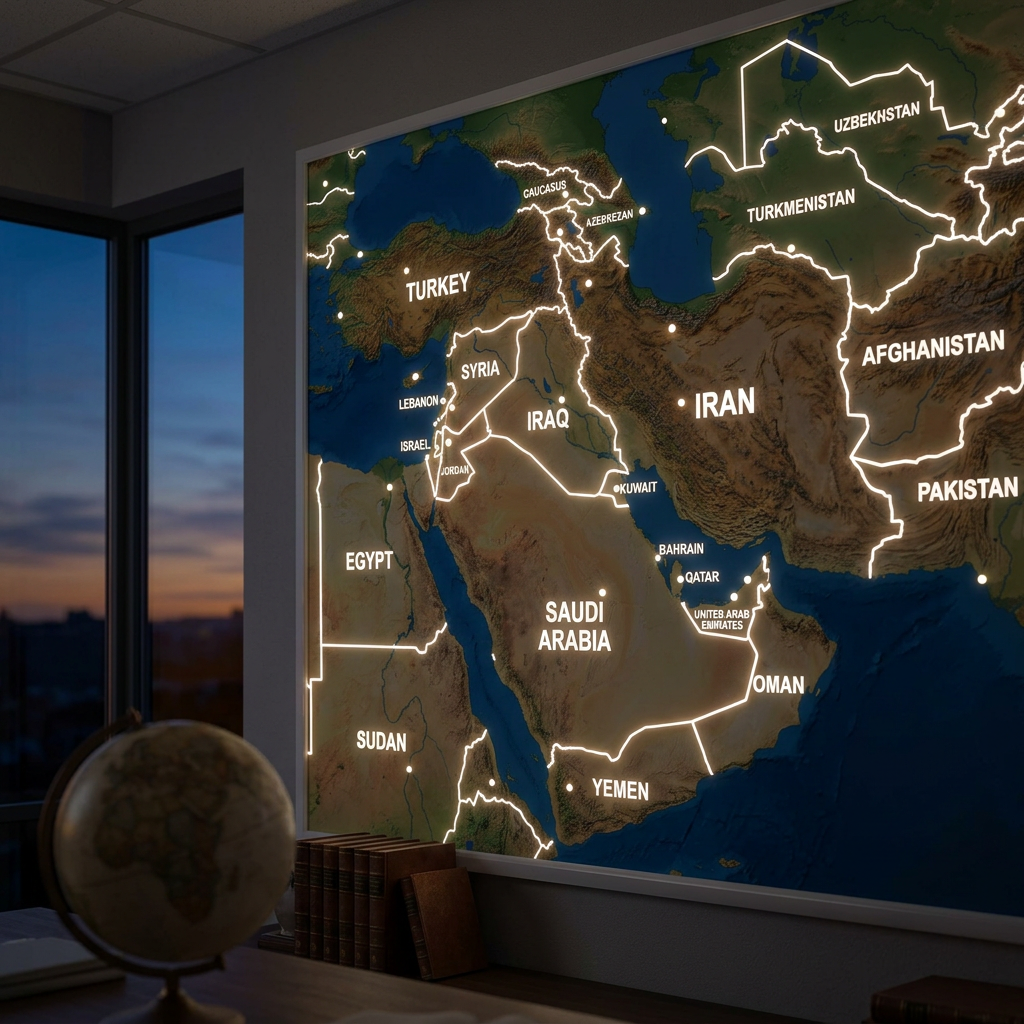
The Iran war has fundamentally reshaped the Middle East’s security landscape, and the consequences are still unfolding. Hezbollah, once the world’s most heavily armed non-state actor, has lost an estimated 80–85% of its pre-war firepower, with its mass-raid and long-range strike capabilities severely degraded after the joint U.S.-Israel campaign severed the IRGC Quds Force’s resupply link. Across the Gulf, the six GCC states are hedging rather than acting as a unified bloc — accumulating arms under a doctrine that treats stability as a multiplier, yet hesitating to deploy that hardware operationally. The UAE stands apart: having absorbed the heaviest Iranian assault of any Gulf state, it has moved closer to Israel than at any point in the Abraham Accords era, hosting an Iron Dome battery operated by IDF crews and demonstrating a clear willingness to act. Israel, meanwhile, has committed roughly 350 billion shekels (~$110 billion) over a decade to expand domestic munitions production, while remaining deliberately tied to key U.S. platforms such as the F-35. Taken together, these shifts carry a central lesson for U.S. regional strategy: capability without demonstrated political will does not constitute deterrence, and sustained, credible American commitment will shape whether Gulf partners lean toward proactive defense or hedge toward accommodation with Iran.
Drawing on a June 24, 2026 interview with Yaakov Lappin — military affairs correspondent and analyst at the Miryam Institute, the Alma Research and Education Center, and the Begin-Sadat Center for Strategic Studies at Bar-Ilan University — and corroborated by external reporting from Chatham House, Axios, and Israeli government sources, this analysis examines the most consequential shifts reshaping the regional order.
Key Takeaways
- Hezbollah has lost an estimated 80–85% of its pre-war firepower, including the mass-raid and long-range precision-strike capabilities that once made it the world’s most heavily armed non-state actor. Its domestic legitimacy in Lebanon has also eroded — though full recovery cannot be ruled out if IRGC financing and resupply recover.
- The Gulf Cooperation Council is not acting as a unified bloc. Each member is calculating its own risk tolerance based on distinct threat perceptions and economic exposures, with Saudi Arabia favoring defensive restraint and the UAE standing out as the most operationally engaged partner for both the U.S. and Israel.
- The UAE absorbed the heaviest Iranian assault of any Gulf state — roughly 550 missiles and more than 2,200 drones — and responded by deepening its alignment with Israel, hosting an Iron Dome battery operated by IDF crews in a first-of-its-kind deployment outside Israel or the United States.
- The Chatham House framing of GCC strategy — “stability is a multiplier” — explains why Gulf states accumulate arms but often hesitate to deploy them. The central lesson is that capability without demonstrable political will does not constitute deterrence.
- Israel struck Iran alone in Operation Rising Lion (June 2025), then returned in a larger coalition with the U.S. in Operation Roaring Lion (March 2026), executing approximately 4,200 sorties and severing the IRGC Quds Force’s operational link to Hezbollah.
- Israel has announced a 350 billion shekel (~$110 billion) decade-long investment in its domestic defense industry, focused on “bread-and-butter” munitions, while deliberately maintaining its F-35 procurement relationship with Lockheed Martin rather than pursuing full platform independence.
- For U.S.-Israel-Gulf coordination, the key implication is that sustained, credible American commitment will shape whether Gulf partners lean toward proactive defense or hedge toward accommodation with Iran.
How Degraded Is Hezbollah After the Iran War?
Hezbollah entered the conflict as the most heavily armed non-state actor in the world. It exits significantly diminished. According to Lappin’s analysis, the group has lost an estimated 80–85% of its pre-war firepower — a figure that reflects not only weapons destroyed but the structural unraveling of Iran’s ability to resupply Hezbollah through the IRGC Quds Force.That resupply link was explicitly targeted and severed during Operation Roaring Lion in March 2026. The joint U.S.-Israel campaign flew approximately 4,200 sorties, according to IDF operational data, dismantling the logistics chain that had sustained Hezbollah’s arsenal for decades. Before that operation, Israel had already struck Iran unilaterally in Operation Rising Lion (June 13–24, 2025), targeting Iran’s nuclear weapons program, ballistic missile infrastructure, and broader military activities threatening Israel — as documented in the Israeli Ministry of Foreign Affairs’ legal and factual account of the conflict, updated September 2025.
What Capabilities Has Hezbollah Actually Lost?
The degradation is qualitative as much as quantitative. Hezbollah’s pre-war arsenal was distinguished by two key capabilities: the ability to conduct mass rocket and missile raids capable of overwhelming Israeli air defenses, and precision-guided munitions capable of targeting Tel Aviv and strategic infrastructure. Both capabilities have been severely degraded.Equally significant is the political erosion. Hezbollah’s identity was built, in part, on a narrative of armed resistance and community defense within Lebanon’s Shiite population. The displacement of that population during the war, combined with the visible destruction wrought by a conflict Hezbollah initiated or escalated, has damaged the group’s domestic legitimacy in ways that weapons transfers alone cannot repair.The ceasefire in Lebanon remains fragile. According to the analyst, the IDF moved rapidly to neutralize Hezbollah cells in the days immediately following the memorandum of understanding — a posture that signals continued wariness about the durability of any halt in hostilities.
Can Hezbollah Recover to Pre-War Strength?
A swift return to pre-war capability is unrealistic given current conditions. The severing of the Iran-Hezbollah Quds Force logistics corridor removes the primary mechanism through which Hezbollah historically rebuilt after previous rounds of conflict. Without sustained IRGC financing and weapons transfers, reconstitution at scale is not feasible in the near term.This assessment carries an important caveat: if Iran stabilizes, restores revenue flows, and reestablishes supply chains, the trajectory could change. The IRGC Quds Force has historically served as the coordinating arm of what Tehran describes as its “forward defense” — a network that includes Hezbollah, the Houthis in Yemen, Iraqi Shia militias such as Kata’ib Hezbollah and Asa’ib Ahl al Haq, and Hamas. The degradation of one node does not eliminate the network’s broader architecture.
How Are Gulf States Responding to the New Regional Reality?
Analysts who assume the GCC is responding to the Iran war as a coherent bloc are working from a flawed premise. The six Gulf states are navigating fundamentally different threat perceptions, economic exposures, and political constraints. Each is hedging — but the direction and degree of that hedging varies considerably.According to Chatham House’s June 2026 analysis by Rashid Al-Mohanadi, the doctrine underpinning Gulf strategy is that “stability is a multiplier, not a scarce resource.” This framing — published in The World Today on June 15, 2026 — explains the GCC’s historical preference for diplomatic accommodation, mediation, and economic integration over direct military confrontation. Saudi Arabia championed the Arab Peace Initiative. Qatar brokered ceasefires between Israel and Hamas in Gaza and between Israel and Iran in June 2025. The UAE and Bahrain signed the Abraham Accords. These were not acts of naivety; they reflected a coherent strategic logic grounded in the belief that stability enables economic transformation.The Iran war tested that logic severely.
Saudi Arabia: Arms Acquisitions, Limited Operational Employment
Saudi Arabia has made substantial arms purchases in the post-war environment. These acquisitions represent genuine capability development, but the analyst notes a persistent gap between procurement and operational employment. Riyadh’s posture during the conflict was one of defensive restraint — consistent with the GCC doctrine of “defensive denial” that Chatham House describes as aimed at rendering adversary strikes “politically and militarily futile” without triggering further escalation.Saudi Arabia’s Vision 2030 agenda creates structural incentives for regional stability. A prolonged conflict — or the perception of direct military involvement against Iran — carries risks to foreign investment, tourism, and the economic diversification programs central to Crown Prince Mohammed bin Salman’s governing vision. That calculus constrains how far Riyadh is prepared to go operationally, regardless of its hardware inventory.
The UAE: The Standout Gulf Ally
The UAE’s experience during the war was qualitatively different from that of other GCC states. According to the UAE Ministry of Defense, Iran fired approximately 550 ballistic and cruise missiles and more than 2,200 drones at the UAE — more than any other country in the region. Most were intercepted, but some struck military and civilian targets.The scale of the Iranian assault accelerated a strategic realignment that had been building since the Abraham Accords were signed in 2020. In April 2026, Axios reported — based on two Israeli officials and one U.S. official — that Israel sent an Iron Dome air defense battery with IDF operators to the UAE early in the war, following a direct call between Prime Minister Benjamin Netanyahu and UAE President Mohammed bin Zayed. It was the first time Israel had deployed Iron Dome to another country, and the first time the system was operated outside Israel or the United States. The system intercepted dozens of Iranian missiles, according to Israeli officials cited in the report.The Emirati response to that assistance was unambiguous. “We are not going to forget it,” a senior Emirati official told Axios. A former official at the UAE’s National Security Council wrote that Israel and the United States “have stepped up to provide real assistance to the UAE,” describing them as “true allies.”The analyst points to additional indicators of UAE operational assertiveness, including reported acquisition of Indian cruise missiles and, according to some accounts, reported kinetic strikes against targets in Iran. These latter claims remain contested and should be treated with appropriate sourcing caution — they have not been officially confirmed by Emirati authorities. But the directional shift is unmistakable: the UAE has demonstrated a willingness to act that sets it apart within the GCC.
The Core Lesson: Arms Without Will Is Not Deterrence
The distinction between capability and political will is analytically important. Gulf states that have invested heavily in modern military hardware — Patriot batteries, advanced fighter aircraft, naval systems — but have shown limited readiness to employ that hardware in contested scenarios are not, in any operational sense, deterrent actors. Deterrence requires that a potential adversary believes force will be used.Israel provides the clearest counterexample. It struck Iran unilaterally in June 2025, before any coalition had formed. When a larger campaign became necessary in March 2026, Israel operated alongside the United States. The willingness to act — even alone, even under significant risk — is precisely what the analyst identifies as the foundation of credible deterrence.
How Is the U.S. Military Presence in the Gulf Evolving?
Iran’s strategic objective throughout the conflict included pressuring Gulf states to expel or distance themselves from U.S. military forces. The Chatham House analysis confirms that Tehran launched widespread strikes against GCC states — including at Ras Laffan energy facilities on March 2, 2026 — even though Gulf states had made clear that their airspace, land, and maritime areas would not be used for offensive operations against Iran. Iran’s targeting of civilian infrastructure in Qatar, particularly at Ras Laffan, made evident that its objectives extended beyond degrading U.S. military capacity.The U.S. military presence in the Gulf, anchored at facilities such as Al-Udeid Air Base in Qatar, remains a central variable. Secretary of State Marco Rubio’s Gulf outreach, and the dynamics surrounding a potential U.S.-Iran memorandum of understanding, have introduced uncertainty about the long-term durability of U.S. regional commitments. Gulf states — aware that U.S. strategic priorities can shift between administrations — are hedging not only against Iran and Israel but against the possibility of reduced American engagement.This structural uncertainty reinforces the case for accelerated GCC defense integration, enhanced intelligence sharing, and improved interoperability — the military architecture that Chatham House argues the Gulf must build with international partners to replace reactive accommodation with proactive resilience.
What Is Israel’s Defense-Industrial Strategy After the Iran War?

Israel’s experience of two major military campaigns in rapid succession — Operation Rising Lion (2025) and Operation Roaring Lion (2026) — produced a clear strategic lesson: military campaigns at this scale consume munitions at rates that no country can sustain without deep domestic production capacity. That lesson has been translated into the most significant defense-industrial investment in Israeli history.In December 2025, Prime Minister Benjamin Netanyahu formally announced that Israel would add 350 billion shekels — approximately $110 billion — to its defense budget over the following decade. Israel’s 2026 defense budget stands at approximately 112 billion shekels (~$35 billion), representing roughly 16% of the country’s public budget. The decade-long investment plan signals a structural commitment to defense-industrial independence, not a temporary wartime surge.
Where Is Israel Concentrating Its Defense Investment?
The analyst identifies the core of Israel’s investment strategy as “bread-and-butter” munitions — the high-volume, high-consumption ordnance that determines operational sustainability in prolonged conflicts: gravity bombs, air-to-surface munitions, tank shells, and artillery ammunition. The lessons from Ukraine’s munitions crisis — in which Western stockpiles were drawn down faster than industrial production could replenish them — are explicitly informing Israeli planning.This focus on munitions production does not mean Israel is abandoning advanced systems development. But the prioritization reflects a sober assessment: precision-guided systems and advanced platforms mean little if the underlying inventory of conventional munitions runs dry in the course of an extended campaign.Israel is also exploring co-production partnerships with India as a potential diversification mechanism — reducing dependence on any single supplier while expanding industrial capacity. India and Israel have an established defense relationship, and India’s own cruise missile development programs offer potential pathways for collaborative production arrangements.
The F-35 Exception: Why Israel Is Not Trying to Replace Everything
One area where Israel is explicitly not pursuing independence is the F-35 platform. The Lockheed Martin F-35 is deeply integrated into Israeli Air Force doctrine, training pipelines, and operational planning. The aircraft’s systems — including the Elbit-developed helmet-mounted display system used by Israeli pilots — represent a level of U.S.-Israeli co-development that would be neither practical nor strategically sensible to replicate domestically.The strategic formula is: acquire U.S. platforms, integrate Israeli systems. Israel’s domestic defense industry — Rafael, Elbit, IAI, and others — focuses on the avionics, sensors, munitions, and electronic warfare systems layered onto U.S.-origin airframes and hardware. This approach preserves interoperability with U.S. forces while ensuring that critical subsystems reflect Israeli operational requirements and remain under Israeli industrial control.
What Does the UAE-Israel Relationship Signal for Regional Security Architecture?
The Iron Dome deployment, the intelligence sharing, the Israeli Air Force strikes against Iranian short-range missiles positioned to target the UAE — these are not episodic acts of wartime convenience. They represent the operational realization of a strategic alignment that the Abraham Accords established in principle. The UAE and Israel share a threat assessment of Iran, a preference for active deterrence over diplomatic accommodation alone, and a demonstrated willingness to act on that assessment.For regional security architecture, the UAE-Israel relationship is significant precisely because it is asymmetric: the UAE brings resources, geography, and Gulf legitimacy; Israel brings operational military capability, intelligence depth, and a proven defense industrial base. Neither has what the other possesses in full. Together, they represent the most functionally integrated bilateral security relationship in the non-NATO Middle East.
What Are the Strategic Implications for Policymakers?
Several conclusions follow from this analysis for those engaged in Middle East policy and strategy:On Hezbollah: The 80–85% degradation of Hezbollah’s firepower is a significant strategic development, but it should not be treated as permanent. Recovery is contingent on the IRGC’s ability to reconstitute its logistics network and financing capacity. Policy frameworks that assume Hezbollah’s long-term weakness without building in contingencies for reconstitution are exposed to strategic surprise.On Gulf hedging: The GCC’s doctrine of “stability as a multiplier” is rational, not timid. Policymakers seeking to engage Gulf states as security partners should recognize that Riyadh, Abu Dhabi, Doha, and Riyadh are operating from different threat assessments and economic constraints. Treating the GCC as a monolithic bloc will produce misaligned policy prescriptions. The UAE requires and rewards a different type of partnership than Saudi Arabia or Qatar.On U.S. commitments: The uncertainty surrounding long-term U.S. military engagement in the Gulf is a structural factor driving Gulf hedging. Concrete, sustained signals of commitment — including formal security guarantees analogous to the executive order providing a NATO Article 5-style commitment to Qatar, as Chatham House notes was issued following Israel’s September 2025 strike on Doha — would reduce the hedging calculus for states that might otherwise tilt toward accommodation with Iran.On Israel’s defense investments: The 350 billion shekel investment plan is not merely a domestic economic decision. It has implications for allied munitions supply, co-production opportunities, and the balance of regional military capability. Partners considering long-term defense-industrial cooperation with Israel should engage with that planning cycle now, not reactively.On deterrence credibility: The central lesson of the conflict is that capability without demonstrated political will does not constitute deterrence. Gulf states that invest heavily in hardware but signal reluctance to employ it operationally may be providing Iran with precisely the assurance it needs to continue calibrated pressure short of the threshold that would trigger a response.
The Road Ahead: Strategic Clarity in a Fluid Environment
The Iran war has not produced a settled regional order. It has produced a new configuration of pressures, opportunities, and uncertainties that will continue to evolve. Ceasefires are fragile. Iran’s proxy network — despite the degradation of its most powerful node in Hezbollah — remains structurally intact across Lebanon, Yemen, Iraq, and among Palestinian armed groups. The IRGC Quds Force, as the coordinating mechanism of Tehran’s “forward defense,” has been damaged but not dismantled.What the war has done is clarify alignments. The UAE has demonstrated that it will act. Israel has demonstrated that it will act — alone if necessary. The United States has demonstrated that, under the right political conditions, it will commit to a large-scale coalition campaign. And the Gulf states, as a collective, have demonstrated that “defensive denial” — the doctrine of making adversary strikes politically and militarily futile — is a viable interim strategy, even if it falls short of the proactive deterrence that long-term regional security requires.For policymakers navigating this landscape, the Chatham House framing remains instructive: “The lesson is that when rogue actors reject collective security, the strategy for managing them must evolve.” Accommodation is a tool, not a strategy. Building a defensively unassailable regional architecture — one that integrates Gulf investment, Israeli operational capability, and sustained U.S. commitment — is the structural challenge the region now faces.
Conclusion
The Iran war has redrawn the region’s strategic map without settling it. Hezbollah, once the world’s most heavily armed non-state actor, now operates from a position of profound weakness, its firepower reduced by an estimated 80–85% and its resupply corridor through the IRGC Quds Force severed — though its potential reconstitution remains a live risk rather than a closed chapter. The Gulf states continue to hedge, accumulating capability under a doctrine that prizes stability while hesitating to convert hardware into demonstrated will. The UAE is the exception that proves the rule: having absorbed the heaviest Iranian assault of any GCC member, it has aligned with Israel more closely than at any point in the Abraham Accords era, showing that capability paired with the readiness to act is what generates real deterrence. Israel, for its part, is translating the lessons of two campaigns into a decade-long, $110 billion investment in domestic munitions production, even as it deliberately preserves its dependence on U.S. platforms such as the F-35. Binding these threads together is a single, durable conclusion: in a regional order defined by fragile ceasefires, intact proxy networks, and shifting alignments, the credibility and constancy of American commitment will be decisive — shaping whether Gulf partners lean toward proactive defense alongside Israel and the United States, or hedge their bets toward accommodation with a wounded but unbroken Iran.
Frequently Asked Questions
How significant is Hezbollah’s 80–85% loss of firepower, and what does it mean operationally?
The loss of 80–85% of its pre-war firepower represents Hezbollah’s most severe military degradation since its founding in 1982. Operationally, it means Hezbollah has lost its ability to conduct mass rocket and missile raids capable of saturating Israeli air defenses, and its precision-guided munitions capacity — critical for targeting strategic infrastructure deep inside Israel — has been substantially reduced. The severing of the IRGC Quds Force logistics corridor during Operation Roaring Lion (March 2026) removes the primary resupply mechanism. Recovery to pre-war strength is not feasible in the near term absent major IRGC reconstitution of its financing and weapons-transfer networks — a development that cannot be ruled out entirely if Tehran stabilizes and restores its revenue streams.
Can Israel achieve genuine defense independence while remaining tied to the F-35 program?
The United States can reduce Gulf hedging by pairing credible deterrence signals with concrete, durable commitments. The most effective instrument is a formal security guarantee — such as the NATO Article 5-style executive order issued to Qatar after Israel’s September 2025 strike on Doha — which converts ambiguous assurances into binding obligations that withstand changes in administration. Beyond guarantees, Washington should sustain a visible forward presence at facilities like Al-Udeid Air Base, deepen integrated air and missile defense cooperation across the GCC, and tie arms sales to interoperability and joint operational planning rather than treating procurement as an end in itself. Crucially, commitments must be consistent over time: Gulf states hedge precisely because they doubt the longevity of American engagement, so predictability across electoral cycles matters as much as the scale of any single deployment. When partners trust that U.S. support will persist, the incentive to seek accommodation with Iran as an insurance policy diminishes.
What explains the divergence within the GCC, and why does the UAE behave differently from Saudi Arabia and Qatar?
The GCC is not a monolithic bloc, and its members draw on different threat perceptions, economic priorities, and strategic cultures. The UAE absorbed the heaviest Iranian assault of any Gulf state — roughly 550 missiles and more than 2,200 drones — and operates from a more activist strategic culture, backed by the deepest security ties with Israel in the region, including the first-ever Iron Dome deployment on its soil operated by IDF crews. That combination of direct exposure and operational willingness sets Abu Dhabi apart. Saudi Arabia, by contrast, anchors its calculus in the Vision 2030 economic transformation, where foreign investment, tourism, and diversification depend on regional stability; as a result, Riyadh leans toward defensive restraint and is wary of actions that could draw it into open conflict with Iran. Qatar follows a third path, emphasizing its role as a mediator — having brokered ceasefires between Israel and Hamas and between Israel and Iran — while relying on the protection associated with hosting the U.S. presence at Al-Udeid Air Base. These distinct postures explain why the same Iranian pressure produces markedly different responses across the GCC, and why treating the bloc as uniform leads to misaligned policy.
How should the United States structure its commitments to keep Gulf partners from hedging toward Iran?
The United States can curb Gulf hedging by converting open-ended assurances into binding, durable commitments. The most effective instrument is a formal security guarantee — such as the NATO Article 5-style executive order extended to Qatar after Israel’s September 2025 strike on Doha — which gives Gulf partners obligations they can count on across changes in administration. Beyond guarantees, Washington should maintain a visible forward presence at facilities like Al-Udeid Air Base, deepen integrated air and missile defense cooperation across the GCC, and link arms sales to interoperability and joint operational planning rather than treating procurement as a transaction. Consistency is decisive: Gulf states hedge precisely because they doubt the longevity of American engagement, so predictability across electoral cycles matters as much as the scale of any single deployment. Commitments should also be calibrated to each partner’s posture — recognizing that the UAE, Saudi Arabia, and Qatar require different mixes of guarantees, presence, and operational cooperation. When partners trust that U.S. support will endure, the incentive to seek accommodation with Iran as an insurance policy diminishes.
What is the IRGC Quds Force, and why is its degradation central to assessing the broader Iranian threat network?
The IRGC Quds Force is the external operations arm of Iran’s Islamic Revolutionary Guard Corps, and it functions as the coordinating mechanism for what Tehran describes as its “forward defense” strategy. In practical terms, the Quds Force manages the financing, weapons transfers, training, and operational direction that bind together Iran’s network of regional proxies — Hezbollah in Lebanon, the Houthis in Yemen, Shia militias in Iraq such as Kata’ib Hezbollah and Asa’ib Ahl al Haq, and Palestinian armed groups including Hamas. Its degradation is central to assessing the broader Iranian threat because the network’s strength depends less on any single proxy than on the connective tissue the Quds Force provides. The severing of the IRGC Quds Force logistics corridor during Operation Roaring Lion (March 2026) is what makes Hezbollah’s 80–85% loss of firepower so consequential: without the resupply mechanism that historically rebuilt the group after previous conflicts, reconstitution at scale becomes far harder. Two qualifications matter, however. First, degrading one node — even the most powerful — does not dismantle the network’s broader architecture, which remains structurally intact across Lebanon, Yemen, Iraq, and the Palestinian theaters. Second, the damage is not necessarily permanent: if Iran stabilizes, restores its revenue streams, and reestablishes supply chains, the Quds Force retains the institutional capacity to rebuild its forward-defense network over time. For analysts, this means Hezbollah’s current weakness should be read as a function of Quds Force degradation rather than as an independent or irreversible condition — a distinction with direct implications for how durable the post-war regional order actually is.
Why does the UAE-Israel relationship matter more for regional security architecture than other Abraham Accords partnerships?
The UAE-Israel relationship matters more than other Abraham Accords partnerships because it has moved from diplomatic principle to operational reality under the pressure of actual combat. Where the broader Accords established normalization on paper, the war converted that framework into a functioning bilateral security relationship — one defined by the first-ever deployment of Iron Dome outside Israel or the United States, operated by IDF crews on Emirati soil, alongside intelligence sharing and Israeli Air Force strikes against Iranian missiles positioned to target the UAE. Three factors give this relationship structural weight. First, it is built on a shared threat assessment of Iran and a common preference for active deterrence over accommodation alone, which gives the alignment durability beyond any single crisis. Second, it is productively asymmetric: the UAE contributes resources, geography, and Gulf legitimacy, while Israel contributes operational military capability, intelligence depth, and a proven defense-industrial base — meaning each partner supplies what the other cannot generate alone. Third, the UAE absorbed the heaviest Iranian assault of any Gulf state and responded by deepening rather than distancing its alignment, demonstrating a willingness to act that distinguishes it from other Accords signatories such as Bahrain or Morocco. The result is the most functionally integrated bilateral security relationship in the non-NATO Middle East — a working model for how Gulf investment, Israeli operational capability, and U.S. backing might combine into a more resilient regional architecture, and a benchmark against which other partnerships will be measured.
What does Israel’s $110 billion defense-industrial investment mean for allied munitions supply and co-production partnerships?
Israel’s $110 billion, decade-long investment plan carries implications that extend well beyond its borders, reshaping the calculus for allied munitions supply and co-production. By concentrating on “bread-and-butter” ordnance — gravity bombs, air-to-surface munitions, tank shells, and artillery ammunition — Israel is building the kind of deep production capacity that the Ukraine conflict demonstrated is decisive in prolonged campaigns, where stockpiles drain faster than industry can replenish them. For allies, this creates two distinct opportunities. First, an expanded Israeli industrial base could become a supplementary source of high-consumption munitions for partners facing their own inventory constraints, easing pressure on overstretched Western production lines. Second, the plan’s explicit interest in co-production — illustrated by exploratory partnerships with India around cruise missile development — signals that Israel is seeking to diversify supply chains and share manufacturing burdens rather than pursue full autarky. The strategic formula remains “acquire U.S. platforms, integrate Israeli systems,” which preserves interoperability while concentrating Israeli industrial effort on avionics, sensors, munitions, and electronic warfare. For policymakers weighing long-term defense-industrial cooperation, the key implication is one of timing: partners that engage with Israel’s planning cycle now — rather than reacting once production lines are committed — are best positioned to secure co-production arrangements, supply assurances, and interoperability standards that will shape the regional munitions balance for the next decade.
Discover more from Responsible Public Affairs
Subscribe to get the latest posts sent to your email.