
Geopolitics · Defense Affairs
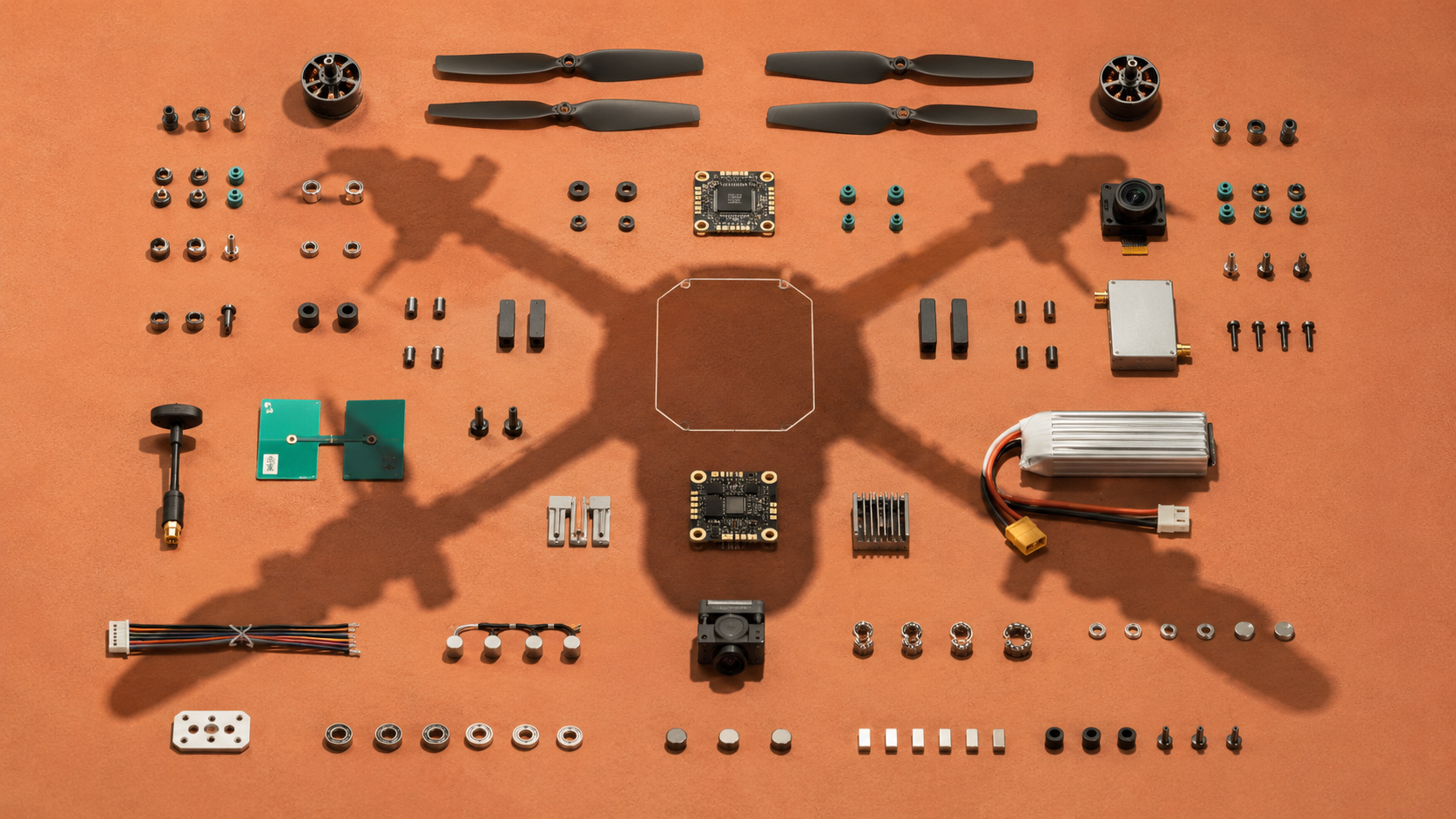
Low-cost drones have changed the economics of combat. They have not abolished industrial power. They have relocated it—from the finished airframe to the motors, controllers, radios, cameras, batteries, magnets, software, and factories that determine whether losses can be replaced tomorrow.
By Frank Farnel
Executive summary
- “Attritable” does not mean strategically disposable. A platform can be cheap to lose while the supply network required to replace it remains concentrated, foreign-controlled, or slow to reproduce.
- Assembly statistics can obscure dependency. Ukraine reported that 95 percent of the drones procured by its Defence Procurement Agency were made in Ukraine, yet an April 2026 European Commission decision approved a derogation for urgently needed components originating outside the EU, EEA-EFTA states, and Ukraine because compliant equivalents were unavailable at the required scale or speed.
- The United States is building a trusted-drone architecture through the Blue UAS system and FCC restrictions, but official audits show that broader defense supply-chain visibility remains incomplete. Screening a platform is not the same as creating wartime production capacity.
- Taiwan is attempting to turn its electronics ecosystem into a “non-red” drone supply chain. Its drone-industry output more than doubled in 2025, but the strategic test will be whether components, certification, and surge capacity can scale together.
- Iranian Shahed procurement networks show the opposite model: distributed intermediaries, commercial components, substitution, and continuous adaptation. Sanctions can raise friction, but the network must be mapped and disrupted repeatedly.
- For defense ministries, boards, investors, and allied governments, the relevant measure is not domestic content at delivery. It is replenishment sovereignty: the ability to replace losses at operational tempo without an adversary, unstable supplier, or regulatory bottleneck controlling the clock.
A revolution assembled from ordinary parts
For much of the modern era, military power favored the exquisite platform: the aircraft, ship, missile, or sensor system whose technical superiority justified high cost, long development, and careful protection. The spread of low-cost unmanned systems has challenged that logic. A force can now distribute surveillance, targeting, strike, deception, and interception across large numbers of machines whose loss is expected rather than exceptional.
This shift is real. Ukraine’s Ministry of Defence said its armed forces received a record three million FPV drones in 2025. By May 2026, the DOT-Chain Defence marketplace had delivered 485,000 unmanned aerial vehicles and other items worth UAH 31.4 billion, with an average delivery time of nine days for in-stock products. These are not prototype numbers. They describe industrialized consumption.
Yet the language of “cheap drones” can mislead. It invites policymakers to compare the purchase price of one airframe with the price of an interceptor or crewed aircraft while ignoring the network behind it. A small drone may combine an imported motor, rare-earth magnets, a flight controller, power-management electronics, a camera, a radio module, connectors, battery cells, firmware, and ground-control software. Each item is commercially familiar. In aggregate, their availability becomes a military variable.
The finished drone is therefore the visible tip of a less visible system. The strategic question is not whether a country can assemble a thousand units this month. It is whether it can source, substitute, certify, update, and replenish the relevant components after trade routes close, export controls tighten, suppliers are sanctioned, factories are struck, or battlefield adaptation changes the specification.
That is the attritability paradox: the easier a platform is to expend in large numbers, the more consequential its replacement network becomes.
Theory: from weaponized interdependence to replenishment sovereignty
Henry Farrell and Abraham Newman’s theory of weaponized interdependence explains how states positioned at central nodes in global networks can use those networks for information or denial. Their framework was developed around global economic and informational structures, but its chokepoint logic applies directly to drone production.
A supply chain need not be fully monopolized to create leverage. It is enough that a component, material, testing process, firmware dependency, or high-volume production cluster is difficult to replace within the time available. A nominally diversified market may still contain a hidden hub if many suppliers rely on the same upstream magnet, semiconductor, battery cell, production tool, or software library.
Drones intensify this problem because their battlefield value comes from iteration as much as from inventory. Frequencies change. Electronic-warfare countermeasures spread. Navigation is denied. New payloads, fiber-optic control, autonomy, and interceptor roles emerge. A resilient supplier must not merely repeat last quarter’s design; it must modify and manufacture the next one quickly.
This leads to a more demanding concept than domestic production: replenishment sovereignty. A state possesses replenishment sovereignty when it can restore a militarily relevant capability at the required rate, with acceptable security, after realistic disruption. The concept has four layers.
Platform sovereignty
Can domestic or allied firms design, assemble, test, and deliver the complete system? This is the most visible layer and the one most often measured in political announcements.
Component sovereignty
Can the system’s critical motors, sensors, communications modules, controllers, batteries, magnets, processors, optics, and materials be sourced from trusted suppliers? If not, are alternatives technically interchangeable, or would substitution require redesign and recertification?
Toolchain and data sovereignty
Who controls firmware, development tools, cloud services, cryptographic keys, mission data, update channels, and testing equipment? Hardware produced domestically may still depend on foreign software or remote services that create intelligence, cyber, or continuity risks.
Tempo sovereignty
Can the whole system replace combat losses at the rate at which they occur? Capacity that looks adequate in peacetime may fail under surge demand. A trusted component delivered in twelve months does not substitute for an untrusted one needed in twelve days.
These layers explain why sovereignty is not binary. A country can lead in platform assembly and remain exposed upstream. It can secure components but lack production tooling. It can build a trusted system whose cost or delivery rate is operationally unusable. It can also accept temporary external sourcing without surrendering long-term resilience—if the exception is governed as a bridge rather than treated as a permanent business model.
The Drone Sovereignty Stress Test
| Test | Question | Evidence to demand | False comfort |
|---|---|---|---|
| Origin | Where do critical parts and materials actually originate? | Tier-two and tier-three mapping; beneficial ownership; material provenance | “Final assembly is domestic” |
| Substitutability | What happens if the principal source disappears? | Qualified alternatives; redesign time; test and certification burden | A second distributor using the same upstream factory |
| Throughput | Can trusted suppliers meet wartime consumption? | Monthly output, surge contracts, tooling, workforce, lead times | A production target without component allocations |
| Trust | Can hardware, software, and data paths be verified? | Cyber assessment, firmware control, penetration testing, update governance | Country-of-origin rules alone |
| Adaptation | Can the supply base change designs as the battlefield changes? | Modular architecture, open interfaces, user feedback, rapid qualification | Large inventories of a design the enemy has learned to defeat |
| Time | How long can operations continue after disruption? | Stockpiles by component, burn rates, repair yields, recovery timelines | Annual capacity compared with monthly attrition |
Case one: Ukraine—the achievement and the dependency can both be true
Ukraine has built one of the world’s most dynamic defense-technology ecosystems under wartime pressure. In June 2026, its Ministry of Defence reported that 95 percent of UAVs procured by the Defence Procurement Agency DOT were manufactured in Ukraine. The ministry linked that result to a market model in which combat units influence demand and battlefield data informs procurement.
The scale and speed are notable. DOT-Chain offered almost 800 items from more than 200 Ukrainian manufacturers in May 2026. Units could select capabilities while the state handled contracting, payment, and logistics. The Brave1 cluster, meanwhile, reported 2,500 companies and more than 5,000 products across its broader innovation ecosystem, including more than 500 UAV manufacturers. On August 20, Brave1 introduced a facility through which units could request drones against customized operational specifications.
This is an institutional innovation, not merely a procurement website. It shortens the path between battlefield evidence, user choice, producer demand, and delivery. It also gives smaller manufacturers information they can use to scale and adapt.
But domestic manufacture of the finished unit does not answer the component question. The Royal United Services Institute’s November 2025 study on decoupling drone supply chains from China identified Chinese-origin components and materials as a critical vulnerability for Western multirotor systems. The report highlighted semiconductors, permanent magnets, and sensors among the areas requiring sovereign or allied alternatives.
Europe’s own legal record makes the tension unusually clear. On April 1, 2026, the European Commission approved a derogation from the Ukraine Support Loan’s component-eligibility conditions. The decision states that Ukraine demonstrated there was no compliant equivalent available at the required scale or with a delivery time matching immediate operational needs. The product schedule is classified, and the public decision does not identify the components or countries of origin. The Financial Times subsequently reported that the exception enabled purchases of Chinese drone components with EU-backed funds.
These facts are not contradictory. Ukraine can successfully build a domestic drone industry and still depend on foreign upstream inputs. Indeed, rapid domestic assembly may increase component demand faster than an allied supply base can emerge.
The responsible conclusion is not that the Ukrainian model has failed. It is that wartime procurement must solve two problems on different clocks. The immediate clock demands usable systems now. The strategic clock demands alternatives before the external source becomes unavailable or coercive. A derogation can be operationally necessary and strategically uncomfortable at the same time.
Case two: the United States—trusted lists are a gate, not a factory
The United States has approached drone dependence primarily through security screening, procurement restrictions, and industrial policy. The Blue UAS initiative evaluates systems and components for statutory compliance, cybersecurity, hardware integrity, supply-chain risk, and data protection. It provides a trusted pathway for government buyers operating in sensitive environments.
The regulatory architecture tightened sharply at the end of 2025. On December 22, the Federal Communications Commission added foreign-produced UAS and critical components to its Covered List following a national-security determination. A subsequent determination, reflected in a January 7, 2026 FCC public notice, temporarily exempted products on the Blue UAS list and products qualifying as domestic end products under the Buy American standard. Those exemptions run until January 1, 2027 unless superseded.
The notice is important for what it says—and for what it does not. It describes rigorous testing and confirms that listed systems comply with relevant legal and cybersecurity standards. It also expressly recognizes that reliance on any foreign country for critical UAS components can create significant vulnerabilities for the domestic drone industrial base. A qualifying domestic end product, under the cited standard, can still contain foreign content; the cost of domestic components must exceed 65 percent of the finished product’s component cost.
In July 2026, the FCC opened a further proceeding concerning the importation and marketing of previously authorized military-grade foreign-produced UAS and critical components. That is a regulatory proposal, not a completed prohibition, and should be described as such. The Commission explicitly sought comment on economic and supply-chain effects.
This model offers a clear success: it turns “trusted” from a marketing adjective into an assessable category. It can reduce cyber, data, and statutory risks and create demand for alternative suppliers. Yet it also exposes an industrial limit. A list can determine what government may buy; it cannot by itself ensure that trusted motors, radios, cells, and processors exist at the volume and price a high-intensity conflict would require.
The U.S. Government Accountability Office’s July 2025 review of foreign dependency across the defense industrial base found that Department of Defense efforts were uncoordinated and limited in scope, with little visibility into the vast majority of lower-tier suppliers. The report concerned the broader defense supply chain rather than drones alone, but its relevance is direct. Drone programs draw heavily from commercial markets and layered supplier networks—the very environment in which country-of-origin knowledge becomes difficult.
The strategic risk is a secure but narrow ecosystem that cannot surge, or a scalable ecosystem that cannot be trusted. Policy has to solve both simultaneously.
Case three: Taiwan and the attempt to industrialize a “non-red” alternative
Taiwan’s response begins from a different position. It has world-class strengths in semiconductors, electronics, precision manufacturing, and information technology, but it also faces direct military pressure from China and understands the danger of relying on a potential adversary for unmanned-system components.
Taiwanese officials have therefore promoted a “non-red supply chain”: a network of democratic or trusted suppliers designed to avoid dependence on the People’s Republic of China. The term is politically explicit, but the industrial strategy behind it is practical—combine Taiwan’s manufacturing depth with allied markets, certification, and technology.
On April 30, 2026, Taiwan’s Executive Yuan reported that the domestic drone industry had reached NT$12.9 billion in output in 2025, more than 2.5 times the previous year. Finished-drone exports totaled NT$2.95 billion, which the government described as a twenty-one-fold year-on-year increase. It set a target of NT$40 billion in output by 2030 and cited NT$44.2 billion in planned public investment from 2025 through 2030.
Those growth rates are impressive, but their base matters. Taiwan is building an ecosystem rather than replacing the full scale of China’s commercial drone supply chain overnight. The 2030 target itself indicates that the project remains developmental. Certification, export markets, production tooling, and assured demand must grow alongside technical capacity.
Taiwan nevertheless offers a potentially important allied model. Full national autarky is neither economically realistic nor strategically necessary for most democracies. A distributed trusted network can be more resilient than a single domestic source, provided that allies map the same upstream dependencies and do not simply relabel components passing through a friendly jurisdiction.
The strongest version of the Taiwanese strategy is therefore not “buy Taiwanese instead of Chinese.” It is to use Taiwan’s industrial strengths to build interoperable, transparent, multi-country capacity that can be scaled and substituted during crisis. The test will be whether the network produces components at relevant volume, not merely whether it produces finished demonstrators.
Case four: the Shahed network and the persistence of commercial adaptation
Iran’s Shahed family demonstrates how a state can convert global commercial supply into strategic effect. The system’s significance does not rest on a single exquisite technology. It rests on the ability to obtain engines, servomotors, guidance elements, materials, and electronics through networks that can adapt when individual entities are exposed.
U.S. Treasury actions provide a partial map of that network. On November 12, 2025, the Office of Foreign Assets Control targeted 32 individuals and entities across Iran, the United Arab Emirates, Türkiye, China, Hong Kong, India, Germany, and Ukraine for roles in multiple missile and UAV procurement networks. The designation illustrates the geographic dispersion of procurement rather than proving that every listed actor served the same transaction chain.
On May 8, 2026, Treasury stated that an Iranian company had procured thousands of servomotors with one-way attack UAV applications and that such motors had been recovered in downed Shahed-136 systems. The same release said a China-based company had supplied or attempted to supply millions of dollars’ worth of carbon fiber, honeycomb fabric, and other aerospace-grade materials to the Iranian company.
Reporting published by The Wall Street Journal on August 26 described further evolution of the Shahed supply chain, citing Ukrainian examinations and current and former U.S. officials. The report said Chinese factories supplied components including engines, servomotors, and gyroscopes, and linked those inputs to faster jet-powered variants. Those attributions are reported assessments, not independently published technical findings, and should be treated accordingly.
The pattern still carries a clear analytical lesson. Commercial availability gives proliferators options. Sanctions against a named producer may slow procurement, raise costs, or force substitution, but the network can move through intermediaries, change specifications, and replace suppliers. Effective enforcement therefore behaves less like a one-time blacklist and more like continuous supply-chain intelligence.
There is a second lesson for Western planners. The same commercial abundance that accelerated allied innovation also enables adversaries. Open markets are not inherently an advantage for the more technologically sophisticated state; they advantage the actor best able to identify, acquire, adapt, and replenish the relevant parts under constraint.
The strategic choices—and the trade-offs
Supply-chain sovereignty is easy to demand and expensive to implement. Reshoring every component would raise cost, narrow competition, and slow innovation. A blanket ban can remove security risks while creating availability gaps. Stockpiles protect against short interruption but can become obsolete in a field where specifications change quickly. Standardization enables scale but can give an adversary a stable target for countermeasures. Modular design supports substitution but requires disciplined interfaces and testing.
The objective is therefore not maximum domestic content. It is acceptable dependence, designed consciously. That means deciding which layers must be sovereign, which can be allied, which can be commercially diversified, and which temporary dependencies require a funded exit plan.
It also requires distinguishing three forms of risk:
- Denial risk: a supplier or government can interrupt access to a critical input.
- Integrity risk: hardware, software, or data paths can be compromised, manipulated, or observed.
- tempo risk: an approved alternative exists but cannot arrive fast enough or in sufficient quantity to replace losses.
Different tools address each risk. Export diversification and stockpiles can reduce denial. Testing, source-code control, trusted lists, and penetration assessment can reduce integrity risk. Surge contracts, common standards, advance purchasing, tooling, and workforce investment can reduce tempo risk. Treating them as one generic “supply-chain problem” produces blunt policy.
What leaders should do now
Measure replacement, not inventory
Boards, defense ministries, and commanders should require a capability-replacement curve: how many mission-capable systems can be delivered after thirty, ninety, and 180 days of disruption? The calculation must include component stocks, repair yields, tooling, qualified alternatives, and expected battlefield adaptation.
Map below the prime contractor
Country-of-origin declarations at platform level are inadequate. Identify tier-two and tier-three suppliers, shared upstream factories, material processors, firmware owners, and testing dependencies. Two nominal suppliers do not create resilience if both depend on the same controller, magnet, or battery-cell producer.
Divide components by strategic criticality
Not every screw needs sovereign production. Rank components by operational impact, substitutability, lead time, security exposure, and concentration. Protect the small number whose loss stops the line or compromises the mission.
Buy interfaces as seriously as platforms
Modular architectures and open, controlled interfaces can allow alternative cameras, radios, controllers, and navigation modules to be integrated quickly. But modularity must be verified through real substitution tests, not asserted in procurement language.
Use derogations as bridges
Urgent exceptions can be strategically responsible when no trusted equivalent exists at battlefield speed. Every exception should nevertheless record the dependency, duration, exit condition, alternative-development owner, and consequences if the source disappears.
Create allied capacity without creating a new single point of failure
Trusted supply chains should distribute production, tooling, and knowledge across several jurisdictions. Alliance labels are insufficient if all firms rely on one upstream node. Joint procurement should include mutual access in crisis and pre-agreed rules for allocation when every ally needs the same component.
Connect sanctions to technical exploitation
Recovered systems should feed a continuous cycle: identify parts and markings, trace distributors and payments, update controls, inform manufacturers, and test whether substitution changes performance. Enforcement is strongest when financial intelligence, customs data, battlefield exploitation, and industrial knowledge are fused.
Conclusion: mass belongs to whoever can replace it
Drones have altered the relationship between cost and military effect. They allow forces to distribute risk, iterate rapidly, and impose losses with systems far cheaper than the platforms they threaten. But the word “cheap” describes a unit price, not a strategic position.
The deeper balance of power sits upstream. It sits in the factory that can produce motors by the hundred thousand; the supplier that controls magnets or cells; the engineer who can substitute a radio without redesigning the airframe; the certification system that distinguishes trusted from merely available; and the procurement process that converts battlefield feedback into deliveries before the requirement changes again.
Ukraine has demonstrated extraordinary platform innovation while exposing the urgency of component access. The United States is constructing a security gate while confronting the limits of supply-chain visibility. Taiwan is attempting to build a trusted industrial alternative. Iran’s procurement networks show how commercial components and intermediaries can sustain adaptation under pressure.
The common lesson is direct: an attritable force is only as sovereign as its next replacement. In the age of mass unmanned warfare, the state that controls the replenishment clock controls more than a supply chain. It controls operational freedom.
Key evidence
- Three million FPV drones: Ukraine’s Ministry of Defence reported this number delivered to its armed forces during 2025. Ukraine Ministry of Defence, December 27, 2025.
- 95 percent domestically manufactured: share of UAVs procured by Ukraine’s Defence Procurement Agency DOT that the ministry said were made in Ukraine. This is a platform-manufacturing measure, not a component-origin measure. Ukraine Ministry of Defence, June 22, 2026.
- April 1, 2026: the European Commission approved a derogation for urgent components originating outside the EU, EEA-EFTA states, and Ukraine after finding that compliant equivalents were not available at the required scale or delivery speed. The public decision does not identify the components or origin countries. European Commission Decision C(2026) 2210.
- €3.9 billion: first payment under an approximately €6 billion EU tranche dedicated to Ukrainian drone procurement. European Commission, June 30, 2026.
- More than 2.5 times: growth in Taiwan’s drone-industry output in 2025, reaching NT$12.9 billion; finished-drone exports rose twenty-one-fold year on year. Taiwan Executive Yuan, April 30, 2026.
- 32 individuals and entities in nine jurisdictions: targets of a November 2025 U.S. sanctions action against Iranian missile and UAV procurement networks. U.S. Treasury, November 12, 2025.
Glossary
Attritable system: an uncrewed system designed or acquired on the assumption that some losses are operationally and economically acceptable. It is not necessarily disposable or used only once.
Blue UAS: a U.S. government assessment and listing framework for drones, components, and software that meet specified legal, cybersecurity, hardware, supply-chain, and data-security requirements.
Critical component: a part whose absence, compromise, or failure materially prevents production or mission performance and which cannot be replaced quickly without redesign or requalification.
FPV drone: a first-person-view drone operated through a live video feed, widely adapted in Ukraine for reconnaissance, strike, and interception.
Non-red supply chain: terminology used by Taiwanese officials for supply networks intended to exclude or reduce reliance on Chinese-controlled sources.
Replenishment sovereignty: the capacity to replace lost capability at operational tempo, with acceptable security, despite realistic supply disruption.
Servomotor: a compact motor-and-control assembly used to position control surfaces or other moving parts accurately.
References and further reading
Official and primary sources
- European Commission. “Commission Implementing Decision C(2026) 2210 Approving Derogations From the Conditions of Eligibility of Defence Products.” April 1, 2026.
- European Commission, Directorate-General for Defence Industry and Space. “Commission Disburses €3.9 Billion for Drones Under the €90 Billion Ukraine Support Loan.” June 30, 2026.
- Federal Communications Commission. “Exemption of Certain Uncrewed Aircraft Systems and Critical Components From the FCC Covered List, DA 26-22.” January 7, 2026.
- Federal Communications Commission. “Public Notice on Previously Authorized Military-Grade UAS and UAS Critical Components, DA 26-758.” July 21, 2026.
- U.S. Government Accountability Office. “Defense Industrial Base: Actions Needed to Address Risks Posed by Dependence on Foreign Suppliers.” GAO-25-107283, July 24, 2025.
- Ukraine Ministry of Defence. “$45 Billion From Partners, Over 3 Million Strike Drones, More Ukrainian Weapons.” December 27, 2025.
- Ukraine Ministry of Defence. “95% of Drones Procured for the Defence Forces Are Ukrainian-Made.” June 22, 2026.
- Ukraine Ministry of Defence. “Nearly Half a Million UAVs and Other Equipment Delivered Through DOT-Chain Defence.” May 26, 2026.
- Executive Yuan, Republic of China (Taiwan). “Taiwan Strengthens Drone Industry Supply Chain to Meet Global Demand.” April 30, 2026.
- U.S. Department of the Treasury. “Treasury Disrupts Iran’s Transnational Missile and UAV Procurement Networks.” November 12, 2025.
- U.S. Department of the Treasury. “Economic Fury Disrupts Networks Supplying Weapons and UAV Components to Iran.” May 8, 2026.
Academic, analytical, and reporting sources
- Farrell, Henry, and Abraham L. Newman. “Weaponized Interdependence: How Global Economic Networks Shape State Coercion.” International Security 44, no. 1 (2019): 42–79.
- Tollast, Robert. “Drones: Decoupling Supply Chains From China.” Royal United Services Institute, November 18, 2025.
- Financial Times. “Ukraine to Buy Chinese Drone Parts With EU Funds.” July 2026.
- Ramzy, Austin. “How the Iranian Shahed Drone Transformed War—With China’s Help.” The Wall Street Journal, August 26, 2026.
Source and methodology note
Research was completed on August 26, 2026. The article prioritizes official government decisions, regulatory notices, defense-ministry releases, public audit findings, and peer-reviewed or institutional research. Corporate and government production figures are reported as the issuing institution defines them; they were not independently audited for this article.
Several limitations are material. “Ukrainian-made” refers to the finished UAVs procured through a specified agency and does not establish the origin of every component. The European Commission’s relevant Ukrainian product schedule is classified; the public decision confirms only that urgent components originated outside the EU, EEA-EFTA states, and Ukraine and that compliant alternatives were unavailable at the required scale or speed. Identification of Chinese components in the EU-backed purchases comes from Financial Times reporting. U.S. FCC actions concern equipment authorization, importation, marketing, and defined exemptions; they should not be misread as a universal ban on possession or continued use. Treasury designations are official allegations and legal actions by the U.S. government, not criminal convictions. Analytical conclusions about replenishment sovereignty are the author’s framework, not official findings.
Suggested internal links
- Defense Industrial Policy 2026: How Nations Are Rebuilding Strategic Capacity — link where the article distinguishes platform production from lower-tier supply resilience.
- Adapting to Drone Threats: Strategies for Modern Defense — link in the Shahed section to connect supply dependence with counter-drone economics.
- Defense Spending: Strategy, Cost, and Opportunity Costs — link in the trade-offs section on the cost of sovereign industrial capacity.
#Geopolitics #DefenseInnovation #SupplyChainSecurity
Discover more from Responsible Public Affairs
Subscribe to get the latest posts sent to your email.