
Geopolitics | Defense | European Security
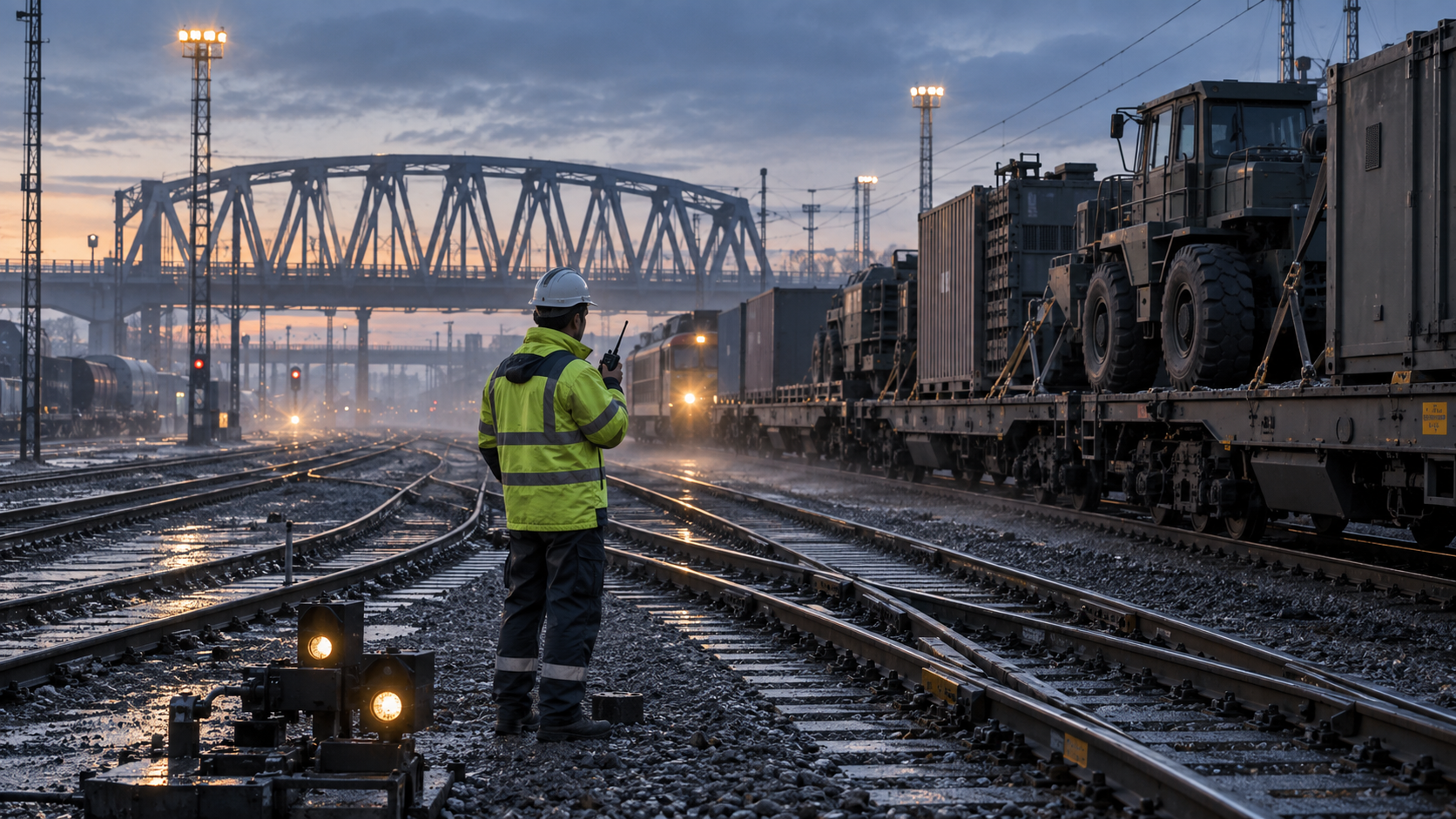
Europe can approve a defense budget, order new equipment and raise a brigade. None of that guarantees the force will arrive where it is needed, when it is needed. Deterrence now runs through customs forms, rail gauges, bridge loads, port capacity and civilian transport markets.
By Frank Farnel | Responsible Public Affairs | September 16, 2026

Executive Summary
- Military mobility is the conversion mechanism between forces owned and forces available. A unit that cannot cross borders, find suitable railcars, clear a tunnel or receive fuel within the operational window has limited deterrent value.
- The European Union is moving from voluntary coordination toward a proposed binding framework. The Commission’s 2025 package would harmonize permissions, create an emergency response system, establish national coordinators and support shared transport capacity. In June 2026, the Council unanimously adopted its negotiating position; the regulation had not yet been enacted at the research cut-off date.
- Europe’s physical and procedural gaps remain substantial. The first dedicated EU envelope—about €1.7 billion—supported 95 dual-use projects in 21 member states, but auditors found that funding was exhausted early and that projects were not always selected through a coherent strategic corridor logic.
- Four cases reveal different parts of the problem: the EU funding audit shows the cost of fragmented prioritization; the eight-country Central Northern European Military Mobility Area addresses procedures; Rail Baltica addresses gauge and infrastructure; and NATO’s Steadfast Dart 2026 tests whether plans work under movement at scale.
- The practical standard should be end-to-end route readiness. Permissions, infrastructure, transport assets, sustainment, protection and command must function as one chain. Improving only one link can leave the deployment no faster than before.
Deterrence Has a Timetable
European defense debates are dominated by inventories: how many tanks, air-defense batteries, artillery systems and brigades exist, how quickly factories can produce more, and how spending compares with gross domestic product. These numbers matter. But they describe ownership more readily than availability.
A military formation becomes strategically useful only when it can reach the theater, arrive with the right equipment, connect to command, obtain fuel and ammunition, and continue moving after the first disruption. Geography has always shaped war. In contemporary Europe, geography is overlaid by twenty-seven legal systems, national infrastructure decisions, commercial transport markets and networks built primarily for civilian efficiency.
The distinction is becoming harder to ignore. The European Court of Auditors’ September 3, 2026 review of EU defense policy again warned that bottlenecks in transport networks limit the ability of European forces to move efficiently around the continent. Eleven weeks earlier, the Council had unanimously approved its negotiating mandate for a regulation intended to make cross-border military movement faster and more coherent. The proposal is expected to be adopted by the end of 2026, but political expectation should not be confused with enacted law or operational capability.
The strategic issue is time. Reinforcement that arrives after an adversary has achieved its objective may still support a counteroffensive, but it did not deter the original move. A credible posture therefore depends not only on combat power but on mobilization latency: the time between the political decision to move and the arrival of a force ready to operate.
Deterrence is not the number of forces a state can display on paper. It is the force an adversary expects can arrive, survive and operate inside the relevant decision window.
That is why a bridge, a customs template or a commercial flatbed wagon can carry strategic weight. None is glamorous. All can decide whether the brigade exists in the place that matters.
The Five-Gate Movement Test
Military mobility is often presented as an infrastructure problem. It is more accurately a systems problem. A reinforced bridge does not accelerate a convoy waiting for diplomatic permission. A common form does not create a railcar able to carry an armored vehicle. A transport asset cannot solve a fuel shortage at the destination. A carefully mapped route can still be disabled by sabotage, cyberattack or congestion.
An end-to-end assessment should therefore pass through five gates.
1. Authority
The movement must be politically approved and legally executable. Cross-border permissions, customs documentation, dangerous-goods rules, road restrictions, police escorts and access to civilian infrastructure all matter. The European Commission’s current proposal would introduce a common process with a maximum three-day processing time in ordinary circumstances and a faster emergency framework. That is a meaningful design objective. It will still require national administrations to align practice, staff the process securely and accept that speed depends on decisions taken before a crisis.
2. Physical Passage
The route must carry the actual load. That includes axle weight, bridge strength, tunnel clearance, loading gauge, road geometry, port draft, runway condition and the interfaces between modes. Aggregate infrastructure spending says little unless it closes the specific bottleneck that interrupts an entire corridor.
3. Lift and Interoperability
Europe needs locomotives, flatbed wagons, heavy-equipment transporters, roll-on/roll-off vessels, cranes, handling teams and compatible couplings. Many of these assets are owned by commercial operators and optimized for peacetime demand. Availability during simultaneous military movements cannot be assumed. The European Defence Agency’s 2026 rail-capacity study identified gaps in rolling stock, interoperability, corridor resilience and crisis-response readiness.
4. Sustainment and Protection
A unit does not deploy once; it consumes. Fuel, ammunition, maintenance, medical support, food, spare parts and secure communications must follow. The transport network itself also becomes a target. Protection therefore includes air defense, cyber resilience, alternate routes, repair capacity, security against sabotage and continuity arrangements with civilian operators.
5. Command and Proof
Someone must see the whole movement, resolve conflicts among national authorities and adapt when the timetable fails. The only reliable evidence is rehearsal. Exercises reveal whether permissions arrive, trains are available, ports can stage units and civilian authorities understand the plan. A corridor that has never carried the intended load under realistic conditions is a hypothesis.
The five gates are sequential but interdependent. Failure at any one can stop the operation. That means the return on a mobility investment is determined less by its individual quality than by whether it completes the route.
Case One: Europe Funded Projects Before It Fully Prioritized Routes
The EU’s first dedicated military-mobility envelope under the Connecting Europe Facility was a significant policy change. Approximately €1.7 billion supported 95 dual-use projects across 21 member states. Bridges, rail links, roads, ports and terminals that benefit civilian transport can also enable military movement. The model is economically and politically attractive because it does not require Europe to build a separate military transport network.
The implementation exposed a familiar weakness. In its 2025 special report on military mobility, the European Court of Auditors concluded that the action plan had not reached full speed. Funding was rapidly committed, but the auditors found weaknesses in governance, needs assessment and project selection. Geopolitical and military factors were not given sufficient weight, and projects could be selected piecemeal rather than as complete corridors. In one example, the final section of a strategically important road was not funded even though other sections had been selected in earlier calls.
The Commission and the European External Action Service accepted that further progress was required. In their formal reply, they emphasized the urgency created by Russia’s full-scale war against Ukraine and noted that approximately €1.69 billion had been allocated quickly to 95 projects. That defense is reasonable: delay also carries a cost. Yet urgency and route coherence are not alternatives. Fast spending that leaves one bridge, border crossing or final road section unresolved may produce local improvements without changing deployment time.
The budget was also consumed unusually early. High demand demonstrated that the need was real, but it produced a gap before the next financial framework. By March 2025, the Council had endorsed four priority multimodal corridors. The Commission now says roughly 500 hotspot projects have been identified along them. The sequence is telling: the corridor logic became clearer after much of the initial funding had already been allocated.
Analysis: The lesson is not that the first program failed entirely. It created dual-use assets and institutional experience that did not previously exist. The lesson is that military mobility must be managed as a route portfolio, not a collection of nationally attractive projects. The relevant unit of value is the completed journey from reception point to operational destination.
Case Two: Eight Countries Are Building a Procedural Corridor
Infrastructure is only one source of delay. In January 2024, the Netherlands, Germany and Poland launched a Military Mobility Model Corridor intended to simplify movement from North Sea reception points toward Europe’s eastern flank. In November 2025, that cooperation expanded into the Central Northern European Military Mobility Area, bringing together Belgium, Czechia, Germany, Lithuania, Luxembourg, the Netherlands, Poland and Slovakia.
The eight countries committed to harmonizing procedures, improving infrastructure and planning, strengthening information exchange, digitizing processes and coordinating more closely with the EU and NATO. This regional approach addresses a basic operational fact: a movement from a western port to the eastern flank crosses a chain of sovereign jurisdictions. Improving one country’s process does not solve the border after it.
The initiative also shows why the phrase “military Schengen” is useful but imperfect. Civilian Schengen largely removes routine internal border checks for people. Military movement will continue to involve sovereign decisions, security controls, dangerous materials, national escorts and infrastructure allocation. The objective is not the disappearance of authority. It is prearranged authority—common data, trusted channels, predictable deadlines and procedures that do not have to be invented during mobilization.
There is an important limitation. A letter of intent and a governance structure are not proof that heavy forces can move at speed and scale. The participating states must demonstrate that approvals, customs, rail slots, road clearances and host-nation support work together under realistic demand. The value of the corridor will be measurable in hours removed from actual deployments, not meetings held or documents signed.
Analysis: The regional model is strategically sensible because corridors are geographical, not institutional. It can complement an EU-wide framework by allowing countries on the same route to solve concrete frictions together. Its risk is fragmentation by another name if different regional corridors adopt incompatible systems or depend on voluntary practices that disappear under political pressure.
Case Three: Rail Baltica Turns Gauge Into Strategy
The Baltic states illustrate the physical meaning of interoperability. Much of their inherited rail network uses the 1,520-millimeter gauge associated with the former Soviet system, while most of continental Europe uses the 1,435-millimeter standard gauge. That difference requires equipment, cargo or rolling stock to be transferred or adapted at an interface—an inconvenience in commerce and a potential delay during reinforcement.
Rail Baltica is designed to connect Estonia, Latvia and Lithuania to Poland and the wider European standard-gauge network. The project is civilian, but its specifications and location make it a major dual-use corridor. According to the project company’s March 2026 update, more than 267 kilometers of main line were construction-ready; 103 kilometers were under construction in Estonia, works covered a 30-kilometer priority section in Latvia, and track laying had begun on the first 8.8 kilometers in Lithuania, with a further 114 kilometers of main line under construction there.
The strategic promise is straightforward. Standard gauge reduces transshipment friction, while the line’s axle-load, train-length and loading-gauge specifications are intended to accommodate heavy freight and military requirements. It also adds a north-south connection to a region whose security depends on timely reinforcement.
The project simultaneously illustrates the difficulty of turning strategic infrastructure into delivered capacity. Cross-border megaprojects face cost escalation, sequencing risk, procurement pressure and dependence on long-term public funding. Rail Baltica reported in September 2026 that approximately €5.19 billion had been secured, including around €4.46 billion from the EU, while arguing that predictable funding across future budget cycles remained essential. Those figures are the project company’s own current account and should be understood as such, not as an independent completion guarantee.
Analysis: Rail Baltica can remove a structural constraint that no customs reform can solve. But strategic value will emerge only when an operational segment connects useful origins and destinations, terminals can load military equipment, rolling stock is available, and the route has protection and repair plans. A railway under construction is strategic potential; a rehearsed corridor is capability.
Case Four: Steadfast Dart Tested the Movement, Not Just the Fight
NATO exercises are often judged by the visible end state: aircraft overhead, armored vehicles maneuvering and ships at sea. Steadfast Dart 2026 was important for a quieter reason. It tested the deployment of the Allied Reaction Force across Europe before the tactical activity began.
NATO reported that approximately 10,000 troops from 13 Allies took part between January and March 2026, with 17 naval vessels, more than 20 aircraft and roughly 1,500 military vehicles. The exercise moved forces into Germany and integrated land, maritime, air, cyber, space and special-operations components. NATO described it as the largest and most visible Alliance exercise of the year and the first major deployment of the Allied Reaction Force in Joint Force Command Brunssum’s area of responsibility.
The logistical detail matters. NATO officers described the exercise as a deployment test involving borders, port authorities, trains and highways. The port of Emden served as a reception, staging and onward-movement node for multinational contingents. The Allied Reaction Force is designed to put its first elements into theater within ten days, making every administrative and transport delay operationally significant.
Steadfast Dart does not prove that Europe can move the much larger formations required for sustained high-intensity conflict. An exercise of 10,000 personnel is substantial, but it is not a continent-wide mobilization under attack. Nor does public reporting reveal every delay, workaround or classified lesson. What it does provide is evidence that mobility is being treated as a capability to exercise rather than a logistical assumption.
Analysis: Exercises convert corridor policy into institutional memory. They expose conflicts between military priorities and civilian schedules, reveal whether commercial assets appear when called, and force authorities to make decisions against a clock. The success metric should include not only arrival, but the number of exceptional interventions required. A system that works only because senior leaders personally unblock every crossing is not yet routine readiness.
The Route-Readiness Matrix
| Gate | Typical failure | Evidence of readiness | Principal owners |
|---|---|---|---|
| Authority | Different forms, late permissions, customs ambiguity, unplanned escorts | Common secure process; time-bounded approvals; pre-cleared scenarios; exercised emergency authority | Defense, transport, customs, interior ministries; national coordinators |
| Physical passage | Weak bridge, narrow tunnel, incompatible gauge, congested terminal | Load-tested end-to-end route; alternate route; funded repair and maintenance plan | Infrastructure ministries, rail and port managers, municipalities, armed forces |
| Lift and interoperability | No suitable wagon, transporter, vessel, crane or trained operator | Contracted and exercised assets; compatible interfaces; surge allocation rules | Armed forces, commercial carriers, infrastructure operators, EU/EDA mechanisms |
| Sustainment and protection | Fuel bottleneck, cyber outage, sabotage, single route, no repair team | Protected nodes; fuel and maintenance plan; cyber recovery; route redundancy; civil continuity arrangements | Military logisticians, energy providers, security services, private operators |
| Command and proof | No common picture; competing priorities; escalation by improvisation | Named command relationships; secure data exchange; measured deployment exercises; corrective actions closed | NATO commands, EU and national coordinators, host nations, movement-control centers |
What Leaders Should Do Now
- Measure time to operational effect. Count from the political decision to the arrival of a force capable of operating, not to the departure of the first vehicle.
- Fund complete corridors. Require every infrastructure proposal to show which end-to-end movement it enables and which remaining bottleneck still governs the route.
- Contract the scarce assets before the crisis. Map ownership and availability of flatbed wagons, heavy transporters, roll-on/roll-off shipping, cranes, locomotives and specialist crews. A national plan that assumes the same commercial asset as neighboring states is not a plan.
- Integrate civilian operators into secure planning. Ports, rail managers, energy companies and logistics providers hold operational knowledge that ministries do not. They also need appropriate security guidance and compensation arrangements.
- Treat data as infrastructure. Digital permissions can reduce delay, but the system must interoperate with NATO, protect sensitive movement data and continue functioning during cyber disruption.
- Exercise the alternate route. The primary corridor will attract congestion and hostile attention. Test what happens when one bridge, port, rail junction or digital platform is unavailable.
- Publish aggregate readiness without exposing routes. Democratic oversight requires evidence that funding changes capability. Governments can report processing times, exercise performance and closed bottlenecks without revealing operational details.
Corporate leaders also have a role. Civilian infrastructure and logistics companies may be asked to support defense movement while maintaining essential public services. Their boards should understand the contractual, insurance, workforce, cybersecurity and reputational implications before an emergency. A voluntary catalogue of assets is useful only if the listed capacity is legally available, technically suitable and supported by personnel.
Hypothesis: Europe’s most consequential mobility constraint may eventually be allocation rather than infrastructure. As civilian supply chains, allied reinforcements and support to Ukraine compete for the same ports, rail paths, fuel and specialist equipment, political authority to prioritize movements could become the decisive scarce resource. This is an analytical judgment, not a verified forecast.
Conclusion: Readiness Is a Journey Completed
Europe has begun to treat military mobility as more than a technical annex to defense policy. The proposed regulation, the four corridors, the national coordinators, regional mobility areas and NATO exercises all move in the right direction. They acknowledge that deterrence depends on the connective tissue between national forces.
The next danger is mistaking architecture for outcome. A common form is not permission granted. A funded bridge is not a complete route. A registered railcar is not an available railcar. An exercise completed is not a lesson implemented.
The test is brutally practical: can Europe move the required force, through several countries, with its sustainment, inside the relevant time window, while civilian networks are congested and at least one critical node is unavailable? Until that question can be answered with measured performance rather than institutional optimism, the tank may be ready while the route is not.
Key Evidence
- The EU’s first dedicated military-mobility envelope provided approximately €1.7 billion for 95 dual-use projects in 21 member states. Source: European Commission.
- The Commission says four priority corridors contain approximately 500 hotspot projects requiring attention. Source: European Commission.
- The proposed common process sets a maximum ordinary processing period of three days for cross-border military-movement permissions. The proposal was still under negotiation at the research cut-off. Source: European Commission.
- Eight countries joined the Central Northern European Military Mobility Area in November 2025: Belgium, Czechia, Germany, Lithuania, Luxembourg, the Netherlands, Poland and Slovakia. Source: Netherlands Ministry of Defense.
- Steadfast Dart 2026 involved around 10,000 troops from 13 Allies, 17 naval vessels, more than 20 aircraft and roughly 1,500 military vehicles. Source: NATO.
Glossary
Dual-use infrastructureTransport or energy infrastructure designed primarily for civilian use but capable of supporting military requirements.Host-nation supportCivil and military assistance provided by a country to allied forces operating in or moving through its territory.Loading gaugeThe maximum height and width of a rail vehicle and its load that can safely pass through tunnels, bridges and other structures.Military mobilityThe ability to move personnel, equipment and supplies rapidly and securely within and across territories.Reception, Staging and Onward Movement (RSOM)The process of receiving arriving forces, organizing them and moving them from ports or other entry points toward their operational destination.Roll-on/roll-off vesselA ship designed so wheeled or tracked vehicles can be driven on and off through ramps.Transport corridorAn integrated route using road, rail, air or maritime nodes to connect an origin with an operational destination.
References and Further Reading
EU Policy, Regulation and Audit
- European Commission, Directorate-General for Defence Industry and Space. Military Mobility. Updated with factsheet dated August 20, 2026.
- Council of the European Union. Military Mobility: Council Agrees Its Negotiating Position. June 17, 2026.
- European Commission and High Representative of the Union for Foreign Affairs and Security Policy. Joint Communication on Military Mobility. November 19, 2025.
- European Commission. Proposal for a Regulation Establishing a Framework of Measures to Facilitate Military Transport. November 19, 2025.
- European Court of Auditors. Special Report 04/2025: EU Military Mobility—Full Speed Not Reached Due to Design Weaknesses and Obstacles En Route. February 5, 2025.
- European Court of Auditors. Review 01/2026: EU Defence Policy in the Spotlight. September 3, 2026.
- European Defence Agency. Study on EU Rail Capacity: Public Factsheet. March 11, 2026.
Corridors, Infrastructure and Exercises
- Netherlands Ministry of Defense. Eight Countries Strengthen European Military Mobility. November 18, 2025.
- NATO. NATO’s Largest Military Exercise of 2026, Steadfast Dart, Is Underway. January 15, 2026.
- NATO. Exercise Steadfast Dart 26 Showcases NATO’s Rapid Reinforcement and the Allied Reaction Force. February 25, 2026.
- NATO Rapid Deployable Corps Italy. Steadfast Dart 2026: From Deployment to Execution Phase. February 17, 2026.
- RB Rail AS. Rail Baltica Highlighted as Strategic Dual-Use Corridor at RailTech Europe 2026. March 10, 2026.
- RB Rail AS. Rail Baltica Highlights the Importance of Predictable EU Funding for Europe’s Cross-Border Rail Infrastructure. September 2026.
Source and Methodology Note
Research was completed on September 16, 2026. The article prioritizes EU institutions, NATO, national authorities and infrastructure operators. The legal framework remains in development: the Council adopted its negotiating mandate on June 17, 2026, but the regulation had not been enacted at the research cut-off. Public sources do not disclose the routes, classified military requirements, exercise deficiencies or readiness levels needed for a complete operational assessment. Rail Baltica construction and funding figures are attributed to RB Rail AS and are treated as project reporting, not independent certification of completion. NATO exercise figures establish participation and stated objectives, not combat effectiveness. The five-gate model, the concept of mobilization latency and all passages labeled “Analysis” or “Hypothesis” are the author’s analytical framework.
Suggested Internal Links
- The Runway Is No Longer the Base: How Dispersion Is Rewriting Airpower and Deterrence
- The Strategic Asset Is Not the Cable. It Is the Ability to Repair It.
- Europe Has Found the Money for Defense. Now It Must Learn to Buy Together.
Hashtags: #EuropeanDefense #MilitaryMobility #NATO
Discover more from Responsible Public Affairs
Subscribe to get the latest posts sent to your email.