
European defense expenditure is projected to reach €454 billion in 2026, yet collaborative procurement represented only 24% of EU equipment spending in 2025. Deterrence will depend on whether governments can convert larger budgets into common requirements, interoperable systems, sustained production and forces that are ready to fight together.
By Frank Farnel | Responsible Public Affairs | August 12, 2026
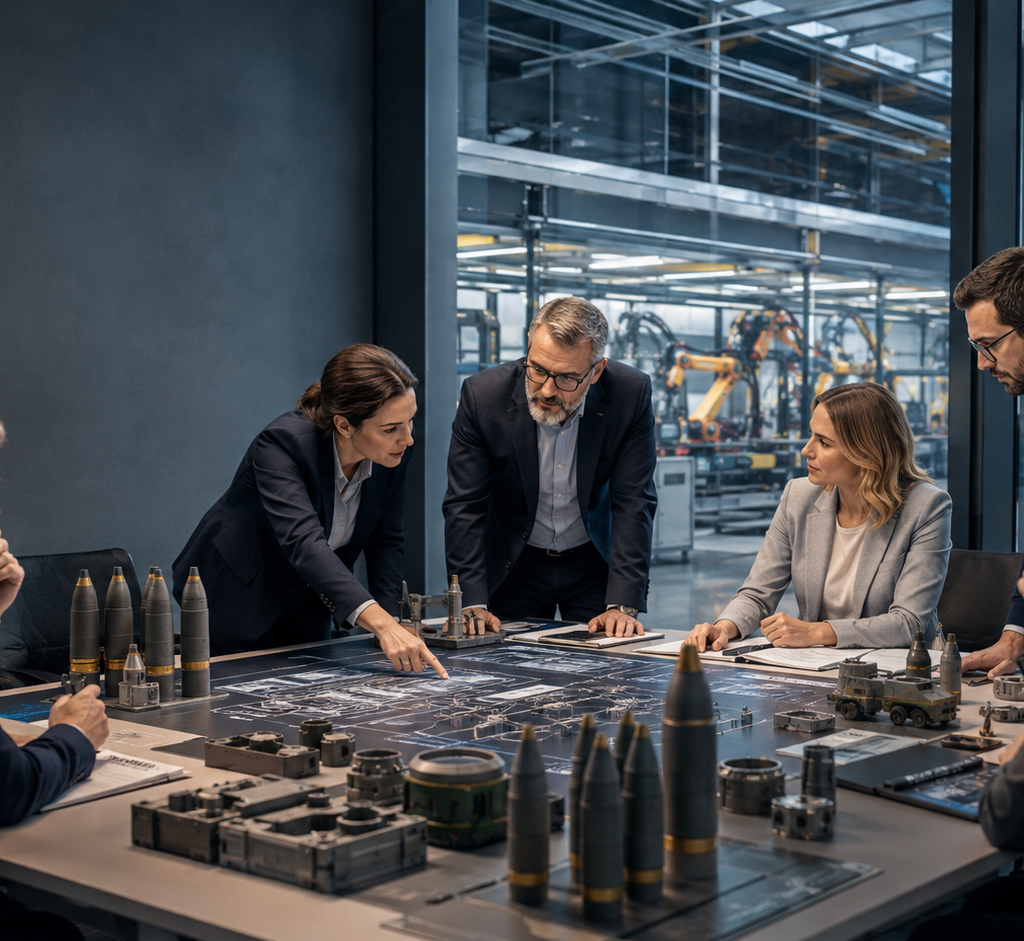

Europe’s defense debate has crossed an important threshold. The argument is no longer principally about whether governments will spend more. They are spending more, and the trajectory is steep. The European Defence Agency reported €418 billion in defense expenditure by the EU’s 27 member states in 2025 and projects €454 billion in 2026. Investment is expected to approach €163 billion this year.[1][3] NATO’s 2025 Hague commitment adds a longer horizon: Allies agreed to invest 5% of GDP annually by 2035, including at least 3.5% for core defense requirements and up to 1.5% for wider security and resilience.[4]
Money, however, is an input. Deterrence is an output. Between the two lies a chain of political choices, technical standards, contracts, factories, supply networks, trained personnel and maintained stockpiles. A budget can rise while that chain remains weak. Equipment can be ordered quickly but arrive in incompatible configurations. A factory can announce capacity that national orders do not sustain. Several states can purchase the same caliber of ammunition without being able to exchange every round safely across their artillery fleets.
The most revealing figure in the EDA’s new data is therefore not the spending total. It is the coordination measure. Collaborative defense expenditure involving EU and/or third-party partners represented 24% of equipment procurement in 2025, with reported national shares ranging from zero to 55%. European-only collaborative expenditure reported by 19 member states amounted to 11% in aggregate; just two exceeded 50%.[2] The EDA itself warns that methodological differences and possible underreporting limit the precision of those comparisons. Even with that caveat, the strategic message is unmistakable: Europe is still spending together less often than it speaks together.
Executive Summary
- Europe’s financing problem is easing faster than its coordination problem. EU defense spending is projected at €454 billion in 2026, but the latest available EDA data put collaborative procurement at only 24% of equipment expenditure in 2025.[1][2]
- Capability is produced through a conversion chain: credible multi-year budgets, aggregated demand, common standards, industrial capacity and operational availability. A break at any link reduces the deterrent value of the money spent.
- NATO’s Air Battle Decisive Munitions framework shows that multinational acquisition can lower legal and technical barriers and deliver repeated procurement cycles. The newly launched GENIFR project applies the same logic earlier, by trying to standardize a generic 155mm round before mass production.[7][8]
- The practical objective should not be joint procurement for its own sake. Governments should cooperate where commonality creates scale, interchangeability or supply resilience, while preserving national freedom where missions genuinely differ.
The Strategic Problem Is Conversion, Not Commitment
Defense expenditure is politically legible because it can be expressed as a percentage of GDP. Capability is harder to measure. It depends on whether a military can generate an effect at the required time, sustain it, replace losses and operate with allies. Two countries can devote the same amount to defense and produce very different levels of readiness. One may finance personnel costs, bespoke platforms and thin inventories; another may buy fewer system types, maintain deeper stocks and train within a multinational force architecture.
This distinction matters to boards as well as governments. Defense manufacturers make capital decisions against expected order duration, not summit language. Banks and investors assess whether announced demand will survive electoral and fiscal cycles. Civilian suppliers need confidence before qualifying a new line for explosives, electronics or precision components. Public-affairs leaders must explain not only the headline budget, but how national procurement choices relate to NATO targets, EU incentives, security-of-supply rules and domestic industrial politics.
NATO’s Updated Defence Production Action Plan captures the architecture unusually well. It assigns the Alliance roles as convenor, requirements setter, standard setter, demand aggregator and delivery enabler. Its three enduring themes are aggregating demand, addressing industrial-capacity constraints, and increasing interoperability and standardization.[5] These are not adjacent workstreams. They are interdependent: standards permit pooled demand; pooled demand justifies investment; investment produces capacity; and capacity has military value only when the resulting systems can be sustained and used together.
The Deterrence Conversion Chain
A useful way to test a rearmament program is to follow five links from authorization to availability. The framework below is analytical: it does not suggest that every capability should be centralized or that a single institution should control the chain. It provides a common set of questions for ministers, military planners, procurement agencies, industry and finance.
| Conversion link | Typical failure | Evidence of credibility |
|---|---|---|
| 1 — Credible budgets | Annual appropriations or politically reversible plans | Funded multi-year demand by capability and delivery year |
| 2 — Aggregated demand | Small national orders, bespoke variants and stop-start contracting | Common requirements, lead nation, pooled order or aligned national contracts |
| 3 — Standardization | Nominally similar systems that cannot share ammunition, data or support | Certified interchangeability, open interfaces and configuration control |
| 4 — Industrial capacity | Orders exceed available plant, labor, energetics or component supply | Qualified suppliers, ramp milestones, second sources and surge clauses |
| 5 — Operational availability | Equipment exists on paper but lacks stocks, crews, maintenance or logistics | Ready units, trained personnel, serviceable fleets and exercisable stockpiles |
The chain changes the management question. The objective is not to maximize activity at each stage; it is to minimize loss between stages. A fully funded order for a national variant that cannot use allied stocks may improve one ledger while weakening coalition resilience. A common technical standard without firm orders creates interoperability on paper but no production economics. A large production target without qualified labor, energetics, testing capacity and long-lead components is an aspiration, not capacity.
Case Study 1: Europe’s Aggregate Data Expose the Coordination Gap
The EDA’s 2025–2026 report documents an extraordinary acceleration. Defense investment reached €134 billion in 2025, up 23% in real terms from 2024, and equipment procurement reached €115 billion, up 26%. Equipment absorbed about 85% of investment and is projected to account for approximately 87% in 2026.[2][3] The spending response is real. So is the fragmentation.
At the aggregate level, only 24% of equipment procurement was reported as collaborative in 2025. When the measure is narrowed to European collaborative spending, the reported share falls to 11% among the 19 member states supplying data.[2] The figures should not be treated as a perfect league table: reporting is uneven, definitions vary and some cooperation may be undercounted. Yet a data-quality caveat cannot explain away the policy problem. National timelines, industrial-return demands, export policies, security classifications and military specifications still pull programs apart.
This is a case of political success producing an operational warning. Governments have broken with decades of underinvestment, but rapid national spending can harden fragmentation if each country commits to a separate architecture. Once a fleet is bought, it creates decades of training, software, ammunition, maintenance and upgrade dependencies. Urgency therefore increases the value of early coordination; it does not justify postponing it.
The EU has begun to change the incentives. The Security Action for Europe instrument offers up to €150 billion in long-maturity loans, with common procurement generally involving at least two participating countries. SAFE also sets origin and design-control conditions intended to strengthen the European industrial base, while allowing participation by Ukraine and specified partners under defined arrangements.[6] Between February 11 and April 10, 2026, the Council approved SAFE funding for 18 member states; 15 of the 19 submitted plans included projects with Ukraine.[6] The design is consequential, but financing cooperation is not the same as governing it. Participants still need a common requirement, a contracting authority, configuration rules and an agreement on through-life support.
Case Study 2: Air Munitions Show What Mature Cooperation Looks Like
NATO’s Air Battle Decisive Munitions initiative offers a more mature example. Six Allies launched the project at the 2014 Wales Summit. The first acquisition cycle delivered in August 2018, and further deliveries followed through repeated multinational rounds. NATO now lists 17 participating countries.[7]
The model addresses more than purchase price. It creates a framework for acquiring air munitions while reducing the legal and technical obstacles that prevent participants from sharing or exchanging stocks. NATO links the initiative directly to an interoperability gap encountered during its 2011 operation in Libya and reports significant cost and time savings across multiple acquisition cycles.[7] Those are NATO’s institutional assessments; the public page does not provide a full independent cost audit. The repeated delivery record is nevertheless evidence of an established mechanism rather than a single political announcement.
The success lies in institutional memory. Participants did not attempt to merge every national procurement system. They created a repeatable vehicle around a capability where common demand and stockpile flexibility have obvious operational value. The framework could start with six states, demonstrate delivery and expand. That sequence is instructive: a coalition of the willing can establish the operating model before universal participation, provided its technical and legal design allows others to join.
Case Study 3: GENIFR Tries to Standardize Before Scaling
On July 7, 2026, at NATO’s Defence Industry Forum in Ankara, nine Allies agreed to work on a prototype for a generic NATO 155mm munition. NATO’s project page currently lists eight participants—Canada, Czechia, Denmark, Finland, Norway, Slovakia, Sweden and Türkiye—while the launch announcement also names Greece.[7][8] That discrepancy is one reason current official status pages should be checked before treating participant counts as fixed.
The Generic NATO Indirect Fire Round, or GENIFR, will begin with feasibility work and prototyping. Later stages could include full development and large-scale production across Allied manufacturers. The ambition is a fully interchangeable round that can be shared more readily among different 155mm systems.[7][8] This is standardization at the right end of the process. Rather than multiplying production first and discovering incompatibilities later, participants are attempting to define what must be common before industrial scale is locked in.
GENIFR should not yet be described as a success. NATO classifies it as being established, and feasibility, certification, intellectual-property, liability and industrial-workshare questions remain. Standardizing a round across existing guns, propelling charges, fuzes and safety regimes is technically and politically demanding. The case is valuable precisely because it is unfinished: it illustrates the decisions that must precede a credible promise of interchangeable mass production.
Case Study 4: Unterlüß Shows the Promise—and the Risk—of Capacity Announcements
Industrial response is visible on the ground. Rheinmetall opened a new 30,000-square-meter ammunition plant at Unterlüß, Germany, in September 2025. The company said the facility would produce up to 350,000 artillery shells annually, with 25,000 planned for 2025, 140,000 for 2026 and full capacity in 2027. It placed the plant within a wider network that it expected could produce as many as 1.5 million artillery rounds per year by 2027.[9]
These are company-stated targets, not independently verified 2027 outcomes. That distinction is important. A completed building is evidence of investment; sustainable output depends on orders, qualified workers, machine reliability, explosives and propellants, component suppliers, testing, energy and regulatory permissions. Governments that measure success in announced nameplate capacity can miss the bottlenecks that determine actual deliveries.
Unterlüß nonetheless demonstrates what a credible demand signal can unlock. A manufacturer will invest faster when governments offer volume, duration and enough standardization to support long production runs. The public sector’s responsibility does not end when a contract is signed. It must monitor the ramp, help resolve shared supply constraints and avoid abrupt demand cliffs that make the next investment economically irrational.
The Necessary Tension: Speed, Sovereignty and Alliance Value
Europe cannot solve the coordination gap by adopting a simplistic ‘buy European’ rule, nor by treating the global market as frictionless. Urgent overseas purchases can close immediate operational gaps. They can also create long-term dependencies in software, munitions, maintenance, export approvals and upgrades. Domestic or European procurement can improve security of supply and industrial learning, but a protected supplier without scale, performance discipline or competitive pressure can deliver expensive delay.
The International Institute for Strategic Studies found that the value of major procurement contracts signed by NATO European states nearly doubled from $131.8 billion in 2018–2021 to more than $245 billion between February 2022 and mid-2025. Its revised dataset attributed 53% of that later contract value to European systems and about 36% to U.S. equipment, while concluding that procurement remained strongly shaped by national priorities, specifications and industrial politics.[10] The numbers undermine two easy narratives: Europe is neither wholly dependent on U.S. supply nor close to an integrated defense market.
The correct response is portfolio sequencing. Buy proven equipment rapidly where a critical gap cannot wait. Require access to stocks, maintenance, data and upgrades commensurate with the strategic risk. At the same time, aggregate future European demand around common requirements where scale and autonomy matter. Competition should occur within an architecture designed for interoperability, not through a proliferation of incompatible national variants.
Academic analysis helps explain why the problem persists. Jan Joel Andersson and Malena Britz describe the EU’s growing role in defense-industry policy as a product of institutional and political development rather than a conventional centralized defense policy.[12] Bruegel’s Guntram Wolff, Armin Steinbach and Jeromin Zettelmeyer similarly argue for European-level governance and funding to address fragmented procurement and the mismatch between national incentives and continental security needs.[13] The obstacle is not the absence of instruments. It is the limited transfer of procurement sovereignty required to make those instruments decisive.
What Leaders Should Do Now
- Measure capability conversion, not budget absorption. Track the proportion of authorized money that becomes contracted common demand, certified production, delivered equipment, trained units, serviceable fleets and usable stocks.
- Segment the portfolio. Identify capabilities that demand common standards and pooled orders; capabilities where aligned national contracts are sufficient; and genuinely sovereign functions where national control outweighs scale.
- Freeze only what must be common. Define interfaces, ammunition compatibility, data architecture, maintenance standards and certification rules early. Permit competition and national variation outside that common core.
- Give industry a credible demand curve. Use multi-year contracts, framework orders, minimum volumes and transparent delivery profiles. Tie public support to measurable ramp milestones, second sourcing and supply-chain resilience.
- Put through-life support into the first decision. A platform without spares, software rights, trained maintainers, munitions and upgrade access is a future readiness problem disguised as a procurement success.
- Govern multinational programs with explicit authority. Name a lead nation or agency, define voting and change-control rules, allocate liability, and decide in advance how late joiners, cost growth and national exceptions will be handled.
- Use public affairs to build durable consent. Explain the capability gap, the industrial trade-offs and the delivery milestones in terms citizens and legislatures can test. Sustainable rearmament requires political legitimacy as well as strategic urgency.
Conclusion: Common Purpose Needs Common Practice
Europe has achieved something that looked improbable only a few years ago: a broad political acceptance that defense requires far more resources. The spending curve now proves commitment. It does not yet prove capability.
The next phase is less dramatic and more demanding. Governments must accept common requirements before national preferences harden. Procurement agencies must aggregate orders before factories invest. Engineers must establish interchangeability before scale multiplies incompatibility. Industry must turn public targets into qualified output, and armed forces must convert deliveries into trained, maintained and sustainable readiness.
The strategic test is not whether every European country buys the same thing. It is whether Allies can use, supply, repair and replace what they buy as a coherent force. Europe has found much of the money. Its deterrence will be judged by what survives the conversion.
Key Evidence
EU defense expenditure reached €418 billion in 2025 and is projected at €454 billion in 2026, equivalent to an estimated 2.4% of EU GDP.[1][3]
EU defense investment reached €134 billion in 2025 and is projected to approach €163 billion in 2026; equipment procurement was €115 billion in 2025.[2][3]
Collaborative procurement involving EU and/or third-party partners represented 24% of EU equipment procurement in 2025; reported national shares ranged from zero to 55%.[2]
SAFE provides up to €150 billion in EU-backed loans and generally requires common procurement involving at least two participating countries.[6]
NATO launched GENIFR on July 7, 2026 to examine a fully interchangeable generic 155mm munition; the project remains in its establishment, feasibility and prototyping phase.[7][8]
References and Further Reading
Official and Primary Sources
- European Defence Agency. ‘EU Defence Spending: €418 Billion in 2025, Projected to €454 Billion in 2026.’ News release, July 16, 2026.
- European Defence Agency. Defence Data 2025–2026. EDA, July 2026.
- Council of the European Union. ‘EU Defence in Numbers.’ Current data page, consulted August 12, 2026.
- North Atlantic Treaty Organization. ‘Defence Investment and NATO’s 5% Commitment.’ Updated June 29, 2026.
- North Atlantic Treaty Organization. Updated Defence Production Action Plan. Endorsed by Allied Defence Ministers, February 13, 2025.
- Council of the European Union. ‘What Is Security Action for Europe (SAFE)?’ Last reviewed June 15, 2026.
- North Atlantic Treaty Organization. ‘Delivering Capabilities Through Multinational Cooperation.’ Current project-status page, consulted August 12, 2026.
- North Atlantic Treaty Organization. ‘Allies Meet Strike Capability Requirements with Multinational Initiatives.’ July 7, 2026.
- Rheinmetall AG. ‘A New Era at Rheinmetall: Ammunition Factory Opening in Unterlüß.’ Corporate release, September 5, 2025.
- European Commission and High Representative. White Paper for European Defence — Readiness 2030. JOIN(2025) 120 final, March 19, 2025.
Academic and Analytical Sources
- International Institute for Strategic Studies. ‘Transforming European Defence Procurement and Industry.’ Chapter 4 in Progress and Shortfalls in Europe’s Defence: An Assessment. IISS Strategic Dossier, September 2025.
- Jan Joel Andersson and Malena Britz. ‘The European Union’s Role in European Defence Industry Policy.’ Defence Studies 25, no. 2 (2025): 322–341; published online March 7, 2025.
- Guntram B. Wolff, Armin Steinbach and Jeromin Zettelmeyer. ‘The Governance and Funding of European Rearmament.’ Policy Brief 15/2025, Bruegel, April 7, 2025.
Glossary
Collaborative procurementThe joint or coordinated acquisition of defense equipment by two or more countries, through a pooled contract, common agency or aligned national arrangements.Demand aggregationCombining national requirements into larger and more predictable orders to reduce unit costs, shorten lead times and justify industrial investment.InteroperabilityThe ability of forces, systems or units to operate together effectively, including through compatible ammunition, communications, data and procedures.Configuration controlThe governance process that prevents unauthorized or unmanaged differences in a system’s design, software or components.Surge capacityThe ability to increase production or operational output rapidly above the normal peacetime rate.EDTIBThe European Defence Technological and Industrial Base: the companies, research organizations, skills, infrastructure and supply chains that support European defense capability.
Source and Methodology Note
Research cut-off: August 12, 2026. This article uses the EDA’s July 2026 expenditure report, current NATO and EU institutional materials, corporate primary information, a peer-reviewed academic article, and analysis by IISS and Bruegel. Established facts include published expenditure totals, enacted SAFE rules, official project dates and reported participants. The 2026 spending figures are projections, not outturns. Collaborative-procurement data are subject to EDA-noted methodological differences and possible underreporting. Rheinmetall’s future production figures are company targets, not independently verified outcomes. NATO’s statements on ABDM savings are institutional assessments without a public cost audit on the cited page. GENIFR is an initiative in establishment; its future technical and commercial success remains uncertain. Judgments about the ‘conversion chain,’ portfolio sequencing and governance priorities are the author’s analysis.
Suggested Internal Links
Defense Industrial Policy 2026: How Nations Are Rebuilding Strategic Capacity
Defense Spending: Strategy, Cost, and Opportunity Costs
Strategic Dossier: Navigating Change in the Indo-Pacific and Europe
Asia’s Sea Lanes Under Pressure: The Strategic Warning from Hormuz
EuropeanDefense #NATO #DefenseProcurement
Discover more from Responsible Public Affairs
Subscribe to get the latest posts sent to your email.