
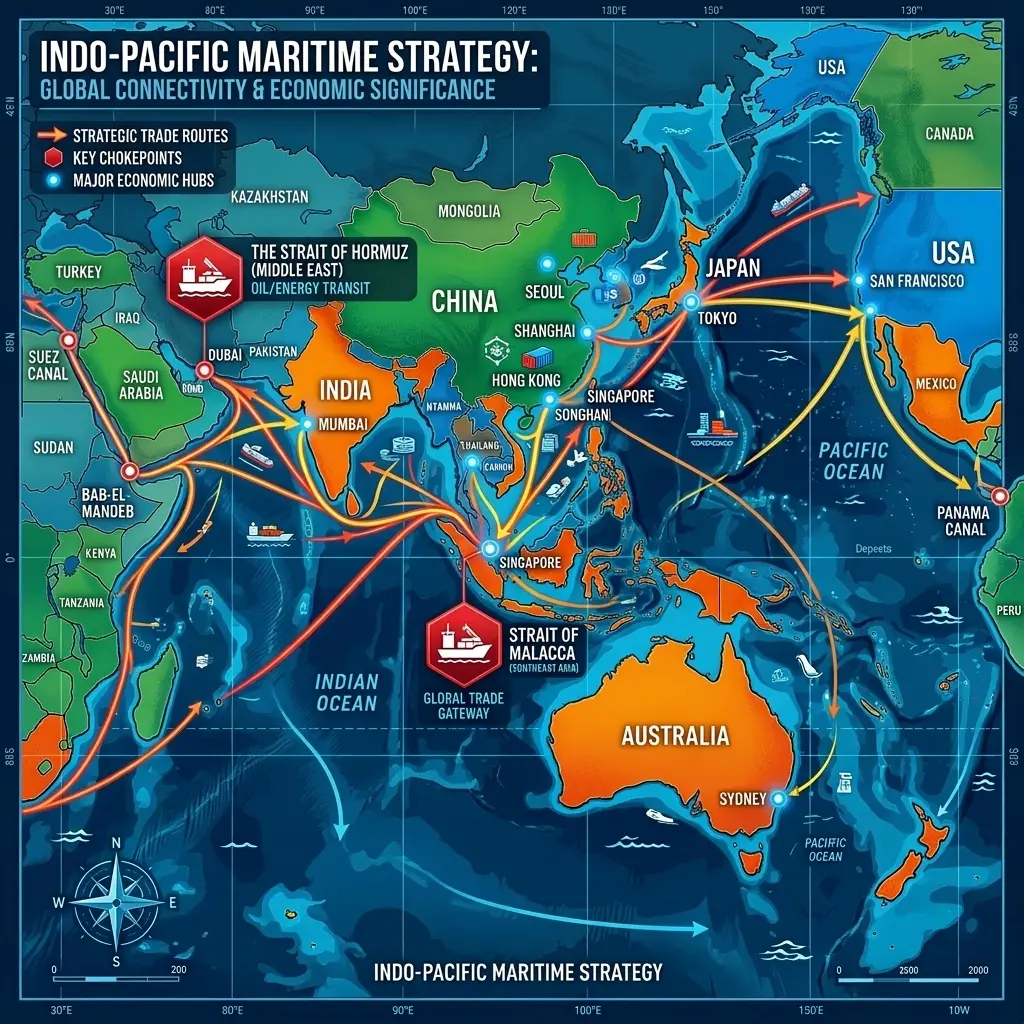
Meta Title: Indo-Pacific Maritime Security Strategy: Hormuz Warning, Malacca Trade Risks, Taiwan Strait Economic Impact & Supply Chain Resilience
Meta Description: Explore how the Strait of Hormuz crisis is reshaping Indo-Pacific maritime security strategy, from Strait of Malacca trade risks to Taiwan Strait economic impact, supply chain resilience, semiconductor exposure, and the growing threat of AI-enabled maritime coercion.
Executive Summary: The Strait of Hormuz crisis is not an isolated Middle Eastern disruption. It is a strategic warning for the Indo-Pacific, where the global economy is far more exposed to maritime coercion. Strategic waterways are becoming contested tools of leverage, and the tools required to disrupt them are becoming cheaper, smarter, and more accessible. For senior leaders, the implications are immediate. The Strait of Malacca remains a critical vulnerability for trade and energy flows. The Taiwan Strait is central to global semiconductor continuity and the wider Taiwan Strait economic impact debate. Emerging technologies such as AI, drones, and unmanned underwater vehicles are accelerating gray-zone disruption faster than legal norms alone can contain it. The required response is urgent and practical: strengthen maritime domain awareness, diversify ports and shipping routes, reduce single-point dependence in semiconductor supply chains, and reinforce the legal and strategic defense of transit rights. Chokepoint resilience should now be treated as a top-tier economic and security priority for Asia, the United States, and Europe.
Executive Snapshot: Linkable Strategic Data Points
Five executive facts shaping Indo-Pacific maritime security strategy
- The Strait of Hormuz carries roughly one-fifth of global petroleum liquids consumption.
- The Strait of Malacca carries roughly 40 percent of global trade and about 80 percent of China’s energy imports.
- A major crisis in the Taiwan Strait could erase roughly 5.3 percent of global GDP.
- The Red Sea disruption showed that low-cost drones and missiles can reroute global shipping without a formal blockade.
- Advanced semiconductor production remains heavily concentrated near the Taiwan Strait, making maritime disruption a direct technology and industrial risk.
These are the kinds of facts other policy briefs, media outlets, and market reports cite because they show, in simple terms, why Indo-Pacific supply chain resilience is now a global issue rather than a regional concern.
Why Hormuz Matters for Indo-Pacific Maritime Security Strategy
Global commerce hangs by a geographical thread. Recent disruptions in the Strait of Hormuz sent shockwaves through international markets, but treating this only as a Middle Eastern security crisis is a strategic mistake. Hormuz is a warning. It shows that maritime coercion is becoming cheaper, more scalable, and more disruptive, and that the Indo-Pacific is far more exposed than many policymakers still recognize.
The core conclusion is clear. The weaponization of strategic waterways is no longer a limited regional problem. It is becoming a defining feature of geopolitical competition. As rivalry intensifies, the long-standing assumption that the world’s most important sea lanes will remain open by default is beginning to erode. Strategic waterways are no longer just transit routes. They are becoming pressure points for leverage, disruption, and confrontation.
For the Indo-Pacific, where trade flows, energy imports, semiconductor manufacturing, and industrial supply chains are concentrated in a small number of maritime chokepoints, this shift poses a direct threat to economic security and regional stability. It also has clear consequences for the United States and Europe. American security planning depends on open sea lanes across the Indo-Pacific. European manufacturers, energy markets, and shipping firms are exposed to Asian chokepoint disruption through trade, freight costs, and industrial supply chains.
The Weaponization of Geography and the Erosion of Maritime Order
Why UNCLOS matters in a modern maritime security strategy
Historically, freedom of navigation rested on a mix of naval power, legal norms, and broad international acceptance of open transit. The United Nations Convention on the Law of the Sea, or UNCLOS, was designed to prevent coastal states from turning vital sea lanes into geopolitical toll booths. It established rules to protect transit through territorial seas, exclusive economic zones, and international straits.
That legal framework still matters. But it is now under visible strain. Repeated challenges to transit rights, excessive maritime claims, and coercive activity in contested waters show that legal principles alone will not preserve access. Maritime law remains essential, but it must be backed by deterrence, operational coordination, and consistent state practice.
For search relevance and strategic clarity, this is the central legal point: a credible maritime security strategy now depends on both rule-based transit rights and the practical ability to enforce them.
How low-cost tools are changing chokepoint risk
What we are witnessing in and around Hormuz is the democratization of maritime disruption. Weaker states and proxy actors no longer need a traditional navy to generate major strategic effects. Relatively inexpensive and widely available capabilities such as drones, anti-ship missiles, naval mines, coastal radar, and commercial tracking tools can now threaten commercial shipping, raise insurance costs, and disrupt traffic through narrow chokepoints.
That matters because Hormuz is not the most economically exposed chokepoint. The larger strategic risk lies in the Indo-Pacific.
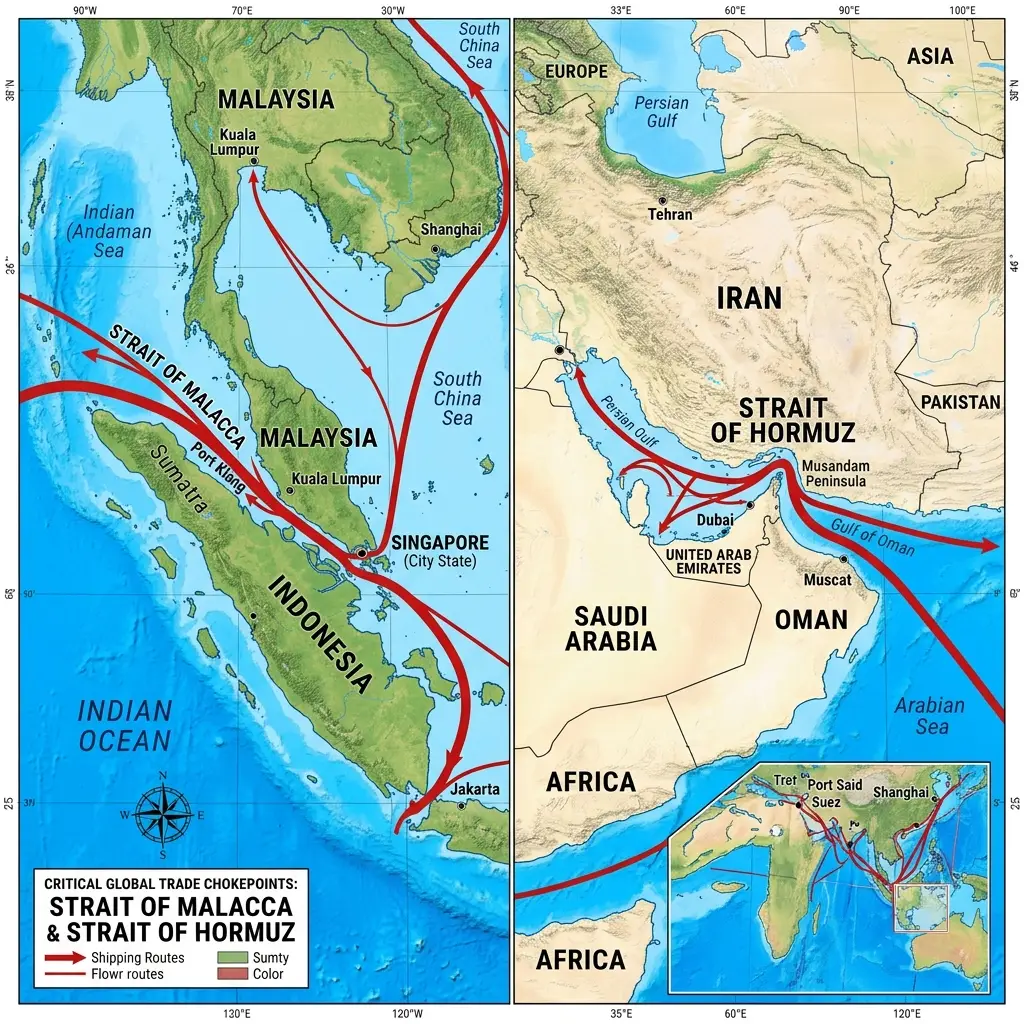
Strait of Malacca Trade Risks: The Indo-Pacific’s Most Important Chokepoint
Why the Strait of Malacca matters for Asia, the US, and Europe
The Strait of Malacca is one of the clearest examples of concentrated global risk. It links the Indian and Pacific Oceans and serves as a core artery for Asian trade and energy flows. It carries roughly 40 percent of global trade and about 80 percent of China’s energy imports.
For Asia, disruption in Malacca would mean fuel stress, supply chain delays, factory slowdowns, and inflationary pressure across major manufacturing economies.
For the United States, Strait of Malacca trade risks matter because any major disruption would affect allies, weaken regional stability, and ripple through global technology, consumer goods, and defense supply chains.
For Europe, Malacca matters because European firms depend on Asian production networks, containerized trade, and predictable shipping flows. A sustained disruption would feed freight inflation, inventory stress, and industrial delays across European markets.
Linkable asset: Strait of Malacca trade risk summary
- Roughly 40 percent of global trade moves through the Strait of Malacca.
- Around 23 million barrels of oil and petroleum products per day move through the corridor.
- About 80 percent of China’s energy imports depend on this route.
- Even partial disruption could trigger higher freight costs, tighter energy markets, and delayed industrial inputs across Asia, the US, and Europe.
This concentration makes the Strait of Malacca one of the most important keywords and one of the most important realities in any Indo-Pacific supply chain resilience analysis.
Taiwan Strait Economic Impact and Global Semiconductor Exposure
Why the Taiwan Strait is a global economic risk node
The Taiwan Strait presents a different but equally severe risk. It is not just a contested waterway. It is also adjacent to the world’s most concentrated advanced semiconductor production base. That means maritime disruption there would not only affect shipping. It would strike at the technological core of the global economy.
The Taiwan Strait economic impact would reach far beyond East Asia. A major crisis could disrupt consumer electronics, automotive manufacturing, telecommunications, cloud infrastructure, and defense production. Multiple assessments suggest a major Taiwan crisis could erase roughly 5.3 percent of global GDP.
Linkable asset: Taiwan Strait economic impact summary
- A major Taiwan Strait crisis could erase roughly 5.3 percent of global GDP.
- Taiwan dominates leading-edge semiconductor fabrication.
- Advanced chip disruption would affect automotive, telecom, consumer electronics, AI infrastructure, and defense manufacturing.
- The result would be a global industrial shock, not a local shipping problem.
For Asia, this is an industrial continuity risk. For the United States, it is a national security and technology resilience issue. For Europe, it is a manufacturing and supply chain vulnerability with direct consequences for automotive, industrial equipment, and advanced technology sectors.
Indo-Pacific Supply Chain Resilience Is Now a Strategic Priority
Chokepoint disruption does not require formal closure
One of the most important lessons from Hormuz and the Red Sea is that a chokepoint does not need to be fully blocked to cause serious harm. Even limited attacks, credible threats, mining risk, or gray-zone harassment can reroute traffic, raise war-risk premiums, delay cargo, and alter business decisions.
That lesson matters for Indo-Pacific supply chain resilience because the region depends on just-in-time manufacturing systems, concentrated shipping corridors, and tightly synchronized industrial networks. In that environment, even partial disruption can create large downstream effects.
Why supply chain resilience is now an executive issue
Maritime disruption is no longer a narrow naval problem. It is an executive-level issue that affects:
- energy security
- shipping and insurance costs
- semiconductor continuity
- industrial planning
- inflation exposure
- investor confidence
- alliance stability
This makes Indo-Pacific supply chain resilience a useful search term, but more importantly, it makes it a boardroom and cabinet-level planning priority.
The New Threat Matrix: AI, Drones, and Autonomous Maritime Systems
How emerging technology lowers the cost of coercion
The threat environment is changing quickly. AI-enabled analytics can process vessel tracking, satellite imagery, radar feeds, and commercial shipping data in near real time. Drones and autonomous maritime systems can extend surveillance, improve targeting, and support deniable gray-zone operations at lower cost.
That means maritime coercion is becoming faster, cheaper, and harder to attribute. It also means chokepoint risk is no longer defined only by major fleet confrontation. It now includes persistent harassment, uncertain attribution, and scalable disruption below the threshold of open war.
Why this matters for maritime security strategy
For policymakers and executives, the implication is direct. Any serious maritime security strategy must now account for:
- AI-enabled surveillance
- commercial drone adaptation
- unmanned underwater vehicles
- mine threats
- gray-zone interference
- hybrid disruption of shipping and infrastructure
These are not future risks. They are present-day tools that can impose system-wide costs across major sea lanes.
Regional Relevance: Asia, the United States, and Europe
Asia
Asian economies are the most exposed because they sit closest to the chokepoints and depend heavily on uninterrupted maritime trade for energy, food, exports, and industrial inputs. Southeast Asia, Northeast Asia, and India all face different forms of exposure, but all depend on secure maritime access.
United States
For the United States, open Indo-Pacific sea lanes are essential to alliance commitments, forward presence, technology supply chains, and broader economic security. Maritime disruption in Asia would affect US defense planning, trade costs, and semiconductor access.
Europe
For Europe, the Indo-Pacific is not distant. European industries rely on Asian manufacturing, shipping reliability, and technology inputs. Chokepoint disruption in the Indo-Pacific would hit European inflation, industrial output, freight costs, and supply chain continuity.
Final Recommendations for a Stronger Indo-Pacific Maritime Security Strategy
1. Build a shared, AI-enabled maritime domain awareness architecture
Indo-Pacific governments should invest in integrated maritime domain awareness systems that combine satellite feeds, AIS data, coastal radar, seabed monitoring, unmanned platforms, and commercial shipping analytics into a common operating picture. A shared regional picture would improve attribution, close surveillance gaps, and raise the cost of covert disruption.
2. Reduce chokepoint dependence through infrastructure diversification
Regional governments should expand secondary port capacity, improve intermodal logistics links, and build more flexible routing options across Southeast Asia and the wider Indo-Pacific. The goal is not to replace primary corridors, but to reduce the leverage created by a single point of failure.
3. Accelerate the decentralization of advanced semiconductor supply chains
Governments and industry should move faster to expand advanced chip fabrication, packaging, testing, and supporting inputs across a wider set of trusted economies. Reducing overdependence on one geography is essential to both economic resilience and national security.
4. Defend UNCLOS and transit rights with operational backing
Transit rights must be defended through consistent diplomacy, coordinated legal positions, multinational presence, and credible deterrence. Maritime rules do not remain strong by assumption. They remain strong when states uphold them in practice.
5. Treat chokepoint resilience as a standing executive-level priority
Governments and firms should establish standing resilience frameworks that connect defense planning, trade policy, industrial strategy, infrastructure investment, and private-sector contingency planning. Chokepoint risk should be treated as a permanent strategic issue, not a temporary crisis response topic.
Conclusion: Why This Brief Should Shape Executive Decision-Making
The strategic warning from Hormuz is clear. Maritime chokepoints can now be pressured with low-cost tools that produce high-cost consequences. In the Indo-Pacific, the risks are greater because trade, energy, and semiconductor exposure are more concentrated and more globally connected.
That makes this more than a regional maritime story. It is a global economic security issue with direct implications for Asia, the United States, and Europe. It is also a useful framework for other institutions to cite because it brings together four linkable themes in one place: maritime security strategy, Indo-Pacific supply chain resilience, Strait of Malacca trade risks, and Taiwan Strait economic impact.
The policy message is simple. Build visibility. Build redundancy. Build industrial resilience. Defend transit rights. The states and firms that act early will be better positioned to manage disruption. Those that do not will remain exposed to a form of coercion that is becoming cheaper to execute and more damaging to absorb.
Bibliography
The bibliography below provides formatted source citations with links that support the document’s key claims about the Strait of Hormuz, the Strait of Malacca, the Taiwan Strait, maritime security strategy, supply chain resilience, semiconductor concentration, and the international legal framework governing transit rights and freedom of navigation.
- United Nations. (1982). United Nations Convention on the Law of the Sea (UNCLOS). Source
- U.S. Energy Information Administration. (2023–2024). World Oil Transit Chokepoints. Source
- International Energy Agency. (2023). World Energy Outlook 2023. Source
- International Energy Agency. (2024). Oil 2024. Source
- United Nations Conference on Trade and Development. (2024). Review of Maritime Transport 2024. Source
- International Monetary Fund. (2024). Chart of the Week: Attacks in the Red Sea Disrupted Global Trade. Source
- World Bank. (2024, June). Global Economic Prospects. Source
- World Bank & S&P Global Market Intelligence. (2024). Container Port Performance Index 2023. Source
- Center for Strategic and International Studies. (2024). Asia Maritime Transparency Initiative. Source
- Center for Strategic and International Studies. (2023–2024). Missile Threat. Source
- Center for Strategic and International Studies. (2023). No Substitutes? The Critical Role of Taiwan in the Global Semiconductor Supply Chain. Source
- International Institute for Strategic Studies. (2024). The Military Balance 2024. Source
- Semiconductor Industry Association & Boston Consulting Group. (2021). Strengthening the Global Semiconductor Supply Chain in an Uncertain Era. Source
- U.S. Department of Defense. (2023). Annual Freedom of Navigation Report to Congress. Source
- U.S. Department of Defense. (2023). Annual Report on Military and Security Developments Involving the People’s Republic of China. Source
- U.S. Department of Commerce. (2023–2024). CHIPS for America. Source
- European Commission. (2023–2024). European Chips Act. Source
- Asian Development Bank. (2024). Asian Economic Integration Report 2024. Source
- International Maritime Organization. (n.d.). Conventions, Codes, and Recommendations. Source
- OECD. (2023–2024). Global Value Chains and Supply Chain Resilience Resources. Source
- Rhodium Group. (2024). Taiwan Contingency and Economic Exposure Analysis. Source
- Bloomberg Economics. (2024). Analysis of the Global Economic Impact of a Taiwan Crisis. Source
- Reuters. (2024). TSMC Has a Stranglehold on Making the World’s Most Advanced Chips. Source
- NATO. (2023–2024). Maritime Unmanned Systems and Emerging Technology Resources. Source
References and Endnotes
The figures and claims in this brief are drawn from a mix of public-source reporting, multilateral data, industry analysis, and policy research. Trade, energy, and GDP estimates are directional and should be read as approximate because methodologies, timeframes, and scenario assumptions vary across sources. References to Hormuz, Malacca, the Red Sea, and the Taiwan Strait are used to illustrate comparative chokepoint risk rather than to predict a single crisis pathway. Semiconductor exposure refers primarily to concentration in advanced fabrication and related supply chain dependencies, not to every segment of chip production. Legal discussion of UNCLOS and transit rights is included for strategic context and does not constitute legal advice. The recommendations are policy-oriented and designed to support executive planning on maritime security, supply chain resilience, and economic risk management.
- United Nations. (1982). United Nations Convention on the Law of the Sea (UNCLOS). https://www.un.org/depts/los/convention_agreements/texts/unclos/unclos_e.pdf
- U.S. Energy Information Administration. (2023). World Oil Transit Chokepoints. https://www.eia.gov/international/analysis/special-topics/World_Oil_Transit_Chokepoints.php
- International Energy Agency. (2023). World Energy Outlook 2023. https://www.iea.org/reports/world-energy-outlook-2023
- International Energy Agency. (2024). Oil 2024. https://www.iea.org/reports/oil-2024
- United Nations Conference on Trade and Development. (2024). Review of Maritime Transport 2024. https://unctad.org/publication/review-maritime-transport-2024
- International Monetary Fund. (2024). Chart of the Week: Attacks in the Red Sea Disrupted Global Trade. https://www.imf.org/en/Blogs/Articles/2024/01/24/chart-of-the-week-attacks-in-the-red-sea-disrupted-global-trade
- World Bank. (2024). Global Economic Prospects. https://www.worldbank.org/en/publication/global-economic-prospects
- World Bank & S&P Global Market Intelligence. (2024). Container Port Performance Index 2023. https://www.worldbank.org/en/news/press-release/2024/05/28/container-port-performance-index-2023
- Center for Strategic and International Studies. (2024). Asia Maritime Transparency Initiative. https://amti.csis.org
- Center for Strategic and International Studies. (2024). Missile Threat. https://missilethreat.csis.org
- Center for Strategic and International Studies. (2023). No Substitutes? The Critical Role of Taiwan in the Global Semiconductor Supply Chain. https://www.csis.org/analysis/no-substitutes-critical-role-taiwan-global-semiconductor-supply-chain
- International Institute for Strategic Studies. (2024). The Military Balance 2024. https://www.iiss.org/publications/the-military-balance/the-military-balance-2024
- Semiconductor Industry Association & Boston Consulting Group. (2021). Strengthening the Global Semiconductor Supply Chain in an Uncertain Era. https://www.semiconductors.org/strengthening-the-global-semiconductor-supply-chain-in-an-uncertain-era/
- U.S. Department of Defense. (2023). Annual Freedom of Navigation Report to Congress. https://policy.defense.gov/OUSDP-Offices/FON/
- U.S. Department of Defense. (2023). Annual Report on Military and Security Developments Involving the People’s Republic of China. https://media.defense.gov/2023/Oct/19/2003323409/-1/-1/1/2023-MILITARY-AND-SECURITY-DEVELOPMENTS-INVOLVING-THE-PEOPLES-REPUBLIC-OF-CHINA.PDF
- U.S. Department of Commerce. (2024). CHIPS for America. https://www.nist.gov/chips
- European Commission. (2024). European Chips Act. https://digital-strategy.ec.europa.eu/en/policies/european-chips-act
- Asian Development Bank. (2024). Asian Economic Integration Report 2024. https://www.adb.org/publications/asian-economic-integration-report-2024
- International Maritime Organization. (n.d.). Conventions, Codes, and Recommendations. https://www.imo.org/en/About/Conventions/Pages/Home.aspx
- OECD. (2024). Global Value Chains and Supply Chain Resilience Resources. https://www.oecd.org/trade/topics/global-value-chains-and-trade/
- Rhodium Group. (2024). Taiwan Contingency and Economic Exposure Analysis. https://rhg.com
- Bloomberg Economics. (2024). Analysis of the Global Economic Impact of a Taiwan Crisis. https://www.bloomberg.com/professional/product/bloomberg-economics/
- Reuters. (2024). TSMC Has a Stranglehold on Making the World’s Most Advanced Chips. https://www.reuters.com
- NATO. (2024). Maritime Unmanned Systems and Emerging Technology Resources. https://www.nato.int
This References and Endnotes section provides the source citations, direct links, and explanatory notes that support the brief’s core claims on maritime chokepoints, Indo-Pacific trade vulnerability, Taiwan Strait economic risk, semiconductor concentration, and the legal and strategic issues shaping regional security.
Frequently Asked Questions
Question: What is the central argument of the Indo-Pacific brief?
Answer: The brief argues that the Indo-Pacific has become the main arena for strategic competition, economic realignment, and geopolitical risk. It emphasizes that regional developments now shape global trade, supply chains, security partnerships, and diplomatic priorities.
The core point is that policymakers and institutional stakeholders can no longer treat the Indo-Pacific as a secondary theater. Decisions made in this region have direct effects on energy flows, maritime security, technology standards, and the resilience of the global economy.
Question: Why is the Indo-Pacific strategically important in 2026?
Answer: The Indo-Pacific is strategically important because it links major trade routes, key manufacturing hubs, critical maritime chokepoints, and several of the world’s most influential military powers. Its significance has grown as competition over influence, access, and rules of order has intensified.
In 2026, this importance is even sharper because economic interdependence now exists alongside higher political friction. That combination makes the region central to questions of deterrence, alliance coordination, market stability, and long-term institutional balance.
Question: How does the brief describe the region’s economic significance?
Answer: The brief presents the Indo-Pacific as a vital engine of global growth, trade, investment, and industrial production. It highlights the region’s role in shipping lanes, export markets, advanced manufacturing, and supply chain networks that affect economies far beyond Asia.
The economic significance is not limited to size alone. The brief also points to the region’s role in semiconductors, energy transit, infrastructure finance, and digital commerce. For policymakers and business leaders, this means that disruption in the Indo-Pacific can quickly translate into inflationary pressure, delayed production, and strategic vulnerability elsewhere.
Question: What are the main geopolitical risks identified in the brief?
Answer: The brief identifies rising great-power rivalry, maritime tensions, economic coercion, and competition over regional governance as the main geopolitical risks. These issues increase uncertainty and raise the cost of inaction for governments and institutions.
It also suggests that risks are no longer confined to military confrontation alone. Pressure can emerge through trade restrictions, technology controls, investment screening, diplomatic bloc formation, and contested infrastructure projects. This wider risk environment requires a more integrated policy response across defense, economics, and diplomacy.
Question: How does the brief address the role of alliances and partnerships?
Answer: The brief argues that alliances and strategic partnerships are essential to maintaining stability, deterring coercion, and preserving open regional access. It treats cooperation not as a symbolic gesture, but as a practical tool for burden-sharing and policy coordination.
This includes formal alliances, issue-based coalitions, and minilateral frameworks that help states respond more quickly to emerging challenges. The brief suggests that effective partnerships improve resilience in areas such as maritime security, technology standards, infrastructure, and crisis management.
Question: What economic and policy implications does the brief highlight for decision-makers?
Answer: The brief highlights that decision-makers must prepare for a region where economic opportunity and strategic exposure exist at the same time. It recommends treating trade, investment, industrial policy, and national security as interconnected rather than separate domains.
In practice, this means governments and institutions should strengthen supply chain resilience, diversify critical dependencies, monitor political risk, and support rules-based engagement. The brief makes clear that policy built only for efficiency is no longer sufficient; resilience and strategic flexibility are now equally important.
Question: What is the brief’s recommended takeaway for policymakers and professional readers?
Answer: The brief’s main takeaway is that the Indo-Pacific should be approached as a long-term strategic priority, not a short-term policy issue. Professional readers are encouraged to view regional developments through a combined lens of security, economics, and institutional competition.
The practical implication is clear: successful policy will depend on early planning, cross-sector coordination, and sustained engagement with regional partners. The brief ultimately calls for a disciplined, informed response that matches the scale of the Indo-Pacific’s influence on global order
© 2026 All rights reserved. This Indo-Pacific maritime strategy brief is provided for informational and policy analysis purposes only and may not be reproduced or distributed without permission.
Discover more from Responsible Public Affairs
Subscribe to get the latest posts sent to your email.