
Geopolitics & International Affairs | September 2, 2026
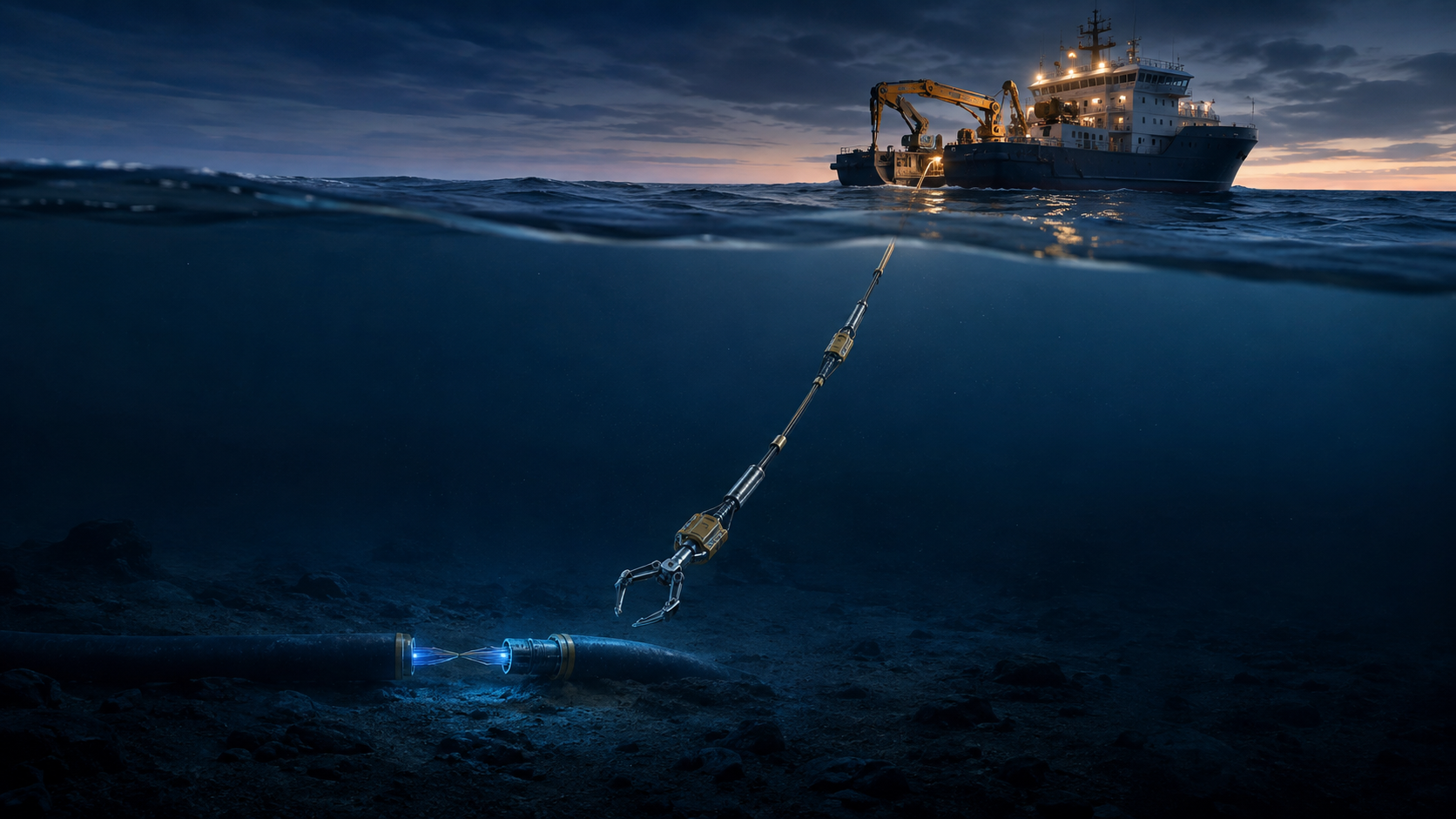
Governments have begun to patrol the seabed, blacklist risky suppliers and build redundant routes. Yet resilience is ultimately tested after a cable fails. A repair ship must be available, a trained crew must be ready, the right spare parts must exist, and coastal states must allow the operation to proceed. That chain is becoming an instrument of geopolitical power in its own right.
By Frank Farnel | Responsible Public Affairs
Executive summary
- Submarine cables carry more than 99 percent of intercontinental data traffic, but repair capacity is much thinner than the network it supports. The International Advisory Body on Submarine Cable Resilience reported in July 2026 that roughly 70 vessels had some technical repair capability in 2025, while only about 20 to 25 were dedicated to repair or held under active long-term maintenance arrangements.
- Availability on paper is not operational access. Vessel location, competing assignments, port clearance, crew visas, permits, weather, conflict and compatible spare parts determine whether restoration begins in days or months.
- The geography is unequal. The same ITU–ICPC report identified only one permanent, wholly dedicated repair vessel for Africa, based in Cape Town. By contrast, pre-positioned arrangements in Northeast Asia can often mobilize within 24 to 48 hours.
- Repair sovereignty does not require national ownership of every ship. It requires credible access to the complete restoration chain during a crisis. Commercial consortia, mutual-assistance agreements, modular equipment and sovereign reserve arrangements can all contribute—if priority and permissions are settled before the break.
- For boards and governments, redundancy and repair must be governed together. Alternative routes buy time. They do not replace damaged capacity indefinitely, especially when several faults occur at once or traffic is concentrated through the same maritime corridor.
The overlooked half of cable security
Most public debate about submarine cables begins with the cut: Was it an anchor, an earthquake, negligent navigation or sabotage? Which vessel crossed the route? Which state might benefit? These are legitimate questions, but they can obscure the operational question that decides the economic outcome: how quickly can the system be restored?
Breaks are not exceptional. The International Telecommunication Union says submarine systems experience approximately 150 to 200 faults each year—roughly three repairs per week. Most damage is caused by ordinary human activity, particularly fishing and anchors, rather than hostile action. [1] The strategic problem is therefore not to construct an unbreakable network. No such network exists. It is to ensure that frequent, mostly accidental faults and rarer hostile events do not become prolonged national vulnerabilities.
The distinction matters because protection and repair use different capabilities. Surveillance may detect a vessel behaving unusually. A navy may deter interference or preserve evidence. A telecommunications operator may reroute traffic. None of those actions lifts a cable from several thousand meters of water, removes the damaged section, splices in compatible fiber, tests the system and lays it safely back on the seabed.
The July 2026 report of the International Advisory Body for Submarine Cable Resilience—created by the ITU and the International Cable Protection Committee—offers the clearest current picture. It estimates that around 70 vessels worldwide had technical repair capability in 2025. Many, however, were occupied laying new cables, were no longer maintained for active service, or were not contracted for continuous repair readiness. Only about 20 to 25 were dedicated to repair under active maintenance agreements or long-term charters. [2]
That is the hidden asymmetry. The physical network is global and extensively interconnected; the means to restore it are scarce, mobile, commercially allocated and geographically concentrated.
A theory of repair sovereignty
Repair sovereignty should not be confused with autarky. Few countries could justify owning every vessel, depot, component and specialist needed to repair every cable in their waters. Even those that could would still depend on foreign landing points, multinational cable consortia and the permissions of other coastal states.
A more useful definition is practical: repair sovereignty is the assured ability to restore strategically important connectivity within an acceptable period, including when markets are congested, political relations are strained or normal logistics are disrupted.
That ability passes through five gates:
- Awareness: the fault is detected, located and classified quickly enough to mobilize the correct response.
- Availability: a suitable vessel, qualified crew and compatible equipment can be assigned. A ship engaged in installation work on another continent is not available merely because it exists.
- Access: the vessel can enter ports and territorial waters, obtain environmental and maritime permits, embark specialists, load spares and operate safely.
- Allocation: the damaged system receives priority when several operators or governments require the same scarce asset.
- Execution: the team can recover, joint, test and recommission the cable while traffic is managed across remaining routes.
Ownership is one way to influence these gates. It is not the only way—and a national flag alone does not guarantee crews, spares, access or operational readiness.
This framework also clarifies the division of responsibility. Cable owners understand systems and hold commercial maintenance agreements. Governments control permits, security support, sanctions, ports and diplomatic channels. Militaries can provide awareness and protection but usually do not perform telecommunications repair. Resilience fails when each actor assumes that another controls the whole chain.
Case one: Tonga and the tyranny of distance
What is established
The Hunga Tonga–Hunga Ha’apai eruption on January 15, 2022 severed Tonga’s international fiber-optic connection to Fiji. Internet service returned after a 38-day outage. The repair ship Reliance replaced approximately 92 kilometers of damaged cable, a task that itself took about 20 days after mobilization to the region. [3]
The physical damage was extraordinary: submarine volcanic activity and sediment flows produced multiple faults across a wide area. But the length of the outage also reflected the Pacific’s geography. The nearest suitable repair asset was not waiting beside Tonga. Travel, survey, safety assessment and the need to carry enough replacement cable all preceded restoration.
What the case demonstrates
Fact Satellite services provided a partial fallback, but they could not reproduce the volume, affordability and normal performance of the international fiber connection. The outage affected payments, remittances, government services, media and ordinary family communication.
Analysis Small island states experience a double disadvantage. They often depend on very few international routes, and their traffic volumes may not commercially justify permanent local repair capacity. In a simultaneous regional emergency, a maintenance provider may also have to choose among several faults.
The strategic lesson is not that every island should purchase a large cable ship. It is that distance must be treated as a quantified component of national risk. Pre-positioned spares, regional vessel pooling, rehearsed access procedures and satellite continuity can turn an uncertain response into an agreed one. Without those arrangements, sovereignty over the landing station ends where the broken cable begins.
Case two: the Red Sea and the politics of physical access
A corridor where redundancy and danger coexist
The Red Sea is one of the world’s most important telecommunications corridors because many systems linking Europe with Asia and East Africa converge through Egypt and the Bab el-Mandeb. It is also a constrained maritime space in which war, commercial shipping, territorial jurisdiction and cable concentration interact.
Multiple cables were damaged in the Red Sea in early 2024. The International Cable Protection Committee emphasized at the time that common causes such as anchors and fishing remained more likely than intentional cutting and that prompt access for repair vessels was essential. [4] Public attribution remained contested; claims that the cables had been deliberately targeted were not established by the available evidence.
The repair challenge was nevertheless real. Regional conflict created security risks, and the affected routes crossed jurisdictions in which permits and vessel clearances could not be assumed. Industry reporting later recorded sharply different restoration periods: the PEACE system restored a March 2025 fault in roughly three weeks, while a December 2024 AAE-1 outage lasted almost four months before repair in April 2025. [5]
The geopolitical implication
Analysis Repair access is a form of infrastructure diplomacy. A coastal state does not need to own a cable to influence the time required to restore it. Port entry, customs, crew visas, security guarantees and authorization to work in territorial waters can become decisive. In conflict zones, a technically available vessel may remain operationally unusable.
The Red Sea also shows why a cable-by-cable view is insufficient. Rerouting works when alternative systems and terrestrial backhaul retain spare capacity. If several cables in the same corridor fail, nominal route diversity can prove geographically illusory. Resilience therefore requires diversity between sea basins, not only multiple cables drawn through the same chokepoint.
Case three: Shantou and the value of a prepared local workaround
A repair success without a conventional cable ship
On February 21, 2023, a container ship dragged its anchor in severe weather near China’s Shantou landing station and severed four submarine cables in rapid succession. The water was less than 15 meters deep—too shallow for a conventional repair vessel to operate safely.
According to the 2026 ITU–ICPC report, the service provider activated a pre-established rapid-response arrangement. A suitable local barge was identified within hours, reached the site on February 28, and supported restoration of all four systems within three weeks. [6]
Why this case matters
The success did not come from owning the largest ship. It came from knowing in advance that the standard asset would not fit the operating environment, maintaining a vetted inventory of alternatives, and having the contractual and technical ability to mobilize them.
Analysis This is an important corrective to the emerging race for sovereign vessels. A ship can become a visible political symbol, while less visible assets—jointing specialists, portable equipment, barges, permits, depot stocks and tested procedures—determine the actual result. Resilience comes from the system around the vessel.
The broader Northeast Asian maintenance model also demonstrates the advantage of proximity. The Yokohama Zone normally keeps repair ships on standby in China, Japan or South Korea, with pre-positioned spares and coordinated procedures. The international advisory report says vessels within the core area can often mobilize and arrive within 24 to 48 hours, compared with five to seven days when assets are not pre-positioned.
Case four: Europe moves from protection to restoration
Europe’s cable-security policy accelerated after damage to telecommunications and power links in the Baltic Sea. The European Union’s February 2025 Action Plan adopted a full cycle: prevent, detect, respond and recover, and deter. Crucially, it recognized that surveillance without repair capacity leaves the cycle incomplete and proposed a reserve fleet for emergencies. [7]
Implementation became more concrete in 2026. On February 5, the Commission announced a €347 million package covering cable projects, resilience measures and repair capacity. A first €20 million call prioritized adaptable repair modules for the Baltic. On June 18, the European Health and Digital Executive Agency opened a further €40 million call extending such modules to the Mediterranean, Atlantic and the EU’s outermost regions. [8]
These modules are designed to be loaded onto suitable vessels when normal market capacity cannot respond to an incident with serious European consequences. The approach is pragmatic: it seeks adaptable capability before a complete publicly controlled fleet exists.
The United Kingdom is confronting a related choice. A 2025 parliamentary report found that Britain had no UK-owned repair capability, that the relevant fleet was aging and that little redundant capacity could be bought at short notice. It recommended acquiring a genuinely sovereign repair ship by 2030. [9] In May 2026, the government said a vessel usually reached a break in UK waters within eight days, but announced market engagement to retain a UK-based, UK-flagged sovereign capability and promised a decision by year-end. [10]
Britain and Ireland have also scheduled the first of a series of live subsea-cable readiness exercises for September 2026, covering information sharing and coordinated response. [11]
Balanced assessment These measures represent progress, not completed sovereignty. Modules require compatible vessels and trained crews. A reserve fleet will require financing, crewing, maintenance and rules for allocation. Exercises reveal gaps only if governments and operators are willing to act on the results. Europe is correctly moving beyond surveillance, but the decisive test will be whether assets can be mobilized across borders under genuine stress.
A repair-sovereignty scorecard
| Capability | Question for governments and boards | Weak signal | Credible evidence |
|---|---|---|---|
| Route continuity | Can essential traffic reroute if one or several systems fail? | Several cables share one corridor or landing area | Tested spare capacity across genuinely diverse routes and satellite fallback for critical services |
| Vessel access | Who must provide a suitable ship, and within what time? | A list of globally capable vessels without contractual priority | Active maintenance agreement, service level, named standby ports and surge provisions |
| Operational package | Are crews, spares, repeaters and jointing equipment compatible with the system? | Generic emergency plan focused on ship availability | Audited inventory, trained personnel and tested loading/interoperability procedures |
| Political access | Can the vessel enter, transit and work during a crisis? | Permits requested after the fault | Fast-track clearances, designated government contacts, security arrangements and pre-cleared documentation |
| Priority governance | Who decides which cable is repaired first during concurrent faults? | Assumption that the market will allocate fairly | Pre-agreed escalation criteria covering public safety, national functions and systemic traffic impact |
| Restoration exercise | Has the complete chain been rehearsed? | Cyber tabletop that ends when traffic is rerouted | Exercise from fault detection through vessel mobilization, permitting, repair and recommissioning |
Key evidence
- More than 99 percent: share of intercontinental data traffic carried by submarine telecommunications cables, according to the ITU–ICPC advisory body. Source
- 150–200 faults per year: the normal global fault range—approximately three repairs each week. Source
- About 70 versus 20–25: vessels with some technical repair capability in 2025 versus those dedicated or retained under active long-term repair arrangements. Source
- One: permanent, wholly dedicated repair vessel serving Africa, based in Cape Town, as reported in July 2026. Source
- 38 days: duration of Tonga’s international connectivity outage after the January 2022 volcanic eruption. Source
- €60 million: combined value of the EU’s two 2026 calls for adaptable emergency cable-repair modules—€20 million announced in February and €40 million in June. Source
What leaders should do now
Measure restoration time, not only outage tolerance
Boards often receive a number for how long critical services can operate on alternative routes. They should also receive a realistic restoration range: time to confirm the fault, secure a vessel, obtain permits, reach the location, repair the cable and return it to service. The range should change with weather, conflict and concurrent incidents.
Audit contractual priority
A maintenance agreement is not enough if the same vessel serves many systems and priority rules are unclear. Operators and public authorities should understand what happens when two high-value cables fail in different parts of the maintenance zone. The answer must be contractual and operational, not based on goodwill.
Treat permits as part of infrastructure
Emergency contact lists, crew-entry arrangements, customs treatment for spares, environmental approvals and maritime security clearances should be prepared before an incident. A six-day sailing time is meaningless if a vessel waits three weeks for authority to work.
Exercise the public-private seam
The most valuable exercise begins where many cyber exercises end. Traffic has been rerouted; now a physical repair must occur. Who identifies the fault? Who informs neighboring states? Who protects the vessel? Who communicates with markets and the public? Who resolves a conflict between commercial and national priorities?
Build regional capacity without confusing it with dependence
Pooling is often more rational than national ownership, especially for smaller states. But pooled capacity must include enforceable access, compatible spares and politically robust governance. A multinational arrangement that collapses during sanctions or armed conflict is not strategic insurance.
Keep attribution separate from restoration
Evidence gathering matters, particularly when malicious activity is suspected. Restoration should not wait for the political debate to conclude. Most faults remain accidental, and even deliberate damage must be repaired before attribution is settled. Governments need parallel tracks: preserve evidence, protect the site and restore service.
The limits of sovereign repair
The language of sovereignty can produce its own mistakes. A national vessel that spends most of its time idle may be financially unsustainable. A government-owned asset can still lack current equipment or qualified crew. Domestic preference rules can exclude the nearest capable ship. Security screening can delay the very response it is intended to protect.
Commercial maintenance zones have delivered reliable repairs for decades because they spread fixed costs across many operators. Their weakness is not that they are private; it is that public authorities may not know how commercial priority will interact with national need during a systemic crisis. The sensible objective is not to displace the market. It is to make the market’s emergency behavior visible, testable and governable.
Nor should every cable break be narrated as gray-zone warfare. Taiwan’s Ministry of Digital Affairs reported seven submarine-cable incidents in 2025, three caused by anchor dragging; two involved illegal anchoring by foreign flag-of-convenience vessels. [12] Those facts justify stronger monitoring. They do not, by themselves, prove state direction in every case. Inflated attribution can distort investment by favoring patrols and deterrence while neglecting mundane but decisive repair logistics.
The balanced position is therefore demanding: prepare for sabotage without assuming it; preserve competitive markets without relying on them blindly; build sovereign leverage without pursuing costly isolation; and invest in redundant routes without pretending that rerouting eliminates the need to repair.
Conclusion: power lies in restoration
A cable on the seabed is a strategic asset. A cable that cannot be repaired under pressure is a depreciating promise.
Tonga showed how distance can turn physical damage into weeks of isolation. The Red Sea demonstrated that security and permission can govern access as much as engineering does. Shantou showed that preparation and local adaptability can outperform a conventional solution. Europe’s new modules, proposed reserve capacity and live exercises show governments beginning to treat restoration as a public interest rather than a purely commercial afterthought.
The next stage of cable geopolitics will therefore be fought partly through unglamorous assets: ships under retainer, depots of compatible spares, trained jointers, port agreements, crew clearances and procedures for deciding who is repaired first.
Deterrence protects infrastructure when it works. Redundancy keeps services moving when protection fails. Repair restores the capacity on which both depend. Strategic resilience requires all three—and it is the last one that the world has taken for granted.
References and further reading
Official and institutional sources
- International Telecommunication Union, “International Advisory Body for Submarine Cable Resilience,” news release, November 29, 2024. Direct link.
- International Advisory Body on Submarine Cable Resilience, International Advisory Body on Submarine Cable Resilience: Working Group Reports and Recommendations, ITU and ICPC, July 2026. Direct PDF.
- European Commission and High Representative, Joint Communication: EU Action Plan on Cable Security, JOIN(2025) 9 final, February 21, 2025. Direct link.
- European Commission, “Commission increases submarine cable security with €347 million investment and new toolbox,” February 5, 2026. Direct link.
- European Health and Digital Executive Agency, “CEF-Digital second call for proposals to increase Europe’s submarine cable repair capacities,” June 18, 2026. Direct link.
- UK Parliament, Joint Committee on the National Security Strategy, Subsea Telecommunications Cables: Resilience and Crisis Preparedness, September 19, 2025. Direct link.
- UK Government, Liz Lloyd, “Plan to toughen protections for subsea internet cables,” speech at RUSI, May 29, 2026. Direct link.
- Government of Ireland, “Statement between Prime Minister Keir Starmer and Taoiseach Micheál Martin,” March 13, 2026. Direct link.
- Taiwan Ministry of Digital Affairs, “MODA Releases 2025 Submarine Cable Damage Analysis,” 2026. Direct link.
Documented cases and technical analysis
- International Cable Protection Committee, “ICPC Addresses Red Sea Cable Damage,” February 28, 2024. Direct link.
- João Tomé, “Internet Is Back in Tonga After 38 Days of Outage,” Cloudflare, February 22, 2022. Direct link.
- Submarine Networks, “PEACE Cable Cut in the Red Sea, Repair to Be Prolonged,” updated April 2025. Direct link.
- U.S. Federal Communications Commission, “FCC Acts to Accelerate Submarine Cable Buildout & Security,” 2025. Direct link.
- Texas National Security Review, “Toward Undersea Cable Resilience: The Case for Global Collaboration,” June 15, 2026. Direct link.
Glossary
Cable maintenance agreement A pooled commercial arrangement through which cable owners retain access to vessels, crews and equipment within a defined region.
Cable jointing The precision work of connecting replacement cable to the recovered ends of the damaged system while preserving optical, electrical and mechanical performance.
Landing station The secured shore facility where a submarine cable connects to terrestrial telecommunications networks and receives power and monitoring.
Repair module: A transportable package of cable-handling, recovery and jointing equipment intended to adapt a suitable vessel for emergency repair work.
Route diversity: Connectivity delivered through physically separate paths so that a single incident or chokepoint does not disable all capacity.
Repair sovereignty: In this article, the assured ability to restore strategically important connectivity within an acceptable period under stressed market or political conditions.
Source and methodology note
Established facts include published fleet estimates, fault ranges, funding calls, announced exercises, and documented restoration dates.
Analysis includes the five-gate model and the definition of “repair sovereignty,” which are the author’s conceptual framework rather than terminology adopted by the cited institutions.
Important limitations remain. Fleet counts vary because some vessels can both lay and repair cables, and technical capability does not establish current availability. Repair times are not directly comparable: distance, water depth, weather, damage extent, permits and conflict conditions differ. Public evidence does not support intentional attribution for every Baltic, Red Sea or Taiwan fault; suspected hostile activity is therefore distinguished from established physical damage. The €60 million figure combines two EU calls for modular capacity and should not be described as the purchase price of an EU fleet.
Suggested internal links
- When the Clock Becomes a Target: GNSS Interference and the New Geography of Coercion
- The Cheap Drone Is a Supply-Chain Illusion
- Europe Has Found the Money for Defense. Now It Must Learn to Buy Together
- Geopolitical Risk Management: Strategies for Businesses
#Geopolitics #CriticalInfrastructure #MaritimeSecurity
Discover more from Responsible Public Affairs
Subscribe to get the latest posts sent to your email.