
Executive Summary
The 2026 war between Israel, Iran, and the Gulf reshaped the security map of the Middle East, but its outcome resists the easy triumphalism that has begun to settle over so many capitals. Israel acted as a sovereign democracy confronting a regime that had spent four decades building the means to destroy it. This was not a contest between equivalent camps. It was a deliberate effort by a free society to dismantle a gathering threat from a position of advantage—and on that narrow military measure, it largely succeeded.
The campaign hit hard. It degraded Iran’s nuclear infrastructure, battered its proxies, and exposed the fragility of an axis long assumed to be unshakable. Independent imagery analysis confirms damage across multiple nuclear-related sites, including sealed tunnel entrances at Isfahan, fresh strikes near Tehran, and impact points around Bushehr. The leadership was struck, and the supreme leader was killed. Yet the regime did not shatter. It replaced its fallen within days, hardened internally, and concentrated power in the Revolutionary Guard. The hoped-for popular uprising never came.
This is the central lesson of the war: military force can dismantle a regime’s offensive capabilities far more reliably than it can summon a free society to replace it. Flattening a facility is not the same as ending a program. Knowledge survives bombing, and stockpiles can be moved quietly. Iran emerged weaker than it has been in a generation—its defenses cratered, its economy in free fall—and yet it has not collapsed. It has adapted. The danger now is not that Iran will win, but that it will refuse to lose in any way the world can recognize as an ending.
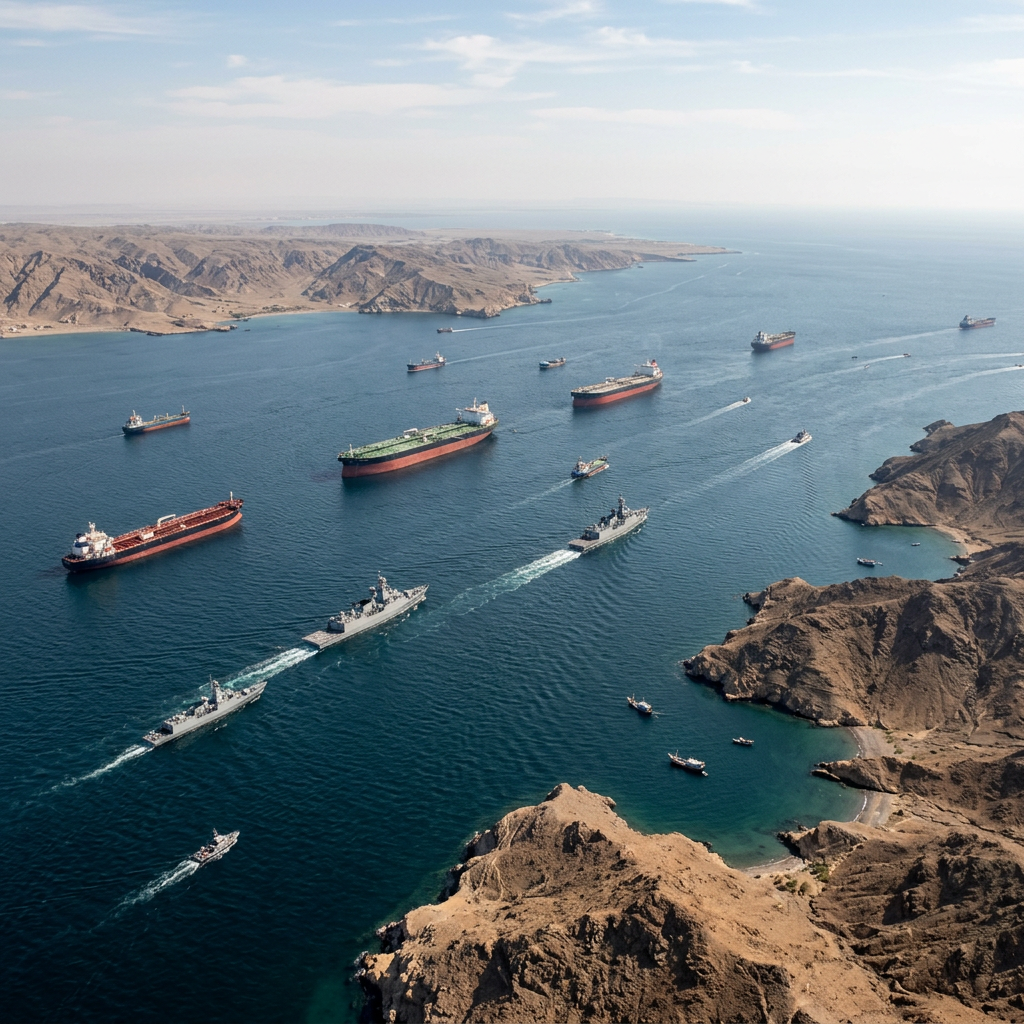
Weakened but unbroken, Tehran reached for the cheapest leverage it had left: geography. By making passage through the Strait of Hormuz uncertain—a mine here, a drone there, a small boat shadowing a tanker—it held a fifth of the world’s oil hostage with weapons that cost almost nothing. Insurance markets did the closing for it. The strait became the hinge between a regional war and a global one, and it remains the unsolvable knot at the center of every negotiation.
The economic shock radiated far beyond the battlefield. Oil prices climbed and stayed high, enriching Russia even as the West labored to starve its war machine. Liquefied natural gas, helium, aluminum, and fertilizer inputs all came under pressure, and the cost traveled down invisible chains to distant fields and markets. Marine insurers repriced or refused risk; shipping lines rerouted the long way around; aviation stalled. The Gulf’s hard-won reputation as an island of stability was punctured, and confidence, once punctured, does not refill on command. The heaviest weight fell on the people least responsible—migrant workers stranded without wages, and households in import-dependent countries pushed toward hunger as fuel and food grew dear.
Beneath the daily tumult, a plausible strategic interpretation deserves attention. Washington may be shifting from victory by force to victory by attrition—isolating Tehran, tightening the economic vise, and prolonging negotiations until exhaustion delivers what arms could not fully seize. On this reading, pressure, delay, and talks endlessly reopened but never concluded are not contradictions but the three movements of a single method: clearing strategic ground rather than producing an abstract peace on paper. The larger prize is the India–Middle East–Europe Economic Corridor, a democratic answer to China’s Belt and Road that bypasses Iran entirely and makes a secure, sovereign Israel its keystone rather than a favor the West might choose to grant. This interpretation illuminates much, though it remains an analyst’s thesis, not a declared doctrine.
The wise path steers between the sigh of relief and the drumbeat of alarm. Iran is strangled without being broken; its proxies are wounded without being uprooted. The military phase—spectacular, finished, satisfying—bought leverage, not victory. What remains is the thankless labor of converting a fragile advantage into a stable order through patient pressure and the slow construction of an economic architecture that renders Iranian mischief beside the point. The danger has not vanished. It has only changed clothes. And history is rarely kind to those who mistake the intermission for the fall of the curtain.
Abstract
The 2026 war between Israel, Iran, and the Gulf states reshaped the security architecture of the Middle East, yet its strategic outcome remains far more ambiguous than the prevailing triumphalism suggests. This essay argues for a crucial distinction too often collapsed in public commentary: the difference between weakening Iran and strategically defeating it. Israel’s campaign, undertaken by a sovereign democracy against a regime that had made its destruction a declared objective, succeeded on its narrow military terms. It degraded Iran’s nuclear infrastructure—documented through independent satellite imagery—battered its proxies, and exposed the fragility of a long-feared axis. But military force, the essay contends, dismantles offensive capability far more reliably than it produces political transformation. Knowledge survives bombing, stockpiles can be relocated, and the regime hardened rather than collapsed.
The analysis then turns to the Strait of Hormuz, which became the hinge between a regional conflict and a global one. By rendering passage uncertain through low-cost coercion, a weakened Tehran held a fifth of the world’s oil hostage, triggering economic shocks that radiated through energy markets, shipping, food supplies, labor mobility, and investor confidence—falling hardest on those least responsible. The essay further examines the durability of proxy structures such as Hezbollah and Hamas, whose bureaucratic embeddedness outlasts their military defeat.
Finally, it advances a plausible interpretive frame: that ongoing negotiations may reflect a strategy of diplomatic attrition and corridor-building—centered on the India–Middle East–Europe Economic Corridor—rather than immediate settlement. The essay concludes with a sober warning against mistaking a dangerous intermission for a definitive end.
I. The Boarding Pass
He had folded his boarding pass into the breast pocket of his shirt, the way careful travelers do, so it would survive the long wait and the longer flights home. June 3 at Kuwait International Airport was a Tuesday, and in a region that had nearly forgotten the meaning of an ordinary Tuesday, the terminal hummed with the particular impatience of people who only want to leave. Then the sky opened above him. A drone—small, cheap, almost insulting in its modesty—punched down through the terminal roof and detonated.
The footage surfaced later, and it is mercifully brief: a flash, a tearing of metal and concrete, a cloud of dust swallowing the camera’s view. One man died. Sixty-three others were wounded. The dead man was an Indian national, one of the millions of foreign workers who hold the Gulf’s glittering economies aloft from below, moving through its airports between the labor that sustains their families and the homes those families keep for them somewhere far away. He had earned his ticket. He did not get to use it.
In the hours that followed, the machinery of attribution churned to life. Iran denied responsibility, suggesting an errant interceptor had come down where it should not have. Kuwait called the strike a heinous act of aggression. Diplomats issued their condolences and their condemnations. None of it would matter to the household now arranging a funeral in place of a reunion. Somewhere, a wife or a mother or a child was learning that the careful man with the folded ticket would not be coming through the door.
This is what the war looks like now, more than three months after the first bombs fell on the night of February 28. Not the grand collision of armies that history books prefer. Not a clean opening or a decisive close. Instead: a Tuesday that refused to remain ordinary, a roof that should have held, a single name added to a ledger that no one in any capital seems eager to read aloud in full. And it is worth saying plainly, at the outset, who fired that drone and the thousands like it. The man in the terminal did not die because Israel defended itself, or because the United States struck at a regime that had spent decades arming for this fight. He died because Tehran chose, deliberately, to turn the airports and hotels and harbors of its neighbors into a battlefield—to spread its own pain outward onto people who had no part in its quarrels.
To understand how the world arrived at this suspended, exhausted place—too violent to call peace, too frozen to call war—you have to look at the lives caught inside the conflict, and then pull back far enough to see both the machinery that made the war possible and the long, genuine threat that made it, in the end, difficult to avoid.
II. The Tyranny of Distance, Undone
For almost the whole of human history, geography did the work of armies. Distance was the cheapest and most reliable defense any nation could possess. Bullets run out of range. Aircraft run out of fuel. Soldiers who march too far from home run out of food, of ammunition, of the simple will to keep going. An ocean is a wall that no amount of ambition can easily climb.
The American century was, more than anything else, the slow dismantling of that wall. Not through some secret weapon, though there were plenty, but through something far less cinematic: arrangements. A treaty here. A handshake there. A runway lent for a season, a harbor opened to refuel the fleet, a stretch of desert leased for a base that would still be standing decades later. When the United States resolved to fight far from its own shores, it did so by persuading other countries to let American power operate from inside their borders.
This is the hidden architecture of reach. A fighter jet is useless if it cannot find a runway within striking distance of its target. A carrier is a magnificent irrelevance if no friendly port will refuel it. An army cannot sustain itself for a week without the long, unglamorous tail of fuel, spare parts, and medicine. Power projection is not, at bottom, a story about weapons. It is a story about welcome.
And so when the campaign against Iran began at the end of February, the old script ran almost word for word. American aircraft surged into the region in the largest concentration of force in a generation, joined by an estimated fifty thousand service members positioned in and around the Middle East. They flowed in through Jordan and dispersed to bases across Qatar, the Emirates, Bahrain, and Saudi Arabia. Carriers worked the warm waters of the Arabian Sea. Reconnaissance flights lifted into the dark from Gulf airfields. Within weeks, commanders would claim to have struck more than ten thousand targets inside Iran.
Strip away the order of battle, and the effect is almost painfully simple. Through the cooperation of its partners, the United States made a country thousands of miles from its coastline into something like a next-door neighbor. It erased the distance that was supposed to protect Iran.
This capacity is double-edged, and honesty requires naming both edges. When war becomes easy to wage, the temptation to wage it grows, and a nation that can show up anywhere may forget to ask whether it should. But the same reach that lowers the bar for reckless wars also makes possible the wars that genuinely need fighting—the ones that confront a real and gathering danger before it matures. The question is never reach alone. It is what the reach is used for, and against whom.
III. The Threat That Was Always Real
It has become fashionable in some quarters to treat this war as a war of choice, conjured out of nothing by hawks in Washington and Jerusalem. That framing does not survive contact with the record.
For more than four decades, the Islamic Republic built its foreign policy around a single, openly stated ambition: to dominate its region and to destroy the one democratic state within it. This was not a Western caricature. It was Tehran’s own doctrine, repeated from its own podiums. Iran funded, armed, and directed a constellation of proxy forces designed to encircle Israel—Hezbollah to its north, militias across Iraq and Syria, the Houthis along the southern shipping lanes, and the architects of the October 2023 massacre to its south. It poured its treasury into ballistic missiles and drones capable of reaching Israeli cities. And it pursued, in defiance of its own treaty obligations and a long succession of inspectors it eventually barred, a nuclear program that crept ever closer to the threshold of a weapon.
Israel is, by any honest reckoning, the Middle East’s only durable democracy—a state with free elections, a free press, an independent judiciary, and a citizenry that argues fiercely and publicly about its own government’s conduct, including the conduct of this war. Such a country, facing a neighbor that has spent forty years promising its annihilation and building the tools to attempt it, does not have the luxury of treating that promise as rhetoric. The lesson of the twentieth century, written into Israel’s founding, is that when a regime declares its intention to destroy you and assembles the means, you are wise to believe it.
The years before this war hardened the logic. In 2024, Israel and its partners absorbed and turned back two large Iranian missile barrages. Israeli operations shattered Hezbollah’s leadership and helped topple Iran’s client in Damascus. The brief but decisive clash of June 2025 exposed how thoroughly Israel could pierce Iranian air defenses, and ended with American strikes on the deepest nuclear sites. Each of these episodes told the same story: Iran’s coercive project was real, dangerous, and—crucially—degradable. By early 2026, with Iran’s regional network battered, its economy in free fall, and its nuclear ambitions intact but exposed, Israeli and American planners reached a sober conclusion. The threat was not going to negotiate itself away. The window to confront it from a position of overwhelming advantage was open, and it would not stay open forever.
This is the indispensable context for everything that followed. One may debate the timing, the targets, the costs, and the exit strategy—and serious people do, including within Israel’s own raucous democracy. But the underlying judgment was neither cynical nor invented. A free society moved to dismantle the offensive machinery of a regime sworn to its destruction. That is not the behavior of an aggressor. It is the behavior of a state that intends to survive.
IV. The First Twelve Hours
The opening of the war was swift and precise. In the first half-day, American and Israeli forces launched close to nine hundred strikes—against missiles and air defenses, against military infrastructure, against the command of the Iranian state. The Americans called their share Operation Epic Fury; the Israelis gave theirs another name. The stated goals were sweeping: destroy Iran’s ballistic missile arsenal, sink its navy, sever its support for armed proxies, and ensure it could never build a nuclear weapon. These were not arbitrary targets. They were the precise instruments of the threat that had menaced the region for a generation.
The campaign worked as designed against the apparatus that mattered most. Iran’s supreme leader, the man who had presided over four decades of enmity, was killed in the opening wave. Dozens of senior commanders died alongside him. Israeli strikes focused with discipline on the regime’s military and security backbone—the Revolutionary Guard, the missile production lines, the command centers that had directed proxy warfare across half a dozen countries. Within weeks, much of Iran’s missile manufacturing capacity was assessed as functionally defeated, its surface navy largely destroyed, and air superiority established over vast stretches of the country. For a state that had spent its treasure building the means to strike its neighbors, this was a genuine and consequential degrading of capability.
And then there was the school. A strike aimed at a naval base near the town of Minab also struck a girls’ school standing too close beside it. Roughly one hundred and seventy people were killed, most of them children. A preliminary American review reportedly found that the United States was responsible and had relied on outdated targeting data—a sentence of bureaucratic neutrality describing something unbearable. The episode drew immediate scrutiny, including from dozens of American senators demanding answers about targeting and civilian protection. It deserved that scrutiny. A war fought by democracies must be willing to examine its own worst moments, and the openness of that examination is itself a mark of the difference between the states waging this campaign and the regime they fought. No Iranian commander wrote a letter demanding an accounting for the missiles deliberately aimed at Kuwait’s airport. The contrast is not incidental. It is the whole moral architecture of the thing.
What confounded the planners was not the success of the strikes but the resilience of the regime. Tehran did not fold. Within days it had buried its dead, named a harder successor to the supreme leadership, and signaled that its most uncompromising men were now in charge. Unable to match allied firepower in the sky, Iran reached for the only strategy left to it: not to defeat its enemies but to punish everyone around them. It launched hundreds of missiles and thousands of drones across the region, a striking share aimed at the United Arab Emirates. The logic was as cynical as it was coherent—make the neighbors bleed, and gamble that they would tire before Iran did.
V. A Ceasefire That Isn’t One
On the seventh of April, after forty days of fighting, the United States and Iran agreed to a two-week ceasefire, brokered by Pakistan with a late push from Beijing. It came barely ahead of a threatened deadline to begin striking Iran’s bridges and power plants. But the word “ceasefire” promised more than the reality delivered. Within a day, the two sides were describing different agreements.
The gap was glaring from the first hours. Washington insisted the pause was conditional on the complete and safe reopening of the Strait of Hormuz. Tehran spoke instead of “safe passage” arranged through coordination with its own armed forces—a phrase that quietly assumed Iranian authority over the waterway rather than the lifting of it. On the nuclear question the divide was just as stark: the American plan demanded that Iran dismantle its facilities, abandon enrichment, and surrender its highly enriched uranium, while Iran’s counter-proposal reportedly insisted that enrichment be accepted as a baseline. These were not the small disagreements diplomacy smooths over. They were the whole argument, restated.
The set-piece exchanges paused. The pressure did not. The American navy began stopping any vessel that had docked at an Iranian port, tightening a blockade designed to throttle Tehran’s economy from the sea. Iran, for its part, played a craftier game than its battered position should have allowed. By early summer it was working to transform negotiations about ending the war into negotiations about ending the separate conflict in Lebanon, refusing to return to serious talks until the fighting there stopped entirely. Every redirection bought time. Every delay protected the two things Iran prized most: its surviving nuclear material, buried beneath the rubble, and its hand on the throat of the world’s most important waterway.
This is a pattern worth naming, because it recurs across the whole war. Iran’s diplomacy has been an extension of its coercion by other means—a way to preserve leverage, run out the clock, and split Washington from Jerusalem rather than a genuine search for settlement. Israeli skepticism toward that diplomacy is not obstinacy. It is the accumulated wisdom of a country that has watched Iran use the cover of talks, again and again, to advance the very programs the talks were meant to constrain.
By the first days of June, the negotiations had limped into their third month without an agreement. Messages had gone quiet for days at a stretch. The American president declared the United States would win “militarily or on paper.” Iran answered with its own hard conditions: release the frozen assets, lift the blockade, stop the fighting on every front. Neither side left itself room to move. The conflict had not ended. It had merely lost its shape, dissolving from a war with a front line into a condition with no edges at all. Sober assessments now lay out a grim menu: an uneasy pause, a partial settlement, an expanded war, or the collapse of the Iranian state. None is clean. Several are dangerous.
VI. The Cheap Machine That Rewrote the Rules
For most of the modern era, the countries that hosted American forces did so with confidence. The protection was real; an enemy’s air force could be swept aside, its missiles counted and intercepted with room to spare. To grant access was to stand behind the strongest shield ever forged.
That bargain has been strained by something humble: the cheap drone, the mass-produced missile, the swarm. The arithmetic is merciless. It costs a fraction as much to build a drone as to shoot one down. A defender can win ninety-nine engagements in a hundred and still be worn thin, because the attacker can simply keep launching while the interceptors run dry. The same logic has played out in Ukraine, where an outmatched defender used homemade drones to blunt a far larger invader—and where Ukrainian specialists have reportedly begun sharing their counter-drone expertise with Gulf states facing the same problem.
Here, though, the lesson cuts in Israel’s favor as much as against it. Israeli and American air defenses performed across this war at a level few militaries on earth could match, intercepting the overwhelming majority of an unprecedented barrage and holding civilian casualties in Israel and among the Gulf partners far below what Iran intended. The Emirates alone knocked something close to three thousand incoming strikes out of its skies—a feat made possible in large part by integrated American and Israeli technology. That so few died, against so many launches, is not an accident. It is the dividend of decades of investment by democracies in defending their people rather than terrorizing their neighbors’.
The strategic worry is real nonetheless. Iranian attacks rendered some American-related sites all but uninhabitable, forcing troops to fall back to improvised positions. Across the region, partners are quietly weighing the benefits of cooperation against the costs of becoming a target. If frightened hosts begin closing their skies and harbors, the reach Washington treats as permanent could erode—not through defeat on the battlefield, but through a thousand sovereign calculations. The answer is not to abandon the partners but to defend them better, and to recognize that the alternative to a confident American-led coalition is not peace but an Iran emboldened to coerce its neighbors at will.
VII. Abu Dhabi’s Lonely Bet
If most of the Gulf flinched when the missiles came, the United Arab Emirates squared its shoulders and stepped toward the fire.
While its neighbors hunkered down, the Emirates absorbed Iran’s heaviest barrages and then hit back, reportedly striking oil targets on Iran’s Lavan Island in early April. Its officials abandoned the cautious ambiguity that has long defined Gulf diplomacy and spoke openly of confronting Tehran. Then, on the first of May, Abu Dhabi walked out of the oil cartel that had bound the Gulf’s energy policy for generations—timing the departure to land on the very day Saudi Arabia hosted a summit on regional unity. No one missed the message.
The strategy is clear enough. The Emirates no longer wishes to be seen as merely a wealthy small state riding currents set by larger powers. It wants a seat among the genuine players, and it has staked nearly everything on three pillars: a tighter embrace of the United States, a deepening partnership with Israel, and aggressive economic expansion abroad. When Iranian strikes were at their fiercest, Israel lent air-defense systems—turning a relationship born of political convenience into one of genuine military partnership. There is something clarifying in that loan. The same Israeli capabilities that Iran’s propaganda casts as a regional menace were, in the event, what helped keep Emirati civilians alive. Hard security, it turns out, is a currency the Gulf values precisely because the threat is real.
The gamble carries risk. By holding Saudi Arabia at arm’s length, the Emirates risks isolation. And the war it labored to keep at a distance has arrived at its door, battering its reputation as a safe harbor, emptying its hotels and clogging its ports. Yet of all the Gulf states, the Emirates may have read the strategic moment most clearly: that an Iran left unchecked would have grown only more dangerous, and that alignment with the region’s strongest democracy and its superpower patron is, for a small and exposed state, a rational bet on survival.
VIII. Riyadh’s Patient Calculus
If Abu Dhabi chose confrontation, Riyadh chose something that looks like caution and is, in truth, something more deliberate.
Saudi Arabia suffered too. Iranian missiles struck its territory and its energy facilities; its citizens absorbed their share of fear. Yet where the Emirates answered force with force, the kingdom held its fire and its tongue. It welcomed the fragile April ceasefire, pressed quietly toward a negotiated settlement, and resisted being drawn fully into an anti-Iran coalition even as it bled.
To mistake this for passivity would be to misread it. The kingdom has staked its future on a vast transformation—an effort to remake its economy and draw investors and entire industries to a place that not long ago kept the world at arm’s length. That project cannot survive a permanent state of war. Glittering new cities do not flourish under missile alerts, and foreign capital does not flow toward a country that might become a front line. Every escalation Riyadh avoids is a year of construction it protects, a class of investors it keeps from fleeing, a vision it keeps alive. Its reluctance is not weakness but arithmetic, and there is a longer game within it: a weakened but enduring Iran will still share the Gulf when the bombs stop. Saudi Arabia is hedging against the peace, or the absence of one, that will follow.
The widening distance between Riyadh and Abu Dhabi is thus more than a clash of personalities. It is a genuine divergence about how a small, rich, vulnerable state should survive in a dangerous neighborhood. One bets that safety lies in alignment, deterrence, and the willingness to strike alongside Israel and the United States. The other bets on flexibility and open doors. Each has its logic. But the split drains the Gulf of the collective bargaining power that might otherwise have earned the region a seat at the table where its fate is decided—leaving its two giants watching from opposite margins, and, paradoxically, leaving the field of decisive action to the states most willing to confront Iran directly.
IX. Iraq, the Other Hinge
There is a second country on which this war quietly turns, one most of the world has not been watching: Iraq, caught as ever between the powers that fight across its territory and the neighbor whose influence runs through its politics like a river underground.
During the worst of the fighting, Iraq was both venue and source of violence. Bases housing American and coalition personnel in the north came under fire from Iranian-aligned militias. Diplomatic facilities near Baghdad were targeted. These attacks were not Iraqi initiatives; they were Tehran’s, executed through the armed groups it has spent two decades embedding inside the Iraqi state—forces that answer in practice more to the Revolutionary Guard than to any Iraqi prime minister. That Iran could turn a sovereign neighbor into a launchpad against American and allied targets is itself a measure of the coercive project the war set out to dismantle.
The deeper drama is political and unfolding slowly. The war put intense American pressure on Baghdad to bring weapons under state control. In early June, something shifted: a coalition of Shia factions publicly endorsed restricting arms to the state, and two prominent Iranian-aligned militias announced steps to disengage from the official security structure. It would be a mistake to read these as surrender. They are maneuvers—bids to soften American opposition to militia political wings entering government, or to trade the appearance of disarmament for a share of power. Behind the scenes, Iran’s own commanders have reportedly urged their Iraqi partners to pause attacks while keeping their organizations and weapons intact: to go quiet without going away.
This is why Baghdad matters far beyond Baghdad. If the direct confrontation cools, Iraq becomes the arena where Tehran preserves and rebuilds its leverage at lower cost. A weakened Iran that can no longer rain missiles on the Gulf can still project influence through Iraqi politics and territory. Squeezing the militias, and the financial pipelines that run through Iraq’s economy to fund Iran’s allies, is therefore not a sideshow. It is part of the same effort to ensure that the regional machine the war degraded cannot quietly reassemble itself once the world looks away.
X. The Regime That Would Not Break
Beneath all of this lies the question haunting both the planners who began the war and the diplomats trying to end it: what did the opening blow accomplish? To answer it, you must look inside Iran—at a regime both more fragile and more durable than its enemies imagined.
The fragility predates the war. Long before the first bomb fell, the Islamic Republic was reeling: its economy gutted by sanctions and mismanagement, its currency collapsed, its people in the streets. The winter before the war brought protests across the country, met with a crackdown of staggering brutality that killed thousands. This was a government already ruling through fear because it had run out of other tools—a regime that, by its own conduct toward its own citizens, forfeited any claim to speak for them.
The war wagered that this fragility could be converted into collapse. The leadership was struck hard; the supreme leader was killed. But the regime did not shatter. It replaced its fallen within days and hardened, elevating a more repressive successor and concentrating power in the Revolutionary Guard. The hoped-for popular uprising never came. Foreign bombs, it turns out, are a poor midwife for revolution; they summon the old reflex to close ranks against an outside attacker. This is no indictment of the strikes’ purpose, but a sober lesson about their limits: military force can dismantle a regime’s offensive capabilities far more reliably than it can summon a free society to replace it.
So Iran today is weaker than it has been in a generation—its defenses cratered, its proxies battered, its economy in free fall—and yet it has not collapsed. It has adapted. It has discovered, in cheap drones, coercive maritime pressure, and the deliberate widening of civilian pain, a way to keep imposing costs even from a position of weakness. That is what makes this moment so dangerous. A regime can be badly damaged and still remain strategically disruptive; it can lose much of its conventional strength and still retain enough leverage to prevent a clean ending. Iran’s remaining nuclear ambiguity, its capacity to threaten shipping, and its ability to activate partners and proxies across the region mean that military success against it does not automatically yield political resolution. The state is weaker, but the crisis it created is not yet spent.”
This is the hard lesson that lies beneath every optimistic scenario. Military success against Iran has not translated into political resolution, because the things Iran retains are not the things that bombs destroy easily. Its remaining nuclear ambiguity, its capacity to threaten shipping with a handful of mines and small craft, its ability to summon partners and proxies from Baghdad to the southern shipping lanes—these endure. Israel and the United States degraded the regime’s ability to project conventional power, and they did so impressively. But a wounded predator is not a tamed one. The state is weaker than it has been in forty years, and the crisis it set in motion is not yet spent. The danger now is not that Iran will win, but that it will refuse to lose in any way the world can recognize as an ending.
XI. The Narrow Water That Holds the World
Trace a finger down the map until it rests on a slim channel dividing Iran from the Arabian Peninsula. At its tightest point it is barely twenty miles across, the shipping lanes narrower still. Through this single gate passes roughly a fifth of all the oil the world consumes, and a great share of its liquefied natural gas besides. This is the Strait of Hormuz, and after everything—the opening strikes, the killed leadership, the shattered proxies, the cratered air defenses—the entire war now pivots on this thin blue line. It is the cruelest irony of the campaign: Israel and the United States dismantled the most visible instruments of Iranian power, and Iran answered by reaching for the one lever that no amount of air superiority could pry from its hands.
When the fighting erupted, commercial traffic through the strait collapsed almost overnight. Tankers diverted or simply stopped. Captains refused the passage. One assessment called it the largest supply disruption in the history of the global oil market, with flow through the waterway falling by some twenty million barrels a day and Gulf producers cutting output by millions more. Iran did not need to close the strait by force, which it could not have sustained. It needed only to make passage uncertain—a mine here, a drone there, a small boat shadowing a tanker—and let fear do the rest. Insurance markets did the closing for it. This is the asymmetric genius of the chokepoint: a weak state, stripped of its navy and its missiles, can still hold a fifth of the world’s energy hostage with weapons that cost almost nothing.
Sensing the leverage in its hands, Tehran began selectively permitting vessels through—its own ships, the ships of countries that struck quiet bargains, and those willing to pay a steep toll for safe passage. It dressed this coercion in the robes of legitimacy, issuing permits, announcing a so-called traffic-separation scheme, and asserting an authority over the waterway that no one outside Iran recognizes as lawful. By early June, Iran’s naval forces were boasting of “smart control” over the strait and the hundreds of vessels that had submitted to its protocols. What it was building, beneath the legal costume, was a toll booth on a passage that belongs to no one and everyone—an attempt to convert a global commons into a private instrument of pressure. The United States pushed back from the other direction, stopping any vessel that had docked at an Iranian port, tightening a blockade meant to throttle Tehran’s economy from the sea until its own storage strained toward overflowing.
So the two sides settled into a strange, suffocating equilibrium. The American navy choked Iran’s exports; Iran choked everyone else’s. Neither could fully win the strait, and neither would fully relinquish it. The fragile April ceasefire only made this clearer, because the two parties never agreed on what the strait’s “reopening” even meant. Washington demanded complete and immediate freedom of passage. Tehran offered “safe passage” coordinated through its own armed forces—a phrase that conceded nothing and assumed everything. The waterway became the unsolvable knot at the center of the whole negotiation: the thing both sides claimed to want open, and the thing Iran could least afford to truly surrender.
By the first days of June, the brinkmanship had taken on a theatrical edge that would be comic if the stakes were lower. On the fifth, Iranian state media claimed its forces had fired warning shots at two American destroyers and driven the warships into retreat toward the Indian Ocean. American Central Command issued a flat denial—no shots fired, vessels moving freely. The truth of the episode mattered less than its shape: a fragile pause punctured again and again by competing claims, each one carrying the spark that could relight the whole conflagration. This is the atmosphere the region now breathes. Not war, exactly, but never peace. A waterway full of waiting tankers and watchful gray hulls, where a single miscalculation by a nervous commander could undo whatever restraint the diplomats have managed to assemble.
And this is why the strait became the hinge between a regional war and a global one. Everything that happens here radiates outward with a speed and reach that no missile could match. A threat whispered in Hormuz becomes a price spike in Rotterdam, a fuel surcharge in Mumbai, an empty shelf in a city that has never heard of the place. Israel and the United States set out to confront a threat measured in centrifuges and proxy armies, and they confronted it with real success. But Iran, in its weakness, discovered that the most powerful weapon left to it was not a weapon at all. It was geography—the simple, immovable fact of a narrow water that the entire world must cross, and that one cornered regime had just enough strength left to make the world afraid to enter.
longer than the war itself. A nation can repair a runway in weeks. It cannot rebuild trust on the same schedule.
The cruelest weight, though, falls on the people who make these economies move. The Gulf runs on imported hands—the engineers and nurses, the drivers and dockworkers, the construction crews who arrive from South Asia, the Philippines, and across the Arab world to earn what they cannot earn at home. When the airports shuttered and the missiles came, that workforce was caught in a place that had turned suddenly perilous. Some could not get out. Some were afraid to stay. Many simply waited, wages frozen, separated from families who depended on every remittance. The same uncertainty rippled through the expatriate professionals who had built whole lives in these cities and now wondered whether those lives were worth the risk. Tourism, the most delicate barometer of confidence, vanished almost entirely. The grand hotels stood empty. The resorts went quiet. And every absence was a livelihood interrupted: a cabdriver without fares, a waiter sent home, a shopkeeper staring down an empty street.
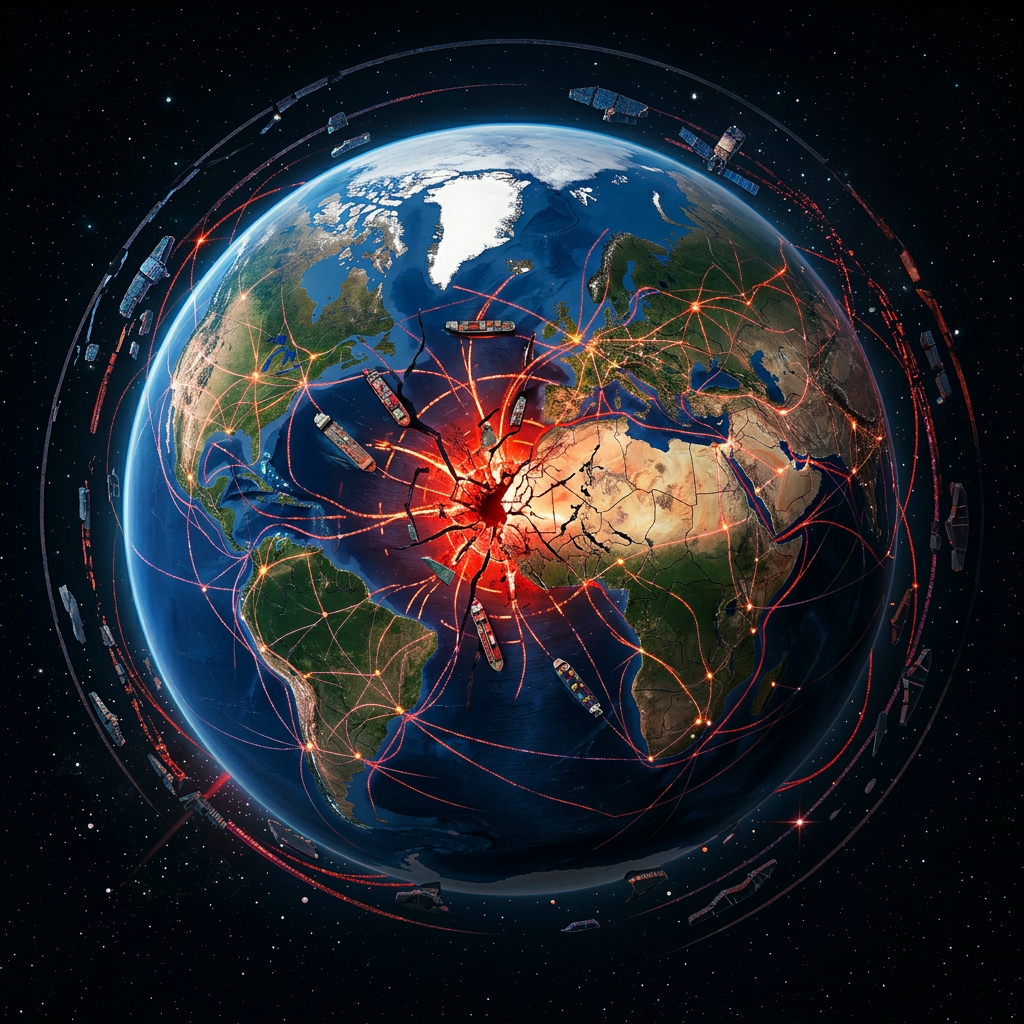
This is the strange physics of the conflict. Violence compressed into one narrow channel, consequences scattered across every continent. A drone over the Gulf becomes an unbooked hotel room in Dubai, an idled crane in Jebel Ali, an empty bowl in a household in Mogadishu that has never heard the names of the men deciding its fate. The reach of the war is longer than any missile and indifferent to every border.
XII. The Global Reckoning
Pull back far enough, and the war stops being a regional story at all. A conflict pressed into one narrow waterway has reached into kitchens and factories and farms on every continent, and the bill is still being tallied. The strikes that degraded Iran’s missiles and proxies were aimed at a danger the region had lived with for forty years. But the cost of confronting that danger, however justified, did not stay where the bombs fell. It traveled along the same global arteries that make the Gulf matter in the first place.
Begin with oil, because everything begins with oil. Prices that sat near seventy dollars a barrel before the war averaged above a hundred within weeks and have stubbornly stayed there. For energy importers, that is a tax on everything—on transport, on manufacturing, on the simple cost of keeping the lights on. For Russia, it has been a windfall, padding the very war machine the West has labored to starve. The irony is bitter but instructive: disruption in the Gulf enriches the aggressor in Ukraine, a reminder that these conflicts are not separate ledgers but a single, interconnected account.
Yet oil is only the headline. The Gulf is one of the world’s great sources of liquefied natural gas, and the threat to gas exports has proven even harder to absorb than the threat to crude, because gas cannot be rerouted as nimbly and its buyers in Asia have fewer alternatives. The strait also carries inputs the modern economy quietly depends upon. A third of the world’s helium—indispensable to medical scanners and semiconductor manufacturing—flows from a single Gulf producer. The region supplies a meaningful share of the world’s aluminum, the metal in everything from aircraft to beverage cans. And the Gulf is a wellspring of the natural gas, urea, and sulfur that go into fertilizer. Choke those off, and fertilizer prices climb; when fertilizer climbs, so does the cost of every crop that depends on it, in fields thousands of miles from any battlefield.
Then there is the machinery of trade itself. Marine insurers, confronting a war zone astride a vital lane, have repriced risk savagely or refused to write policies at all—and a tanker that cannot be insured is a tanker that does not sail. Shipping lines have rerouted the long way around, adding days and fuel and cost to every voyage, the expense passed quietly down to consumers who will never know why their goods grew dearer. Aviation has suffered its own paralysis: flights in and out of the region halted in the early days, a major hub airport was damaged, and the steady rhythm of business travel and tourism that lubricated the Gulf’s economies simply stopped.
That stoppage exposed something deeper than lost bookings. For decades the Gulf sold the world a promise: that here, amid a turbulent region, was an island of stability where capital was safe, contracts were reliable, and the future could be planned. The war has punctured that promise, and confidence, once punctured, does not refill on command. Investors who had begun to treat the region as a frontier of opportunity now treat it as a frontier of risk. Projects pause. Capital that arrives looking for stability does not linger to watch the sky for drones. A reputation built over decades can be undone in a season, and rebuilding it will take far longer than the war itself. A nation can repair a runway in weeks. It cannot rebuild trust on the same schedule.
The cruelest weight, though, falls on the people who make these economies move. The Gulf runs on imported hands—the engineers and nurses, the drivers and dockworkers, the construction crews who arrive from South Asia, the Philippines, and across the Arab world to earn what they cannot earn at home. When the airports shuttered and the missiles came, that workforce was caught in a place that had turned suddenly perilous. Some could not get out. Some were afraid to stay. Many simply waited, wages frozen, severed from the families who depended on every remittance. The same uncertainty rippled through the expatriate professionals who had built whole lives in these cities and now wondered whether those lives were worth the risk. Tourism, the most delicate barometer of confidence, vanished almost entirely. The grand hotels stood empty. The resorts went quiet. And every absence was a livelihood interrupted: a cabdriver without fares, a waiter sent home, a shopkeeper staring down an empty street.
The damage travels furthest along the lines that are hardest to see, and it falls hardest on those least responsible. Aid agencies have warned that the combination of dear fuel and dear food is pushing millions toward acute hunger—not in the war zone, but in import-dependent countries far from it. Households in Somalia, Afghanistan, and Sri Lanka, nations with no stake in Tehran’s quarrels, are sliding toward crisis as the cost of bread outruns their means. A drone over the Gulf becomes, by a long and invisible chain, an empty bowl in a distant home. This is the strange physics of the conflict: violence compressed into one narrow channel, consequences scattered across every continent.
None of this changes the underlying judgment that an unchecked Iran would have grown only more dangerous, that the threat Israel and the United States moved to degrade was real, and that a democracy has the right to dismantle the machinery of its own destruction. But it does enlarge the frame. The cost of confronting that threat was never going to be confined to the men who built the missiles or the regime that fired them. It spread outward, as such costs always do, onto neighbors and strangers and the poorest people on earth—a reminder that even a necessary war casts a shadow far beyond the place where it is fought. And it is that shadow, longer than any missile and indifferent to every border, that the reckoning must finally weigh.
XIII. The Long Shadow
Stand back from the wreckage and the ledgers, and the shape of the thing comes clear.
This war was made possible by reach—by the long American habit of fighting far from home through the welcome of others. But it was made necessary by something more concrete: a regime that spent four decades arming for the destruction of its democratic neighbor, building the missiles and the proxies and the nuclear program to attempt it, and turning, when challenged, to the deliberate punishment of civilians across an entire region. Those two truths are not in tension. A democracy facing a sworn and gathering threat used the tools available to it. That the tools were powerful, and that power tempts overreach, does not erase the danger they were turned against.
An honest accounting must hold every cost at once. Israel acted, as a free society facing annihilationist enemies has every right to act, to dismantle the machinery of its own destruction—and it did so with air defenses that kept its people, and many of its neighbors’, alive against an onslaught designed to kill them. Iran answered its own defeat by spreading pain outward onto airports and harbors and homes that had no part in its quarrel. The Gulf states, caught between, have paid in lives and treasure and confidence for a war few of them wanted. And far beyond the region, in countries that never heard a siren, families eat less and pay more because of a fight on a waterway they will never see.
The ceasefire holds the way a cracked pane holds—intact until it isn’t. The diplomats meet and part. The tankers wait at the mouth of the strait for permission to pass. Inspectors remain locked out, and no one can say with certainty what lies buried beneath the rubble at Fordow. The region is suspended between escalation and exhaustion, too depleted to fight all out, too unresolved to stop. It is the most dangerous kind of quiet, and everyone living inside it knows the danger by name.
What this war has demonstrated is not that strength is dangerous, though it is, but that the absence of resolve is more dangerous still. An Iran left unchecked would not have grown gentler. Its missiles would not have rusted; its enrichment would not have paused; its proxies would not have laid down their arms out of goodwill. The threat that Israel and the United States moved to confront was real, and meeting it from a position of advantage was a defensible choice—perhaps a wise one. The unfinished task now is to ensure that what was degraded stays degraded, and that the machine does not quietly reassemble itself in the long shadow of a truce no one trusts.
But strategy, in the end, is only the architecture of consequence, and consequence is always measured in people. So return, one last time, to the man at the airport with the folded boarding pass in his shirt pocket. He was not a target or a data point or a line in any assessment. He was someone’s whole world, on his way home, until a regime that had run out of soldiers and ships reached for the cheapest weapon it had left and aimed it at the place where ordinary people gather to leave.
He did not start this. He could not stop it. He only wanted to go home. That he never will is the truest measure of the war—not the maps redrawn or the leverage preserved or the prices that rose and may yet fall, but the careful man who folded his ticket so it would survive the journey, and did not survive it himself.
The bombs fall less often now. The talks grind on. And somewhere in the long gray space between a ceasefire that will not hold and a peace that has not come, a family waits for a flight that has already landed without him. They are the ones who will carry this war longest—in rooms the powerful will never enter, paying for choices made far from their door, hoping against all the evidence of every recent Tuesday that the next one stays ordinary.
XIV. The Right to Win, Not Merely to Survive
There is a peculiar danger in the moment when everyone exhales at once. It usually comes just before the next mistake, and it is arriving now. In a dozen capitals, the same comfortable conclusion is settling in: Iran is broken, the axis is spent, the long ordeal is nearly over. The temptation is easy to understand. After years of war and missiles and mourning, who would not want to believe the threat finally carries an expiration date?
But wanting a thing and winning it are two different acts, and the gap between them is where this story will actually be decided.
Iran and the network it patiently built over forty years have been badly weakened. They have not been strategically defeated. Reading the first claim as if it were the second is the costliest error available right now, and it is precisely the one that fatigue draws us toward in silence. It is worth saying plainly what conventional commentary keeps softening: this was never a quarrel between equivalent camps. On one side stands a sovereign democracy, with the same right as any nation to defend its citizens. On the other stands a regime that made the destruction of that democracy a declared objective, an organizing principle, and an export. Treating those two realities as morally interchangeable is not balance. It is a failure of judgment.
Begin with what can be shown, because an argument without evidence is only a mood in formal dress.
The damage to Iran’s nuclear program is documented, not merely alleged. The Institute for Science and International Security, an independent body that reads satellite imagery rather than reciting official talking points, found that at least six nuclear-related sites were struck during the second phase of the 2026 war, with as many as nine possibly hit.1 Fresh strikes marked the Shahid Meysami research center near Tehran.2 Imagery identified impact points around the Bushehr complex.3 At Isfahan, believed to hold a large share of Iran’s enriched uranium, tunnel entrances were packed with earth and left sealed.4 To those who wave off the campaign with a shrug, as one might dismiss a piece of theater, the images answer bluntly. This was a demolition, and it was real.
It is worth dwelling on who paid the price. It was Israel that committed its pilots, its intelligence services, and its credibility to confront a regime the wider West preferred to manage at a prudent distance. The observation is not sentimental. It is strategic. A democracy that carried the burden of weakening a common threat, on behalf of far more than itself, has earned more than gratitude. It has earned a decisive voice in what comes next, and the legitimacy to insist that gains paid for in blood and risk not be quietly surrendered at a negotiating table.
Honesty, though, demands the harder sentence, the one that victory laps tend to skip. Flattening a building is not the same as extinguishing a program. You cannot bomb knowledge, and no one can say with certainty where a stockpile may have been moved without a sound. The Institute itself locates the next chapter in verification and nonproliferation, not in laurels.5 The damage is established; its permanence is not. Regimes that have survived war, sanctions, and revolution rarely abandon their ambitions because their centrifuges were buried. They wait. Tehran has always been a patient student, and patience is the one resource a wounded autocracy never lacks.
This is why the real question is no longer how hard the blow landed, but whether the West will have the discipline to see it through. A thesis now circulates among Israeli strategists: that Washington has shifted from victory by force to victory by attrition—isolating Tehran, tightening the economic vise, prolonging negotiations until exhaustion delivers what arms could not fully seize. The phrase is diplomatic attrition, and its advocates point to Gaza, where sustained pressure, paired with the severing of ties between Hamas and its sponsors, is said to have forced concessions long refused.
The thesis is elegant, and elegant theses deserve scrutiny. This is an analyst’s reading, not a published doctrine; the observed behavior is, at best, consistent with such a strategy without proving it. But the underlying intuition is sound, and the signs of Iranian strain keep accumulating. The regime is rationing water and fuel, shutting failing wells, executing its opponents at a grim and rising pace. More telling still, it has reportedly leaned on foreign Shia militias, including Afghan fighters, to suppress unrest in its own cities. A revolution that once dreamed of exporting itself now struggles to hold its own streets. That is not the posture of a confident power. It is the posture of a regime listening for footsteps in the corridor.
And it is within that continuity, rather than apart from it, that a figure too quickly filed under impulse deserves a second reading. We have grown used to judging Donald Trump by his words, which blur, and his tempo, which disorients, and concluding that no design inhabits the disorder. A more demanding reading surfaces the moment one stops watching his words and starts watching what his actions produce—understanding, and this bears insisting upon, that what follows is a plausible strategic interpretation, not a doctrine anyone has formally claimed. Seen this way, his diplomacy does not aim at the grand, sprawling treaty that chancelleries adore and history almost always unmakes. It aims at an environment: not an abstract peace committed to paper, but a workable space, stable enough and held long enough for others to lay foundations.
That nuance changes everything, because it shifts the very meaning of the negotiation. If the goal is not to sign one more parchment with Tehran but to neutralize its capacity for harm long enough for another structure to take shape, then the pressure, the stalling, and the talks endlessly reopened but never concluded stop being contradictions. They become the three movements of a single method—the method of a man who bargains over conditions rather than convictions. The transactional negotiator, unsentimental, indifferent to the prestige of communiqués and attached to the tangible, turns out to be curiously suited to a task that is nothing like a duel of ideas: clearing ground. To contain Iran is to protect the route; to weaken the axis is to secure the straits; to wring stability from a feverish regime is to buy the time any heavy architecture demands. By this account, the apparent inconsistency—the open hand that follows the threat, the restraint that borders the din—is no longer drift but the rhythm of a builder in a hurry, one who knows you cannot pour foundations on ground you are still bombing.
Caution remains, and it will not be dismissed. To credit a leader with a comprehensive design always risks imposing on the facts an order they never requested. The behavior is consistent with this logic of corridors; it does not amount to a signed confession of it. But the hypothesis has the rare merit of illuminating what the lazy reading leaves to chance, and of connecting acts that seemed scattered. It suggests that the diplomacy run from Washington may not be an end in itself, but the quiet instrument of a larger recomposition—one in which commerce, not confrontation alone, holds the pen.
Here too, restraint keeps its value. The much-discussed quarrel between a well-funded Revolutionary Guard and an unpaid regular army is plausible and seductive, but it remains an assertion rather than an established fact. A fissure worth watching is not a breach you can open at will, and a policy built on the hope that a rival institution is about to defect tends to age badly.
The same unforgiving logic governs the proxies, where the gap between wounded and defeated weighs heaviest. Hezbollah has absorbed hard blows since October 2023, but it remains fused to the Lebanese state, master of its base, and woven into institutions too compromised to contain it. The Lebanese army, by the most credible accounts, manages the movement rather than fighting it. Hamas tells the same story in a different key. Its military capacity is gutted, but it still governs through its functionaries, its police, and its ministries. Power that runs through a bureaucracy outlives power that runs through battalions: that is how a movement can lose every battle and still rule the morning after. Israel understood this before its allies did, which is part of why its warnings deserve more weight than they are usually given.
Some answer with a radical prescription: to separate the population of Gaza from Hamas through displacement, on the model of the PLO’s expulsion from Beirut in 1982. Here, firmness must not curdle into recklessness. The forced transfer of civilians is no convenient instrument. It collides head-on with international law and with the standards a serious democracy owes itself, and christening it “strategy” changes nothing. Israel’s case is strongest, not weakest, when it holds to the principles that distinguish it from its enemies. That is the whole of the matter: a state that protects civilians against an adversary that uses them as shields does not honor that distinction by blurring it.
All of this leads to the board too few are watching. Stripped of the daily tumult, the real contest is increasingly about corridors, not only about conflicts. The India–Middle East–Europe Economic Corridor, launched at the 2023 G20 summit, would link India to the Gulf, cross Saudi Arabia and Jordan, then reach Israel and the Mediterranean.6 It rests on three pillars—transport, energy, and digital—and amounts, in effect, to the democratic world’s answer to China’s new silk roads.7 The Atlantic Council estimates it could cut maritime transit times by roughly 40 percent and yield some 5.4 billion dollars in annual savings on Asia–Europe trade.8 Its genius is geographic: it bypasses Iran entirely, which is precisely why a nuclear-armed Tehran straddling the Strait of Hormuz would poison the whole architecture. Its vulnerability is just as concrete: a financing gap of roughly 5 billion dollars, concentrated on the unbuilt central segment through Saudi Arabia, while a rival Turkey–Qatar route waits in the wings, designed to write Israel off the map.9
Here is the knot of the matter, and one grasps more clearly why the negotiation run from Washington finds its underground coherence in it. The corridor is what the pressure must serve, and Israel holds its western anchor—a fact that makes its security a condition of the entire architecture, not a favor the West might choose to grant. A sovereign, secure Israel is not a complication for this emerging order. It is the keystone. Weakening Iran is not a prize to bank and admire; it is the clearing of ground on which something durable might finally be built. To degrade Tehran and then neglect to lay the rails would be to win the argument and lose the era.
The wise path, then, steers between the sigh of relief and the drumbeat of alarm. Iran is strangled without being broken. Its proxies are wounded without being uprooted. The military phase—spectacular, finished, satisfying—bought leverage, not victory. What remains is the thankless labor of converting a fragile advantage into a stable order, through patient pressure and the slow construction of an economic architecture that will render Iranian mischief beside the point. The nation that paid the most to reach this moment has every right to demand that it not be squandered, and the West every interest in recognizing as much.
The danger has not vanished. It has only changed clothes. And history is rarely kind to those who mistake the intermission for the fall of the curtain.
Note on Sources
The references below document the key factual claims that anchor this essay’s argument. The analysis throughout distinguishes between assertion and evidence, and the sources here are meant to make that line visible. Two bodies of work carry most of the weight.
The first is a series of reports from the Institute for Science and International Security, an independent organization that interprets satellite imagery rather than official statements. These reports underpin every claim about the physical damage done to Iran’s nuclear infrastructure during the 2026 war. They matter precisely because they are independent: when the argument says the demolition was real, it rests on imagery analysis, not on the talking points of any government.
The second is an Atlantic Council study on the India–Middle East–Europe Economic Corridor. It supplies the factual basis for the essay’s larger strategic frame—the argument that the contest is increasingly about corridors, not only conflicts, and that a secure, sovereign Israel sits at the keystone of an emerging economic architecture.
Where the essay advances interpretation rather than fact—such as the “diplomatic attrition” thesis or readings of internal Iranian strain—it says so plainly, and no source is cited in support, because none exists. The annotations below are limited to the six core sources actually relied upon.
References
- Institute for Science and International Security. “Comprehensive Analysis of Nuclear Facilities Targeted During the Second Phase of the Iran War.” May 7, 2026.
- Institute for Science and International Security. “Imagery Shows New Damage to Shahid Meysami Research Center.” May 15, 2026.
- Institute for Science and International Security. “Imagery Update: Projectile Impact Sites Identified Outside the Bushehr Nuclear Power Plant Complex.” April 10, 2026.
- Institute for Science and International Security. “Imagery Update: Makeshift Roadblocks Installed in Front of the Esfahan Underground Complex Tunnel Entrances.” April 9, 2026.
- Institute for Science and International Security. “The Iran Nuclear Deal the World Deserves Takes Us Back to the Basics.” May 14, 2026.
- Hussain, Afaq, and Nicholas Shafer. “The India–Middle East–Europe Economic Corridor: Connectivity in an Era of Geopolitical Uncertainty.” Atlantic Council, August 2025.
Copyright © 2026. All rights reserved.
No part of this publication may be reproduced, distributed, transmitted, displayed, or otherwise used in any form or by any means, electronic or mechanical, without prior written permission from the author, except for brief quotations used in reviews, criticism, or other uses permitted by applicable law.
geopolitics, #middleeast, #israel, #iran, #gulf, #straitofhormuz, #security, #war, #diplomacy, #nuclearprogram, #proxywarfare, #energymarkets, #globaltrade, #economiccorridors, #imec, #foreignpolicy, #strategicanalysis, #internationalrelations, #regionalconflict, #policyessay
@CSIS, @CFR_org, @BrookingsInst, @CarnegieEndow, @AtlanticCouncil, @RUSI_org, @IISS_org, @ChathamHouse, @FDD, @RANDCorporation, @AEI, @StimsonCenter, @WarOnTheRocks, @TheSoufanCenter, @ASPI_org, @LowyInstitute, @CAPolicyLab, @HudsonInstitute, @MiddleEastInst, @WashingtonInst, @CSETGeorgetown, @BelferCenter, @StanfordCISAC, @SAISHopkins, @MSFS, @KingsCollegeLon, @LSEnews, @Harvard, @Georgetown, @DefenseIntel, @NATO_ACT

Discover more from Responsible Public Affairs
Subscribe to get the latest posts sent to your email.