

Few regions reward patient observation quite like the Middle East—and few punish complacent assumptions as quickly. Over the past three years, the region’s strategic order has been rewritten by a cascade of high-impact events: the 2026 Iran war, the reimposition of UN sanctions on Tehran, and the steady erosion of the armed network that Iran spent two decades building. Old certainties have given way to a more fluid, harder-to-read landscape. For policymakers and strategists, the task is no longer simply to track who stands with whom, but to understand why those alignments are shifting—and how durable they are likely to be. This analysis examines the forces driving the current realignment in Middle East alliances: Iran’s weakened proxy network, the contested status of its nuclear program, the recalibration of Gulf states, and the expanding roles of the United States, Israel, China, and Russia. It closes with what these shifts mean for regional stability through 2026 and beyond.
Abstract
This analysis assesses the structural realignment of Middle East alliances between October 2023 and mid-2026. It argues that the region has transitioned from a bipolar contest—Iran’s “Axis of Resistance” against a U.S.-aligned bloc—toward a fluid, hedging order in which most states decline firm commitment to any single power. Three reinforcing developments drive this shift: the sustained degradation of Iran’s proxy network, the September 27, 2025 reimposition of UN sanctions through the Resolution 2231 “snapback” mechanism, and the February–April 2026 Iran war. Drawing on documented events, sanctions timelines, and proxy-group profiles, the analysis examines how the erosion of Iranian deterrence has reshaped the calculations of Gulf states and external powers alike. It concludes that the region has entered a period of managed instability, in which adaptive strategy—rather than fixed alignment—offers decision-makers the most reliable protection against miscalculation.
Executive Summary
The strategic order of the Middle East has been fundamentally rewritten, and the change is structural rather than cyclical. For two decades, the region could be read along a single axis: Iran and its allied armed groups on one side, the United States and its partners on the other. That framework no longer holds. A reinforcing sequence of events—proxy attrition since October 2023, the 2025 sanctions snapback, and the 2026 Iran war—has weakened Tehran’s regional position and dismantled the bipolar logic that once organized the region.
The consequences are most visible in the behavior of regional states. Rather than realign toward a victorious bloc, Gulf states such as Saudi Arabia and the United Arab Emirates have adopted a deliberate strategy of hedging—deepening security ties with Washington while preserving economic and diplomatic channels to Beijing and Moscow. The March 2023 China-brokered restoration of Saudi-Iranian diplomatic relations, struck well before the recent escalation, foreshadowed this preference for optionality over commitment; even amid open conflict, Riyadh has shown little appetite to foreclose its options.
External powers have moved to fill the resulting gaps. The United States remains the region’s indispensable security actor, but its central role in the 2026 war reignited a domestic debate over the sustainability of long-term commitments. China has expanded its commercial and diplomatic footprint, and Russia has leaned on arms relationships and nuclear cooperation with Iran. The net effect is a more multipolar region than at any point in recent memory.
For policymakers and strategists, the practical implication is clear: alignment can no longer be inferred from history or ideology. The most resilient decision-makers will be those who build adaptive frameworks—ones that account for rapid escalation, contested legal regimes, and genuine multipolar competition—as the region’s alliances continue to shift.
Answer-First Summary: The New Shape of Middle East Alliances
The Middle East is moving away from a bipolar contest—Iran’s “Axis of Resistance” on one side, a U.S.-aligned bloc on the other—toward a more fluid order defined by hedging rather than firm commitment. Three developments have accelerated this transition: the February–April 2026 Iran war, the September 27, 2025 reimposition of UN sanctions through the “snapback” mechanism, and the sustained degradation of Iranian proxies such as Hezbollah, Hamas, and the Houthis. Together, they have weakened Tehran’s regional position considerably. In response, Gulf states are hedging their bets—deepening ties with Washington while keeping channels open to Beijing and Moscow—rather than committing fully to any single camp.
From Bipolar Contest to a Fluid Order
For two decades, the regional contest could be mapped along a single axis: Iran and its allied armed groups on one side, the United States and its partners on the other. That framing no longer holds. The bipolar structure has given way to a system in which most states decline to commit fully to either pole, preferring to keep their options open as conditions shift.
The Three Developments Driving Realignment
The 2026 Iran war, the 2025 sanctions snapback, and the attrition of Iran’s proxy network are not isolated events but a reinforcing sequence. Each compounded the others, and their combined effect has been to erode the foundations on which the old order rested.
Why This Matters for Strategy and Policy
For decision-makers, the practical implication is that alignment can no longer be assumed from history or ideology. Reading the region now requires tracking interests in motion—who benefits from which arrangement, and for how long.
Key Takeaways at a Glance
- Iran’s proxy network has been significantly degraded. Hezbollah, Hamas, Iraqi militias, and the Houthis—Tehran’s primary instruments of regional influence—have faced sustained military pressure since October 2023, eroding a central source of Iranian leverage.
- UN sanctions on Iran were reimposed on September 27, 2025. The E3 (France, Germany, and the UK) triggered the Resolution 2231 “snapback” mechanism, restoring and indefinitely extending sanctions that had been lifted under the JCPOA—and reopening a legal dispute with China, Iran, and Russia over the mechanism’s legitimacy.
- The 2026 Iran war marked a turning point. Initiated by U.S. and Israeli strikes on February 28, 2026, the conflict drew in more than a dozen states before a Pakistan-mediated ceasefire on April 8, 2026—signaling a widening cast of regional brokers.
- Gulf states are hedging, not picking sides. Saudi Arabia and the UAE are balancing closer ties to the West with open channels to China and Russia, building on the China-brokered Saudi-Iranian détente of March 2023.
- External powers are filling strategic gaps. China and Russia have expanded their economic and diplomatic footprint as U.S. policy shifts, producing a more multipolar regional order.
- Uncertainty is now the defining condition. With no new equilibrium to replace the fallen bipolar order, the region has entered a period of managed instability that rewards adaptive strategy over fixed alignment.
What Is Driving the Shift in Middle East Alliances in 2026?
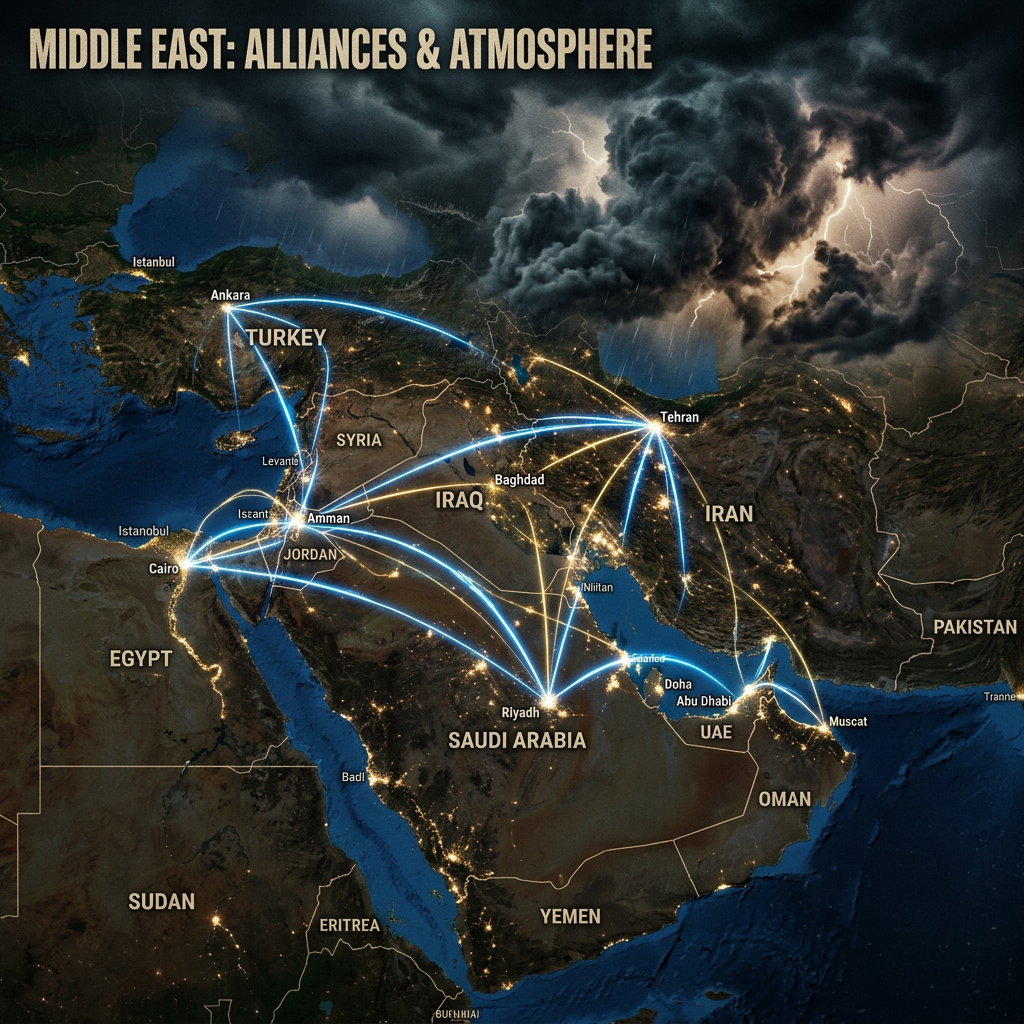
The central driver is straightforward, even if its consequences are not: Iran’s regional deterrence has eroded, undercut by direct military conflict and deepening economic isolation. For two decades, Tehran projected power along two parallel tracks—a network of nonstate armed groups that extended its reach across borders, and a nuclear program that gave it leverage and ambiguity in equal measure. Since late 2023, both pillars have come under pressure they had never faced before, and regional states have taken note.
The Erosion of Iranian Regional Deterrence
The reliance on armed proxies is not new. Since the 1979 revolution, supporting regional nonstate actors has been a core pillar of Iranian foreign policy—a comparatively cheap way to project power, defend aligned communities, and counter the influence of the United States and its allies without committing conventional forces. Iran’s Islamic Revolutionary Guards Corps–Quds Force (IRGC-QF) has long coordinated this effort. What has changed is the cumulative weight bearing down on it.
Two Pillars Under Pressure: Proxies and the Nuclear Program
Tehran’s two instruments of influence have rarely been challenged at the same time. The proxy network has absorbed sustained attrition since October 2023, while the nuclear program—long a source of strategic ambiguity—has been struck militarily and stripped of much of its monitoring. Pressure on both at once leaves Iran with fewer levers to pull.
How Military Setbacks and Sanctions Narrowed Tehran’s Options
Military setbacks, the 2026 Iran war, and the September 2025 sanctions reimposition have, in combination, narrowed Tehran’s room to maneuver—and that contraction has opened space for new alignments to form. As Iran’s options shrink, the states that once calibrated their behavior around Iranian strength have begun to recalibrate around its weakness.
How Has Iran’s Proxy Network and Axis of Resistance Been Weakened?
Iran’s network of allied armed groups—commonly known as the “Axis of Resistance”—has absorbed steady military and political losses since October 2023. Because this network has historically been Tehran’s primary instrument for shaping events beyond its borders, its degradation translates directly into diminished Iranian leverage. When the proxies weaken, so does the hand Iran can play. The shift is most pronounced in the case of Lebanese Hezbollah, long the most capable member of the network. By many estimates, the group has lost between 80 and 85 percent of its original firepower, sharply reducing the large arsenal that once underwrote pre-war assessments of its ability to strike deep into Israeli population centers and to mount mass cross-border raids into the north. That degradation alters the regional balance of power in concrete terms, removing much of the offensive capacity that gave Hezbollah—and, by extension, Tehran—its deterrent weight. The accompanying displacement of hundreds of thousands of Lebanese Shiites has compounded the damage, undercutting the group’s narrative as the protector of its own base. The groups below form the core of that regional architecture:
| Group | Location | Role and status |
|---|---|---|
| Lebanese Hezbollah | Lebanon | Established in 1982; the most powerful Iranian proxy, with an estimated arsenal of 150,000 missiles and rockets. Engaged in escalating cross-border conflict with Israel since October 2023. |
| Hamas | Gaza | Sunni Islamist group backed by Iran for decades; the U.S. State Department estimates Iran provides up to $100 million annually to Palestinian groups. |
| The Houthis (Ansar Allah) | Yemen | Shia militant group supplied with missiles and drones; attacked Red Sea shipping from November 2023, disrupting global trade. |
| Iraqi Militias | Iraq, Syria | Includes U.S.-designated groups such as Kata’ib Hezbollah and Asa’ib Ahl al Haq; repeatedly targeted U.S. forces. |
Case Study: The Red Sea Shipping Crisis
The Lebanon front offers the clearest illustration of how far the balance has shifted—and how unstable that shift remains. Hezbollah, long the most capable member of Iran’s network, has lost an estimated 80 to 85 percent of its original firepower, gutting the mammoth arsenal that once underwrote pre-war warnings about its ability to strike the Tel Aviv skyline and to launch mass cross-border raids into northern Israel. That degradation matters in strategic terms: it strips away much of the offensive capacity that gave Hezbollah, and by extension Tehran, its deterrent weight, while the displacement of hundreds of thousands of Lebanese Shiites has further eroded the group’s narrative as the defender of its own base. Yet the front is far from settled. The situation remains highly fluid, with a Washington-backed memorandum of understanding holding only under conditions of mutual distrust; immediate threats can still trigger Israeli action, as when the IDF moved to neutralize two Hezbollah cells it judged an imminent danger. Israel has observed the ceasefire carefully, wary of being blamed for its collapse, even as few in Jerusalem would lament its unraveling. The episode captures the broader dynamic: as the proxies absorb attrition, Iran’s ability to project pressure through them has steadily declined, and with it a central source of its regional influence—but the arrangements managing that decline rest on fragile, contested ground.
Case Study: Iraqi Militias and the Tower 22 Strike
The fate of Iran’s Iraqi militias offers a parallel lesson. After October 2023, U.S.-designated groups such as Kata’ib Hezbollah and Asa’ib Ahl al Haq sharply escalated attacks on U.S. forces across Iraq, Syria, and Jordan. The January 2024 drone strike on the Tower 22 outpost in Jordan, which killed three U.S. servicemembers, triggered retaliatory U.S. airstrikes and marked a clear escalation. The episode underscored both the reach of Iran’s proxy architecture and the risks it carried for Tehran: each attack invited a response that further degraded the network on which Iranian influence depended.
What Was the 2026 Iran War and How Did It Change the Region?
The 2026 Iran war was a conflict initiated by the United States and Israel on February 28, 2026, focused on Iran’s nuclear program, its ballistic missile arsenal, and its broader regional military reach. The opening U.S. campaign, known as Operation Epic Fury, relied on missiles and drones to strike Iranian missile and air defense assets. It did not arrive without warning. The war followed June 2025 Israeli and U.S. strikes on Iranian nuclear facilities, after which Tehran suspended its cooperation with the International Atomic Energy Agency (IAEA), and inspectors withdrew in early July 2025.
What began as a targeted exchange did not stay contained for long. More than a dozen countries were drawn in as either active parties or affected states—a sobering reminder of how quickly localized escalation can ripple outward across the region. The fighting ran for roughly six weeks before momentum gave way to diplomacy. On April 8, 2026, the United States and Iran agreed to a two-week ceasefire mediated by Pakistan—a striking instance of a non-Arab, non-Western state stepping into the role of regional broker.
For strategists, the war carries two enduring lessons. First, it exposed the limits of military force in resolving the underlying nuclear dispute, which remains unsettled despite the scale of the campaign. The precedent of the June 2025 strikes is instructive: even a sustained, targeted bombing campaign against Iran’s nuclear facilities slowed the program without eliminating it, and Tehran responded by suspending the very inspections that had offered the outside world a window into its activities. Second, Pakistan’s mediating role signals that the cast of diplomatic actors shaping the region is widening—and that influence is no longer concentrated solely in Washington, Brussels, or the traditional Arab capitals.
What Happened With Iran’s Nuclear Program and UN Sanctions?
Two parallel developments reshaped the strategic picture: Iran’s nuclear program shifted from a monitored, constrained activity to a contested and largely unverified one, while the international sanctions framework was not only restored but extended indefinitely. Taken together, these changes have hardened positions on all sides and altered how regional and external powers calculate their interests.
The key milestones tell the story in sequence:
| Date | Event |
|---|---|
| July 2015 | JCPOA finalized between Iran and the P5+1 (China, France, Germany, Russia, the UK, and the US). |
| May 2018 | The United States withdrew from the JCPOA and began reimposing sanctions. |
| June 12, 2025 | The IAEA Board of Governors found Iran in noncompliance with its safeguards agreement. |
| June 2025 | Israeli and U.S. strikes hit Iranian nuclear facilities; Iran suspended IAEA cooperation. |
| August 28, 2025 | The E3 invoked the Resolution 2231 “snapback” mechanism. |
| September 27, 2025 | UN sanctions on Iran were reimposed and extended indefinitely. |
The snapback’s impact reached further than a simple restoration of penalties. According to the Congressional Research Service (CRS), the 2025 invocation reimposed previously terminated sanctions and extended both those sanctions and Security Council consideration of Iran’s nuclear program on an indefinite basis. The move also reopened a legal fault line that remains unresolved: in an October 18, 2025 letter to the Security Council, China, Iran, and Russia argued that the E3 lacked the standing to invoke snapback at all—a dispute that has hardened into a broader contest over the legitimacy of the process itself.
The history of Iran’s nuclear file offers useful context for why verification matters so much. The covert enrichment facilities at Natanz and Fordow were each detected by foreign intelligence before becoming operational, and the Stuxnet cyberattack discovered in 2010 demonstrated how deeply outside actors had penetrated the program. That track record of external visibility is precisely what stands to be lost as monitoring erodes. Looking ahead, the most consequential variable may be the Nuclear Nonproliferation Treaty (NPT). Iranian officials have raised the possibility of withdrawal, and if Tehran follows through, it would no longer be bound by its comprehensive safeguards agreement—sharply curtailing what little verification remains. Iranian leaders insist the government would still refrain from producing nuclear weapons. But the practical effect of reduced monitoring is the same regardless of intent: greater uncertainty for every actor that must plan around what Iran might, or might not, be doing.
How Are Gulf States Recalibrating in the New Iranian Paradigm?
Gulf states have answered this volatility with a clear-eyed strategy of hedging—deepening their security ties with the United States while carefully preserving economic and diplomatic relationships with China and Russia. The logic behind it is not indecision but prudence: in an environment this fluid, no single patron can credibly guarantee their interests, so binding themselves to one would be a gamble few are willing to make.
Over the past decade, Saudi Arabia and the United Arab Emirates have worked to support regional stability and draw closer to the West, particularly on defense and security. At the same time, they have kept their lines to Beijing and Moscow open, especially where energy and trade are concerned. Much of this recalibration has unfolded behind closed doors, as Gulf capitals hedge in private even when their public posture appears settled. The motivations vary across the bloc. Saudi Arabia and several other GCC members, wary of the financial costs of a prolonged regional conflict, pressed Washington to bring the war to a close and have prioritized the stability their development agendas require. The UAE, by contrast, has emerged as a particularly close regional partner for Israel—an alignment grounded in a shared reading of the Iranian threat and reinforced by practical security cooperation, including reports of an Iron Dome battery positioned on Emirati soil. The underlying calculation, however, is consistent across the Gulf and pragmatic at its core: hedging reduces dependence on any one power and preserves the freedom to adjust as conditions change—which, lately, they have done with unsettling speed.
Case Study: The China-Brokered Saudi-Iranian Détente
The clearest illustration of Gulf hedging predates the recent escalation. In March 2023, Saudi Arabia and Iran agreed to restore diplomatic relations in a deal brokered by China—a development that would have been difficult to imagine a decade earlier, and one that signaled both Riyadh’s appetite for de-escalation and Beijing’s growing diplomatic reach. The agreement did not make Saudi Arabia an ally of Iran, nor did it weaken its security relationship with Washington. Instead, it exemplified the hedging logic precisely: Riyadh reduced the risk of direct confrontation with Tehran while keeping its strategic options open and elevating a third-party broker that the United States could not control. When open conflict later arrived, that posture of calculated optionality shaped how the Gulf states navigated it.
For policymakers, the lesson is that Gulf alignment should be read as conditional, not fixed. These states will engage seriously where there are concrete security and economic guarantees on the table, but broad ideological appeals are unlikely to override their underlying commitment to strategic autonomy. If durable cooperation is the goal, it will have to be built on specifics rather than sentiment.
How Are Israel and the External Powers—the US, China, and Russia—Adapting?
For Israel, a weakened Iran is an opportunity to consolidate, not a reason to relax. Having degraded much of the proxy network that long pinned it on multiple fronts—most notably Hezbollah and Hamas—Israel has shifted toward a more forward-leaning deterrence posture, demonstrated by its direct participation in the June 2025 strikes on Iranian nuclear facilities and the February 2026 war. The collapse of Hezbollah’s offensive capacity has materially reshaped Israel’s threat environment: with the group’s firepower reduced by an estimated 80 to 85 percent, the northern front that once threatened mass rocket barrages and cross-border raids no longer pins Israeli forces as it did before October 2023, freeing attention and resources for the Iranian file itself. Israel’s intelligence focus has narrowed onto Iran’s nuclear program, particularly as IAEA monitoring eroded and inspectors withdrew, leaving Israel increasingly reliant on its own collection to track an activity that can no longer be verified from outside. At the same time, Israel has leaned more heavily on practical regional partnerships, most visibly with the United Arab Emirates—an alignment grounded in a shared reading of the Iranian threat and reinforced by concrete security cooperation, including reports of an Iron Dome battery positioned on Emirati soil—even as such partners hedge rather than align outright. Israel has also begun planning for greater strategic autonomy, working from the premise that modern conflicts are long wars of endurance and that it cannot assume unlimited external support; that calculation underpins a reported decade-long commitment of roughly 350 billion shekels to expand domestic production of munitions such as bombs, tank shells, and artillery, alongside efforts to diversify its military-industrial base through co-production arrangements with partners like India, even as it remains deeply integrated with advanced U.S. platforms such as the F-35. Yet the central challenge is escalation management: a diminished Iran is not a predictable one, and with proxies attrited and the nuclear file contested, Israel must weigh the value of preemptive action against the risk of provoking the very breakout it seeks to prevent.
Israel’s Strategic and Defense-Industrial Adjustments: Autonomy, Endurance, and Diversification
Israel’s response to the new Iranian paradigm rests increasingly on the premise that modern conflicts are prolonged wars of endurance, and that overdependence on any single external supplier carries strategic risk. That assessment underpins a reported decade-long commitment of roughly 350 billion shekels to expand domestic production of essential munitions, including bombs, tank shells, and artillery—an effort to ensure that sustained operations need not hinge on the timing or terms of outside resupply. Israel remains deeply integrated with advanced U.S. platforms, most notably the F-35 program, in which Israeli firms such as Elbit produce the helmet-mounted display and Israel Aerospace Industries manufactures the outer wing skins. At the same time, it is working to reduce single-source reliance by diversifying its military-industrial base, reportedly pursuing co-production arrangements with other partners such as India. The combined approach reflects a calculated effort to preserve interoperability with Washington while building the independent industrial depth that a long war would demand.
- United States: Washington remains the region’s primary security actor, a role underscored by its central part in the 2026 Iran war. Yet that very war reignited debate at home over the sustainability of long-term U.S. military commitments—and the resulting uncertainty has created openings that other powers are quick to explore.
- China: Beijing has expanded both its economic footprint and its diplomatic engagement, building on its earlier role brokering the Saudi-Iranian détente and on deep energy ties with Gulf producers. Its appeal lies less in security guarantees than in scale and commercial reliability.
- Russia: Moscow sustains its influence through arms relationships and its long-standing nuclear cooperation with Iran, including at the Bushehr reactor—where a 2005 agreement requires spent fuel to be returned to Russia. It also joined China and Iran in contesting the legality of the 2025 snapback, signaling its intent to shape the diplomatic terrain as well.
The upshot is that regional states now weigh their options against a more varied menu. Where the United States offers security depth, China offers economic scale, and Russia offers transactional flexibility—and faced with three distinct value propositions, many states are choosing to diversify rather than commit exclusively to any one.
What Does This Mean for Regional Stability Through 2026?
The Middle East is settling into a period best described as managed instability. The old bipolar contest has dissolved, but nothing stable has yet taken its place; in its stead is a fluid system of hedging and shifting partnerships. The degradation of Iran’s proxy network, the unresolved nuclear dispute, and the reimposition of sanctions have weakened Tehran without producing a new equilibrium to replace the one that has fallen away.
For strategists, three priorities follow naturally. First, watch the durability of the April 2026 ceasefire closely—its collapse would risk reigniting conflict on multiple fronts at once. Second, track Iran’s nuclear decisions, and any movement toward NPT withdrawal in particular, because reduced IAEA verification raises the cost of every miscalculation. Third, treat Gulf alignments as conditional rather than settled; hedging behavior will persist for as long as no single power can guarantee regional security.
Conclusion
The transformation of Middle East alliances over the past three years is best understood not as a single rupture but as the cumulative result of reinforcing pressures. The attrition of Iran’s proxy network, the indefinite reimposition of UN sanctions, and the 2026 war each weakened Tehran’s position, and together they dissolved the bipolar order that had organized the region for two decades. What has emerged in its place is not a new alliance structure but the absence of one—a fluid system in which states hedge, brokers multiply, and great powers compete across distinct domains of influence.
The case studies bear out the pattern. The Red Sea crisis showed how a single proxy could disrupt global commerce, even as the costs of doing so accelerated that proxy’s own degradation. The Tower 22 strike revealed how each escalation invited a response that further eroded Iran’s network. The China-brokered Saudi-Iranian détente demonstrated that even close U.S. partners now prize optionality over commitment. And the June 2025 strikes on Iran’s nuclear facilities illustrated the stubborn limits of force against a program that can be slowed but not erased.
For policymakers and strategists, the throughline is uncertainty—and the conclusion that follows is a practical one. Durable influence in this environment will not come from assuming fixed loyalties or relying on ideological appeal. It will come from building adaptive frameworks that anticipate rapid escalation, contested legal regimes, and genuine multipolar competition. Those who plan for uncertainty rather than against it will be best positioned to protect their interests as the region’s alliances continue to shift beneath everyone’s feet.
Frequently Asked Questions
How Are Gulf States Adjusting to the New Iranian Paradigm?
Gulf states such as Saudi Arabia and the United Arab Emirates have responded with a deliberate strategy of hedging—deepening security ties with the United States while preserving economic and diplomatic channels to China and Russia. Much of this maneuvering has unfolded behind closed doors, with Gulf capitals hedging in private even when their public posture appears settled. The motivations vary across the bloc: Saudi Arabia and several other GCC members, wary of the financial costs of a prolonged regional conflict, pressed Washington to bring the war to a close and have prioritized the stability their development agendas require. The UAE, by contrast, has emerged as a particularly close practical partner for Israel—an alignment grounded in a shared reading of the Iranian threat and reinforced by concrete security cooperation, including reports of an Iron Dome battery positioned on Emirati soil. Rather than realign toward a single victorious bloc, these states have prioritized strategic autonomy and optionality, reducing dependence on any one power so they can adjust quickly as conditions change. The March 2023 China-brokered restoration of Saudi-Iranian diplomatic relations exemplifies this approach: it lowered the risk of direct confrontation with Tehran without weakening Riyadh’s relationship with Washington.
Why Are Gulf Alignments Considered Conditional Rather Than Fixed?
Gulf states engage seriously where concrete security and economic guarantees are on the table, but broad ideological appeals are unlikely to override their commitment to strategic autonomy. In an environment this fluid, no single patron can credibly guarantee their interests, so binding themselves to one would be a gamble few are willing to make. For policymakers, the practical implication is that durable cooperation must be built on specifics rather than sentiment, and Gulf alignment should be read as a function of shifting interests rather than fixed loyalty.
How Is Israel Adjusting Its Strategy in the New Iranian Paradigm?
With much of Iran’s proxy network degraded—most notably Hezbollah and Hamas—Israel has shifted toward a more forward-leaning deterrence posture, demonstrated by its direct role in the June 2025 strikes on Iranian nuclear facilities and the February 2026 war. The collapse of Hezbollah’s offensive capacity has materially reshaped Israel’s threat environment: with the group’s firepower reduced by an estimated 80 to 85 percent, the northern front that once threatened mass rocket barrages and cross-border raids no longer pins Israeli forces as it did before October 2023, freeing attention and resources for the Iranian file itself. Its intelligence focus has narrowed onto Iran’s nuclear program, particularly as IAEA monitoring eroded and inspectors withdrew, leaving Israel increasingly reliant on its own collection to track activity that can no longer be verified from outside. Israel has also leaned more heavily on practical regional partnerships, most visibly with the United Arab Emirates—an alignment grounded in a shared reading of the Iranian threat and reinforced by concrete security cooperation, including reports of an Iron Dome battery positioned on Emirati soil—even as those partners hedge rather than align outright. Working from the premise that modern conflicts are long wars of endurance and that it cannot assume unlimited external support, Israel has also begun planning for greater strategic autonomy, with a reported decade-long commitment of roughly 350 billion shekels to expand domestic production of munitions such as bombs, tank shells, and artillery, alongside efforts to diversify its military-industrial base through co-production arrangements with partners like India—even as it remains deeply integrated with advanced U.S. platforms such as the F-35.
What Is Israel’s Central Strategic Challenge Now That Iran Is Weakened?
Israel’s central challenge is escalation management: a diminished Iran is not a predictable one. With proxies attrited and the nuclear file contested and largely unverified, Israel must weigh the value of preemptive action against the risk of provoking the very nuclear breakout it seeks to prevent. The loss of external monitoring sharpens this dilemma, since reduced visibility raises the cost of any miscalculation about Iran’s intentions and capabilities.
What Triggered the 2026 Iran War?
The 2026 Iran war was initiated by the United States and Israel on February 28, 2026, driven by concerns over Iran’s nuclear program, its ballistic missiles, and its regional military reach. It followed the June 2025 strikes on Iranian nuclear facilities and the subsequent breakdown of nuclear diplomacy.
When Were UN Sanctions on Iran Reimposed?
UN sanctions were reimposed on September 27, 2025, after France, Germany, and the United Kingdom (the E3) invoked the “snapback” mechanism under Security Council Resolution 2231 on August 28, 2025. The move not only restored sanctions that had been lifted under the JCPOA but also extended both those sanctions and Security Council consideration of Iran’s nuclear program indefinitely. China, Iran, and Russia have disputed the legality of the move, arguing in an October 18, 2025 letter to the Security Council that the E3 lacked the standing to invoke snapback.
How Has the 2026 Iran War Weakened Iran’s Proxy Network?
Iran’s nuclear program shifted from a monitored, constrained activity to a largely unverified one after June 2025, when Israeli and U.S. strikes hit Iranian facilities and Tehran suspended cooperation with the IAEA, prompting inspectors to withdraw in early July. While the strikes slowed the program, they did not eliminate it, and the loss of monitoring removed much of the outside world’s visibility into Iran’s activities. Iranian officials have since raised the possibility of withdrawing from the Nuclear Nonproliferation Treaty (NPT), which would end Tehran’s comprehensive safeguards obligations and sharply limit verification. Although Iranian leaders maintain they would still refrain from producing nuclear weapons, the reduced monitoring increases uncertainty for every regional and external actor that must plan around what Iran might, or might not, be doing.
Who Are Iran’s Main Regional Proxies?
Iran’s proxy network has been significantly weakened since October 2023 through sustained military pressure on its core armed groups—Lebanese Hezbollah, Hamas, the Houthis, and various Iraqi Shia militias. Hezbollah has absorbed heavy losses in its escalating conflict with Israel, the Houthis have drawn direct U.S. and partner military responses to their Red Sea attacks, and Iraqi militias triggered retaliatory U.S. airstrikes after the January 2024 Tower 22 attack in Jordan. Because this network served as Tehran’s primary tool for projecting power beyond its borders, its degradation has directly reduced Iran’s regional leverage and narrowed the options available to it.
MiddleEastAlliances, #MiddleEastGeopolitics, #Iran, #IranStrategy, #IranNuclearProgram, #IranProxies, #AxisOfResistance, #Hezbollah, #HezbollahDecline, #Lebanon, #LebanonCeasefire, #Israel, #IsraelStrategy, #IsraeliDefense, #IsraelDefenseIndustry, #IsraelMilitaryIndependence, #GulfStates, #GCC, #SaudiArabia, #UAE, #AbrahamAccords, #UAEIsraelRelations, #RegionalRealignment, #RegionalDeterrence, #MiddleEastSecurity, #RegionalSecurity, #USIranRelations, #USMiddleEastPolicy, #ProxyWarfare, #RedSeaCrisis, #Houthis, #IraqiMilitias, #StrategicRealignment, #MultipolarMiddleEast, #GeopoliticalAnalysis, #DefenseIndustrialBase, #MilitaryIndustrialStrategy, #RegionalOrder, #MiddleEastConflict, #IranIsraelConflict
Discover more from Responsible Public Affairs
Subscribe to get the latest posts sent to your email.