
Abstract
This essay examines the uneven erosion of nuclear deterrence across the conflicts of 2025 and 2026, and argues that the failure is neither uniform nor total but selective—holding in some theaters, collapsing in others, and revealing, in the pattern of its collapse, a deeper truth about the nature of power. Drawing on the Ukrainian strike against Russian strategic aviation, the assault upon Israel’s presumed deterrent, the Indo-Pakistani war of 2025, and the straining nonproliferation order surrounding Iran, it contends that the conventional and hybrid instruments of the present age have rendered the threat of nuclear retaliation increasingly hollow against adversaries determined to fight. It proposes a reorientation from deterrence by threat toward deterrence by denial—toward resilience, defense, and the patient cultivation of norms—and argues against the proliferation impulse now spreading among anxious allies. Power, the essay concludes, is never a possession but a relationship, and an instrument that awes in one configuration of the world may be worthless in the next.
Executive Summary
For three-quarters of a century, the possession of nuclear weapons was treated as the surest guarantor of national survival. The events of 2025 and 2026 have unsettled that assumption. They suggest not that nuclear weapons have become irrelevant, but that their deterrent power has fractured unevenly—failing precisely where conventional and hybrid warfare now flourishes.
- Russia (Operation Spider’s Web, June 2025). Ukrainian drones, smuggled deep into Russian territory and launched across Russia’s own cellular network, destroyed at least ten strategic bombers and damaged forty-one aircraft. Russia, despite explicit doctrine threatening nuclear retaliation for attacks on its strategic forces, answered only with a conventional barrage. The sanctuary of the homeland proved porous; the threat in reserve was exposed as hollow.
- Israel (2023–2026). A state widely presumed to be nuclear-armed has absorbed sustained assault from Hamas, Hezbollah, the Houthis, and Iran—culminating in the March 2026 strike on the Dimona reactor. Its deterrent did not deter; it became a target. Layered missile defense, a strategy of denial, now strains against the inverted economics of cheap drones.
- South Asia (May 2025). India and Pakistan fought their gravest conventional war since 1999 beneath the supposed ceiling of mutual deterrence. The fear of escalation did not prevent the war but helped summon outside powers to end it—an unreliable safety mechanism, not a guarantee.
- Iran. Following the June 2025 IAEA noncompliance finding and the joint U.S.–Israeli strikes of 2026, Tehran suspended cooperation and drove its program into the dark. The pressure meant to contain it destroyed the transparency on which confidence depended.
The recommended course is a turn from threat to denial: invest in resilience and defense over ever-larger arsenals; strengthen norms against attacks on nuclear facilities; align declaratory policy with genuine intent; and resist the seductive but false promise that more bombs purchase more safety.
I Once Believed the Bomb Kept Us Safe. I No Longer Can.
Let me open with a confession, for its shadow falls across everything that follows. For the better part of my working life I treated a single proposition as though it were a law of nature—as settled as gravity, as unremarkable as the sun’s daily return: that nuclear weapons were the bedrock upon which the survival of nations rested. You possessed them, and the argument was concluded. No one could invade you. No one could press you into a corner. No one could leave you wakeful in the small hours, wondering whether your country would still be standing at dawn. The grim arithmetic of mutual annihilation did all the work, silently, in the deep background, like a great clockwork one never had occasion to wind. I did not examine the premise; scarcely anyone in my profession did. It was not so much a belief as a foundation, and foundations, by their nature, escape scrutiny. They are what we stand upon while we quarrel over everything else.
Then came 2025 and 2026, and I found myself drawn into something acutely uncomfortable for anyone who has built a career atop a scaffolding of inherited certainties: I was compelled to begin dismantling them, one by one, in plain view, while the very events demanding it were still in motion. There is a particular vertigo in unlearning what one took to be permanent—the sensation, perhaps, of an earlier age watching its map of the world dissolve into rumor and revision.
This essay is my effort to reason through that reckoning with what honesty I can muster: not to perform a confidence I no longer possess, but to trace how the ground gave way beneath me, and to ask what, if anything, a sober mind ought to raise in its place. For the question is finally not about weapons at all. It is about order: how the powerful conceive their own safety, what arrangements actually hold the peace, and how those arrangements quietly expire long before anyone consents to bury them.
What a Five-Hundred-Dollar Drone Taught Me
Permit me to begin with the moment that broke the spell, for it merits the full light rather than a slow and orderly approach. Some things will not be eased into. They arrive whole, and they rearrange the furniture of the mind before one has resolved to admit them.
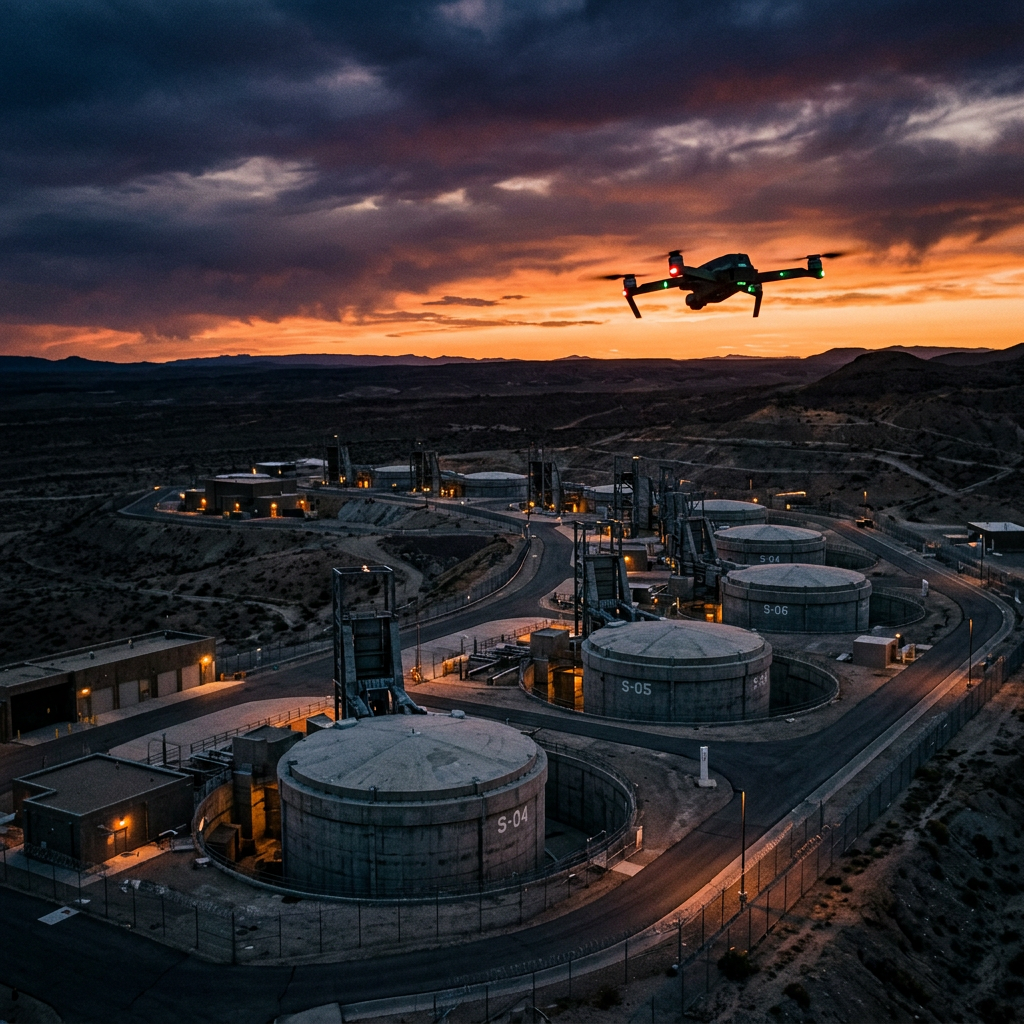
In June 2025, Ukrainian operatives drove ordinary cargo trucks deep into Russian territory, parked them beside airfields scattered across the breadth of the country—some as distant as the Amur region, out toward the Chinese frontier—and loosed short-range attack drones that had lain concealed within those trucks the whole while.¹ The most audacious stroke of all: they conducted the entire operation across Russia’s own cellular network, converting the adversary’s infrastructure into the instrument of its undoing. By Kyiv’s reckoning, the raid destroyed at least ten strategic heavy bombers and damaged forty-one aircraft, several of them wired directly into the machinery of nuclear command and control. Operation Spider’s Web, they called it, and the name was apt—patient, woven long in advance, sprung all at once.
Almost everyone fastened upon the price, and I cannot fault them for it. A drone costing perhaps five hundred dollars annihilating a bomber worth tens of millions makes an irresistible figure, and the disproportion is, in truth, very nearly comic. But the figure was never the thing that robbed me of sleep. What robbed me of sleep was plainer, and far harder to set aside: Russia did nothing nuclear in answer. Nothing whatsoever.
Consider how strange that silence is, and how much it holds. For years Moscow had proclaimed—and proclaimed the louder upon rewriting its doctrine in 2024—that a conventional strike against its strategic forces might summon a nuclear reply.² The entire edifice rested upon the ambiguity, upon the unspoken menace kept in reserve. Hold the threat veiled, and any aggressor falters before laying a hand on the crown jewels. Ukraine laid rather more than a hand upon them. It went directly for the very aircraft built to carry Russian nuclear arms, and Russia could neither arrest the attack, nor reverse it, nor even rattle the saber in a manner anyone found persuasive. And what, in the end, did the Kremlin do? It flung some four hundred drones and forty missiles at Kyiv. Conventional, to the last. Not so much as a rhetorical gesture toward the ultimate option.
That was the moment I had to sit with for a long while, and I sat with it as one sits with the death of a conviction one had assumed would outlive oneself. The most destructive arsenal ever assembled by human hands did not shield a great power from a smaller one that had simply resolved to fight. The homeland—that supposedly inviolable ground, the inner sanctum the whole theory was raised to protect—proved reachable with a handful of trucks and hardware one might very nearly order from a catalog. And once you grant that the sanctuary is no sanctuary, a load-bearing beam of the entire structure does not merely fracture; it buckles. The terror meant to stand watch at the gate is exposed as standing watch over an empty room.
So let me plant my flag here, at the threshold, that you may know where I am bound. Deterrence is not failing everywhere at once, in some tidy collapse one could circle on a calendar. History seldom grants us so clean a verdict. It is failing in patches. And the pattern of those patches—where it holds, where it gives, and why—discloses far more than any single doctrine ever could. It tells us, in the end, something about the nature of power itself: that power is never a possession but a relationship, perpetually renegotiated, and that an instrument which awes in one configuration of the world may be worth nothing in the next. What remains of this essay is my walking through those patches, case by case, for the cases are what truly altered my conviction. Not the abstractions. The abstractions arrived afterward, limping along behind the facts, struggling to keep pace—as theory, in these matters, almost always does.
Israel: A Deterrent Too Quiet to Hear
Israel has never confessed to holding the bomb. The whole posture is built upon a studied vagueness—neither confirm nor deny, and let the question hang suspended in the air, drawing its force from precisely what it declines to say. And for decades, beneath that ambiguity, Israeli leaders carried a quiet assurance: that the weapon, named or unnamed, would hold the truly existential threats at bay. That assurance is gone now, and the manner of its going repays our lingering, for it is a failure of a different order than Russia’s—a failure not of a stated threat called and found hollow, but of a silence that adversaries simply ceased to fear.
October 7, 2023, was the first fracture—a mass-casualty ground assault upon a state the entire region presumes to be nuclear-armed. And then the volleys would not relent: Hezbollah out of Lebanon, the Houthis out of Yemen, Iran directly and repeatedly. Not one of these actors treated the suspected arsenal as cause for restraint. The bluntest moment of all came in March 2026, when Iran struck the plutonium reactor at Dimona—the very heart of Israel’s nuclear establishment. Read that sentence again, as I had to, for it took me some time to absorb its full meaning. The deterrent did not merely fail to deter; it became the target. The thing meant to hold attacks at a distance was itself the object of attack—as though the fortress wall had become the prize, precisely because it was the wall.
And here is the irony I keep turning in my hands, the one I cannot quite set down. Israel’s answer to all of it has been to pour vast resources into layered missile defense—Iron Dome for the close-in threats, David’s Sling for the middle distance, Arrow for the long reach. Look closely, and this is in truth a strategy of denial: a wager that one’s enemies will desist the instant they grasp the futility of striking. Except that this, too, is buckling, and for a reason no one can readily engineer their way past. Cheap, accurate drones and missiles have inverted the arithmetic of defense—an arithmetic that has, in every age, quietly decided which walls hold and which fall. To bring down a bargain-bin drone with a premium interceptor is a losing trade no power can sustain indefinitely, and however excellent the system, some rounds always slip through. And so Israel now finds itself studying Ukraine’s improvised, low-cost counter-drone gear—drawn from the very war it has pointedly declined to furnish with its own advanced systems. There is a lesson buried in that humility, even if circumstance pressed it upon them, and it is older than any of these weapons: that the proud instrument of one era becomes the costly burden of the next.
Meanwhile, the nuclear deterrent has all but vanished from Israel’s public voice. After Dimona was struck—Dimona, of all places—Jerusalem uttered nothing that read as nuclear signaling, to avoid igniting a regional arms race, perhaps, or inviting a fresh round of sanctions. Prudent it may well be. But it means Israel’s enemies have no reason to weigh the bomb in their calculations at all. And there lies the crux: a deterrent too quiet to name, aimed at those who have already ceased to listen, is no deterrent in any meaningful sense. It is a footnote—a capability that lives on paper and in everyone’s assumptions, yet does no work whatever in the world. And a thing that does no work in the world, however awesome in principle, has in some deep sense ceased to exist, for power that goes unfelt is indistinguishable from power that was never there.
South Asia: The Weapons That Watched From the Bench
The subcontinent offered me a different vantage on the same problem—and, I confess, a more confounding one. I am not certain I have wholly untangled it even now, and I have learned to be wary of the tidy conclusion that arrives too eager to be believed.
In May 2025, India and Pakistan—each nuclear-armed for more than two decades—fell into their gravest conventional clash since 1999, striking one another well past the frontier.³ The whole of it unfolded beneath the supposed ceiling of mutual deterrence, which did precisely nothing to prevent the fighting from beginning.
But here is the turn, the thing that complicates my own argument and that I am bound to honor rather than smooth away. The dread of nuclear escalation did appear to help bring the fighting to a close. The fear of catastrophe drew outside powers into the room with remarkable haste. Washington helped broker a ceasefire, as it has more than once before; Beijing claimed a share in it as well. And so the weapons found themselves saddled with a strange second occupation—not the prevention of war, but the office of an alarm bell that summons third parties once the war is already under way. That is a far cry from what deterrence was meant to deliver, and it functions at all only when outsiders feel inclined to spend their diplomatic capital on intervention. As a safety net it is frayed and conditional, dependent upon the goodwill and attention of distant capitals that may, on some future day, be looking elsewhere. I would not wish to hang the future of a continent upon it. Yet neither can I pretend it accomplished nothing, and intellectual honesty obliges me to say so even when the admission muddies the clean lines of my thesis. The world is not built to vindicate our theories, and a thinker who flinches from the inconvenient case has already begun to deceive himself.
Iran: Watching the Whole System Strain
If the other cases punched their separate holes in deterrence, Iran is where I sit and watch the entire nonproliferation order groan beneath the load—every joint creaking at once, every assumption of the postwar settlement audibly under strain.
The paper trail is sobering, and I mean the dry, official sort: Congressional Research Service reporting, IAEA documents, the bureaucratic record that traffics in no drama at all and is the more chilling for its flatness. On June 12, 2025, the IAEA Board of Governors passed resolution GOV/2025/38, finding that Iran’s refusal to cooperate fully amounted to noncompliance with its safeguards obligations under Article XII.C of the agency’s statute.⁴ The first formal finding of its kind in twenty years—two full decades.⁵ The board concluded, further, that the Director General could no longer certify the program as peaceful, which deposited the whole matter in the Security Council’s lap. And yet the resolution stopped short of actually scheduling a report to the Council, framing the pause as Tehran’s final opportunity to come clean.⁶ A door left deliberately ajar—and there is something almost emblematic in that gesture, the way the great institutions of the order now hedge and defer, half-aware that the machinery built for an earlier world may not survive a confrontation it can no longer compel.
The technical dimension troubles me more than the procedural one. Iran has amassed something near four hundred kilograms of uranium enriched to roughly sixty percent—far beyond the three to five percent that power reactors require, and a short, ugly stride from the ninety percent that signifies weapons-grade.⁷ A Defense Intelligence Agency assessment in May 2025 placed the time required to produce enough weapons-grade material for a single device at “probably less than one week.”⁸ A November 2024 ODNI report estimated that the existing stockpile, pressed further, would furnish “more than a dozen nuclear weapons.”⁹ Figures of that order have a way of crowding out all else within one’s head, of collapsing the long horizon into a single dreadful afternoon.
So let me deliberately apply the brakes, for I distrust panic and have no wish to peddle any—panic being, in matters of state, nearly as dangerous as complacency, and frequently its secret twin. Two things bear remembering. First, U.S. intelligence has held steadily that Iran shuttered its organized weapons effort in late 2003 and has still not resolved to build a bomb; the 2025 ODNI assessment names Khamenei, by name, as the “final decisionmaker.”¹⁰ And the manufacture of fissile material is not the fielding of a usable warhead, however thoroughly the headlines blur the two. The IAEA has signaled that Iran yet lacks a workable weapon design and a fit detonation system, and would require considerably more practice casting uranium metal into a usable core.¹¹ The road from breakout to bomb is still measured in months, not days. That distinction matters, and it is forever being lost—for fear, like power, has its own appetites, and prefers the round number to the careful caveat.
Second—and this is the part that genuinely unsettles me, the part I would circle in red—look hard at what the strikes truly accomplished. After the joint U.S.–Israeli campaign opened in February 2026 and struck Iranian nuclear sites, Tehran passed a law suspending IAEA cooperation, and the inspectors were gone by early July.¹² In answer to the June finding, Iran announced it would raise a new enrichment plant somewhere shielded and exchange Fordow’s older centrifuges for advanced sixth-generation machines.¹³ The agency has since lost the thread of Iran’s centrifuges, its heavy water, its uranium feedstock—and these are gaps one cannot simply stitch back together after the fact.¹⁴ Once the continuity of knowledge breaks, it remains broken. There is a finality there that ought to give every strategist pause, for it is the finality of lost sight, and a power blind to its rival’s hand is a power already half-defeated by its own ignorance.
That is the lesson to which I keep returning, the one that recasts how I think about coercion altogether and, beyond coercion, about the whole grammar of control that the modern order presumes to wield. The very pressure meant to contain Iran drove the program into the dark, beyond the reach of the inspectors whose presence was the single thing affording the world a sliver of confidence. A strike may wreck the hardware—Grossi himself conceded the program was “significantly set back”¹⁵—while in the same stroke tearing away the transparency that allowed anyone to judge what survived the rubble. And here is where I have come to rest, plainly stated: a program I cannot see frightens me more than a larger one I can watch. The whole nonproliferation framework runs on verification and a thin, hard-won trust—and trust, history insists, is the most fragile and the most indispensable of all the materials from which an order is built. It does not work blind. It was never built to. No order ever is.
So If Threats No Longer Work, What Does?

Here is where I come down after all of it, and I will be candid that it amounts to less a grand theory than a question of where I would actually place the wager, were the decision mine to make. The grandest theories, I have noticed, tend to be the ones that have survived the fewest encounters with the world.
If deterrence-by-threat is slipping—and the cases above persuade me that it is—then the surer wager is deterrence by denial: not the promise to end the world, but the patient labor of rendering attacks pointless and ruinously dear to whoever attempts them. That reframing alters the spending logic entirely, and not by degrees. The three great nuclear powers are pouring staggering sums into the refurbishment of their missiles, their submarines, their bombers. And Spider’s Web showed those same platforms picked off cheaply, on the ground, before they could ever matter. I would sooner spend on resilience, on survivability, on genuine air and missile defense ringing the nuclear sites themselves. The template already exists, sitting in plain view before us—Ukraine’s cheap and plentiful counter-drone systems, the ones it now reportedly ships to the Gulf states. Guard the deterrent rather than merely enlarging it without end. The instinct to pile on more warheads is, in a real sense, the eternal temptation of every power in decline: to fight the last war more lavishly, mistaking the scale of one’s preparation for the soundness of one’s idea.
And I would press hard upon norms, though I am well aware that “norms” rings soft in ears tuned to hardware and megatons. Consider this, all the same, for it touches something near the root of how peace is actually kept: India and Pakistan, two countries that can scarcely abide each other’s mention, still exchange lists of nuclear facilities every New Year’s Day and pledge not to strike them.¹⁶ They contrive to do it every single year, through every crisis. There is a quiet wisdom in that ritual—the recognition that even bitter enemies may agree to fence off a small precinct of common interest, and that such fences, faithfully tended, can outlast the hatreds that surround them. The IAEA would have states vow never to strike nuclear power plants in time of war. Extend that pledge to military nuclear sites, carry it global over time, and you slow escalation, you hedge against a radiological disaster that would dwarf the original conflict, you reinforce the wider taboo that has done so much quiet good across eighty years. It is no panacea—nothing here is, and I distrust anyone who offers one. But in a world where cheap conventional weapons keep menacing nuclear assets, guardrails of that kind may be among the few things that actually hold when it counts.
One further honest point, for it follows directly from the Russian case and bears upon the very credibility of states: declaratory policy must mean something. Russia threatened nuclear consequences, Ukraine ignored them, and no bill came due. Empty threats are worse than silence—they either hollow out one’s credibility before the watching world or they trap one into escalating merely to save face, which is precisely how genuine catastrophes are born. A nation’s word, once known to be empty, cannot easily be made full again; the reputation for restraint and the reputation for resolve are both slow to build and swift to squander. So say what you will actually do, and then do what you say. It is the species of counsel that sounds self-evident until one notices how rarely, across the whole sweep of statecraft, it has ever been heeded.
The Temptation I Most Wish to Argue Against
There is an instinct loose in a good many capitals just now, and I hold it to be exactly, precisely backward—so let me dwell upon it a moment, for it is the kind of error that wears the mask of prudence and ends in calamity. The reasoning runs thus: if the American nuclear umbrella looks unsound, and if China’s buildup threatens to leave the United States staring down two nuclear peers at once, then surely the allies ought to go and acquire bombs of their own. Better safe than forsaken.
You can watch the impulse spreading everywhere, the way such impulses have always spread—by contagion, by fear, by the terrible logic that each man’s defense is his neighbor’s alarm. Poland’s president floating the notion aloud. German politicians taking up the echo. South Korean opinion swinging toward an arsenal of its own. Even Japan—the one nation on earth ever struck by nuclear weapons, the one people who carry in their collective memory the full and literal meaning of the thing—has begun, however hesitantly, to let the old taboo soften at its edges, to permit the question to be asked aloud where once it could not be whispered. And I understand the pull. I do not pretend otherwise. Set against a wavering guarantor and a darkening horizon, the bomb of one’s own wears the face of prudence; it promises to convert a borrowed safety into an owned one, a dependence into a sovereignty. Who would not wish for that?
But here is the cruelty of it, and the reason I would argue against the impulse with whatever conviction I have left: every case I have walked through in these pages testifies that the bomb no longer buys what its purchasers imagine they are buying. Russia held the largest arsenal on earth and could not keep trucks off its airfields. Israel’s presumed deterrent did not spare it October 7, nor the long siege that followed, nor the strike on Dimona itself. The thing each anxious ally reaches for is precisely the thing that has just been shown, again and again, to fail at the one task for which it is sought. They would mortgage their security to acquire a guarantee that the events of these two years have already voided—paying in the hard coin of broken norms, regional arms races, and forfeited alliances for an insurance policy whose underwriter has quietly gone insolvent. It is the oldest error in the strategic repertoire: to flee toward the very refuge that is burning.
And yet I would urge the opposite course, and urge it with whatever conviction I have left after watching so many certainties dissolve. The remedy for a fraying order is not to hasten its unraveling. Every new arsenal weakens the taboo that has, against all the gloomy forecasts, held for eighty years; every new entrant multiplies the chances of theft, of accident, of miscalculation, of a weapon falling into hands no one can deter at all. The allies anxious for their safety would do better to bind themselves more tightly to the arrangements that remain—to deepen alliances, to invest in the conventional defense and resilience I have urged throughout, to shore up the verification regimes whose erosion I have mourned—than to bolt for a sovereignty that purchases the appearance of safety at the price of the thing itself. For the bomb, as this whole essay has labored to show, no longer guarantees what it once seemed to promise. To acquire it now, at such cost and such risk, would be to buy an expensive insurance policy against the last war while leaving oneself naked before the next.
Conclusion: Power Is a Relationship, Not a Possession
I began with a confession, and I will end with one. I do not know, with anything approaching certainty, what arrangement will hold the peace in the decades before us. The man who tells you he does has mistaken the confidence of his voice for the soundness of his knowledge—an error to which my own profession is especially prone. What I have come to believe, after walking through these cases one by one, is narrower and, I hope, sturdier for its modesty: that the events of 2025 and 2026 have exposed something we ought to have grasped long ago, namely that power is never a possession but a relationship, perpetually renegotiated between those who wield it and those who must reckon with it.
The bomb did not lose its destructive force; that remains as terrible as ever. What it lost was its grip upon the imagination of adversaries who had simply resolved to fight, or who had found in cheap and plentiful weapons a way around the threat altogether. Russia’s bombers burned beneath a doctrine that promised retaliation and delivered none. Israel’s silent deterrent became a target rather than a shield. India and Pakistan warred beneath the supposed ceiling, and the bomb served only as an alarm bell rung for distant capitals. Iran’s program slipped into the dark precisely because the pressure meant to contain it shattered the transparency on which all confidence rested. In each theater, the instrument that was supposed to settle the question simply ceased to settle it.
If there is a single thread running through all of it, it is this: an instrument that awes in one configuration of the world may be worthless in the next, and the powerful are forever the last to notice when the ground beneath their certainties has shifted. The task before us is not to mourn the old arrangements, nor to cling to them past their season, but to build, soberly and without illusion, the resilience and the norms and the honest declaratory restraint that might actually hold when the threats no longer do. I cannot promise it will be enough. I can only say that it is wiser than the alternative now tempting so many—the headlong rush toward more arsenals, more triggers, more hands upon them—which mistakes the scale of one’s fear for the measure of one’s safety, and would leave us all, in the end, far less safe than before.
References
- Kyiv Independent and associated reporting on Operation Spider’s Web, June 2025. Ukrainian Security Service (SBU) accounts of the drone strikes against Russian strategic aviation.
- Basic Principles of State Policy of the Russian Federation on Nuclear Deterrence, revised November 2024.
- Reporting on the India–Pakistan conventional conflict, May 2025, and the subsequent U.S.- and China-brokered ceasefire.
- International Atomic Energy Agency, Board of Governors, Resolution GOV/2025/38, June 12, 2025.
- Paul K. Kerr, Iran’s Nuclear Program: Tehran’s Compliance with International Obligations, Congressional Research Service, Report R40094, updated August 7, 2025.
- IAEA Board of Governors, GOV/2025/25, May 2025 report by Director General Rafael Grossi.
- Paul K. Kerr, Iran and Nuclear Weapons Production, Congressional Research Service, Report IF12106, updated June 24, 2025.
- Defense Intelligence Agency assessment, May 11, 2025, as cited in CRS Report IF12106.
- Office of the Director of National Intelligence, November 2024 report, as cited in CRS Report IF12106.
- Office of the Director of National Intelligence, Annual Threat Assessment of the U.S. Intelligence Community, March 25, 2025.
- IAEA reporting on Iran’s uranium metal production and weapons-relevant activities; see also GOV/2015/68, “Final Assessment on Past and Present Outstanding Issues Regarding Iran’s Nuclear Programme,” December 2, 2015.
- CRS Report R40094, on Iran’s suspension of IAEA cooperation following the June 2025 and February 2026 strikes; inspectors withdrew in early July.
- IAEA Board of Governors, GOV/2025/38, and associated reporting on Iran’s announced enrichment facility and sixth-generation centrifuges.
- IAEA reporting on the loss of continuity of knowledge regarding Iran’s centrifuges, heavy water, and uranium feedstock.
- Rafael Grossi, IAEA Director General, CNN interview, June 17, 2025.
- India–Pakistan Agreement on the Prohibition of Attack against Nuclear Installations and Facilities, signed December 31, 1988; in force since January 27, 1991, with annual exchange of facility lists.
Discover more from Responsible Public Affairs
Subscribe to get the latest posts sent to your email.