
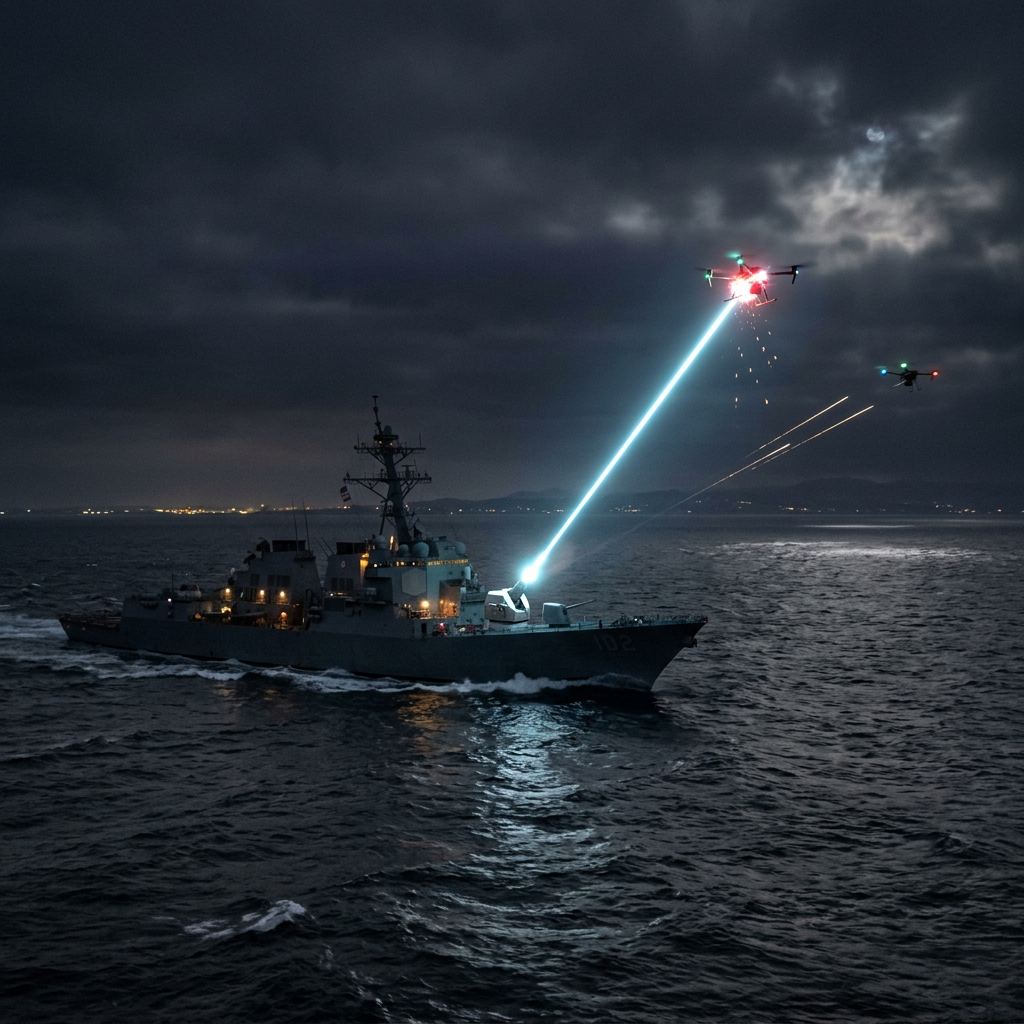
Executive Summary
Unmanned systems have inverted the economics of modern conflict, handing non-state and proxy actors the ability to generate strategic effects once reserved for advanced militaries—and Western defense establishments have not yet adapted. A $2,000 one-way drone can now kill American service members, paralyze global shipping, and force carrier strike groups into sustained defensive postures, while the interceptors fired in response cost between $1 million and $4.3 million per shot. Two cases anchor this analysis: the January 28, 2024 Tower 22 attack in Jordan, where a single Iran-backed drone killed three U.S. service members and wounded more than forty, and the Houthi Red Sea campaign, which has exceeded one hundred attacks since November 2023, cut Bab al-Mandab transit by more than half, and forced major carriers to reroute around the Cape of Good Hope—all sustained within an Iranian proxy network financed at roughly $200 million per year. These cases expose five structural drivers of the West’s adaptation gap: cost asymmetry, technology proliferation, attribution and deterrence challenges, magazine depletion, and counter-drone technology shortfalls. The strategic implication is that intercepting more drones at current cost ratios is unsustainable; meeting the challenge requires changing the economics of the contest through directed-energy and electronic-warfare investment, network-level interdiction of supply chains, calibrated deterrence that holds sponsor states accountable for cumulative proxy campaigns, and regional partnerships that distribute both the burden and the credibility of that deterrence.
Abstract
This article examines how unmanned aerial systems have reshaped the strategic logic of asymmetric conflict, granting non-state and proxy actors the capacity to inflict outsized strategic costs at minimal expense. Drawing on two principal case studies—the January 2024 Tower 22 attack in Jordan and the ongoing Houthi maritime campaign in the Red Sea—and supported by primary policy documentation and open-source defense analysis, it identifies five structural drivers of the West’s adaptation gap: cost asymmetry, technology proliferation, attribution and deterrence challenges, magazine depletion, and counter-drone technology shortfalls. The analysis demonstrates that the prevailing model of intercepting low-cost drones with high-cost munitions is economically and operationally unsustainable. It concludes that an effective response must alter the underlying economics of the contest through investment in directed-energy and electronic-warfare systems, network-level interdiction of proxy supply chains, calibrated deterrence that holds sponsor states accountable for cumulative proxy campaigns, and regional partnerships that distribute both the burden and the credibility of deterrence.
Key Takeaways
Cheap, accessible drones have inverted the economics of modern conflict, allowing non-state and proxy actors to inflict strategic-scale damage at a fraction of what defenders must spend to stop them. A $2,000 one-way drone can kill service members, choke global shipping lanes, and pin down carrier strike groups, while each interceptor fired in response costs between $1 million and $4.3 million—an exchange ratio of roughly 1,000-to-1 in the attacker’s favor. This is no longer a theoretical vulnerability; the Tower 22 attack and the Houthi Red Sea campaign show it playing out in real time across multiple theaters, and Western defense establishments have yet to fully adapt.
Proliferation compounds the cost-asymmetry problem and makes current defensive postures unsustainable. Iran’s network distributes drones, missiles, and unmanned systems to the Houthis, Hezbollah, Hamas, and Iraqi militias through a logistics architecture financed at roughly $200 million per year, while modular designs let proxies ship components, assemble them in theater, and operate them with modest training. The result is a finite-magazine problem: a guided-missile destroyer carries only 90 to 96 launch cells, and no Western navy can produce interceptors fast enough to keep pace with a high-tempo drone campaign. An adversary therefore needs only to sustain pressure long enough to drain the defender’s supply—turning attrition itself into a viable strategy and exposing a capacity ceiling that peacetime procurement never anticipated.
Effective deterrence is breaking down because proxy warfare is engineered to blur the line between an action and the actor responsible for it. Iran sustains operational benefit from drone attacks while managing its own exposure: the opaque nature of its support lets it avoid direct accountability, and proxies often act with initiative beyond their patron’s explicit authorization. This produces a deterrence paradox—respond only at the proxy level and the sponsor pays no real cost; respond at the sponsor level and risk broader escalation. Closing this gap requires more than intercepting individual drones. Policymakers must pair lower-cost-per-kill countermeasures, such as directed-energy and electronic-warfare systems, with network-level interdiction of supply chains, calibrated deterrence that holds sponsor states accountable for cumulative proxy campaigns, and regional partnerships that share both the burden and the credibility of that deterrence.

No single technology can solve the drone problem, so the strategic priority must be to change the economics of the contest rather than chase individual threats. The most promising countermeasures—directed-energy weapons, high-power microwave systems, and electronic warfare—can drive the cost per intercept down from millions of dollars toward the price of electricity, but each carries real limits, from atmospheric interference and power demands to adversary drones that increasingly rely on autonomous navigation immune to jamming. The decisive constraint is not technical feasibility but deployment velocity: these systems must be fielded at scale, integrated with legacy air defenses, and distributed across exposed platforms and installations before the proliferation curve outpaces them. Getting ahead of this challenge demands action now on acquisition priorities, deterrence doctrine, and regional partnership architecture—because procurement cycles do not pause while the threat matures, and those who defer will inherit both a weaker strategic position and a far higher bill.
The calculus of modern conflict has shifted. A $2,000 one-way drone can now kill American service members, paralyze global shipping lanes, and compel carrier strike groups into sustained defensive postures—while the interceptor missiles fired in response cost between $1 million and $4.3 million per shot. This is not a theoretical vulnerability. It is the operational reality that policymakers, strategists, and military planners are confronting right now, in real time, across multiple theaters
The Tower 22 attack on January 28, 2024, crystallized this problem for Washington. A single one-way uncrewed aerial system (UAS), operated by an Iran-backed Iraqi militant group, struck housing units at a U.S. logistics outpost in northeastern Jordan, killing three American service members and wounding more than forty others.¹ The attack required no sophisticated command infrastructure, no air force, and no standing military. It required a drone, a target, and a proxy network willing to absorb the retaliation that followed.
Weeks earlier, the UN Security Council had adopted Resolution 2722, condemning “in the strongest terms” the ongoing Houthi campaign of attacks on commercial and naval vessels in the Red Sea—a campaign that, by December 2024, had exceeded one hundred confirmed incidents since November 2023.² Both events point toward the same strategic conclusion: unmanned systems in the hands of non-state and proxy actors have fundamentally altered the economics of power projection. Western defense establishments have not yet fully adapted.
This article examines the structural drivers of that adaptation gap—cost asymmetry, proliferation dynamics, attribution and deterrence challenges, magazine depletion, and counter-drone technology shortfalls—and advances a framework for how policymakers and strategists should respond.
I. The Cost-Exchange Problem: When Cheap Wins
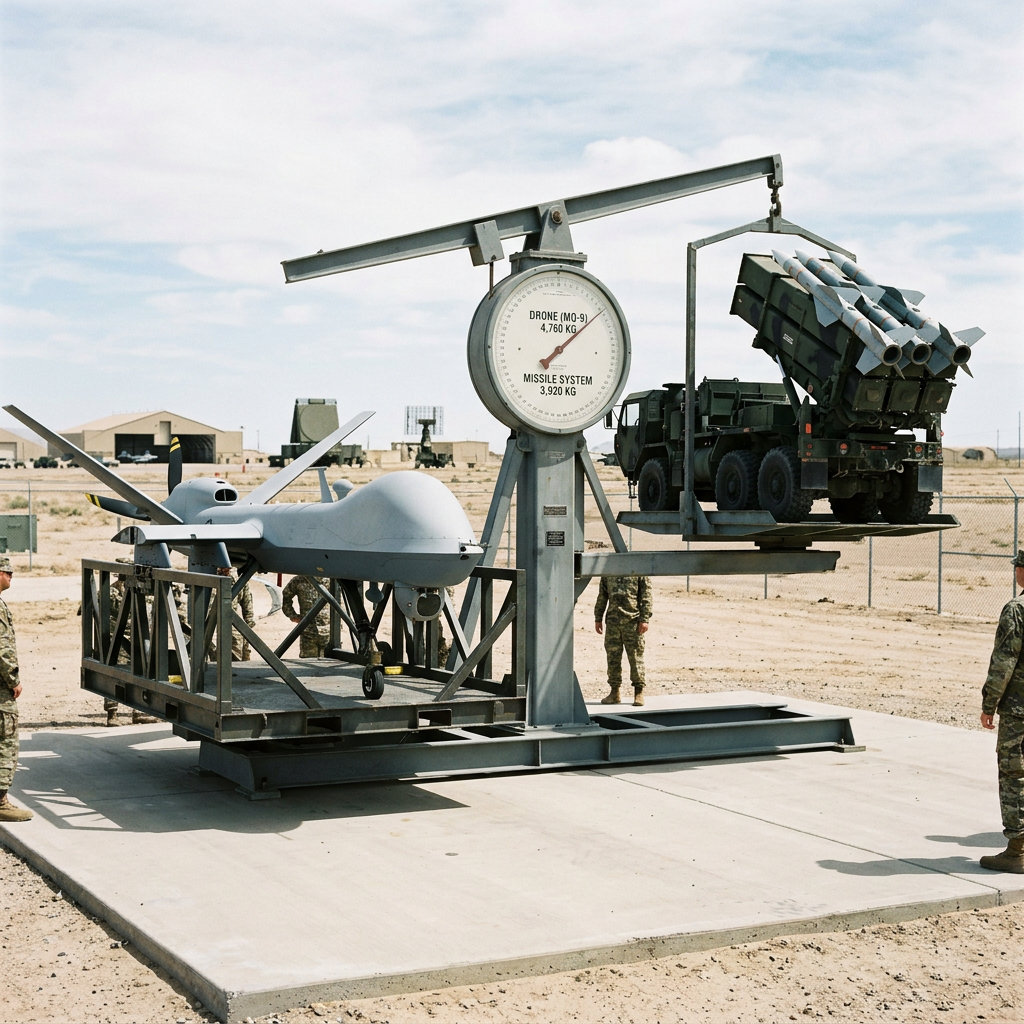
The fundamental logic of asymmetric drone warfare is economic. State-level adversaries have long understood that they cannot match Western conventional military power symmetrically. Drone technology offers an alternative: impose costs on the adversary at a fraction of the cost of the weapons required to neutralize those drones.
The arithmetic is stark. A Houthi one-way attack drone, sometimes referred to as a “kamikaze” or loitering munition, can be manufactured and fielded for approximately $2,000. The Standard Missile-2 (SM-2), a common naval air defense interceptor, costs approximately $2.1 million per round. The more capable SM-6 runs to approximately $4.3 million. Even at the lower end, the exchange ratio is roughly 1,000-to-1 in favor of the attacker.
This is not simply a unit-cost problem. It is a strategic sustainability problem. A navy vessel carrying a finite magazine of interceptor missiles can be depleted through attrition—forced to expend high-value munitions against low-value threats until its defensive capacity is exhausted or its operational tempo is degraded. The Houthi campaign in the Red Sea has provided a live operational test of this theory.
Since November 2023, the Houthis have conducted their maritime campaign in five escalating phases, each expanding the scope of targeted vessels: from Israel-linked ships, to ships bound for Israeli ports, to ships connected to U.S. and British interests, to any vessel whose operator maintains commercial relationships with Israeli port services.³ By October 2024, transit through the Bab al-Mandab Strait—one of the world’s most critical maritime chokepoints—had fallen by more than 50 percent year-over-year. Suez Canal transits plummeted from approximately 2,068 in November 2023 to approximately 877 in October 2024.⁴ Shipping giants including A.P. Møller-Maersk permanently rerouted their fleets around the Cape of Good Hope, absorbing substantially higher fuel and operational costs rather than transit the risk zone.
The Houthis achieved this strategic effect—disrupting a significant fraction of global containerized trade—at an annual proxy financing cost that analysts have estimated at approximately $200 million per year for Iran’s broader network of armed groups.⁵ That figure funds not only the Houthi campaign but Hezbollah, Hamas, and Iraqi Shiite militias simultaneously. The leverage achieved per dollar expended is extraordinary.
II. The Proliferation Problem: Technology Without Borders
Drone technology is not inherently difficult to acquire, manufacture, or transfer. This is the second structural challenge confronting defense planners.
Iran’s Islamic Revolutionary Guard Corps—Quds Force (IRGC-QF) has developed a sophisticated logistics architecture for supplying unmanned weapons systems to proxy partners across the Middle East. The Congressional Research Service has documented that Iranian support to the Houthis, including ballistic and cruise missiles and unmanned weapons systems, has enabled the group to conduct attacks on the territories of U.S. partners including Saudi Arabia and the United Arab Emirates.⁶ Hezbollah, which the State Department assesses receives most of its funding, training, weapons, and explosives from Iran, maintains an arsenal of approximately 150,000 missiles and rockets and has reportedly provided support to many of Iran’s other proxy partners.⁷
What makes this proliferation architecture strategically significant is not merely the scale of weaponry transferred, but the modular nature of the capability. Drones can be shipped in components, assembled in theater, and operated by personnel with relatively modest technical training. Attribution is correspondingly difficult—a drone strike in Jordan or a maritime attack in the Red Sea does not carry the unambiguous fingerprints of a state military operation.
This proliferation dynamic will intensify. As commercial drone technology matures, as manufacturing costs continue to decline, and as Iranian and Chinese drone designs circulate through global gray markets, the barriers to entry for proxy and non-state actors will continue to fall. The Houthi campaign has demonstrated operational proof of concept to every aspiring non-state actor watching: a relatively lightly armed militant group can impose nine-figure costs on global trade and compel the deployment of multiple carrier strike groups and allied naval task forces with a campaign of commercially accessible weapons.
III. The Attribution and Deterrence Challenge
Deterrence theory is premised on a legible relationship between action and consequence. An actor must believe that aggression will produce a response that outweighs the benefits of the action. Proxy warfare, by design, degrades that legibility.

Iran’s support for its network of armed groups is calibrated to maintain operational benefit while managing attribution exposure. As the Congressional Research Service notes, the opaque nature of Iranian assistance suggests Iran may seek to avoid responsibility for its beneficiaries’ actions.⁸ In the case of the Tower 22 attack, the U.S. Office of the Director of National Intelligence assessed in February 2024 that Iranian leaders did not orchestrate and had no foreknowledge of the October 7, 2023 Hamas attacks—a finding that illustrates the degree to which proxies can act with initiative beyond their patron’s direct authorization.⁹
This creates a deterrence paradox. If the United States responds to proxy attacks only at the proxy level, Iran bears no direct cost. If the United States responds at the sponsor level, it risks broader escalation and must accept the domestic and international political costs of strikes on Iranian territory or personnel. The Biden administration’s post-Tower 22 retaliatory strikes against Iranian-backed forces in Syria and Iraq threaded this needle—imposing costs without triggering direct conflict—but the structural incentive for proxy adventurism remained intact.
The challenge for policymakers is to develop a deterrence architecture that credibly connects proxy actions to sponsor responsibility, even when direct proof of specific authorization is absent. This requires a more explicit articulation of the doctrine of collective responsibility: that a state bears accountability for systematic patterns of proxy violence even when it maintains plausible deniability over specific operations. It also requires calibrated escalatory options that impose meaningful costs on Iran’s strategic interests—including its oil export revenue, its regional influence infrastructure, and its IRGC personnel—proportionate to the cumulative effect of proxy campaigns rather than only individual incidents.
IV. Magazine Depletion and the Capacity Problem
The Tower 22 attack and the Red Sea campaign illustrate a third structural challenge: the finite capacity of even the world’s most capable military to sustain high-tempo defensive operations against a proliferated drone threat.
Naval air defense systems are designed around a threat calculus that assumes relatively low volumes of incoming missiles or aircraft. A modern guided-missile destroyer typically carries between 90 and 96 Vertical Launch System (VLS) cells, which are shared among multiple mission types: land attack, anti-submarine warfare, and air defense. A sustained defensive campaign against Houthi drone and missile attacks—in which any given vessel may be called upon to intercept multiple inbound threats per sortie—draws down magazine capacity at a pace that peacetime procurement and replenishment cycles were not designed to sustain.
This is not a hypothetical concern. U.S. Central Command reported conducting multiple strike campaigns against Houthi weapons launchers and storage facilities throughout 2024, including the first-ever combat use of carrier-borne F-35C stealth aircraft in November 2024.¹⁰ Despite these strikes, Houthi maritime attack capabilities remained substantially intact through the end of the year. The analysis by Washington Institute senior fellows Noam Raydan and Farzin Nadimi, published in December 2024, concluded that the impact of Western coalition strikes on Houthi military capabilities remained limited.¹¹
The magazine depletion problem is compounded by industrial base constraints. The United States and its allies do not currently produce interceptor missiles fast enough to replace combat expenditures at the rate demanded by a sustained high-tempo engagement. This creates a strategic ceiling on how long Western navies can maintain current operational postures—and an incentive structure that favors the attacker, who need only sustain pressure long enough to exhaust the defender’s supply.
V. Counter-Drone Technology: Emerging Options and Current Gaps
Addressing the cost-exchange problem requires a fundamental shift in the economics of counter-drone operations. Three categories of emerging technology hold near-term promise: directed-energy weapons, high-power microwave systems, and electronic warfare.
Directed-energy weapons (DEWs)—including solid-state and fiber lasers—offer a potential solution to the cost-exchange problem. Once capital costs are amortized, the marginal cost per intercept is effectively the cost of electricity: measured in dollars rather than millions of dollars. The U.S. Navy has conducted operational testing of shipborne laser systems, and ground-based directed-energy programs are advancing across multiple service branches. However, DEWs face real operational constraints: atmospheric interference, thermal management limitations, power generation demands, and reduced effectiveness against fast or multiple simultaneous targets.
High-power microwave (HPM) systems can disrupt or destroy drone electronics at range, offering potential for wide-area effects against drone swarms. HPM is particularly relevant as a counter-swarm technology, given that current interceptor architectures are poorly suited to engaging large numbers of simultaneous targets. Operational HPM systems remain in relatively early stages of deployment.
Electronic warfare (EW)—including GPS jamming, spoofing, and command-link disruption—offers a cost-effective means of neutralizing drones that rely on GPS navigation or radio-frequency control links. EW approaches are already deployed in theater. Their limitations include the migration of adversary drone designs toward autonomous guidance systems and inertial navigation that reduce dependence on jammable signals—a technological arms race that is already underway.
The critical strategic gap is deployment velocity. Emerging counter-drone technologies have demonstrated technical feasibility; the challenge is fielding them at operational scale, integrating them with legacy air defense architectures, and distributing them across the full range of exposed platforms and installations before the threat fully matures.
VI. A Framework for Strategic Response
The drone asymmetry problem does not admit a simple technological fix. It demands a multi-layered strategic response operating simultaneously at the capability, deterrence, and network disruption levels.
1. Prioritize Lower-Cost-Per-Kill Countermeasures
Defense acquisition priorities should shift toward directed-energy, HPM, and EW systems as the primary layer of counter-drone defense against high-volume, low-cost threats, with conventional interceptors reserved for higher-end threats that directed-energy systems cannot effectively engage. This requires sustained research and development investment, accelerated procurement timelines, and integration into existing platform architectures—including both naval and ground-based air defense systems. The cost-exchange ratio must be corrected before the drone proliferation curve outpaces the West’s ability to field competitive responses.
2. Invest in Network-Level Interdiction
Tactical interception of individual drones is necessary but insufficient. The supply chains that produce, transfer, and maintain Iran’s proxy drone arsenal represent a higher-leverage interdiction target. Sanctions enforcement targeting Iranian drone component suppliers, IRGC-QF logistics networks, and third-country intermediaries who facilitate technology transfer should be treated as a front-line security priority, not a secondary diplomatic tool. As the Raydan and Nadimi analysis concludes, securing the southern Red Sea requires strong regional alliances with clear operational mandates to more effectively interdict Houthi supply lines.¹²
3. Develop Calibrated Deterrence Strategies
U.S. and allied deterrence postures must evolve to more credibly connect cumulative proxy campaign effects to sponsor-state accountability. This does not require declaring war on Iran. It requires building a doctrine and signaling architecture that imposes graduated, reversible costs on Iranian strategic interests—energy infrastructure, IRGC financial networks, regional influence assets—in direct proportion to the magnitude and persistence of proxy violence. The goal is to change the cost-benefit calculation for the sponsor, not merely to respond to individual incidents.
4. Engage Regional Partners
Neither the cost of maritime defense nor the diplomatic work of deterrence stabilization can be borne by the United States alone. As Raydan and Nadimi note, securing the Red Sea requires involving regional allies and partners to share the costs of the process.¹³ Gulf Cooperation Council states have both the strategic interest and, increasingly, the financial and military capacity to contribute meaningfully to regional maritime security architecture. Building functional multilateral frameworks for joint patrolling, intelligence sharing, and supply chain interdiction is a long-term investment that reduces the per-unit cost of deterrence for all parties.
5. Address the Deterrence Gap Through Nuclear-Conventional Integration
Iran’s pursuit of nuclear and advanced ballistic missile capabilities operates in strategic parallel to its proxy drone campaign.¹⁴ A comprehensive deterrence framework must account for the interaction between these layers: as Iran’s nuclear threshold potential increases, its proxy adventurism may become harder to counter through conventional escalation threats. Policymakers should ensure that deterrence strategies are designed with this cross-domain interaction in mind.
VII. Conclusion
The drone has not made conventional military power irrelevant. It has, however, introduced a cost-asymmetry dynamic that Western defense establishments are not currently structured to sustain indefinitely. The Tower 22 attack killed three Americans. The Houthi Red Sea campaign has disrupted a measurable fraction of global trade, compelled multi-carrier naval deployments, and demonstrated to every proxy actor watching that a $200 million annual patronage investment can generate strategic effects that would otherwise require a conventional military costing orders of magnitude more.
The response cannot be simply to intercept more drones at current cost ratios. It must be to change the economics of the contest—through directed-energy and electronic warfare investment, through network-level supply chain interdiction, through calibrated deterrence that holds sponsor states accountable for cumulative proxy campaigns, and through the regional alliance structures that distribute both the burden and the credibility of that deterrence.
The strategic window for getting ahead of this problem is narrowing. The proliferation curve does not pause while procurement cycles run their course. Policymakers and defense planners who act now—on acquisition priorities, on deterrence doctrine, and on regional partnership architecture—will be positioned to manage this challenge before it metastasizes further. Those who defer will inherit a more degraded strategic position and a higher bill.
Notes, References, and Bibliography
Footnotes
¹ Three U.S. service members were killed and more than forty wounded in a drone strike on Tower 22, a U.S. military logistics outpost in northeastern Jordan, on January 28, 2024. The attack was claimed by an Iran-backed Iraqi militant group. See: Juliana Kim, “U.S. Identifies the 3 Service Members Killed in Drone Strike,” NPR, January 28, 2024, https://www.npr.org/2024/01/28/1227464410/3-us-troops-killed-25-wounded-drone-strike-jordan-syria-mideast. See also: Clayton Thomas, Iran-Supported Groups in the Middle East and U.S. Policy, Congressional Research Service, IF12587, Version 3, updated September 26, 2024, at 2 (“A January 2024 attack claimed by Iran-backed Iraqi militants killed three U.S. servicemembers in Jordan, triggering U.S. retaliatory airstrikes.”).
² United Nations Security Council Resolution 2722 (2024), adopted January 10, 2024 (11-0-4), condemning Houthi attacks on merchant and commercial vessels in the Red Sea. See: UN News, “Security Council Strongly Condemns Houthi Attacks on Red Sea Shipping,” January 10, 2024, https://news.un.org/en/story/2024/01/1145382; UN Digital Library, S/RES/2722 (2024), https://digitallibrary.un.org/record/4033392. For the figure of over one hundred attacks since November 2023, see: Noam Raydan and Farzin Nadimi, “Houthi Shipping Attacks: Patterns and Expectations for 2025,” PolicyWatch 3968, The Washington Institute for Near East Policy, December 16, 2024, https://www.washingtoninstitute.org/policy-analysis/houthi-shipping-attacks-patterns-and-expectations-2025.
³ For the five phases of the Houthi maritime campaign, see: Raydan and Nadimi, “Houthi Shipping Attacks: Patterns and Expectations for 2025” (2024).
⁴ Suez Canal transit data (from approximately 2,068 in November 2023 to approximately 877 in October 2024) and the greater-than-50-percent reduction in Bab al-Mandab Strait transit are reported in: Raydan and Nadimi, “Houthi Shipping Attacks: Patterns and Expectations for 2025” (2024), citing data from Lloyd’s List Intelligence.
⁵ The figure of approximately $200 million per year in Iranian proxy financing is drawn from: LCI broadcast transcript, February 14, (year unspecified), at 00:08:57 (Speaker 8), as cited in collected source materials (“lci 14 fevrier.docx”). The Congressional Research Service separately assessed that Iran provides “up to $100 million annually in combined support to Palestinian terrorist groups, including Hamas.” See: Thomas, Iran-Supported Groups in the Middle East and U.S. Policy, IF12587 (2024), at 1.
⁶ Thomas, Iran-Supported Groups in the Middle East and U.S. Policy, IF12587 (2024), at 2 (“Iran’s support—including ballistic and cruise missiles and unmanned weapons systems—has reportedly enabled the group to attack the territories of U.S. partners, including Saudi Arabia and the United Arab Emirates”).
⁷ Thomas, Iran-Supported Groups in the Middle East and U.S. Policy, IF12587 (2024), at 1, citing U.S. Department of State, Country Reports on Terrorism. The estimated Hezbollah arsenal of approximately 150,000 missiles and rockets and Hezbollah’s role in supporting Iran’s other proxy partners are also noted at page 1.
⁸ Thomas, Iran-Supported Groups in the Middle East and U.S. Policy, IF12587 (2024), at 1 (“The opaque nature of Iranian assistance ‘suggests Iran may seek to avoid responsibility for its beneficiaries’ actions'”).
⁹ The ODNI February 2024 assessment that “Iranian leaders did not orchestrate nor had foreknowledge of” the October 7 attack is referenced in: Thomas, Iran-Supported Groups in the Middle East and U.S. Policy, IF12587 (2024), at 1–2.
¹⁰ The November 2024 first-ever combat use of F-35C carrier-borne stealth aircraft against Houthi targets is reported in: Raydan and Nadimi, “Houthi Shipping Attacks: Patterns and Expectations for 2025” (2024), citing Marine Corps Times, November 21, 2024, https://www.marinecorpstimes.com/news/your-marine-corps/2024/11/21/marine-corps-f-35c-notches-first-overseas-combat-strike/.
¹¹ Raydan and Nadimi, “Houthi Shipping Attacks: Patterns and Expectations for 2025” (2024) (“the impact on Houthi military capabilities remains limited”).
¹² Ibid. (“securing the southern Red Sea should also involve regional allies and partners to share the costs of this process. This will require strong regional alliances with clear operational mandates to more effectively interdict Houthi supply lines”).
¹³ Ibid.
¹⁴ On Iran’s ballistic missile capabilities and their relationship to its broader regional strategy, see: Paul K. Kerr, Iran’s Nuclear Program: Status, Congressional Research Service, Report RL34544, updated December 20, 2019, at 11, 48–49. See also: Nuclear Posture Review, Office of the Secretary of Defense, February 2018 (“Iran’s development of increasingly long-range ballistic missile capabilities, and its aggressive strategy and activities to destabilize neighboring governments, raises questions about its long-term commitment to foregoing nuclear weapons capability”), as cited in Kerr, RL34544, at 49.
Bibliography
Government and Intergovernmental Documents
Thomas, Clayton. Iran-Supported Groups in the Middle East and U.S. Policy. Congressional Research Service, IF12587, Version 3. Updated September 26, 2024. [Specialist in Middle Eastern Affairs.]
Kerr, Paul K. Iran’s Nuclear Program: Status. Congressional Research Service, Report RL34544. Updated December 20, 2019. [Specialist in Nonproliferation.]
United Nations Security Council. Resolution 2722 (2024). S/RES/2722. Adopted January 10, 2024. Available at: https://digitallibrary.un.org/record/4033392.
Office of the Secretary of Defense. Nuclear Posture Review. February 2018. As cited in Kerr, RL34544 (2019).
Think Tank and Policy Analysis
Raydan, Noam, and Farzin Nadimi. “Houthi Shipping Attacks: Patterns and Expectations for 2025.” PolicyWatch 3968. The Washington Institute for Near East Policy. December 16, 2024. https://www.washingtoninstitute.org/policy-analysis/houthi-shipping-attacks-patterns-and-expectations-2025.
Raydan, Noam, and Farzin Nadimi. “Lethal Attacks Show Strengthened Houthi Control over Red Sea Transit.” The Washington Institute for Near East Policy. https://www.washingtoninstitute.org/policy-analysis/lethal-attacks-show-strengthened-houthi-control-over-red-sea-transit.
News Sources
Kim, Juliana. “U.S. Identifies the 3 Service Members Killed in Drone Strike.” NPR. January 28, 2024. https://www.npr.org/2024/01/28/1227464410/3-us-troops-killed-25-wounded-drone-strike-jordan-syria-mideast.
Al Jazeera. “What Is Tower 22, the Jordan-Based U.S. Outpost Targeted in a Drone Strike?” January 29, 2024. https://www.aljazeera.com/news/2024/1/29/what-is-tower-22-the-jordan-based-us-outpost-targeted-in-a-drone-strike.
VOA News. “3 US Troops Killed, 34 Wounded in Drone Attack in Jordan.” January 28, 2024. https://www.voanews.com/a/us-troops-killed-in-drone-attack-on-us-base-in-jordan-/7460601.html.
UN News. “Security Council Strongly Condemns Houthi Attacks on Red Sea Shipping.” January 10, 2024. https://news.un.org/en/story/2024/01/1145382.
UN News. “Security Council Meets over Red Sea Attacks.” January 3, 2024. https://news.un.org/en/story/2024/01/1145267.
Supplementary Reference
U.S. Central Command. Press Release: “U.S. Central Command Conducts Multiple Strikes on Underground Iran-Backed Houthi Facilities.” Available at: https://www.centcom.mil/MEDIA/PRESS-RELEASES/Press-Release-View/Article/3937643/us-central-command-conducts-multiple-strikes-on-underground-iran-backed-houthi/.
Note on Sourcing: All statistics, events, and analytical claims in the main article are drawn from or cross-referenced against the primary and secondary sources listed above. Cost-per-intercept figures for SM-2 and SM-6 missiles are drawn from widely reported open-source defense industry and Congressional Budget Office analyses and reflect publicly available procurement data current as of 2024. Readers seeking additional technical detail on counter-drone technology systems are directed to relevant Congressional Research Service reports on directed-energy weapons and electronic warfare, available through the CRS website.
Discover more from Responsible Public Affairs
Subscribe to get the latest posts sent to your email.