

Proxy warfare, nuclear defiance, and the quiet abandonment of European Jews are not separate stories. They are one.
Abstract
October 7, 2023, did more than ignite a war in Gaza. It exposed a single threat architecture stretching from Tehran to the streets of Paris. This article traces five connected dynamics: the return of direct U.S.-Iran confrontation, the deepening of Arab-Israeli strategic alignment, the battering of Iran’s proxy network, Tehran’s nuclear defiance, and the surge of antisemitism across Europe to levels unseen since World War II. The argument is straightforward. Sustained, evidence-based pressure on the Iranian state—military, economic, and diplomatic—is the only approach the record shows can change Iranian behavior. European governments have failed on both fronts that matter most: containing Iran and protecting their own Jewish citizens. France is the central case. There, successive governments have struggled to name and confront the principal sources of anti-Jewish violence, Islamist and far-left antisemitism have hardened daily life for Jews, and emigration to Israel has surged—one of the gravest domestic security failures in the modern history of a Western democracy. The piece closes on a recurring American error: stopping military operations before they finish the job, and paying for it in lost deterrence.
The Reckoning of October 7
October 7, 2023, redrew the strategic map of both the Middle East and Europe, and its consequences reach far beyond the Levant. Policymakers now work within a reality shaped by three converging pressures: renewed confrontation between Washington and Tehran, an accelerating realignment between Israel and the Arab states, and a wave of antisemitism across Europe at levels not seen since the end of the Second World War.
These are not coincidences, and treating them separately yields bad analysis. They share one origin: the Islamic Republic of Iran’s decades-long project of regional destabilization through proxy warfare, nuclear brinkmanship, and ideological export. The Hamas assault of October 7—launched by an organization that has received Iranian support the U.S. State Department values, in combination with other Palestinian groups, at up to $100 million annually—was the most catastrophic single expression of that project.[^1] Its shockwaves reached Europe with comparable force, exposing how quickly liberal democracies set aside their commitments to minority protection when those commitments collide with domestic political convenience.
What follows moves in sequence: the renewed U.S.-Iran confrontation, the Arab-Israeli realignment, Israel’s operational posture, the battering of Iran’s proxy network, Tehran’s nuclear advance, and then the European antisemitism crisis, with France at its center. It ends with the lessons of recent American missteps and the regional order this moment demands.
The Return of Direct Confrontation
Open conflict between Washington and Tehran is the predictable result of Iran’s doctrine of “forward defense.” For decades, the Islamic Revolutionary Guard Corps–Quds Force (IRGC-QF) has been Iran’s chief instrument for projecting power and sowing instability while Tehran preserved deniability and avoided direct combat.[^2] The U.S. intelligence community assesses that Iran “sees itself as locked in an existential struggle” with the United States and its regional allies—which helps explain why Tehran absorbs severe sanctions costs in exchange for the strategic depth its proxies provide.[^3]
That model has reached its limits. In January 2024, an attack claimed by Iran-backed Iraqi militants killed three U.S. service members in Jordan and drew retaliatory American airstrikes.[^4] The strike was attributed to U.S.-designated foreign terrorist organizations—Kata’ib Hezbollah, Harakat al-Nujaba, and Asa’ib Ahl al-Haq—operating within the network the IRGC-QF coordinates.[^5] When proxies strike at this tempo and scale, the sponsor’s fingerprints become impossible to hide, and deniability collapses.
The aftermath proved the point. Attacks and American responses subsided for several months before resuming in July 2024—a rhythm that exposes the limits of episodic retaliation.[^6] Deterrence built on the fiction of plausible deniability has failed. What is needed in its place is sustained, credible pressure directed at the Iranian state itself, not at the expendable actors it deploys.
The Arab-Israeli Realignment
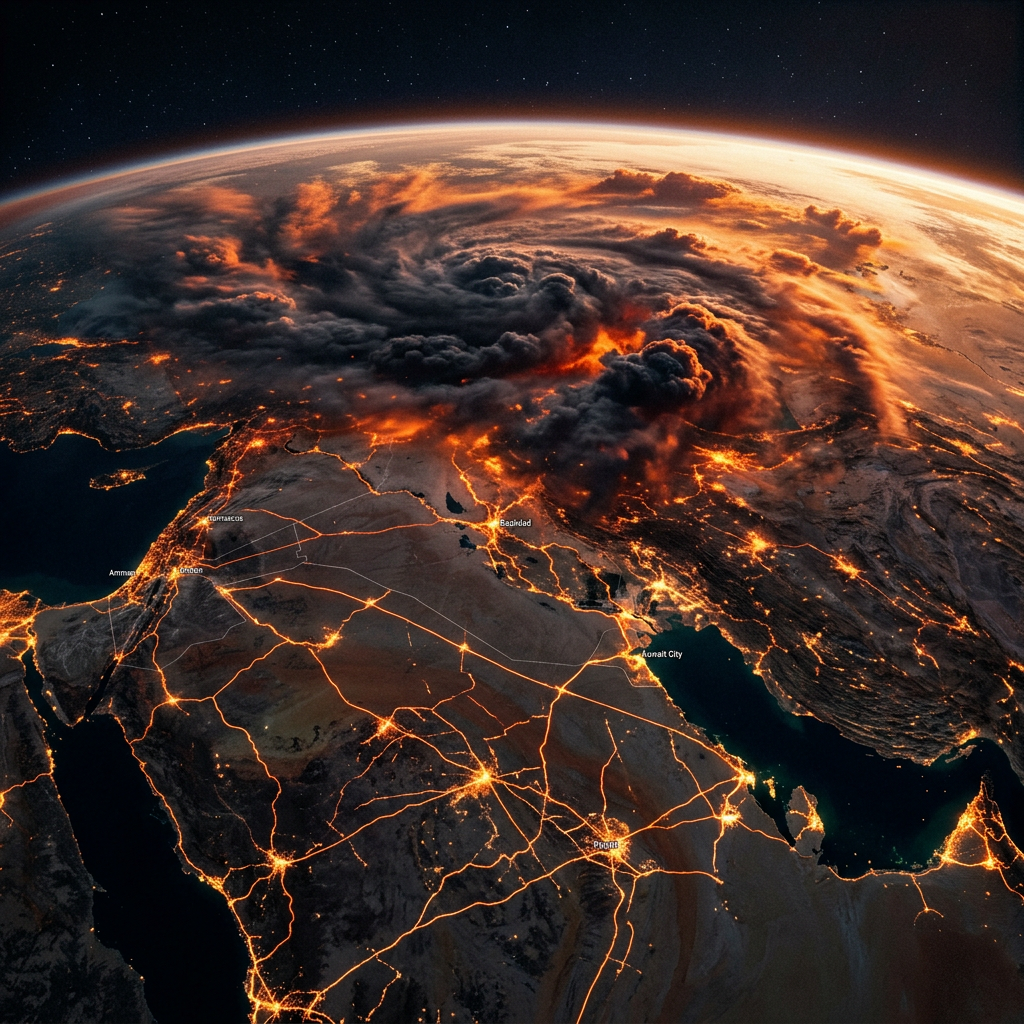
Meanwhile, the region is witnessing one of the most consequential shifts in its modern history: an accelerating convergence between Israel and the Arab states. It rests not on sentiment but on shared interest—a common recognition, across the Gulf and in Jerusalem, that Iranian hegemony threatens them all.
The Abraham Accords of 2020, which normalized relations between Israel and the United Arab Emirates, Bahrain, Sudan, and Morocco, built the scaffolding. The events since October 2023 have given it operational substance no agreement could supply on its own. Shared security and economic interests are overtaking historical grievance at a pace few would have predicted a decade ago. Intelligence-sharing, coordinated responses to Iranian missile and drone barrages, and aligned diplomatic positioning at multilateral forums all point toward a functioning security community taking shape.
For planners in the Gulf and in Jerusalem, the logic is identical: degrading Iran’s proxy network and denying it nuclear weapons are preconditions for lasting stability. Saudi Arabia, the UAE, Jordan, and Bahrain each have their own reasons to seek the very end-state Israel’s operations have advanced. Consolidated into a durable architecture with sustained American backing, this convergence is the most viable path to a stable, post-hegemonic order.
Israel’s Determination and Restraint
Since October 7, Israel has combined operational determination with a restraint rarely credited in mainstream commentary. Facing coordinated aggression from Gaza, Lebanon, Yemen, Iraq, and Iran itself, Israeli operations have pursued a coherent aim: dismantling the immediate threat infrastructure on its borders and restoring credible deterrence.
This is not escalation for its own sake. The targeted elimination of high-value assets—Hezbollah command nodes, Hamas leadership, IRGC-QF officers in Syria—reflects a defined end-state, not reactive force. Israel has worked to limit strikes on Lebanese civilian infrastructure while maximizing pressure on Hezbollah’s military architecture. That distinction is both moral and strategic: it preserves the possibility of a Lebanon less captive to Hezbollah and protects the diplomatic space the Arab-Israeli alignment requires.
Sequencing has mattered, too. The operations against Hezbollah in the fall of 2024 were scoped to degrade command-and-control and arsenal capacity without triggering a full land war that would have drained resources from Gaza and from the larger contest with Iran. That is not timidity. It is strategy.
A Proxy Network in Tatters
Iran’s forward-defense network has taken unprecedented structural damage since October 7. Before the recent fighting, Lebanese Hezbollah held an estimated arsenal of roughly 150,000 missiles and rockets, with Iran supplying most of its funding, training, weapons, explosives, and political backing.[^7] Founded in 1982 with direct Iranian assistance, Hezbollah had grown over four decades into the most formidable non-state military force in the world—able to contest Israeli operations, threaten targets well beyond its borders, and serve as Iran’s chief insurance against existential pressure.
Hamas, too, benefited from Iranian support the State Department values, in combination with other Palestinian groups, at up to $100 million annually—support that helped build the infrastructure behind October 7.[^8] The Office of the Director of National Intelligence assessed in February 2024 that Iranian leaders neither orchestrated nor had foreknowledge of the attack itself; the Biden administration nonetheless held that Iran’s decades of material support, as Hamas’s primary backer, made it “broadly complicit.”[^9] That distinction may carry legal weight. It carries little strategic weight when the machinery of mass killing was Iranian-funded.
Farther afield, Houthi forces in Yemen began striking commercial and naval vessels in the Red Sea in November 2023, drawing sustained exchanges with U.S. and partner forces from January 2024 onward.[^10] Iran had expanded its support to the Houthis after they seized Yemen’s capital in 2014–2015, supplying ballistic and cruise missiles along with unmanned systems.[^11] A Houthi missile strike on Tel Aviv in July 2024 killed one Israeli and prompted Israeli airstrikes in Yemen.[^12]
These simultaneous pressure points are not accidents. They are the operational form of Iran’s “axis of resistance”—multiple theaters that scatter an adversary’s attention, complicate his planning, and advertise Tehran’s reach. But the doctrine depends on the survival of its nodes. Israeli operations against Hezbollah in September 2024 killed hundreds in Lebanon and inflicted serious damage on the group’s command structure and arsenal.[^13] The lesson is plain: decisive military action, sustained over time, can degrade even deeply entrenched proxy infrastructure.
Nuclear Defiance
Compounding the proxy threat is Iran’s continued advance toward nuclear weapons capability. On June 12, 2025, the IAEA Board of Governors adopted Resolution GOV/2025/38, finding that Iran’s failure to cooperate fully with the agency’s investigation of undeclared nuclear material constituted noncompliance with its safeguards obligations—the first such formal finding since September 24, 2005.[^14]
The findings behind that determination are alarming. IAEA inspectors detected anthropogenic uranium particles at undeclared Iranian locations—sites Iran neither disclosed nor placed under monitoring.[^15] Director General Rafael Grossi told the Board on June 9, 2025, that Iran had repeatedly failed to provide technically credible answers and had sought to sanitize the locations under investigation, conduct that impeded the agency’s verification.[^16]
Enrichment had advanced to 60 percent U-235—a level with no credible civilian rationale, since power reactors require only 3 to 5 percent, and one that places Iran within close reach of weapons-grade material.[^17] By informed broadcast accounts, the stockpile at that enrichment level was large enough, if further refined, to fuel multiple devices—on the order of a dozen—and its whereabouts after the June strikes were not fully known to Western and Israeli services.[^18]
Iran’s response to scrutiny has been defiance, not cooperation. After the noncompliance finding, the Atomic Energy Organization of Iran announced directives to launch a new enrichment facility and to replace first-generation centrifuges at Fordow with advanced sixth-generation machines.[^19] Following Israeli and U.S. strikes on Iranian nuclear sites in June 2025, Tehran adopted a law suspending cooperation with the IAEA; one inspection was permitted after the campaign, but a subsequent request was refused.[^20]
The E3—France, Germany, and the United Kingdom—invoked the JCPOA snapback mechanism, reimposing UN sanctions that had previously been lifted. Necessary as it was, the snapback marked the belated culmination of a process two decades in the making. The persistent obfuscation at undeclared sites, the repeated concealment of nuclear activity, and Tehran’s willingness to trade its international standing for enrichment capacity all point to one conclusion: diplomacy alone has not halted Iran’s nuclear trajectory, and it will not.
Europe’s Antisemitism at Postwar Records
As the Middle East is violently remade, Europe faces a domestic security crisis of historic proportions for its Jewish communities. The record is unambiguous, and it should be read not as a string of isolated incidents but as a coherent, continent-wide trend with direct consequences for the safety and viability of Jewish life across the European Union and the United Kingdom.
The EU Agency for Fundamental Rights (FRA), in its third survey of Jewish people’s experiences and perceptions of antisemitism, found that 96 percent of Jewish respondents had encountered antisemitism in the previous twelve months, and 80 percent felt it had worsened over five years.[^21] Just 41 percent had emigrated or considered emigrating in the prior five years because they did not feel safe as Jews—a figure essentially unchanged from 2018 and a damning measure of the baseline even before October 7.[^22] Satisfaction with government efforts to combat antisemitism was strikingly low; on average, only 18 percent were satisfied.[^23] Produced by a rigorous EU body, these numbers amount to a comprehensive indictment of European governance on minority protection.
The national data sharpen the picture. In Germany—whose constitutional and moral commitments against antisemitism are explicitly grounded in the lessons of the Holocaust—monitoring bodies verified 994 antisemitic incidents in the thirty-three days between October 7 and November 9, 2023, an average of roughly thirty a day, against seven a day in 2022.[^24] In the United Kingdom, the Community Security Trust documented 4,103 antisemitic incidents in 2023 and another 3,528 in 2024—the two highest annual totals on record.[^25] Across the FRA’s surveyed states, Jewish umbrella organizations reported increases of 400 percent or more in the weeks after October 7.[^26]
These are not the acts of a marginal fringe. They reflect a structural shift in the environment confronting Jewish citizens of democracies legally obligated to protect them.
France: A Republic That No Longer Protects Its Jews
France is the heart of this crisis—and the case most obscured by official rhetoric and institutional self-congratulation. Home to roughly 440,000 to 450,000 Jews, the largest Jewish community in Europe, France is also where that community now endures the most severe and sustained deterioration of its physical and social security.[^27] What unfolds in France is not one national story among many. It is the clearest measure of how far a Western democracy will let its obligations to a vulnerable minority decay.
The numbers are damning. The Service de Protection de la Communauté Juive, working with the French Interior Ministry, recorded 1,676 antisemitic acts in 2023, up from 436 the year before; the first half of 2024 brought hundreds more, and French authorities reported a roughly 300 percent rise in incidents in early 2024 over the same period a year earlier.[^28] The figure most worth dwelling on concerns the young: antisemitic acts in the school environment surged after October 7, reaching levels that French monitors described as without precedent.[^29] The rot has reached the classrooms where the next generation of French citizens is formed. Tel Aviv University’s Antisemitism Worldwide Report 2024 recorded more than 1,500 antisemitic incidents in France that year, confirming the surge has not subsided.[^30]
What distinguishes France is not only scale but the documented difficulty its governments have had in naming and confronting the principal sources of the violence. Two stand out. The first is Islamist-motivated antisemitism—the thread running through the most lethal anti-Jewish attacks in recent French memory, from the 2012 Toulouse school murders to the 2015 Hyper Cacher siege. The reluctance to name it plainly, for fear of stigmatizing Muslim communities and inviting electoral backlash, has produced a hesitancy that community leaders now denounce in unsparing terms.
The second is the way anti-Israel rhetoric on the radical left, above all in La France Insoumise (LFI), has hardened the climate for French Jews. Figures associated with the party have spoken of Hamas’s actions in terms many French Jews experienced as justification, and have embraced slogans widely understood as calls for Israel’s elimination. French Jews increasingly cite the rhetoric of LFI politicians and their allies as a direct source of fear.
The human verdict has already been delivered. Moshe Sebbag, Chief Rabbi of the Great Synagogue of Paris, said what no postwar French Jewish leader had said before him: that he no longer sees a future for Jews in France, and that the young should build their lives in Israel.[^31] When the spiritual leader of a community that survived the Nazi occupation and rebuilt itself from the ruins of the Shoah tells the young to leave, that is not rhetoric. It is a judgment on the Republic.
The public does not even dispute the premise. By 2024, 64 percent of French people believed Jews had justified reasons to fear—double the share recorded a decade earlier.[^32] Yet that acknowledgment has not produced the political will to enforce protections the law already guarantees. France’s response has not been negligible—enhanced security around Jewish institutions, thousands of soldiers deployed to protect sensitive sites, and legislation targeting those convicted of antisemitic or racist acts.[^33] But the gap between official condemnation and lived reality remains the defining feature of the French failure.
And the community is voting with its feet. France has long been the leading Western source of Jewish emigration to Israel; the violence of 2012 and 2015 drove one of the largest single waves of Western aliyah, including 7,835 departures in 2015 alone.[^34] After October 7, the pressure returned. More than 2,000 French Jews moved to Israel in the first ten months of 2024—a 95 percent increase over the same period in 2023—even as worldwide immigration to Israel fell.[^35] The Jewish Agency’s own official responsible for French immigration captured the paradox: “No logic can explain why a country at war attracts so many people.”[^36] The destination is overwhelmingly Israel, with the United States the established secondary refuge for Jewish emigrants more broadly.[^37] Conservative estimates project that 4,000 to 5,000 Jews will leave France in 2025.[^38] This is not economic migration; France’s Jews have long been woven into the country’s professional and commercial life. It is a security-driven departure, and the people leaving include business owners, professionals, and community leaders whose absence France will feel for a generation.
The Cost of European Inaction

France is the extreme case, but the pattern runs across the continent. Almost everywhere, the surge in antisemitism has met a response built from symbolic gestures, intermittent condemnations, and structural inaction. The FRA’s finding that only 18 percent of European Jews are satisfied with their governments’ efforts is not a statistical quirk; it is the collective judgment of communities that have watched the gap between rhetoric and reality persist across multiple governments and election cycles.[^39]
That paralysis mirrors Europe’s broader posture toward Tehran. The Instrument in Support of Trade Exchanges (INSTEX)—created on January 31, 2019, by France, Germany, and the United Kingdom to preserve trade with Iran and protect the JCPOA—offers the precise analogy. For all the announcements and diplomatic investment, INSTEX had not completed a single transaction as of December 6, 2019.[^40] It was a gesture of commitment engineered to impose little cost on European interests and to secure no measurable Iranian compliance.
The resemblance is not incidental. In both domains, European governments have subordinated their stated commitments to the management of domestic political coalitions. The costs fall on others—on the populations living under Iranian proxy violence, and on Jewish citizens who have concluded that the state will not protect them. When roughly four in ten of a targeted minority contemplate emigration on safety grounds, that is a governance failure of the kind that ordinarily triggers institutional reckoning. That it has triggered so little is itself the point.
The Strategic Logic of the New Alignment
The evidence supports a clear conclusion: sustained U.S.-Israeli military pressure, the degradation of Iran’s proxy network, and the consolidation of Arab-Israeli security cooperation together offer the most credible path to regional stability. That conclusion deserves to be tested against its strongest objections.
Critics of sustained pressure raise two: that assertive operations risk full-scale regional war, and that a restored JCPOA offers a steadier route to de-escalation. Both deserve a hearing.
The escalation concern is real, but it misframes the alternative. The question is not whether pressure creates friction—it does—but whether accommodation reduces the threat or merely defers and compounds it. The post-2015 record is instructive: during the years of maximum diplomatic engagement and sanctions relief, Iran expanded its proxy infrastructure, advanced its ballistic missile program, and built Hezbollah’s arsenal toward 150,000 missiles. Accommodation did not moderate Iranian behavior. It financed it.
The JCPOA argument fails on parallel grounds. Even fully restored, the agreement would not touch Iranian proxy warfare, ballistic missile development, or the regional destabilization that has killed thousands and displaced many more. It addressed one dimension of a multidimensional threat—and even that on a clock, with key restrictions set to expire on schedules Tehran would have exploited.
The calculus is therefore clear. The cost of inaction—degraded deterrence, expanded enrichment, emboldened proxies, and the steady attrition of European Jewish communities—exceeds the friction sustained pressure generates. A unified, evidence-based strategy anchored in U.S. military capability and Israeli operational intelligence, backed by the emerging Arab-Israeli alignment, remains the most credible means of disrupting the threat that originates in Tehran.
The American Error: Deterrence Left Unfinished
For all the necessity of pressure, American execution since October 7 has been marred by a recurring mistake: stopping military operations at the very moments when their continuation was essential to securing durable results.
The pattern repeats across theaters. The response to Iranian-backed attacks on U.S. forces—retaliation, pause, then renewed attacks after a months-long lull—signaled that American pressure could simply be waited out.[^41] More consequentially, the twelve-day campaign against Iranian nuclear facilities in June 2025, in which Israeli and U.S. forces took part, degraded but did not eliminate the program. Informed assessments concluded that the bombing “slowed” Iran’s nuclear effort but did not “obliterate” it, and that key sites left untouched were being reinforced and used to conceal parts of the program.[^42]
The strategic cost is measurable. Stopping a campaign at an intermediate stage leaves the adversary’s core capabilities intact and, worse, signals to allies and enemies alike that Washington lacks the patience to finish what it starts. Deterrence that can be waited out is not deterrence. It is a pause.
What Must Be Done
The order that emerges from this period of violent restructuring is not predetermined. It will be decided by choices governments make in the next few years, and four of those choices are now unavoidable.
First, pressure on Iran must be sustained—military, economic, and diplomatic—because it is the only approach the record shows can change Iranian behavior. Episodic retaliation followed by de-escalatory pauses has produced a cycle of Iranian recalibration that serves Tehran’s interests, not ours. Permanently degrading the proxy network and denying nuclear weapons capability requires operational continuity.
Second, the emerging U.S.-Israeli-Arab alignment must be hardened into a formal architecture, not left as an informal convergence vulnerable to the next election or the next reshuffle. The Abraham Accords built the foundation; the shared response to Iranian aggression since October 2023 has given that foundation operational weight. The task now is to institutionalize it—through standing intelligence-sharing arrangements, integrated air and missile defense, and codified security commitments that bind Washington, Jerusalem, and the Arab signatories together regardless of who holds office in any capital. A convergence that survives only as long as the current leaders remain in power is no architecture at all; it is a moment, and moments pass.
Third, European governments must close the gap between condemnation and protection. Naming the sources of antisemitic violence plainly, enforcing the legal safeguards already on the books, and funding the security of Jewish institutions are not optional gestures. They are the minimum tests of whether a democracy still protects its minorities. France, above all, must decide whether it will act before the community that has defined so much of its cultural and intellectual life finishes its exit.
Fourth, the United States must learn the discipline of finishing what it starts. Operations halted at an intermediate stage preserve the adversary’s core capabilities and corrode the credibility on which deterrence depends. Sustained follow-through is not recklessness; it is the precondition for any pressure strategy to work.
Conclusion
The threads traced here—renewed U.S.-Iran confrontation, the Arab-Israeli realignment, the battering of Iran’s proxy network, Tehran’s nuclear defiance, and the European antisemitism crisis—are not separate crises that happen to overlap in time. They are expressions of a single threat architecture that runs from Tehran to the streets of Paris. October 7 made that architecture visible. The question now is whether policymakers will act on what they have seen.
The record points one way. Sustained, evidence-based pressure changes Iranian behavior; accommodation finances its expansion. A formalized U.S.-Israeli-Arab alignment can anchor a stable regional order; an informal convergence will dissolve with the next election. And the protection of Europe’s Jews is not a matter of statements but of enforcement—of whether governments will name the threat and act against it before more of their citizens conclude that departure is the only safe choice.
The shadow Tehran casts is long, but it is not fixed. It can be shortened by choices made deliberately and carried through to completion. What the past two years have shown is that half-measures—the campaign halted early, the gesture mistaken for a policy, the condemnation unaccompanied by enforcement—do not shorten that shadow. They lengthen it. The work now is to choose differently, and to finish the job.
References and Endnotes
[1] Clayton Thomas, Iran-Supported Groups in the Middle East and U.S. Policy, Congressional Research Service, Report IF12587, Version 3 (September 26, 2024). The State Department assesses that Iran provides up to $100 million annually in combined support to Palestinian terrorist groups, including Hamas.
[2] On the proxy network and IRGC–Quds Force coordination, see Thomas, Iran-Supported Groups (CRS IF12587, 2024). Hezbollah’s arsenal is estimated at roughly 150,000 missiles and rockets; Iran supplies most of its funding, training, and weapons. The January 2024 attack that killed three U.S. service members in Jordan, the July 2024 Houthi strike on Tel Aviv, and the September 2024 Israeli operations in Lebanon are documented in the same report.
[3] Paul K. Kerr, Iran’s Nuclear Program: Status, Congressional Research Service, Report RL34544 (December 20, 2019). On enrichment thresholds and breakout timelines: weapons-grade HEU contains roughly 90% uranium-235, while reactor-grade LEU is below 5%. The 2007 National Intelligence Estimate assessed that Iran halted its weapons program in 2003 but kept the option open—a decision the estimate called “inherently reversible.”
[4] On the IAEA monitoring record, see Kerr, Iran’s Nuclear Program: Status (CRS RL34544, 2019). The IAEA first found Iran in noncompliance with its safeguards agreement on September 24, 2005, and referred the matter to the UN Security Council on February 4, 2006. The November 2011 report (GOV/2011/65) cited “credible” information that Iran had conducted activities relevant to developing a nuclear explosive device.
[5] EU Agency for Fundamental Rights, Jewish People’s Experiences and Perceptions of Antisemitism: Third Survey (Vienna, 2024). The survey found that 96% of Jewish respondents had encountered antisemitism in the prior twelve months, that 41% had emigrated or considered emigration in the previous five years because they did not feel safe, and that only 18% were satisfied with government efforts to combat antisemitism. The survey was conducted between January and June 2023, before the October 7 attacks, and covers thirteen member states accounting for about 96% of the EU’s Jewish population.
[6] On the French emigration surge, see reporting drawn from Jewish Agency for Israel figures (December 2024): more than 2,000 French Jews moved to Israel in the first ten months of 2024, a 95% increase over the same period in 2023, with conservative estimates projecting 4,000–5,000 departures in 2025. On comparative destinations, see Stephanie Kramer and Yunping Tong, “Jewish Migrants Around the World,” in The Religious Composition of the World’s Migrants (Pew Research Center, August 19, 2024), which identifies Israel as the overwhelmingly primary destination for Jewish migrants and the United States as the secondary one.
A note on figures: Where sources diverge—most notably on Iran’s enriched-uranium stockpile and on annual proxy funding—this piece relies on the documented CRS estimates rather than unverified broadcast figures.
MiddleEast, #Iran, #Israel, #USForeignPolicy, #Geopolitics, #NationalSecurity, #IranNuclearProgram, #AxisOfResistance, #Hezbollah, #Hamas, #Houthis, #AbrahamAccords, #RegionalSecurity, #Antisemitism, #Europe, #France, #JewishSecurity, #StrategicAffairs, #ForeignAffairs, #DefensePolicy
Discover more from Responsible Public Affairs
Subscribe to get the latest posts sent to your email.