
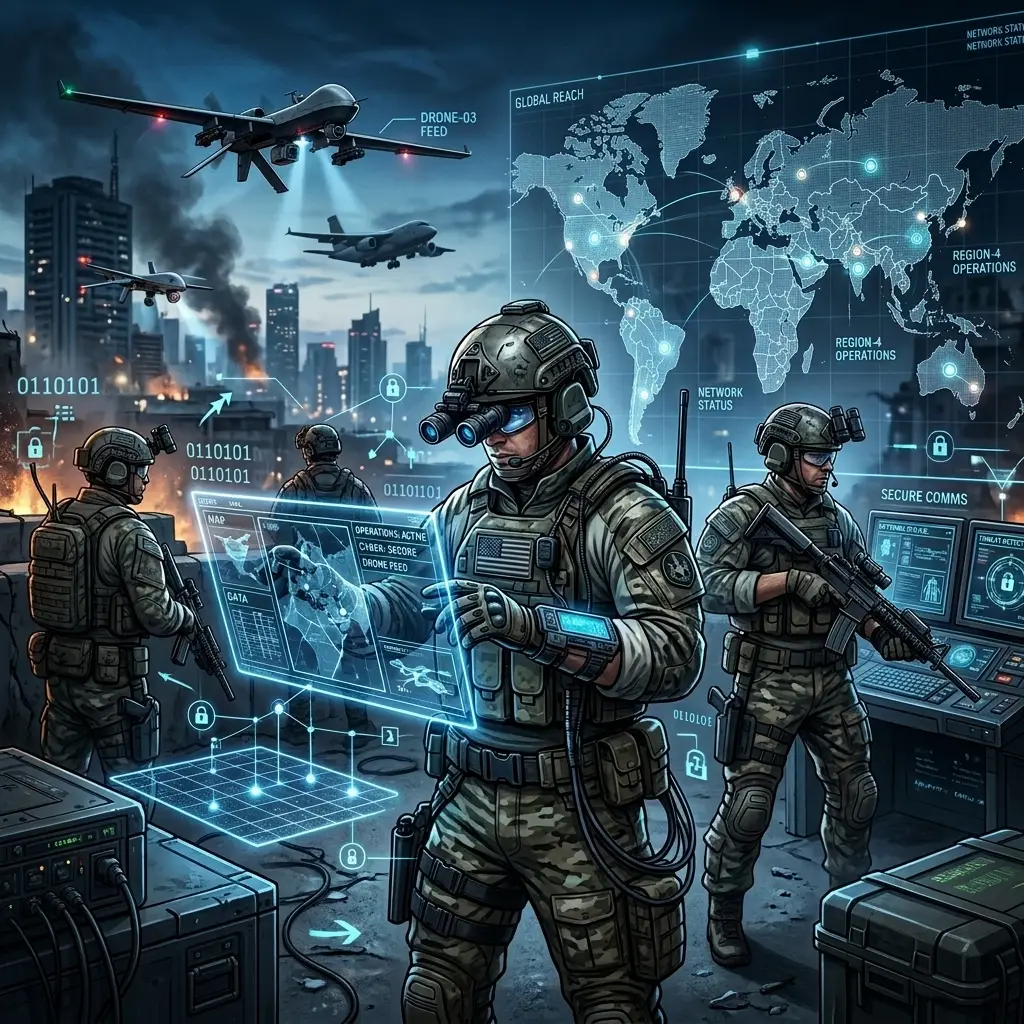
Meta Title: Modern Warfare & Hybrid Conflict: A Defense Strategy
Meta Description: Analyze modern warfare’s kinetic and digital convergence. Explore hybrid conflict, AI defense strategy, cybersecurity, and South China Sea tensions.
Executive Summary
The character of war is changing faster than most defense institutions are adapting. While the nature of war remains rooted in coercion, violence, and political purpose, the means through which power is projected, contested, and denied have expanded decisively beyond the traditional battlefield. State and non-state actors now operate across an integrated spectrum of conflict in which cyber operations, electronic warfare, space-based enablers, information manipulation, economic coercion, and precision kinetic force are employed in concert. The result is a battlespace defined less by clear declarations of war than by persistent competition below, at, and above the threshold of armed conflict.
This article argues that the convergence of kinetic and digital domains is not a supporting trend but a structural transformation in the conduct of war. Hybrid warfare has matured into a preferred strategic method for revisionist powers and agile non-state actors alike because it enables them to shape the operational environment, impose costs, fragment political will, and exploit legal and doctrinal ambiguity without necessarily provoking decisive retaliation. The South China Sea, the war in Ukraine, and repeated campaigns against critical national infrastructure collectively demonstrate that strategic advantage now depends on the ability to synchronize military, technological, informational, and political instruments of power.
Artificial Intelligence (AI) is accelerating this transformation. Its integration into intelligence fusion, predictive logistics, targeting support, cyber defense, autonomous systems, and decision-support architectures promises meaningful gains in speed, scale, and operational adaptability. Yet these same advantages introduce systemic risks: compressed decision cycles, algorithmic opacity, escalation by automation, and unresolved questions of legal accountability under international humanitarian law. The challenge for defense leaders is therefore dual: to exploit AI’s operational benefits while preventing a deterioration of strategic control and ethical restraint.
For ministries of defense, joint staffs, military academies, universities, and strategic think tanks, the central conclusion is clear: success in future conflict will depend on institutional integration. Armed forces must move beyond platform-centric modernization and toward a doctrine of cross-domain resilience, decision superiority, and whole-of-government deterrence. This requires investment not only in advanced capabilities, but also in organizational reform, professional military education, alliance interoperability, public resilience, and the legal frameworks needed to govern competition in the digital age. Adaptation is no longer optional. It is the precondition for credible deterrence and operational relevance.
Key takeaway: Future conflict will be decided less by isolated battlefield excellence than by a state’s ability to integrate military, digital, political, industrial, and legal instruments into a coherent system of deterrence and warfighting.
Introduction: The New Architecture of Conflict
The central strategic problem of modern warfare is no longer how to prevail on a defined battlefield, but how to compete and deter across a battlespace that is continuous, contested, and increasingly integrated across physical and digital domains. Traditional defense planning was built around identifiable theaters, measurable force balances, and a workable distinction between war and peace. That framework still matters, but it no longer explains how power is actually exercised or challenged in contemporary conflict. Today, states and non-state actors can impose strategic effects through cyber intrusion, information manipulation, economic pressure, space-enabled disruption, and limited kinetic force without crossing the thresholds that conventional doctrine was designed to address. This article argues that the convergence of kinetic and digital domains represents a structural shift in the conduct of war, and that defense institutions that fail to adapt their doctrine, command systems, and deterrence models to this reality will enter future crises at a decisive disadvantage.
Contemporary conflict unfolds in a far more fluid architecture. Military force remains essential, but it is increasingly embedded within broader campaigns designed to degrade an adversary’s systems before combat begins or, in many cases, to secure political objectives without large-scale combat at all. Financial networks, media ecosystems, civilian communications infrastructure, commercial satellites, supply chains, cloud architecture, and public perception have all become operationally relevant terrain. An adversary does not need to destroy a division if it can corrupt the logistics network feeding it, blind the sensors guiding it, manipulate the public debate surrounding its deployment, and sabotage the industrial base responsible for sustaining it.
This evolution has profound implications for the theory and practice of deterrence. Traditional deterrence models rested heavily on the threat of visible retaliation against conventional or strategic attack. But in the digital domain, attribution can be delayed, legal thresholds remain contested, and coercive actions are often calibrated to remain below the level that would trigger alliance consensus or military response. Strategic competition has therefore become persistent, layered, and ambiguous. The operational environment now rewards actors that can combine deniability, speed, and narrative control.
For specialized defense audiences, the key analytical point is that the distinction between preparation and execution has narrowed. Cyber reconnaissance may precede wartime attack by months or years. Influence operations may be used to soften public resistance ahead of a coercive move. Commercial technology can be militarized faster than acquisition systems can respond. This blurring of boundaries means that conflict is increasingly won or lost in the shaping phase. States that fail to recognize this risk may enter crises already degraded.
Key takeaway: The modern battlespace begins before open hostilities, extends far beyond military formations, and punishes institutions that still plan as if war, competition, and coercion can be neatly separated.
From Industrial-Era Warfare to Multi-Domain Competition
The transition from industrial-era warfare to multi-domain competition should not be understood as a simple technological upgrade. It is a transformation in strategic logic. Industrial warfare emphasized mass, attrition, and production depth. Information-age warfare introduced precision, networks, and real-time command and control. The emerging era combines both, but adds a decisive new feature: the contest for cognitive, digital, and systemic dominance.
In this environment, military effectiveness depends on more than combat power in the narrow sense. It depends on the ability to sense, process, decide, and act faster and more coherently than an adversary across multiple domains simultaneously. The side that best integrates intelligence, cyber effects, electronic attack, deception, logistics, and fires will possess a significant advantage, even if its raw force numbers are inferior.
This is why modern conflict increasingly privileges integration over accumulation. A force may possess sophisticated aircraft, precision munitions, cyber teams, and ISR assets, but if these capabilities are not fused through doctrine, training, and interoperable command architectures, their strategic effect will remain fragmented. Conversely, a more agile actor can generate disproportionate effect by attacking seams: between civil and military systems, between alliance members, between public messaging and operational reality, and between technological capability and political will.
The war in Ukraine has reinforced this lesson. The conflict has demonstrated both the enduring relevance of mass, artillery, and territorial defense, and the increasing centrality of drones, satellite communications, cyber resilience, precision strike, open-source intelligence, and digital adaptation cycles. It has shown that innovation is no longer confined to major procurement programs; it can emerge from battlefield improvisation, civilian technology ecosystems, and distributed problem-solving networks. Defense institutions that remain overly centralized, slow-moving, or doctrinally rigid will struggle in such an environment.
Key takeaway: Modern military advantage comes from integrating mass, precision, data, and adaptation faster than an adversary—not from owning advanced platforms in isolation.
The Ascendancy of Hybrid Warfare
Hybrid warfare has become one of the most consequential modes of modern strategic competition because it exploits the vulnerabilities of open societies while preserving escalation flexibility for the aggressor. It is not simply a blend of regular and irregular tactics, though that remains part of the concept. More precisely, hybrid warfare is the coordinated use of military and non-military means to achieve strategic objectives while complicating attribution, delaying response, and dividing the target’s political consensus [1].
Its power lies in ambiguity. A cyberattack on transportation networks can be framed as criminal activity. Maritime coercion can be carried out by ostensibly civilian vessels. Information campaigns can be laundered through proxies, bot networks, and sympathetic media ecosystems. Economic pressure can be justified as lawful regulation. Limited border pressure can be dismissed as an isolated incident. Taken individually, such actions may not justify major retaliation. Taken cumulatively, they can alter the balance of power.
Several operational components now define mature hybrid campaigns:
- Cyber Espionage and Sabotage: Intrusions into government systems, defense contractors, energy grids, and telecommunications networks enable adversaries to pre-position access, extract intelligence, and retain options for disruption during crisis or war.
- Information Warfare and Cognitive Operations: Narrative manipulation, disinformation, forged media, and algorithmically amplified polarization are used to erode trust in institutions, undermine alliance cohesion, and influence decision-making.
- Economic Coercion: Trade restrictions, sanctions circumvention, supply chain dependency, debt leverage, and targeted pressure on critical industries can shape political outcomes without overt military action.
- Lawfare and Normative Manipulation: Actors exploit international legal ambiguity, selective interpretations of sovereignty, and procedural delays in multilateral institutions to secure strategic space.
- Proxy Utilization: Militias, private military actors, political fronts, and ideologically aligned movements allow external powers to exert influence while preserving deniability.
- Limited Kinetic Signaling: Small-scale military acts, border pressure, or targeted strikes are used to calibrate fear and impose psychological effect without triggering full-scale response.
For defense establishments, the significance of hybrid warfare is institutional as much as operational. Most ministries are still structured around functional separation: external defense, internal security, intelligence, cyber, infrastructure protection, strategic communication, and industrial policy are often distributed across different bureaucracies with uneven coordination. Hybrid adversaries exploit these gaps. As a result, resilience must be built not only in military formations, but also in national decision-making systems.
The appropriate response is not to militarize every threat, but to establish frameworks for integrated deterrence. This includes whole-of-government planning, public-private coordination for critical infrastructure defense, allied mechanisms for rapid attribution, and doctrines that define response options across the full spectrum of coercion. Deterrence in the hybrid era depends on convincing adversaries that ambiguity will not guarantee impunity.
For institutions seeking a strong baseline on alliance thinking and integrated deterrence, key reference points include the U.S. Department of Defense and NATO, both of which increasingly frame security challenges through cross-domain resilience, persistent competition, and collective readiness.
Key takeaway: Hybrid warfare succeeds by exploiting bureaucratic seams, political hesitation, and legal ambiguity, so effective deterrence must be integrated, continuous, and coordinated across the whole state.
Cyber Power as a Strategic Instrument
Cyber power has moved from a niche technical issue to a central component of national security strategy. It is now indispensable to intelligence preparation, infrastructure defense, military operations, and statecraft. Yet much public discussion still treats cyber conflict as a separate domain rather than as a force multiplier across all domains. That view is increasingly obsolete.
Cyber operations serve at least four major strategic functions. First, they enable persistent intelligence access. Long-term penetration of government, military, industrial, and communications networks provides strategic warning, order-of-battle insights, targeting data, and crisis leverage. Second, they provide disruptive options below the threshold of war, such as ransomware-enabled coercion, network degradation, and attacks on critical services. Third, they support battlefield effects, including ISR disruption, command-and-control interference, spoofing, and denial of service during military operations. Fourth, they facilitate political coercion, especially when combined with public leaks, disinformation, or demonstrations of latent access.
Critical infrastructure is especially vulnerable in this context because modern societies are deeply dependent on interconnected digital systems. Power distribution, transportation management, water systems, health networks, ports, and financial clearing platforms are all potential targets. Defense planners must therefore abandon the assumption that homeland vulnerability begins only when missiles fly. In many cases, strategic paralysis can be induced digitally before any overt military strike.
The challenge is magnified by the growing fusion of civilian and military digital ecosystems. Defense supply chains rely on commercial software, outsourced maintenance, cloud platforms, and globally distributed vendors. This creates efficiency, but also multiplies attack surfaces. Cyber defense can no longer be treated as an IT function subordinate to routine network administration. It must be integrated into operational planning, force readiness, procurement design, and alliance coordination.
At the alliance level, the cyber domain also raises difficult questions regarding thresholds, attribution, and collective response. When does a cyberattack qualify as an armed attack? What degree of certainty is sufficient for public attribution? How should proportionality be assessed in cross-domain retaliation? These questions are not merely legal abstractions. In crisis, uncertainty over them can delay action, weaken deterrence, and embolden aggressors. Strategic clarity, even if incomplete, is preferable to ambiguity that benefits only the attacker.
For authoritative cyber policy and infrastructure-defense context, practitioners should consult the Cybersecurity and Infrastructure Security Agency (CISA), the European Union Agency for Cybersecurity (ENISA), and NATO’s cyber defense resources. These institutions provide high-value reference material that strengthens both analytical rigor and search visibility.
Key takeaway: Cyber power is now a strategic instrument of intelligence, coercion, and warfighting, which means critical infrastructure defense and operational cyber integration can no longer be treated as secondary support functions.
Geopolitical Tensions: The South China Sea as a Laboratory of Gray-Zone Conflict
The South China Sea is one of the clearest illustrations of how modern coercion operates in the space between peace and war. It is not merely a maritime dispute; it is a long-term strategic contest involving sovereignty claims, sea control, trade security, military basing, legal interpretation, and regional order. More importantly, it is a theater in which gray-zone tactics are used systematically to alter facts on the ground—or, more accurately, at sea—without crossing the threshold into major war [2].
The principal mechanisms are well known: maritime militias, coast guard pressure, artificial island construction, administrative decrees, selective law enforcement, and calibrated naval signaling. But these visible instruments are only part of the picture. Beneath them lies an increasingly sophisticated web of surveillance, cyber-enabled monitoring, satellite support, electronic mapping, and information shaping. Strategic advantage in the South China Sea is not secured solely by hulls in the water. It is reinforced by the ability to track movements, dominate narratives, pressure weaker claimants, and exploit hesitation among external powers.
This is why the region should be understood as a live model of integrated coercion. The actor able to synchronize legal argument, maritime presence, digital surveillance, and political messaging gains cumulative leverage. Each individual move may appear minor; the aggregate effect is strategic normalization. Over time, this can erode rival claims, complicate freedom of navigation, and alter deterrence expectations.
For external powers and regional defense planners, three lessons stand out. First, gray-zone competition rewards persistence more than dramatic escalation. Second, maritime security is inseparable from digital awareness and information dominance. Third, deterrence must be continuous rather than episodic. Occasional naval patrols alone cannot counter a strategy designed to generate incremental advantage every day.
The implications extend beyond the Indo-Pacific. Similar patterns are visible in the Baltic, the Eastern Mediterranean, the Arctic, and parts of Africa and the Middle East where external powers combine infrastructure investment, information manipulation, cyber access, and selective security partnerships. The South China Sea is therefore not an outlier. It is a preview.
For ongoing tracking of geopolitical flashpoints and strategic trendlines, the Council on Foreign Relations Global Conflict Tracker and the International Institute for Strategic Studies (IISS) offer valuable supplementary context for readers in defense institutions, ministries, universities, and think tanks.
Key takeaway: The South China Sea shows that gray-zone conflict is cumulative, not episodic, and that lasting deterrence requires persistent presence, legal clarity, digital awareness, and political resolve.
The Return of Attrition and the Persistence of Mass
If one error in recent strategic commentary has been to underestimate the digital transformation of warfare, another has been to overstate the obsolescence of conventional mass. Recent conflicts have shown that while precision, AI, and cyber capabilities are critical, they do not eliminate the enduring importance of manpower, munitions stockpiles, industrial depth, and territorial control. In fact, the digital and kinetic domains are converging in ways that make logistical endurance even more important.
Precision strike is valuable only when supported by resilient ISR and sustainable supply chains. Drones are effective only if they can be produced, adapted, and replaced at scale. Cyber defenses matter only if command systems can continue operating under pressure. Space-based connectivity matters only if forces are trained to fight through degradation. The romantic notion that future wars will be won by exquisite systems alone has been disproven.
This matters because many advanced militaries have optimized for short, high-intensity campaigns while underinvesting in industrial resilience, ammunition production, and mobilization planning. A credible defense posture in the current era requires both technological sophistication and the capacity to absorb shocks over time. Defense ministries should therefore revisit assumptions regarding stockpile sufficiency, reserve structures, repair capacity, dispersed basing, and civil-military mobilization.
The synthesis is straightforward but demanding: future warfare will not be purely digital, nor purely kinetic. It will be technologically accelerated attrition, shaped by data but decided through endurance, adaptation, and institutional coherence.
Key takeaway: Advanced technology changes how attrition is managed, but it does not remove the need for stockpiles, industrial capacity, mobilization, and the ability to endure a long fight.
The Impact of Artificial Intelligence on Military Strategy and Ethics
Artificial Intelligence is poised to become one of the most consequential military-enabling technologies of the century. Its promise lies not in replacing strategy, but in increasing the speed and quality of military functions that already determine operational effectiveness: detection, classification, prioritization, routing, prediction, maintenance, logistics optimization, and decision support.
In intelligence, AI can process vast quantities of ISR data far beyond human analytic capacity, assisting in anomaly detection, geospatial interpretation, and pattern recognition. In logistics, it can improve predictive maintenance, optimize routing under contested conditions, and identify likely supply disruptions. In cyber defense, it can enhance threat detection and automate elements of response. On the battlefield, AI-enabled systems may support target recognition, autonomous navigation, swarm coordination, and adaptive mission planning.
For militaries operating under time pressure and information overload, these advantages are not marginal. They can be decisive. The side that processes relevant information faster and translates it into action more effectively will enjoy superior tempo. This is especially important in environments saturated with sensors, decoys, electronic interference, and distributed unmanned systems.
Yet the strategic promise of AI is inseparable from serious risk. The first risk is opacity. Complex models can generate outputs that are difficult to interpret, especially under operational stress. If commanders do not understand how recommendations are produced, trust may become either excessive or insufficient. The second risk is bias and data fragility. AI systems trained on incomplete, manipulated, or context-specific data may fail catastrophically when exposed to novel battlefield conditions. The third risk is escalation compression. If machine-assisted systems accelerate response cycles too far, political and military leaders may lose the time needed for judgment, deconfliction, and restraint.
These concerns become especially acute in the debate over Lethal Autonomous Weapons Systems (LAWS). The core issue is not merely whether machines can select and engage targets. It is whether meaningful human control can be preserved over the use of force in environments where speed, autonomy, and complexity are pushing command structures toward automation [3].
Several unresolved questions remain central:
- Accountability: Who is legally and morally responsible when an autonomous system commits an unlawful act—the commander, programmer, manufacturer, operator, or state?
- Distinction and Proportionality: Can autonomous systems reliably satisfy the principles of international humanitarian law in complex civilian environments?
- Escalation Control: Could interacting autonomous systems generate unanticipated cycles of action and reaction beyond intended political limits?
- Adversarial Manipulation: How vulnerable are AI-enabled systems to spoofing, deception, data poisoning, or model corruption?
- Strategic Stability: If states fear falling behind in military AI, will competitive pressure reduce safeguards and accelerate unsafe deployment?These are not arguments against military AI. They are arguments for rigorous governance, testing, and doctrinal discipline. Militaries that fail to adopt AI intelligently will lose operational advantage. Militaries that adopt it recklessly may lose control of escalation and legitimacy alike.For broader strategic analysis, the Center for Strategic and International Studies (CSIS) and the Center for a New American Security (CNAS) provide sustained research on AI, force design, and defense innovation.Key takeaway: AI can deliver major operational advantage, but without testing, oversight, and meaningful human control, it can also increase error, erode accountability, and destabilize escalation management.
Command, Control, and Decision Superiority
At the heart of the convergence between kinetic and digital warfare lies the contest for decision superiority. This concept should not be reduced to speed alone. Faster decisions are valuable only if they are informed, coherent, lawful, and strategically aligned. The real objective is to compress the time required to move from sensing to action while preserving command intent and political control.
This places extraordinary pressure on command-and-control systems. Modern C2 architectures must function in environments marked by jamming, cyber intrusion, satellite disruption, misinformation, and degraded communications. They must support decentralized execution without strategic fragmentation. They must integrate inputs from manned and unmanned platforms, national and allied networks, and military and civilian data streams. This is not merely a technical challenge; it is a doctrinal and organizational one.
Many armed forces remain vulnerable because their C2 structures were built for more permissive information environments. Centralized decision-making may be too slow under contested conditions. Excessive reliance on reach-back connectivity can become a liability if networks are degraded. Conversely, over-decentralization can create inconsistency, duplication, or uncontrolled escalation. The emerging requirement is mission command enabled by resilient digital architecture and disciplined interoperability.
Decision superiority also has a human dimension. Commanders must be educated not only in tactics and operational art, but in data literacy, cyber awareness, AI limitations, and the strategic effects of information operations. Professional military education has to evolve accordingly. A future senior leader will not need to code, but will need to understand how algorithmic systems shape operational judgment.
This is one reason defense organizations are paying closer attention to joint and all-domain approaches. Debates around JADC2, multi-domain operations, and digitally enabled command architectures should be viewed not as passing concepts, but as responses to a real shift in the operating environment.
Key takeaway: Decision superiority depends on resilient command systems, disciplined decentralization, and leaders who can operate effectively when data is contested, incomplete, or manipulated.
Space, Electromagnetic Spectrum, and the Expanding Battlespace
No serious analysis of modern warfare is complete without recognizing the growing importance of space and the electromagnetic spectrum. Satellite-enabled communications, positioning, navigation, timing, missile warning, weather observation, and ISR are foundational to modern military operations. Their disruption would have immediate consequences across land, sea, air, and cyber domains.
Similarly, the electromagnetic spectrum is now a central arena of contestation. Electronic warfare—jamming, spoofing, signal interception, emitter detection, and spectrum denial—can blind sensors, sever communications, misdirect precision systems, and generate operational confusion at critical moments. In a highly networked force, spectrum dominance can be nearly as consequential as air superiority.
The strategic implication is clear: the convergence of kinetic and digital domains is actually part of a broader fusion that includes cyber, space, and electromagnetic operations. Defense planning must therefore be truly multi-domain, not rhetorically but structurally. That means integrated training, acquisition programs built for interoperability, and war-gaming that reflects degraded conditions rather than idealized connectivity.
Key takeaway: Space and spectrum are no longer enabling backdrops to war; they are contested operational arenas that can determine whether forces can sense, communicate, navigate, and strike at all.
Strategic Recommendations and Next Steps
The transition from conventional conflict to persistent, multi-domain competition requires more than incremental modernization. It demands institutional redesign. To preserve deterrence, warfighting credibility, and strategic autonomy, defense institutions should prioritize the following lines of effort:
- Integrate Cyber, Electronic, Space, and Kinetic Planning. Operational planning should assume that future conflict will involve simultaneous pressure across all major domains. War-gaming, exercises, and campaign design must reflect this reality.
- Build Resilient Command Architectures. Invest in distributed, redundant, and secure C2 systems capable of functioning under conditions of cyber disruption, signal degradation, and partial information denial.
- Treat Critical Infrastructure as a Defense Issue. Energy grids, ports, telecommunications, cloud environments, transportation systems, and industrial supply chains must be incorporated into national defense planning through public-private coordination mechanisms.
- Institutionalize AI Governance in Defense. Establish rigorous testing, auditing, human oversight, red-teaming, and legal review procedures for AI-enabled systems before operational deployment.
- Rebuild Industrial and Logistical Depth. Precision capabilities and digital tools do not remove the need for ammunition, maintenance, spare parts, reserve mobilization, and scalable production. Industrial resilience is a strategic capability.
- Strengthen Alliance Interoperability. Shared standards for cyber defense, data exchange, attribution mechanisms, AI governance, and gray-zone response are essential for coalition effectiveness.
- Enhance Professional Military Education. Officers and civilian defense leaders should be trained in the operational and strategic implications of cyber conflict, AI, information operations, and cross-domain deterrence.
- Develop Response Frameworks for Hybrid Aggression. States should define playbooks for attribution, legal characterization, public communication, and calibrated response to gray-zone coercion.
- Invest in Societal Resilience. Public trust, media literacy, continuity planning, and civil preparedness are not peripheral concerns. They are core determinants of national endurance under hybrid attack.
- Clarify Strategic Signaling. Ambiguity can be useful operationally, but excessive ambiguity in policy can weaken deterrence. Adversaries should understand that persistent coercion across non-kinetic domains will generate cumulative consequences.
The essential strategic task is to align doctrine, procurement, governance, and political leadership around a unified conception of conflict. States that continue to organize their defense institutions around outdated separations—war versus peace, military versus civilian infrastructure, physical versus digital attack—will remain vulnerable to actors that do not respect those boundaries.
For defense ministries, universities, research institutions, and allied strategic communities, the next phase should focus on applied doctrine and implementation. The priority is no longer simply to understand the convergence of kinetic and digital warfare; it is to operationalize that understanding into force design, strategic planning, alliance mechanisms, and legal norms. The future battlespace is already here. The question is whether our institutions are prepared to meet it with equal coherence.
Key takeaway: The strategic requirement is implementation, not awareness—states must translate multi-domain theory into doctrine, institutions, infrastructure protection, alliance practice, and credible deterrent posture.
References and Footnotes
[1] Hoffman, F. G. (2007). Conflict in the 21st Century: The Rise of Hybrid Wars. Potomac Institute for Policy Studies. Hoffman’s framework remains foundational in identifying the fusion of conventional, irregular, and non-military tools within hybrid conflict.
[1a] Royal United Services Institute (RUSI). Military Sciences and Defense Studies Research. RUSI adds strong institutional support for analysis of force development, strategic competition, and contemporary defense policy.
[1b] National Defense University. Institute for National Strategic Studies. NDU strengthens the bibliography with senior-level military education and strategic research on joint operations, national defense, and international security.
[1c] NATO Defense College. Academic Programs and Research Division. This institution contributes alliance-centered military education and strategic analysis relevant to deterrence, hybrid threats, and transatlantic security.
[1d] German Institute for Defence and Strategic Studies. GIDS Research. GIDS provides European military-academic insight into strategic adaptation, operational concepts, and defense policy.
[1e] Australian War College. Professional Military Education. The Australian War College expands the bibliography’s Indo-Pacific and allied defense education perspective on joint operations and strategic competition.
[1f] Swedish Defence University. Research and Education in War Studies and Security. This defense university adds academic depth on military studies, security policy, and modern operational environments.
[1g] École de Guerre. French Joint War College. France’s senior military education institution strengthens the bibliography with perspectives on joint doctrine, operational art, and European defense strategy.
[2] U.S. Naval War College. China Maritime Studies Institute. This military-academic source strengthens the references list with institutionally grounded analysis of gray-zone coercion, maritime competition, and strategic dynamics in the South China Sea and wider Indo-Pacific.
[3] National Defense University. Institute for National Strategic Studies. This military education and research institution adds authoritative context on joint strategy, defense planning, great-power competition, and the evolving character of modern warfare.
[4] U.S. Department of Defense. (2022). 2022 National Defense Strategy of the United States of America. This strategy underscores integrated deterrence, campaigning, and the need to address threats across interconnected domains, and it provides a foundational policy reference for professional military education institutions examining multi-domain operations and strategic competition.
[5] NATO Defense College. Academic Programs and Research Division. This military education institution highlights alliance resilience, strategic adaptation, cyber defense, and the operational implications of persistent competition.
[6] U.S. Air Force Academy. Institute for Future Conflict. This military-academic institution strengthens the references list with research on emerging warfare, strategic competition, artificial intelligence, and the future operating environment.
[7] Air University. China Aerospace Studies Institute. Air University, as the U.S. Air Force and U.S. Space Force’s professional military education institution, strengthens the references list with military-academic analysis of aerospace power, space strategy, doctrine, and strategic competition across emerging domains.
[8] U.S. Army War College. Strategic Studies Institute. As a leading U.S. professional military education institution, the Army War College strengthens the references list with research on landpower, strategic competition, deterrence, defense policy, and the doctrinal adaptation required for integrated, data-enabled warfare.
[9] NATO Cooperative Cyber Defence Centre of Excellence (CCDCOE). Publications and Cyber Defence Research. As a NATO-affiliated military education and research institution, CCDCOE strengthens the references list with authoritative analysis on cyber operations, strategic competition, deterrence, and the operational defense of digital infrastructure.
[10] U.S. Marine Corps University. Brute Krulak Center for Innovation and Future Warfare. This professional military education institution strengthens the references list with research on future warfare, strategic adaptation, force innovation, and the operational challenges of contested multi-domain environments.
[11] U.S. Naval Academy. Stockdale Center for Ethical Leadership. This military education institution strengthens the references list with relevant work on ethics, leadership, civil-military decision-making, and the strategic challenges posed by emerging forms of conflict.
[12] National Defense University. College of Information and Cyberspace. As a U.S. professional military education institution, NDU’s College of Information and Cyberspace strengthens the references list with military-academic expertise on cyber strategy, information operations, digital competition, and national defense in contested multi-domain environments.
[13] King’s College London, Department of War Studies. Department of War Studies. This leading academic department strengthens the references list with internationally recognized expertise in war studies, military history, defense policy, strategic theory, and contemporary conflict analysis, making it a valuable complement to the article’s military education and strategic research sources.
[14] National Defence University Pakistan. National Institute of Public Policy and School of Politics and International Relations. This military education institution broadens the references list with South Asian strategic studies, national security analysis, defense policy, and civil-military perspectives relevant to hybrid conflict and modern warfare.
[15] Johns Hopkins School of Advanced International Studies. Strategic Thought and the Kissinger Center for Global Affairs. This university-based international affairs institution strengthens the references list with research on geopolitical strategy, great-power competition, diplomacy, and national security, complementing the article’s military academies and professional military education sources.
[16] Royal Military Academy Sandhurst. Research and Military Education. Sandhurst strengthens the references list with a leading military education institution focused on leadership, land warfare, strategic studies, and officer development relevant to modern conflict and defense adaptation.
[17] Naval Postgraduate School. Center for Homeland Defense and Security. As a U.S. military graduate education institution, the Naval Postgraduate School strengthens the references list with applied research on homeland security, resilience, strategic planning, emerging threats, and the integration of civilian and defense institutions in complex conflict environments.
[18] Naval Postgraduate School. Department of National Security Affairs. As a leading U.S. military graduate education institution, the Naval Postgraduate School strengthens the references list with advanced research and instruction on strategy, defense planning, irregular warfare, regional security, and the operational challenges of modern conflict.
Q&A: Key Questions on Modern Warfare, Hybrid Conflict, and Strategic Competition
1. What is the most important strategic shift in modern warfare?
The most important shift is the move from battlefield-centric war to continuous competition across military, cyber, informational, economic, legal, and political domains. States now compete through persistent shaping operations that begin long before open conflict and often continue without formal declarations of war.
2. What is hybrid warfare?
Hybrid warfare is the coordinated use of military and non-military tools to achieve strategic goals while complicating attribution and delaying response. It often includes cyberattacks, disinformation, economic coercion, proxy forces, legal manipulation, and limited military signaling.
3. Why is hybrid conflict so effective against open societies?
Hybrid conflict is effective because it exploits institutional seams, legal ambiguity, public debate, infrastructure dependence, and political hesitation. Aggressors can apply pressure in ways that remain below the threshold of conventional war while still imposing real strategic costs.
4. How does cyber power function as a strategic instrument?
Cyber power enables espionage, disruption, coercion, and battlefield support. It can give states access to critical networks, degrade infrastructure, collect intelligence, interfere with command systems, and create leverage without immediate kinetic escalation.
5. Why is critical infrastructure now central to national defense?
Energy grids, ports, telecommunications systems, transportation networks, cloud platforms, and financial systems are all essential to military readiness and national resilience. If these systems are disrupted, a state can suffer operational paralysis before conventional combat even begins.
6. What role does artificial intelligence play in modern warfare?
AI increasingly supports intelligence analysis, predictive maintenance, logistics, cyber defense, targeting support, and decision support. Its main value lies in helping militaries process data faster, identify patterns more effectively, and improve operational tempo.
7. What are the main risks of using AI in military operations?
The key risks include algorithmic opacity, biased or corrupted data, overreliance on automated recommendations, escalation caused by compressed decision cycles, and unresolved questions about accountability when AI-enabled systems fail or produce unlawful outcomes.
8. Why does meaningful human control remain important in AI-enabled warfare?
Meaningful human control helps preserve legal accountability, ethical judgment, escalation management, and political oversight. Even highly capable AI systems should support human decision-making rather than replace responsibility for the use of force.
9. What does decision superiority mean in contemporary conflict?
Decision superiority is the ability to sense, understand, decide, and act more effectively than an adversary while maintaining strategic coherence and lawful control. It is not just about speed, but about making better decisions under contested and uncertain conditions.
10. Why does the South China Sea matter in discussions of modern warfare?
The South China Sea is a live example of gray-zone competition in practice. It shows how maritime pressure, legal claims, surveillance, information shaping, and persistent presence can gradually change strategic realities without triggering full-scale war.
11. What is gray-zone conflict?
Gray-zone conflict refers to coercive activity that remains below the threshold of conventional war but is still designed to alter political or strategic outcomes. It often relies on ambiguity, deniability, and cumulative pressure rather than decisive military confrontation.
12. How should states deter gray-zone aggression without triggering unnecessary escalation?
States should build integrated deterrence through resilient cyber defenses, rapid attribution, clear response frameworks, alliance coordination, public communication, and credible military capability. The goal is to convince adversaries that ambiguous coercion will still generate meaningful consequences.
13. Why are alliances so important in hybrid and cyber conflict?
Alliances improve deterrence by sharing intelligence, aligning thresholds, coordinating responses, improving interoperability, and strengthening political resolve. In ambiguous conflict, collective clarity and coordination can reduce the advantages aggressors gain from deniability.
14. Has modern technology made mass and attrition obsolete?
No. Recent wars show that advanced technology changes how attrition is managed, but it does not eliminate the need for manpower, stockpiles, industrial depth, repair capacity, and logistical endurance. Precision and digital capability still depend on sustained material support.
15. Why are drones and autonomous systems so influential in current conflicts?
They expand surveillance, targeting, strike options, and adaptation at relatively low cost. They also accelerate tactical learning cycles and increase pressure on traditional force structures, especially when combined with digital networks and electronic warfare.
16. How does information warfare influence military outcomes?
Information warfare shapes perception, trust, legitimacy, and political will. By manipulating narratives, spreading disinformation, and amplifying social division, adversaries can weaken cohesion and reduce the effectiveness of military and political decision-making.
17. What is the relationship between cyber operations and kinetic warfare?
Cyber operations increasingly support kinetic warfare by degrading sensors, disrupting communications, interfering with logistics, and shaping the operational environment before strikes occur. In many cases, cyber effects are used to prepare or amplify conventional military action.
18. Why is command-and-control resilience so important now?
Modern forces rely heavily on data, networks, and communications. If command systems are disrupted by cyberattacks, jamming, spoofing, or satellite interference, even advanced militaries can lose coordination, tempo, and strategic control.
19. How are space and the electromagnetic spectrum part of the modern battlespace?
Space systems provide communications, navigation, timing, missile warning, and intelligence support, while the electromagnetic spectrum underpins sensing and connectivity. Their disruption can severely reduce military effectiveness across every other domain.
20. What should defense institutions prioritize to prepare for future conflict?
They should prioritize cross-domain integration, resilient command systems, critical infrastructure defense, AI governance, industrial capacity, alliance interoperability, professional military education, and clear response frameworks for hybrid aggression. Preparation now depends on institutional adaptation as much as technological modernization.
#ModernWarfare, #HybridConflict, #TacticalOperations, #CyberWarfare, #AdvancedTechnology, #GlobalConnectivity, #DefenseStrategy, #MilitaryInnovation, #UrbanConflict, #HolographicInterfaces, #DroneSurveillance, #EthicalAI, #StrategicAdaptation, #MilitaryEducation, #DefenseInnovation, #AdvancedCombatGear, #GlobalOperations, #TacticalSuperiority, #UrbanWarfare, #AutonomousWeapons, #DigitalInterfaces, #SurveillanceTechnology, #NetworkConnectivity, #StrategicResilience, #ModernDefenseSystems, #AIinWarfare, #CybersecurityMeasures, #DefenseTechnology, #MilitaryTactics, #GlobalDefenseNetworks, #AdvancedSurveillanceSystems, #TacticalCommandCenters, #UrbanCombatScenarios, #EthicalMilitaryPractices, #AIDrivenDefenseStrategies, #IntegratedMilitaryOperations, #FutureWarfareTechnologies, #DefenseModernization, #HybridWarfareTactics, #StrategicMilitaryPlanning, #AdvancedTacticalEquipment, #GlobalMilitaryCoordination, #DefenseReadiness, #TechnologicalSuperiorityInWarfare
Discover more from Responsible Public Affairs
Subscribe to get the latest posts sent to your email.