

SEO Title: Samuel Huntington vs. Francis Fukuyama: Ukraine-Russia War, U.S.-Iran Tensions, and Modern Geopolitical Conflicts
SEO Meta Description: Compare Samuel Huntington vs. Francis Fukuyama through the Ukraine-Russia war, U.S.-Iran tensions, China-Taiwan, the Balkans, and the Arab Spring to see how identity, liberal democracy, religion, and power shape modern geopolitical conflict.
Samuel Huntington vs. Francis Fukuyama: Ukraine-Russia War, U.S.-Iran Tensions, and Modern Geopolitical Conflicts
Explore Samuel Huntington vs. Francis Fukuyama through a clear comparison of global political theories applied to the Ukraine-Russia war analysis, U.S.-Iran tensions, and other modern geopolitical conflicts. This article explains how Huntington’s Clash of Civilizations and Fukuyama’s End of History help interpret the roles of identity, liberal democracy, religion, and geopolitical power in today’s conflicts.
Introduction
The post-Cold War order did not create the simple, unified world many expected. Instead, it produced a more complex global landscape shaped by identity, ideology, power, religion, borders, and competing ideas of political legitimacy. Today’s geopolitical climate has made that complexity even more visible, as major-power rivalry has intensified, regional wars have expanded, democratic systems face renewed pressure, and states are increasingly using history, culture, and sovereignty to justify conflict and competition. Few debates explain these modern geopolitical conflicts better than Samuel Huntington vs. Francis Fukuyama, whose rival theories still shape how scholars and analysts interpret conflict, democracy, and global order today.
Huntington’s Clash of Civilizations argues that future conflicts would be driven by civilizational identity, culture, and religion. Fukuyama’s End of History argues that liberal democracy became the most compelling model of government after the collapse of communism.
This article uses both frameworks to examine Samuel Huntington vs. Francis Fukuyama across modern geopolitical conflicts:
- The Ukraine-Russia war analysis through civilizational and democratic lenses
- The U.S.-Iran rivalry as a clash of political systems and regional influence
- Additional case studies, including China-Taiwan tensions, the Balkans, and the Arab Spring
- The strengths and limits of both global political theories
- Why these theories still matter for understanding modern geopolitical conflicts
Executive Summary: Samuel Huntington vs. Francis Fukuyama in Modern Geopolitical Conflicts
The debate between Samuel Huntington and Francis Fukuyama remains central to the study of global political theories and modern geopolitical conflicts. Huntington argued that future conflict would emerge from cultural, religious, and civilizational identity divides. Fukuyama argued that liberal democracy represented the strongest endpoint of ideological development and the most legitimate long-term political model.
The Ukraine-Russia war brings both theories into sharp focus. Ukraine, centered politically in Kyiv and geographically positioned between Europe and Russia, has increasingly moved toward Western institutions such as the European Union and NATO. That shift became especially visible after the 2013–2014 Euromaidan protests, Russia’s 2014 annexation of Crimea, and the full-scale invasion launched in February 2022. Since then, the war has produced major concrete developments, including prolonged fighting in the Donbas, repeated Russian missile and drone strikes on Ukrainian cities and energy infrastructure, and expanding Western military and financial support to Kyiv. Ukraine’s EU candidate status in 2022 and continuing cooperation with NATO further underline its westward political direction. Russia, led from Moscow, views Ukraine as part of its historical, cultural, and strategic sphere. This makes the war both a territorial conflict and a struggle over identity, sovereignty, and political direction.
The U.S.-Iran conflict also reveals the tension between Western liberal democracy and Islamic theocracy. The United States, with Washington, D.C. as its political center, promotes a system based on elections, constitutional rights, and secular institutions. Iran, governed from Tehran, maintains a revolutionary Islamic political model that rejects Western dominance and asserts influence across the Persian Gulf and wider Middle East. Recent developments make this rivalry especially concrete: the U.S. withdrawal from the Joint Comprehensive Plan of Action (JCPOA) in 2018, Iran’s subsequent expansion of uranium enrichment, the 2020 killing of Qassem Soleimani, repeated tensions involving Iran-backed militias in Iraq and Syria, attacks and seizures linked to shipping in and around the Strait of Hormuz, and continued sanctions pressure have kept the relationship volatile. Together, these examples show that U.S.-Iran tensions are not only ideological. They are also driven by nuclear policy, regional proxy networks, energy security, and military deterrence.
Other cases deepen the comparison. China-Taiwan tensions raise questions about sovereignty, historical continuity, national identity, and the future of democracy in East Asia. The Balkan wars show how religion, ethnicity, and historical memory can fuel fragmentation and violence. The Arab Spring highlights the appeal of dignity, representation, and political participation, even where democratic transitions remain unstable.
Huntington helps explain the role of civilizational identity. Fukuyama helps explain the continuing appeal and resistance to liberal democracy. Yet neither theory fully explains the economic, military, regional, and strategic forces behind these conflicts.
Samuel Huntington vs. Francis Fukuyama: Comparing Two Global Political Theories
The contrast between Huntington and Fukuyama is more than an academic debate. It is a useful lens for understanding why states fight, why alliances form, and why political systems compete for legitimacy.
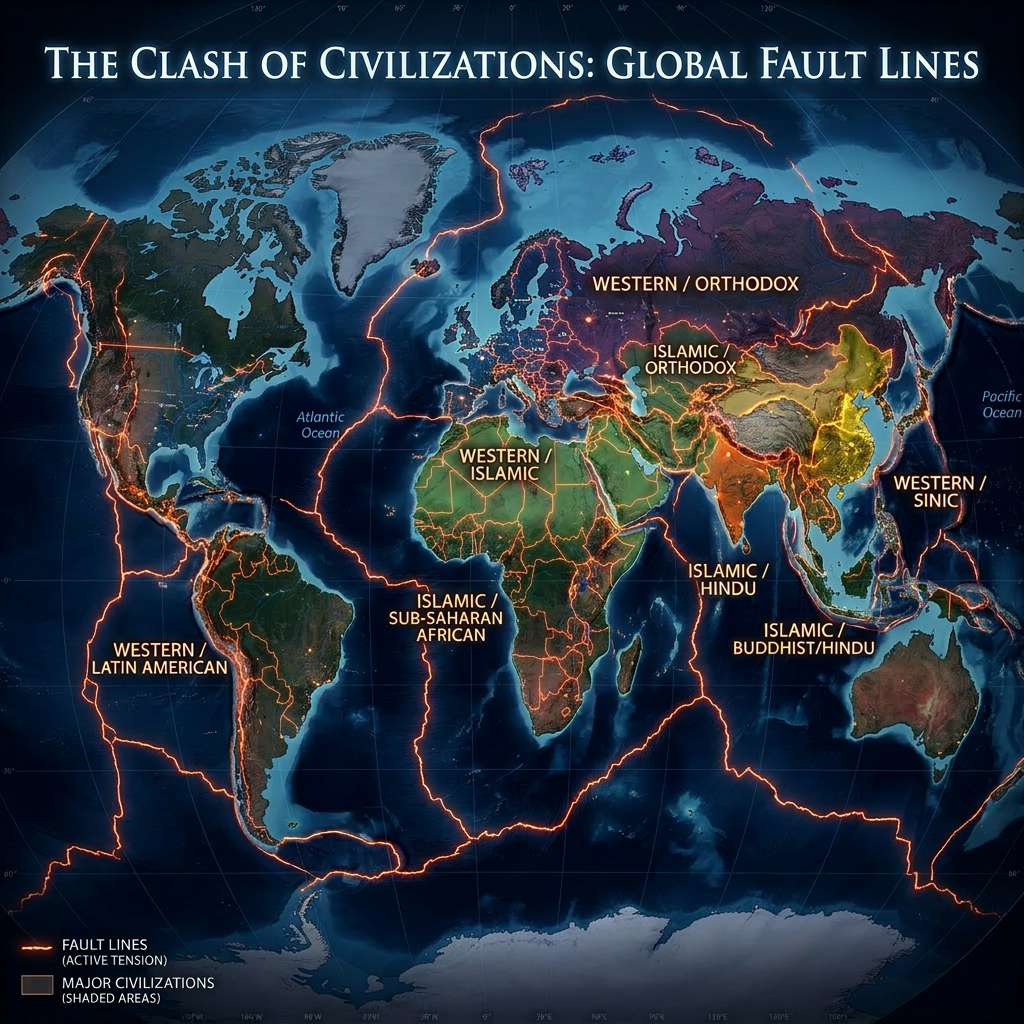
Huntington’s Clash of Civilizations
Samuel Huntington argued that the major conflicts after the Cold War would not be mainly ideological or economic. Instead, they would emerge from cultural and civilizational fault lines.
In this view, people often organize their political loyalties around religion, language, shared history, and cultural memory. These identities can outlast governments and even borders.
Key ideas in Huntington’s thesis include:
- Civilizations are major sources of political identity
- Western influence can provoke resistance from non-Western societies
- Modernization does not always lead to Westernization
- Conflicts often intensify where civilizations overlap
Encyclopaedia Britannica: “The Clash of Civilizations?” overview and related background on Huntington’s thesis### Fukuyama’s End of History
Francis Fukuyama offered a different vision. He argued that after the collapse of the Soviet Union, liberal democracy became the most successful and legitimate form of government.
Fukuyama did not claim that wars would end. Rather, he argued that liberal democracy had defeated its major ideological rivals at the level of political ideas. In his view, authoritarianism, fascism, and communism had failed to offer a better long-term model.
Key ideas in Fukuyama’s thesis include: - Liberal democracy has strong global appeal
- People seek recognition, rights, and political participation
- Authoritarian systems may survive but lack lasting legitimacy
- History continues through events, but not necessarily through new dominant ideologies
Foreign Affairs: “The End of History?” by Francis Fukuyama## Ukraine-Russia War Analysis Through Huntington’s Clash of Civilizations Theory
A serious Ukraine-Russia war analysis must go beyond battlefield maps. The war is about territory, security, history, national identity, and Ukraine’s right to choose its future.
From Huntington’s perspective, the conflict reflects a civilizational fault line between a Western-leaning Ukraine and a Russia that claims leadership over a distinct Orthodox and Slavic civilizational space.
Ukraine’s Geographic and Political Position
Ukraine sits at a critical crossroads between Central Europe, Eastern Europe, and the Black Sea region. Kyiv has increasingly pursued closer ties with Brussels, Washington, and NATO capitals through concrete steps such as the EU-Ukraine Association Agreement, deeper military cooperation with NATO, and its formal EU candidate status granted in 2022. Public support for joining Western institutions also grew sharply after Russia’s 2014 annexation of Crimea and especially after the full-scale invasion in February 2022, as the war pushed Ukraine further toward the European political and security order. This shift reflects a broader desire among many Ukrainians to join a European political and economic order.
The 2013–2014 Euromaidan protests in Kyiv were a turning point. They showed that many Ukrainians wanted democratic reforms, less corruption, and closer integration with Europe.
For Huntington, this matters because Ukraine is not just choosing foreign policy partners. It is also redefining its civilizational orientation.
Russia’s View from Moscow
Russia views Ukraine through a very different lens. Moscow has long considered Ukraine central to Russian history, security, and identity. Russian leaders have often framed Ukraine’s Western alignment as a threat to Russia’s cultural and geopolitical space. That view has been expressed in concrete ways, including Vladimir Putin’s repeated claims that Russians and Ukrainians are “one people,” the Kremlin’s denunciation of NATO expansion toward Russia’s borders, and Russia’s use of the 2014 annexation of Crimea and its recognition claims over occupied Ukrainian territories to argue that Ukraine falls within a vital Russian sphere of influence. Since the full-scale invasion in 2022, Moscow has also tied the war to preventing what it portrays as Western military encirclement and the permanent loss of influence in a country it sees as strategically essential.
This is where civilizational identity becomes politically powerful. Russia’s claims are not only strategic. They are also historical and cultural.
Examples include:
- Crimea: Russia annexed Crimea in 2014, citing historical ties and the protection of Russian-speaking communities
- Donbas: The eastern Ukrainian regions of Donetsk and Luhansk became centers of separatist conflict, shaped by language, identity, and Russian influence
- Black Sea security: Crimea’s location gives Russia strategic access to the Black Sea and the Mediterranean
U.S. Institute of Peace: Russia’s War in Ukraine—Identity, History, and Conflict### Why Huntington’s Theory Fits the Ukraine-Russia War
Huntington’s theory helps explain why the conflict carries such emotional and symbolic weight. The war is not only about land. It is also about whether Ukraine belongs to a Western political order or remains within Russia’s claimed civilizational sphere. That claim has been reinforced by direct examples since 2014 and especially since 2022: Russia justified the annexation of Crimea in part through historical and cultural arguments about Russian identity, promoted the idea of protecting Russian speakers in eastern Ukraine, and framed the full-scale invasion as a response to Ukraine’s deepening ties with Europe and NATO. Ukraine, meanwhile, has moved further toward the West through its EU candidate status, continued cooperation with NATO, and strong public resistance to Russian rule. These developments make the conflict a clear example of how civilizational identity, historical memory, and competing political alignments can intensify war beyond immediate battlefield goals.
This explains why compromise is so difficult. When conflicts become tied to identity, history, and national destiny, they become harder to resolve through simple diplomacy.
Ukraine-Russia War Analysis Through Fukuyama’s Liberal Democracy Theory
Fukuyama’s framework tells a different but equally important story. From this perspective, Ukraine is fighting not only for territory but also for liberal democracy, sovereignty, and the right to choose its political future.
Ukraine as a Democratic Test Case
Ukraine’s post-2014 political path has been uneven, but its direction has been clear. The country has sought closer ties with the European Union, strengthened national institutions, and resisted Russian domination through concrete steps such as signing and implementing the EU-Ukraine Association Agreement, pursuing anti-corruption reforms, maintaining competitive national elections, and securing EU candidate status in 2022. Even after Russia’s full-scale invasion in February 2022, Ukraine preserved core elements of democratic governance, including active civil society networks, public scrutiny of government performance, and continued engagement with European institutions. These developments make Ukraine a direct example of a state that continues to link sovereignty, reform, and wartime resistance to a broader democratic future.
For Fukuyama, this is significant. Ukraine represents the ongoing appeal of democratic self-government, even under severe military pressure.
Key examples include:
- Competitive elections in Ukraine
- Public demand for anti-corruption reforms
- Civil society mobilization during wartime
- Support for EU membership
- Resistance to authoritarian pressure from Moscow
See current reporting and analysis from Freedom House and the European Commission on Ukraine’s democratic and accession trajectory### Russia as a Challenge to Fukuyama
Russia challenges Fukuyama’s optimism. The Russian state under Vladimir Putin has built a centralized authoritarian system that rejects Western liberalism as weak, decadent, and hostile to Russian interests.
This does not disprove Fukuyama’s thesis entirely. But it does show that liberal democracy is not inevitable. It must be defended, strengthened, and renewed.
The Ukraine-Russia war therefore becomes a test of whether democratic systems can withstand authoritarian pressure in a high-stakes geopolitical environment.
U.S.-Iran Conflict Analysis: Civilizational Identity, Religion, and Regional Power
The rivalry between the United States and Iran is another major example of modern geopolitical conflict. It includes religion, ideology, regional influence, military power, sanctions, energy security, and nuclear concerns.
Huntington’s theory helps explain why this conflict is often framed as more than a policy dispute. It is frequently presented as a clash between Western liberal order and Islamic revolutionary identity.
Iran’s Political Center: Tehran and the Islamic Republic
Iran’s government, based in Tehran, emerged from the 1979 Iranian Revolution. That revolution overthrew the Western-backed Shah and created an Islamic Republic built around clerical authority and revolutionary ideology.
Iran’s leaders often describe their system as independent from Western political models. They reject U.S. influence in the Middle East and present Iran as a defender of Islamic resistance.
Important regional areas include:
- Tehran: Iran’s political and religious power center
- Persian Gulf: A strategic energy and military corridor
- Iraq, Syria, Lebanon, and Yemen: Key arenas of Iranian influence
- Strait of Hormuz: A vital global oil transit route
The U.S. Position from Washington, D.C.
The United States views Iran as a strategic rival in the Middle East. Washington has objected to Iran’s nuclear program, including uranium enrichment well beyond JCPOA limits, its support for regional militia networks such as Hezbollah and groups operating in Iraq and Syria, its missile and drone development, and its hostility toward U.S. allies such as Israel and Gulf Arab states. This position has been reinforced by concrete developments in recent years, including the U.S. withdrawal from the JCPOA in 2018, the 2020 killing of Qassem Soleimani, repeated U.S. strikes against Iran-linked targets in Syria and Iraq, continued sanctions on Iranian oil exports and financial institutions, and ongoing warnings over attacks on commercial shipping in and around the Strait of Hormuz and the Red Sea.
The U.S. also frames its opposition in ideological terms. American foreign policy often emphasizes human rights, democratic governance, and a rules-based international order.
This creates a sharp contrast between two systems:
- The U.S. model: constitutional government, secular institutions, and liberal democracy
- The Iranian model: Islamic theocracy, revolutionary legitimacy, and clerical authority
Huntington’s Explanation of U.S.-Iran Tensions
Huntington’s idea of “modernization without Westernization” fits Iran well. Iran has developed advanced military, nuclear, and technological capabilities while rejecting Western political norms. Recent examples make this especially clear: after the U.S. left the JCPOA in 2018, Iran increased uranium enrichment far beyond the deal’s earlier limits; it has expanded its missile and drone capabilities; it continues to support allied armed groups across Lebanon, Iraq, Syria, and Yemen; and it has remained central to repeated tensions over shipping and security in and around the Strait of Hormuz. These developments show that Iran can strengthen state power, military reach, and strategic influence without moving toward Western liberal democracy.
This distinction matters. A country can modernize economically or militarily without becoming politically Western. Iran demonstrates that modernization does not automatically produce liberal democracy.
Fukuyama and the Limits of Liberal Democracy in the U.S.-Iran Conflict
Fukuyama’s theory faces a serious challenge in Iran. If liberal democracy is the most legitimate form of government, why has Iran’s theocratic system endured for decades?
The answer lies in power, identity, repression, nationalism, and religion. Iran’s government has survived by combining ideological control, powerful security institutions such as the Islamic Revolutionary Guard Corps, regional strategy, and appeals to sovereignty. Direct examples help show how this works in practice: the state suppressed the 2009 Green Movement and the 2022–2023 protests after the death of Mahsa Amini through arrests, surveillance, and force; it has maintained tight control over elections by allowing unelected bodies such as the Guardian Council to limit who can run for office; and it continues to use sanctions pressure and confrontation with the United States to reinforce its narrative of national resistance. Iran has also preserved regional influence through concrete networks and actions, including support for Hezbollah in Lebanon, partner militias in Iraq and Syria, the Houthis in Yemen, and expanding missile and drone capabilities that have increased its reach across the Middle East.
Despite these limits, Fukuyama’s theory remains relevant. Protest movements in Iran have often expressed demands for dignity, accountability, and political freedom. These demands reflect the deeper human search for recognition that Fukuyama placed at the center of politics.
Additional Modern Geopolitical Conflicts Through Huntington’s and Fukuyama’s Theories
Before turning to additional examples, it helps to distinguish the two theories more clearly. Huntington is most useful for analyzing conflicts driven by civilizational identity, religion, culture, and historical belonging. Fukuyama is most useful for analyzing conflicts centered on liberal democracy, political legitimacy, rights, and democratic aspiration. The case studies below apply both lenses side by side so readers can see what each theory explains best in practice, where they overlap, and where each reaches its limits.
China-Taiwan Tensions: Sovereignty, Democracy, Identity, and Military Pressure
China-Taiwan tensions offer a strong case study because they bring together concrete disputes over sovereignty, identity, military deterrence, and democratic legitimacy. Beijing insists that Taiwan is part of one China and has increased pressure through military aircraft crossing the median line of the Taiwan Strait, large-scale naval exercises, diplomatic isolation campaigns, and warnings against any move toward formal independence. Taiwan, governed separately since 1949 and transformed into a vibrant multiparty democracy, has developed its own political institutions, regular presidential elections, and a distinct public identity that often differs from mainland Chinese nationalism. The case therefore is not only about territorial claims. It is also about whether political legitimacy rests on historical unity backed by state power or on the democratic consent of Taiwan’s people.
From a Huntington-style lens, the dispute is not a classic clash between separate civilizations, since China and Taiwan share language, cultural traditions, and long historical ties. Still, identity politics remain central. Beijing frames Taiwan as an inseparable part of the Chinese nation, links reunification to the legacy of the “century of humiliation,” and presents resistance to separation as a defense of historical continuity after the civil war of 1949. In official narratives, Taiwan is not simply a disputed territory but a symbol of national unity, sovereignty, and civilizational restoration. That framing gives the conflict weight beyond strategy alone. It ties Beijing’s claims to collective memory, nationalism, and the political meaning of who belongs within the Chinese historical community.
From a Fukuyama-style lens, Taiwan is one of the clearest examples of liberal democracy taking deep root in a Chinese-speaking society. After the end of one-party Kuomintang rule and the lifting of martial law in 1987, Taiwan moved through democratic reforms that led to full multiparty competition and its first direct presidential election in 1996. Since then, regular transfers of power between the Kuomintang and the Democratic Progressive Party, strong voter participation, an independent media environment, active social movements, and civil society campaigns on issues such as labor, transitional justice, and marriage equality have reinforced the legitimacy of its democratic system. For Fukuyama, Taiwan matters not only because it is strategically important, but because it shows that Chinese cultural traditions are fully compatible with competitive elections, public accountability, and open political debate, directly challenging the claim that authoritarian rule is the natural political endpoint for Chinese societies.
Key dynamics include:
- Beijing’s position: The Chinese government treats Taiwan as an inseparable part of China, links reunification to the unfinished outcome of the 1949 civil war, and has backed that claim with pressure such as PLA air and naval operations near the Taiwan Strait, diplomatic efforts to isolate Taipei, and repeated warnings against formal independence.
- Taipei’s political evolution: Taiwan has moved from authoritarian rule under martial law to a stable multiparty democracy, with direct presidential elections since 1996, regular transfers of power, and a growing share of the public identifying primarily as Taiwanese rather than Chinese.
- Regional stakes: Any escalation would shape U.S. security commitments, Japanese and wider Indo-Pacific defense planning, semiconductor supply chains centered on Taiwan, and freedom of navigation through one of Asia’s most sensitive strategic waterways.
- Theoretical significance: Huntington helps explain the force of Beijing’s historical and national-unity narrative, while Fukuyama highlights why Taiwan’s democratic system, electoral legitimacy, and civic freedoms give the conflict meaning far beyond a simple territorial dispute.
China-Taiwan tensions show more concretely how identity and democracy can work together: as more people in Taiwan identify primarily as Taiwanese, they also defend elections, civil liberties, and self-government as part of that identity, while Beijing treats reunification as a test of national unity and historical legitimacy.
Balkans Conflict Case Study: Yugoslavia’s Breakup, Bosnia, and Ethnic and Religious Conflict
The Balkans, especially the wars that followed the breakup of Yugoslavia from 1991 to 1999, offer one of the clearest historical cases for applying Huntington’s theory in concrete terms. As Yugoslavia collapsed, conflicts in Croatia, Bosnia-Herzegovina, and later Kosovo exposed sharp divisions tied to Serbian Orthodoxy, Croatian Catholicism, and Bosniak Islam, alongside rival ethnic nationalisms and competing memories of Ottoman and Habsburg rule. The Bosnian War (1992–1995), including the siege of Sarajevo and the Srebrenica massacre in 1995, showed how identity markers rooted in religion, ethnicity, and historical memory could become central to political mobilization and mass violence. This makes the Balkans especially useful for Huntington’s framework because the region sits at a long-standing civilizational crossroads where symbolic boundaries between East and West, Christianity and Islam, and empire and nation-state have repeatedly shaped conflict.
The region’s violence was shaped by overlapping identities tied to Serbian Orthodoxy, Croatian Catholicism, Bosniak Islam, ethnic nationalism, and deeply contested historical memory. Serb, Croat, and Bosniak communities were divided not only by immediate political disputes, but also by rival claims to territory, statehood, and victimhood. Leaders and movements drew on memories of Ottoman rule, Habsburg influence, World War II atrocities involving the Ustaše and Chetniks, and fears of domination after the breakup of Yugoslavia. Huntington’s framework helps explain why these religious and ethnic boundaries, reinforced by competing narratives of belonging, trauma, and legitimacy, became so politically explosive once the Yugoslav state collapsed.
At the same time, the Balkans also reveal limits in Huntington’s approach. These wars were driven not only by civilizational identity, but also by political elites who used nationalist media, wartime memory, and fear to mobilize support; by territorial projects such as the push for a Greater Serbia and competing claims in Bosnia, Croatia, and Kosovo; and by the institutional breakdown that followed the collapse of Yugoslav federal authority, the weakening of the Yugoslav People’s Army as a neutral state force, and the rapid disintegration of shared state structures. In that sense, identity mattered deeply, but so did elite strategy, contested borders, and the collapse of the state itself.
Fukuyama’s framework enters the story differently. In the postwar Balkans, several states turned toward democratic reform and European integration as sources of legitimacy and stability. Croatia moved from the nationalist politics of the 1990s toward institutional reform and eventually joined NATO in 2009 and the European Union in 2013. Bosnia-Herzegovina, despite the heavy constraints of the Dayton system, developed shared state-level institutions and held repeated elections under international supervision. Serbia, after the fall of Slobodan Milošević in 2000, expanded multiparty competition, cooperated more closely with European institutions, and pursued EU candidate status. Across the region, reforms tied to EU accession pushed governments to strengthen rule of law, improve judicial systems, build more professional public administration, and adopt constitutional and human-rights standards aligned with the broader European order. From a Fukuyama perspective, these developments show the continuing pull of liberal democracy: after ethnic war and state collapse, legitimacy increasingly rested on elections, institutions, legal reform, and entry into a rules-based European framework.
This case study highlights several points:
- Huntington’s strength: He helps explain why the breakup of Yugoslavia turned differences among Orthodox Serbs, Catholic Croats, and Muslim Bosniaks into powerful political fault lines, especially in conflicts such as the Bosnian War, the siege of Sarajevo, and the Srebrenica massacre.
- Huntington’s limit: Identity alone does not explain why violence escalated so sharply in the 1990s; nationalist leaders such as Slobodan Milošević, competing territorial projects in Bosnia and Croatia, propaganda, and the collapse of Yugoslav federal institutions were also decisive.
- Fukuyama’s strength: He helps explain why, after the wars, many states in the region sought legitimacy through elections, constitutional reform, rule-of-law standards, and integration with European institutions such as NATO and the European Union, as seen in Croatia’s later accession path and Serbia’s post-Milošević political transition.
- Fukuyama’s limit: Democratic aspiration did not erase nationalism or historical grievance, as shown by Bosnia-Herzegovina’s enduring ethnic power-sharing tensions, Serbia-Kosovo disputes, and recurring political appeals to wartime memory across the region.
The Balkans show this clearly: Orthodox, Catholic, and Muslim identities helped define the lines of conflict after Yugoslavia collapsed, but the postwar path depended on institutions such as the Dayton framework in Bosnia, Serbia’s post-Milošević political transition, and the pull of EU and NATO integration. Identity shaped who fought and why, while institutions shaped whether the region moved toward renewed violence, fragile coexistence, or gradual democratic reform.
Arab Spring Case Study: Tunisia and Egypt, Democratic Aspiration, Political Legitimacy, and Fragile Transitions
The Arab Spring is one of the most useful case studies for testing Fukuyama’s theory because it unfolded across several countries in distinct but connected ways. It began in Tunisia in late 2010 after Mohamed Bouazizi, a street vendor in Sidi Bouzid, set himself on fire after harassment by local officials, an event that crystallized public anger over corruption, unemployment, and state abuse. The protests helped force President Zine El Abidine Ben Ali from power in January 2011. The uprising then spread to Egypt, where mass demonstrations in Cairo’s Tahrir Square and other cities challenged police brutality, economic stagnation, and the three-decade rule of Hosni Mubarak, who resigned in February 2011. In Libya, protests against Muammar Gaddafi escalated into civil war and outside military intervention. In Syria, demonstrations against repression by Bashar al-Assad’s government were met with violent crackdowns that spiraled into a prolonged and devastating war. In Yemen, protests against corruption, weak governance, and the rule of Ali Abdullah Saleh led to a political crisis that later fed a wider conflict. Across these cases, the uprisings were driven by public frustration with corruption, repression, economic hardship, and political exclusion.
From a Fukuyama perspective, the Arab Spring strongly supports the claim that people seek dignity, recognition, accountability, and political participation. Protesters were not simply responding to material conditions. Many were demanding legitimate government and a political voice. This aligns closely with Fukuyama’s argument that the desire for recognition remains a core driver of history.
Yet the aftermath also exposes the limits of democratic optimism. In several states, authoritarian restoration, civil war, military intervention, or institutional weakness prevented democratic consolidation. This shows that the appeal of democracy does not guarantee a successful democratic transition.
Huntington’s framework is relevant in a different way. In some countries, political struggle unfolded through debates over religion, secularism, national identity, and the role of Islam in public life. These tensions did not always amount to a civilizational clash in Huntington’s broad sense, but they did show how cultural and religious identity can structure post-revolution politics.
Important lessons from the Arab Spring include:
- Fukuyama’s insight: The uprisings in Tunisia and Egypt showed that demands for dignity, political voice, and accountable government can mobilize people across very different social settings, from Mohamed Bouazizi’s protest in Sidi Bouzid to the mass demonstrations in Cairo’s Tahrir Square.
- Fukuyama’s limit: The early push for democratic change did not produce stable democracy in most cases, as Egypt returned to military-backed authoritarian rule after the 2013 coup and Libya and Yemen descended into prolonged conflict and institutional breakdown.
- Huntington’s insight: In countries such as Egypt and Tunisia, post-revolution politics were shaped in part by conflicts over religion, secularism, and the public role of Islamist movements such as the Muslim Brotherhood and Ennahda, showing how cultural identity can influence political transition.
- Huntington’s limit: The Arab Spring began less as a civilizational clash than as a revolt against corruption, repression, unemployment, and abusive state power, which means Huntington’s framework cannot fully explain why the uprisings started or why they spread so quickly across very different regimes.
The Arab Spring shows that political legitimacy matters deeply, but the route from protest to democracy is uncertain and often unstable.
Samuel Huntington vs. Francis Fukuyama Across Modern Geopolitical Case Studies
Looking across Ukraine-Russia, U.S.-Iran, China-Taiwan, the Balkans, and the Arab Spring, a broader pattern emerges from the specific cases discussed. Russia’s claims over Crimea and Donbas, Iran’s revolutionary model centered in Tehran, Beijing’s pressure on Taiwan through military drills and diplomatic isolation, the Bosnian War and Srebrenica during Yugoslavia’s breakup, and the protests in Sidi Bouzid and Cairo’s Tahrir Square all show that modern conflict is rarely driven by just one force. In each case, questions of identity, legitimacy, power, and political order overlap rather than stand apart.
Huntington is strongest when conflicts revolve around:
- Civilizational identity
- Religion and cultural memory
- Symbolic borders
- Historical narratives of belonging
- Resistance to Western influence
Fukuyama is strongest when conflicts and political movements center on: - Democratic legitimacy
- Public demands for rights
- Recognition and representation
- Institutional reform
- Resistance to authoritarian rule
In practice, these theories are most useful when read together and tied to concrete events. In China-Taiwan, Beijing’s claims draw strength from nationalism, historical continuity, and the legacy of 1949, while Taiwan’s resistance is rooted in its democratic institutions, direct elections, and a distinct civic identity. In the Balkans, Orthodox, Catholic, and Muslim identities shaped the lines of conflict during Yugoslavia’s breakup, but the region’s postwar trajectory also depended on institutional collapse, the Dayton settlement, and later efforts at democratic reform and European integration. In the Arab Spring, protests in places like Sidi Bouzid and Tahrir Square reflected clear demands for dignity, accountability, and political voice, yet the outcomes were also shaped by struggles over religion, weak state institutions, military power, and elite competition.
The lesson is clear: modern geopolitical conflicts rarely fit into a single theoretical box. Huntington and Fukuyama remain valuable not because either explains everything, but because each highlights forces the other can miss.
Key Takeaways on Samuel Huntington vs. Francis Fukuyama and Modern Geopolitical Conflicts
Samuel Huntington vs. Francis Fukuyama remains one of the most important debates in international relations and the study of modern geopolitical conflict.
- Huntington explains how civilizational identity shapes modern geopolitical conflicts
- Fukuyama explains why liberal democracy remains a powerful political aspiration
- The Ukraine-Russia war analysis shows both theories at work, as Ukraine’s Western alignment challenges Russia’s historical and civilizational claims
- The U.S.-Iran rivalry reveals how religion, ideology, sanctions, regional power, and political legitimacy intersect
- China-Taiwan tensions show how sovereignty disputes can also become contests over democratic legitimacy
- The Balkans demonstrate the enduring force of ethnicity, religion, and historical memory
- The Arab Spring shows the broad appeal of dignity and political participation, even where democratic transition falters
- Neither theory is complete on its own; together, they offer a stronger framework for understanding global politics
Conclusion
The debate over Samuel Huntington vs. Francis Fukuyama remains essential to understanding modern geopolitical conflicts because today’s world continues to reflect both theories at once. The Ukraine-Russia war analysis shows the force of civilizational identity and the enduring struggle for liberal democracy through direct developments such as Russia’s 2014 annexation of Crimea, the full-scale invasion in February 2022, prolonged fighting in the Donbas, repeated missile and drone strikes on Ukrainian cities and energy infrastructure, and Ukraine’s deeper turn toward Europe through EU candidate status in 2022 and continued cooperation with NATO. The U.S.-Iran rivalry highlights how religion, ideology, regional power, and resistance to Western political models shape modern geopolitical conflict, as seen in the U.S. withdrawal from the JCPOA in 2018, Iran’s expanded uranium enrichment, the 2020 killing of Qassem Soleimani, recurring tensions involving Iran-backed groups in Iraq and Syria, and continued sanctions and shipping-related confrontations in and around the Strait of Hormuz. Looking ahead, Huntington’s theory suggests that conflicts tied to identity, religion, sovereignty, and historical belonging may remain especially hard to resolve, particularly in flashpoints such as Taiwan, the Middle East, and other borderlands where political and cultural claims overlap. Fukuyama’s theory suggests that demands for accountability, representation, and liberal democracy will continue to challenge authoritarian and theocratic systems, even when those systems appear durable or militarily strong.
Additional case studies make the comparison more concrete. China-Taiwan tensions show how Beijing’s claims of national reunification, backed by military drills in the Taiwan Strait and pressure after Taiwan’s democratic consolidation, collide with a political system built on direct elections and popular consent. The Balkans, especially the wars that followed Yugoslavia’s breakup, the siege of Sarajevo, and the Srebrenica massacre, show how Orthodox, Catholic, and Muslim identities, along with competing historical memories, can turn political collapse into violent conflict. The Arab Spring, from Mohamed Bouazizi’s protest in Sidi Bouzid to the mass demonstrations in Cairo’s Tahrir Square, shows that demands for dignity, accountability, and political voice remain powerful even when transitions end in repression, military rule, or civil war. The strongest analysis does not choose one theory and reject the other. It uses both carefully. Huntington explains why identity matters. Fukuyama explains why political legitimacy matters. Together, they help us better understand the conflicts shaping the global order now and in the years ahead—and they raise a deeper question for the future: will the next era of global conflict be driven more by civilizational rivalry, or by the unfinished struggle over legitimacy, rights, and democratic order?
Footnotes
- Samuel P. Huntington, The Clash of Civilizations and the Remaking of World Order (New York: Simon & Schuster, 1996).
- Francis Fukuyama, The End of History and the Last Man (New York: Free Press, 1992).
- “Civilizational identity” refers to a framework that emphasizes culture, religion, language, and historical memory as long-term drivers of political alignment and conflict.
- Fukuyama’s “End of History” thesis does not claim that events or wars cease; it argues that liberal democracy emerged as the most persuasive ideological model after the Cold War.
- References to Ukraine’s Western alignment primarily point to its growing ties with the European Union, NATO, and broader democratic institutions after 2014.
- The Euromaidan protests are widely seen as a major turning point in Ukraine’s political trajectory toward Europe and away from Russian dominance.
- Russia’s claims regarding Ukraine draw on a mix of security concerns, imperial history, cultural narratives, and geopolitical strategy.
- The term “modernization without Westernization,” associated with Huntington, helps explain how states such as Iran can develop technologically and militarily while rejecting Western political norms.
- The U.S.-Iran conflict is not purely ideological; it also involves regional influence, nuclear policy, sanctions, energy security, and alliance politics.
- Ukraine’s democratic development remains uneven, but its post-2014 political direction has broadly favored stronger democratic institutions and closer integration with Europe.
- Iran’s political system combines republican institutions with clerical oversight, making it distinct from both liberal democracies and conventional authoritarian regimes.
- Both Huntington and Fukuyama offer useful interpretive frameworks, but neither fully explains modern conflict without accounting for economics, military power, domestic politics, and state strategy.
References
- Beyond Intractability. “The Clash of Civilizations and the Remaking of World Order.” Accessed January 1, 2026. https://www.beyondintractability.org/bksum/huntington-clash
- Brookings Institution. “The Future of Liberal Democracy in a Competitive World.” Accessed January 1, 2026. https://www.brookings.edu/
- Carnegie Endowment for International Peace. “Ukraine, Russia, and the Future of European Security.” Accessed January 1, 2026. https://carnegieendowment.org/
- Council on Foreign Relations. “Iran’s Hard-Line Regime and Regional Ambitions.” Accessed January 1, 2026. https://www.cfr.org/
- European Council and Council of the European Union. “EU Response to Russia’s Invasion of Ukraine.” Accessed January 1, 2026. https://www.consilium.europa.eu/en/policies/eu-response-ukraine-invasion/
- Foreign Affairs. “The End of History?” Accessed January 1, 2026. https://www.foreignaffairs.com/articles/1989-12-01/end-history
- Freedom House. “Freedom in the World: Iran.” Accessed January 1, 2026. https://freedomhouse.org/country/iran/freedom-world
- Freedom House. “Freedom in the World: Ukraine.” Accessed January 1, 2026. https://freedomhouse.org/country/ukraine/freedom-world
- JSTOR. “The Clash of Civilizations and International Conflict.” Accessed January 1, 2026. https://www.jstor.org/stable/3096113
- Journal of Democracy. “Articles on Democratic Resilience, Authoritarianism, and Political Legitimacy.” Accessed January 1, 2026. https://www.journalofdemocracy.org/
- National Defense University, Institute for National Strategic Studies. “Russia’s War in Ukraine: Identity, History, and Conflict.” Accessed January 1, 2026. https://inss.ndu.edu/Research-and-Commentary/View-Publications/Article/3010403/russias-war-in-ukraine-identity-history-and-conflict/
- North Atlantic Treaty Organization. “NATO Relations with Ukraine.” Accessed January 1, 2026. https://www.nato.int/cps/en/natohq/topics_37750.htm
- Samuel P. Huntington. The Clash of Civilizations and the Remaking of World Order. New York: Simon & Schuster, 1996.
- Francis Fukuyama. The End of History and the Last Man. New York: Free Press, 1992.
- U.S. Department of State. “U.S. Relations With Iran.” Accessed January 1, 2026. https://www.state.gov/u-s-relations-with-iran/
- Francis Fukuyama, The End of History?, Foreign Affairs (Summer 1989): foundational statement of the End of History thesis. https://www.foreignaffairs.com/articles/1989-12-01/end-history
- Samuel P. Huntington, The Clash of Civilizations?, Foreign Affairs (Summer 1993): original article outlining Huntington’s thesis. https://www.foreignaffairs.com/articles/united-states/1993-06-01/clash-civilizations
- European Commission, Ukraine country page and enlargement materials: current reference point for Ukraine’s EU candidate status and accession track. https://neighbourhood-enlargement.ec.europa.eu/enlargement-policy/ukraine_en
- Freedom House, Freedom in the World country reporting on Ukraine and Iran: current democratic governance and political rights context. https://freedomhouse.org
- NATO, relations with Ukraine: current institutional and security cooperation context. https://www.nato.int/cps/en/natohq/topics_37750.htm
- U.S. Department of State, U.S. relations with Iran and related policy materials: current official U.S. policy framing. https://www.state.gov/countries-areas/iran/
- International Atomic Energy Agency (IAEA), verification and monitoring reporting on Iran: current reference point for nuclear developments and uranium enrichment concerns. https://www.iaea.org
- Council on Foreign Relations, backgrounders on Taiwan, Ukraine, and Iran: updated policy context and timeline summaries. https://www.cfr.org
- U.S. Institute of Peace, analysis on Russia’s war in Ukraine, identity, and conflict: current contextual source on history and identity claims. https://www.usip.org
- Brookings Institution, research on liberal democracy, authoritarian competition, and regional conflict: current policy analysis and comparative framing. https://www.brookings.edu
#SamuelHuntington, #FrancisFukuyama, #ModernGeopoliticalConflicts, #UkraineRussiaWar, #USIranTensions, #ChinaTaiwanTensions, #BalkansConflict, #ArabSpring, #LiberalDemocracy, #ClashOfCivilizations, #EndOfHistory, #InternationalRelations, #PoliticalTheory, #CivilizationalIdentity, #GlobalPolitics
@georgetownsfs, @LSEnews, @LSEIRDept, @sciencespo, @CFR_org, @BrookingsInst, @ChathamHouse, @CarnegieEndow, @CSIS, @IISS_org, @ecfr, @StateDept, @FCDOGovUK, @francediplo_EN, @GermanyDiplo, @eu_eeas, @MEAIndia, @MofaJapan_en, @FletcherSchool, @SAISHopkins, @Kennedy_School, @Harvard, @ColumbiaSIPA, @PrincetonSPIA, @YaleJackson, @OxUniPolitics, @Cambridge_Uni, @StanfordFSI, @MunkSchool, @ElliottSchoolGW, @IESchool, @CERI_SciencesPo, @RSIS_NTU, @ASPI_org, @AtlanticCouncil, @RUSI_org, @LowyInstitute, @CEIPEurope, @SIPRIorg, @StimsonCenter, @USIP, @WilsonCenter, @NBRnews, @Merics_eu, @Bruegel_org, @GMFUS, @ISEAS, @IPSnews, @SwissMFA, @MFATNZ, @dfat, @CanadaFP, @DutchMFA, @MFA_Russia, @PolandMFA, @MFA_SWE, @DanishMFA, @NorwayMFA, @MFAFinland, @PortugalMNE, @BelgiumMFA, @MOFAkr_eng, @MofaQatar_EN, @ABZ_RU, @MFAEgypt, @MFAUkraine, @IsraelMFA, @MFABrazil, @Dirco_ZA, @EmbaMexOEA
© 2026. This article is provided for informational and educational purposes, and all rights are reserved.
Discover more from Responsible Public Affairs
Subscribe to get the latest posts sent to your email.