
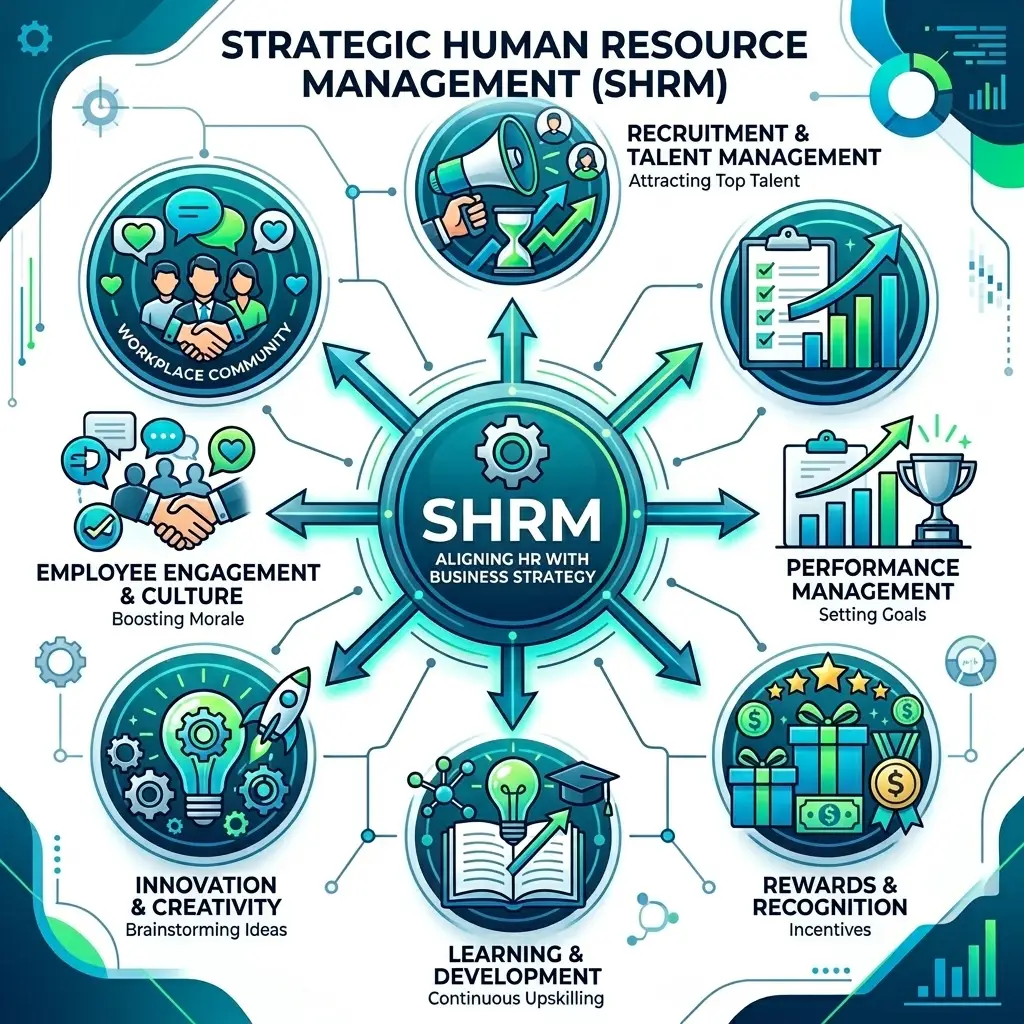
Executive Summary
Strategic human resources management is no longer limited to hiring, payroll, compliance, and employee administration. It is now a core business discipline that shapes execution, resilience, innovation, leadership quality, and long-term growth. Organizations that align people strategy with business strategy are far better positioned to attract scarce talent, build leadership pipelines, strengthen culture, improve performance, manage risk, and sustain an advantage in fast-changing markets.
This article explains what strategic human resources management is, why it matters, and how organizations can put it into practice with greater discipline and clarity. It explores the shift from traditional HR to a fully integrated strategic model, reviews influential frameworks that still shape modern HR thinking, and outlines practical approaches that connect talent decisions to business outcomes. It also expands on the strategic functions HR manages directly, including workforce planning, organizational design, leadership development, succession, culture, performance systems, retention, employee relations, learning, change management, and capability building.
It also examines a specialized area that has become increasingly important for many organizations: the recruitment, sourcing, and hiring of public affairs professionals. As regulatory pressure, stakeholder scrutiny, geopolitical uncertainty, and reputational risk intensify, companies need stronger public affairs capability across government relations, policy analysis, advocacy, corporate communications, stakeholder engagement, issues management, and regulatory strategy. Hiring effectively in this field takes far more than publishing a job description. It requires role clarity, labor-market intelligence, network-based sourcing, employer positioning, rigorous assessment, and close coordination between HR, business leadership, communications, and legal teams.
For executives, HR leaders, communications chiefs, founders, and business owners, the message is simple: strategy succeeds or fails through people. When HR is aligned with enterprise priorities and treated as a strategic operator rather than an administrative service, it becomes a force multiplier. When it is fragmented, reactive, or shut out of decision-making, execution slows, leadership gaps widen, and business performance suffers. Strategic HRM provides the discipline needed to ensure the workforce is capable, committed, adaptable, and ready to deliver on the organization’s goals.
Key Takeaways
- Strategic alignment is essential: HR strategy must support business goals, operating priorities, market expansion plans, risk posture, and long-term growth.
- People create durable advantage: Skills, judgment, leadership quality, collaboration, and culture can differentiate a company in ways competitors struggle to copy.
- HR manages more than transactions: Modern HR owns or co-owns workforce planning, leadership pipelines, organizational design, succession, performance systems, culture, learning, employee relations, and change execution.
- Foundational frameworks still matter: Models such as the Michigan School and the Harvard Framework remain useful for understanding how HR systems affect performance, stakeholder outcomes, and organizational health.
- Strong HR strategy is multidimensional: Effective organizations combine resource-based thinking, strategic fit, high performance, commitment, and employee involvement.
- Culture is an execution system: If the culture does not support accountability, trust, learning, adaptability, and strategic clarity, even strong plans will underperform.
- Knowledge management is a strategic necessity: Companies must capture, transfer, and apply knowledge to reduce execution risk, preserve expertise, and improve agility.
- Performance management should drive the future: The best systems focus on coaching, capability growth, expectations, and business results, not only retrospective appraisal.
- Retention is a strategic discipline: Reducing regrettable turnover requires strong managers, fair rewards, clear growth paths, thoughtful job design, and credible leadership.
- Public affairs hiring requires precision: Recruiting public affairs professionals demands targeted sourcing, stakeholder mapping, policy awareness, reputation sensitivity, and role-specific assessment methods.
- HR leaders need business fluency: Strategic HRM works best when HR participates in planning, investment decisions, talent forecasting, and enterprise risk discussions.
- Measurement drives credibility: HR initiatives should be linked to metrics such as quality of hire, retention, internal mobility, leadership readiness, engagement, productivity, capability growth, and business performance.
The True Value of Human Capital
Why do promising strategies fail even when the market opportunity is real, the business case is sound, and leadership appears confident? In many cases, the answer is not the strategy itself. The real problem is execution through people. Organizations do not deliver results through plans, slide decks, or ambition alone. They deliver results through capability, leadership, role clarity, disciplined management, cultural alignment, and sustained commitment.
That is why human capital deserves the same level of strategic attention as finance, operations, technology, legal, and commercial planning. Talent is not simply an input or a labor cost. It drives innovation, customer experience, stakeholder trust, operational reliability, risk management, and long-term value creation. A company may have a strong brand, a differentiated offer, or favorable market timing, but without the right people in the right roles, supported by coherent systems and capable managers, those advantages fade quickly. Research from McKinsey & Company and workplace data from Gallup continue to show the close relationship between people quality, manager effectiveness, engagement, and business outcomes.
Strategic human resources management starts from that reality. It moves HR beyond administration and positions it as a central business function that helps the organization perform, adapt, scale, and compete. In this model, HR is responsible not only for staffing and policy administration, but also for workforce planning, talent strategy, leadership development, succession management, organizational effectiveness, employee value proposition, learning systems, culture shaping, performance architecture, and change readiness.
This shift matters because the business environment has changed dramatically. Skills become outdated faster. Labor markets are tighter in critical functions. Employee expectations around flexibility, purpose, growth, inclusion, and manager quality are higher. Regulatory oversight is more intense. Business models evolve more rapidly. AI and digital tools are reshaping job design, decision-making, communications, and productivity expectations. In that environment, efficient HR operations are necessary, but they are no longer enough. Organizations need an HR function that helps leadership anticipate capability needs and turn workforce choices into business results. For a broader labor-market lens, the World Economic Forum Future of Jobs reports and the OECD employment and skills analysis provide useful context.
A strategic approach to HRM helps leaders answer critical questions:
- What capabilities will the organization need in one, three, and five years?
- Which roles create the most strategic value?
- Where are the greatest leadership, skills, and succession gaps?
- Which functions face the highest retention risk?
- How should hiring plans change based on market expansion, regulation, or digital transformation?
- What kind of culture is needed to support innovation, compliance, service, growth, or stakeholder trust?
- How should performance, rewards, learning, and mobility systems reinforce strategic priorities?
- Where does the organization need specialist talent, such as public affairs, policy, or regulatory professionals, to protect and advance enterprise interests?
Organizations that ask and answer these questions consistently are far better positioned to execute. Strategic HRM closes the gap between ambition and capability. It helps ensure that business strategy is not undermined by talent shortages, weak management, poor communication, fragmented incentives, or a culture that resists change.
Bridging the Gap: Aligning HRM with Organizational Strategy
One of the hardest challenges in management is turning broad business goals into operational reality. Leadership teams may define growth targets, digital priorities, geographic expansion plans, M&A goals, product innovation objectives, or customer experience ambitions. Yet every one of those priorities has a people dimension. When HR is disconnected from strategic planning, organizations often run into predictable problems: poor hiring decisions, weak succession, conflicting incentives, low engagement, capability gaps, leadership bottlenecks, and avoidable turnover.
Strategic alignment begins with a simple but demanding truth: every business objective depends on workforce capability. If a company wants to expand into regulated markets, it may need stronger compliance expertise, public affairs capability, and in-market stakeholder management. If it wants to improve margins, it may need sharper manager effectiveness, tighter workforce planning, clearer performance standards, and redesigned roles. If it wants to innovate faster, it may need a culture that supports experimentation, learning, constructive challenge, and cross-functional collaboration.
For that reason, HR cannot operate in a silo. It must understand the business model, revenue drivers, cost pressures, market dynamics, operating structure, legal exposure, stakeholder environment, and competitive threats. HR leaders need to speak the language of enterprise performance, not just the language of policy. They must be able to explain how talent decisions affect execution speed, productivity, customer outcomes, reputational resilience, and enterprise value. Guidance from the Society for Human Resource Management and practitioner research published by the CIPD reinforce this point: HR creates the most value when it is integrated into enterprise planning, not bolted on afterward.
Alignment also requires true integration between strategic planning and workforce planning. Too many organizations finalize business strategy first and ask talent questions later. By then, capability gaps are more expensive and harder to solve. A stronger model brings HR into the conversation early, so the organization can forecast workforce needs, identify likely constraints, and build realistic people plans before execution risk grows.
Effective alignment usually includes:
- Workforce planning: identifying future talent needs by role, function, geography, seniority, and skill cluster.
- Capability mapping: defining the technical, managerial, digital, commercial, and stakeholder skills required now and later.
- Leadership planning: building succession depth for critical executive, managerial, and specialist roles.
- Performance alignment: linking objectives, incentives, and management expectations to enterprise priorities.
- Organization design: shaping structures, reporting lines, spans of control, and team interfaces to support accountability and speed.
- Talent acquisition strategy: defining where to find critical talent, how to compete for it, and how to assess it effectively.
- Change management: preparing managers and employees to adopt new behaviors, systems, and operating models.
- Employee communications: translating strategy into language employees can understand and act on.
When these elements are missing, organizations experience friction. Functions move in different directions. Managers optimize for local priorities rather than enterprise goals. Employees receive mixed signals about what matters. HR programs become isolated initiatives instead of drivers of business performance.
When HRM is closely aligned with strategy, the organization becomes more coherent. Hiring is more focused. Development is more relevant. Performance systems reinforce what matters most. Leaders understand the capabilities they need. Employees have a clearer sense of the organization’s direction and their role in delivering it. That is where strategic HRM starts to create measurable value.
How HR Manages Strategic Functions
A common misconception is that HR becomes “strategic” simply by attending executive meetings. In reality, strategic HRM is defined less by access and more by what HR actively manages, shapes, measures, and improves across the enterprise. A high-performing HR function translates strategic intent into workforce architecture and operating discipline.
Workforce Planning and Talent Forecasting
HR manages the process of identifying how many people the business needs, what capabilities they must have, where they should be located, and when those roles need to be filled. This includes scenario planning for growth, restructuring, automation, international expansion, and shifts in customer demand. Workforce planning is strategic because under-hiring slows execution, over-hiring strains costs, and hiring the wrong profiles creates long-term drag on performance. Practical frameworks from CIPD’s workforce planning resources and employer research from Deloitte Insights offer useful benchmarks.
Organizational Design
HR helps shape the structure through which work gets done. This includes role definition, reporting lines, decision rights, layers of management, spans of control, and cross-functional interfaces. Strong organizational design improves speed, accountability, and collaboration. Weak design creates confusion, duplicated effort, political friction, and decision bottlenecks. Strategic HR does not simply fill roles inside a structure. It helps determine whether the structure itself supports the strategy.
Leadership Development and Succession
One of HR’s most important responsibilities is making sure the organization has the leaders it will need tomorrow, not just the managers it has today. That means identifying high-potential talent, assessing leadership capability, creating development pathways, planning succession for critical roles, and reducing dependence on a small number of senior individuals. Succession planning is both a talent process and a risk-management discipline. When it is weak, organizations become more vulnerable during growth, crisis, or executive transition. Leadership research from Center for Creative Leadership and executive succession analysis from Spencer Stuart are especially valuable for this topic.
Performance Management
HR manages the systems that define, track, and improve performance. At its best, performance management aligns individual effort with organizational priorities. It clarifies expectations, supports coaching, surfaces underperformance early, and encourages development. At its worst, it becomes bureaucratic, backward-looking, and disconnected from the realities of the business. Strategic HR functions redesign performance systems so they are simpler, fairer, and more useful to both managers and employees. Thought leadership from Harvard Business Review has repeatedly highlighted the importance of moving from punitive appraisal toward forward-looking performance conversations.
Rewards and Incentives
Compensation is more than a cost. It is a strategic signal. HR manages pay structures, incentive design, recognition programs, and reward philosophy in ways that reinforce business priorities. If an organization says it values collaboration, innovation, or customer experience, its reward system should reflect those priorities. Poorly designed incentives can distort behavior, encourage short-term thinking, and undermine trust. For compensation data and talent-market signals, many employers use Mercer, Willis Towers Watson, and public insights from WorldatWork.
Culture and Employee Experience
HR helps shape culture through what the organization hires for, promotes, rewards, tolerates, and communicates. It also manages major parts of the employee experience, including onboarding, development, recognition, feedback, manager quality, internal mobility, and inclusion. Culture becomes strategic when leaders recognize that it is not a branding exercise. It is the operating environment in which decisions are made, effort is applied, and standards are reinforced.
Learning, Reskilling, and Capability Building
Strategic HR identifies which capabilities are becoming more valuable and which are becoming obsolete. It then builds systems that help the workforce adapt. This can include formal learning programs, internal academies, coaching, mentoring, skill certification, stretch assignments, leadership labs, and digital learning platforms. In periods of disruption, the ability to reskill employees quickly can be more important than the ability to hire externally. Evidence from the World Economic Forum and skills research from LinkedIn Learning support the growing importance of continuous capability building.
Employee Relations and Organizational Trust
HR also manages the quality of the relationship between the organization and its people. This includes grievance handling, conflict resolution, policy interpretation, labor relations where relevant, and the broader climate of fairness and trust. Employee relations becomes strategic when leaders understand that unresolved conflict, inconsistent management, and poor communication erode execution and increase risk. High-trust environments perform better because people are more willing to contribute, speak up, adapt, and stay. Trust and employee voice are also recurring themes in ACAS guidance and Gallup workplace research.
Change Management and Strategic Execution
When companies introduce new systems, redesign operations, integrate acquisitions, or shift business models, HR often plays a central role in making change stick. This includes stakeholder mapping, communication planning, manager enablement, training, adoption tracking, and resistance management. Strategic change is far more likely to succeed when HR is involved early, because people issues are anticipated instead of treated as an afterthought. For structured change frameworks, practitioners often draw from Prosci and research published by McKinsey.
In short, HR manages strategic functions by turning business priorities into talent systems, management disciplines, and workforce decisions that can actually be implemented.
Foundational Models of Strategic HRM
Modern strategic HRM draws on several influential frameworks that still shape how leaders think about the relationship between people and performance. Business conditions have evolved, but these models remain useful because they give structure to the design of HR systems that support organizational goals.
The Michigan School Model
The Michigan School Model, often referred to as the matching model, emphasizes alignment between HR systems and organizational strategy. In this view, selection, appraisal, rewards, and development should all reinforce the capabilities and behaviors the organization needs to succeed. The strength of this model lies in its discipline: if a company wants better execution, innovation, compliance, or growth, it must design people systems that make those outcomes more likely.
The model remains particularly useful in organizations where role clarity, execution discipline, and strategic focus are essential. It reinforces the idea that HR should be integrated with business planning rather than operating alongside it.
Its limitation is that it can become too narrow if applied mechanically. Modern organizations need alignment, but they also need engagement, fairness, employee voice, and a sustainable culture. Still, the principle of fit remains central to contemporary HR strategy.
The Harvard Framework
The Harvard Framework takes a broader, more stakeholder-oriented view of HRM. It considers management, employees, owners, and the wider social environment. Rather than focusing only on efficiency, it draws attention to the long-term consequences of HR decisions for commitment, competence, congruence, and cost-effectiveness.
This framework remains valuable because it reflects organizational reality. HR decisions affect morale, legitimacy, trust, culture, and reputation, not just staffing efficiency. Choices about rewards, work systems, employee influence, and talent flow have consequences that extend well beyond short-term output. They shape how people experience the organization and whether the organization remains healthy over time.
Together, the Michigan and Harvard perspectives provide a durable foundation. One stresses strategic fit and coherence. The other widens the lens to include stakeholder outcomes, legitimacy, and long-term organizational health. The strongest HR strategies usually reflect both.
For practical guidance on strategic alignment, workforce planning, and talent management, many HR professionals rely on the Society for Human Resource Management. Additional leadership research and organizational insights are available through Harvard Business Review, CIPD, and peer-reviewed management journals indexed by Google Scholar.
Five Approaches to Effective HR Strategy
No single HR model fits every organization. Industry conditions, business maturity, workforce composition, talent supply, regulatory pressure, and competitive strategy all matter. Still, five established approaches offer a strong framework for building an adaptable and credible HR strategy.
1. The Resource-Based Approach
The resource-based view argues that sustainable competitive advantage comes from resources that are valuable, rare, difficult to imitate, and well organized. In many organizations, the most important of those resources is human capital: not just headcount, but expertise, judgment, leadership, relationships, creativity, and institutional knowledge.
From this perspective, strategic HRM is about building capabilities that competitors cannot easily copy. That means attracting strong talent, developing specialized skills, retaining top performers, protecting critical knowledge, and creating an environment where employees can apply their strengths effectively.
This approach is especially relevant in knowledge-intensive sectors such as technology, healthcare, financial services, energy, advanced manufacturing, consulting, and public policy. It is also increasingly important in corporate affairs and public affairs functions, where external influence, stakeholder management, and policy understanding can materially affect business outcomes.
2. The Fit Approach
The fit approach emphasizes alignment. HR strategy must fit business strategy, and HR practices must fit one another. This is often described as vertical fit and horizontal fit.
- Vertical fit means HR supports the broader strategic direction of the business.
- Horizontal fit means HR practices are internally consistent and mutually reinforcing.
An organization that says it values innovation cannot rely on rigid hierarchies, inconsistent managers, and reward systems that punish intelligent risk-taking. A company that claims to prioritize stakeholder trust cannot hire aggressively into public-facing roles while neglecting ethics, communications discipline, or policy literacy. The fit approach is valuable because it exposes the gap between what organizations say and what their systems actually encourage.
3. High-Performance Management
High-performance management focuses on practices that improve results through stronger execution, better communication, capable leadership, role clarity, and disciplined talent processes. It includes selective hiring, effective onboarding, training, coaching, performance standards, and thoughtful job design.
This is not a single intervention. It is a system. Organizations improve results when they combine strong people practices rather than applying them in isolation. A company may recruit excellent talent and still underperform if managers do not coach, roles are unclear, or performance is not rewarded fairly.
When implemented well, this approach improves productivity, quality, service, innovation, and customer outcomes. For deeper evidence, readers can explore organization performance research from MIT Sloan Management Review and talent-performance analysis from McKinsey.
4. High-Commitment Management
High-commitment management focuses on building trust, loyalty, and shared purpose. The logic is simple: people contribute more when they feel respected, informed, supported, and connected to meaningful goals.
This approach emphasizes communication, development, fairness, leadership credibility, and meaningful work. Commitment is not created through slogans or internal campaigns. It is built through management behavior, consistency, and institutional trust. Employees pay close attention to whether leaders follow through, whether promotions are fair, whether concerns are heard, and whether stated values match real decisions.
Strategic HRM strengthens commitment by ensuring leadership behavior and people systems reinforce trust instead of undermining it.
5. High-Involvement Management
High-involvement management treats employees as active contributors to organizational success. It emphasizes voice, dialogue, empowerment, and collaboration. The goal is not only better morale, but better decisions and stronger execution.
Employees often spot operational risks, customer frustration, stakeholder concerns, and process failures earlier than senior leaders do. Organizations that create channels for meaningful input can identify problems faster and improve systems more effectively. This approach is especially valuable during transformation, restructuring, market expansion, and reputation-sensitive initiatives.
In practice, the strongest HR functions do not rely on just one of these approaches. They combine them. They build hard-to-copy capabilities, align closely with business goals, pursue high performance, strengthen commitment, and involve employees in improvement. That integrated model is what gives strategic HRM its real strategic power.
Recruitment, Sourcing, and Hiring as Strategic HR Functions
Talent acquisition is often misunderstood as a narrow recruiting process. In reality, for strategic roles, hiring is an enterprise capability. The way an organization defines, sources, assesses, and secures talent often determines whether strategy can be executed at all. This is particularly true for scarce-skill roles, leadership hires, and positions that influence reputation, regulation, investor confidence, and public trust.
Strategic HR does not wait for vacancies to appear. It builds talent pipelines, maps labor markets, sharpens employer positioning, partners with business leaders on role design, and improves quality of hire through disciplined assessment. This matters even more when hiring professionals in specialist areas such as public affairs, government relations, policy, external communications, and stakeholder engagement.
What Strategic Hiring Requires
Strong strategic hiring typically includes:
- clear role architecture and success profiles
- market mapping and competitive intelligence
- proactive sourcing channels
- employer brand credibility
- rigorous screening and structured interviews
- assessment of both technical skill and contextual judgment
- efficient candidate experience
- compensation alignment with the labor market
- close coordination among HR, hiring managers, and senior stakeholders
When these elements are weak, organizations make poor hires, lose strong candidates, and create delays that ripple across the business. For practical recruiting benchmarks, teams often review LinkedIn Talent Solutions, the SHRM talent acquisition hub, and market intelligence from firms such as Gartner HR.
How Organizations Recruit, Source, and Hire Public Affairs Professionals
Demand for public affairs professionals has grown across industries including healthcare, energy, technology, finance, infrastructure, defense, education, consumer goods, and other regulated sectors. As governments intervene more directly in markets, stakeholder expectations rise, and reputational issues spread faster, organizations need professionals who can anticipate policy risk, build institutional relationships, influence public debate, and protect the company’s license to operate.
Public affairs professionals may work in roles such as:
- Government Affairs Manager
- Public Affairs Director
- Policy and Regulatory Affairs Lead
- External Affairs Manager
- Corporate Affairs Specialist
- Stakeholder Engagement Director
- Advocacy and Campaigns Manager
- Issues Management Lead
- Public Policy Analyst
- Strategic Communications and Public Affairs Counsel
- Vice President of Public Affairs, with direct access to the CEO and responsibility for embedding public affairs priorities into the company’s growth playbook
- Chief Corporate Affairs Officer, in close contact with the CEO and responsible for aligning external affairs strategy with enterprise growth, risk management, and institutional interests
- Board Member with oversight of public affairs, government relations, or stakeholder strategy, working directly with the CEO to ensure public affairs plans are integrated into the organization’s long-term growth agenda and broader interests
Why Public Affairs Hiring Is Different
Hiring in this field is different from hiring for many generalist corporate roles because success depends on a blend of capabilities that are difficult to assess at a glance. Strong candidates often combine policy knowledge, political judgment, relationship-building ability, media awareness, business literacy, writing skill, discretion, and strategic instinct. In many cases, they also need a deep understanding of regulatory systems, legislative processes, public institutions, and the stakeholder landscape surrounding the company’s industry.
A weak hire in public affairs can create serious risk. The person may misread a policy environment, damage external relationships, communicate poorly during an issue, or fail to influence decision-makers effectively. That is why organizations should approach public affairs hiring as a strategic process, not an administrative one. For policy context, organizations often monitor official sources such as Congress.gov, the European Commission, the UK Government, and sector regulators relevant to their markets.
Step 1: Define the Public Affairs Mandate Clearly
The first task is role clarity. HR and business leaders need to decide what the public affairs function is expected to achieve. Is the role focused on government relations, advocacy, policy monitoring, trade associations, crisis and issues management, community relations, regulatory engagement, or corporate reputation? Too many organizations create broad job descriptions that blend several functions without setting priorities. That leads to mismatched candidates and weak performance.
A strong public affairs brief should define:
- the policy and stakeholder environment
- priority issues and jurisdictions
- internal reporting lines
- expected relationships with legal, communications, compliance, ESG, investor relations, and business leaders
- near-term deliverables
- required policy, communications, or lobbying experience
- the level of external visibility and influence expected
- success metrics for the first 12 to 24 months
Step 2: Build a Precise Candidate Profile
The best hiring processes define not only tasks, but also the profile of a successful candidate. For public affairs roles, that often includes:
- policy analysis capability
- stakeholder mapping and relationship management
- understanding of government and regulatory processes
- executive presence and judgment
- strong writing, briefing, and messaging skills
- ability to operate in ambiguity and under pressure
- discretion with sensitive information
- industry knowledge
- cross-functional collaboration with legal, communications, compliance, and commercial teams
Some roles also require campaign strategy, coalition building, association management, media handling, or experience engaging ministers, regulators, legislative staff, or public bodies.
Step 3: Use the Right Sourcing Channels
Public affairs professionals are rarely sourced effectively through generic job advertising alone. The strongest candidates are often passive, well networked, reputation-conscious, and selective. Strategic HR teams therefore use a mix of sourcing methods:
- specialist recruiters in public affairs, government relations, policy, or corporate affairs
- targeted LinkedIn outreach through calibrated search strings
- industry associations and policy forums
- alumni networks from public institutions, consultancies, trade associations, and think tanks
- referrals from senior leaders, board members, and external advisers
- conference participation and stakeholder events
- talent mapping across competitors, agencies, NGOs, regulators, and in-house corporate affairs teams
In many cases, direct search is more effective than open-market recruitment. This is especially true for senior public affairs leaders and for roles in highly regulated sectors. Market signals from LinkedIn Talent Insights, CIPD, and public hiring data from government and policy institutions can help sharpen sourcing strategy.
Step 4: Assess for Influence, Judgment, and Credibility
Public affairs candidates should not be evaluated only through conventional competency interviews. Organizations need evidence of judgment, stakeholder awareness, writing quality, and strategic thinking. A rigorous process may include:
- structured behavioral interviews
- policy briefing exercises
- stakeholder mapping simulations
- issue-response case studies
- writing tests for memos, briefings, or public positioning
- panel interviews with communications, legal, and business stakeholders
- scenario questions involving regulation, crisis, or reputational pressure
- reference checks focused on influence, judgment, and credibility
The objective is to understand not only whether the candidate knows policy, but whether they can operate effectively in politically sensitive, high-stakes, and fast-moving situations.
Step 5: Evaluate Cultural and Strategic Fit
Public affairs professionals often sit at the intersection of external pressure and internal decision-making. They need enough credibility externally to represent the organization well, and enough influence internally to shape decisions early. That means cultural fit matters, but it should be assessed intelligently. The real question is not whether the candidate feels familiar. It is whether they can work effectively with senior leaders, challenge assumptions constructively, and navigate the organization’s pace, governance, and stakeholder model.
Step 6: Offer a Compelling Value Proposition
Top public affairs talent often has multiple options across corporations, consultancies, trade groups, advisory firms, think tanks, and public institutions. Compensation matters, but so do mandate quality, leadership access, policy relevance, autonomy, reputation, and career trajectory. HR should help hiring leaders build a compelling value proposition that answers the questions serious candidates are already asking:
- Will this role influence real decisions?
- Is the organization serious about public affairs, or is the role mostly symbolic?
- How visible is the function internally?
- Will the candidate have access to leadership?
- Is the company’s reputation defensible?
- What is the growth path from this role?
Without credible answers, organizations often lose strong candidates even when compensation is competitive.
Step 7: Onboard Public Affairs Talent Properly
Even highly capable hires can underperform if onboarding is weak. Public affairs professionals need fast access to business context, stakeholder history, policy priorities, decision-makers, governance structures, and reputational sensitivities. A strong onboarding process should include:
- briefing on business strategy and commercial priorities
- overview of regulatory and policy exposure
- introductions to executive stakeholders
- background on current issues, legacy positions, and key relationships
- access to prior briefings, messaging, and issue logs
- clear 30-, 60-, and 90-day objectives
In strategic functions, onboarding is part of the hiring outcome, not a separate administrative step.
Where HR Adds the Most Value in Public Affairs Hiring
HR creates value in this process by:
- clarifying the scope and level of the role
- calibrating compensation and title competitiveness
- selecting sourcing channels intelligently
- improving assessment quality and consistency
- protecting process discipline and candidate experience
- reducing bias in a highly network-driven talent market
- ensuring alignment among communications, legal, public policy, and business leadership
- helping the organization hire for both external credibility and internal effectiveness
As stakeholder capitalism, public scrutiny, and regulatory complexity intensify, public affairs hiring is becoming a board-relevant issue in many industries. Organizations that build this capability deliberately will be better equipped to anticipate policy shifts, manage risk, shape narratives, and protect long-term business interests.
For hiring trends and workforce insights, useful sources include LinkedIn Talent Solutions, CIPD, SHRM, and governance research from the National Association of Corporate Directors.
Managing Culture and Knowledge
Strategy sets direction, but culture shapes behavior when pressure rises, information is incomplete, and leadership is not in the room. An organization may have a clear strategy, but if daily norms reward silence, blame avoidance, short-term thinking, or internal competition, execution will suffer. Culture influences decision-making, accountability, collaboration, innovation, trust, and the overall quality of execution. For that reason, culture is not separate from strategy. It is part of the operating system of the business.
Strategic HRM plays a central role in shaping culture because HR systems communicate what the organization truly values. Recruitment signals who belongs. Onboarding signals what matters. Performance management signals what success looks like. Rewards signal which behaviors are genuinely valued. Leadership development signals how authority should be used. Promotion patterns signal what kind of person advances.
A strategic approach to culture management begins with diagnosis. Leaders need an honest view of the current culture, not the one described in company messaging. That may involve engagement surveys, interviews, focus groups, exit data, promotion analysis, employee relations trends, manager effectiveness data, and leadership assessments. The goal is to identify where the culture supports strategy and where it quietly undermines it.
For example:
- A company pursuing innovation needs a culture that supports experimentation, learning, and constructive challenge.
- A company focused on operational excellence needs discipline, clarity, ownership, and continuous improvement.
- A company competing on trust and reputation needs integrity, responsiveness, consistency, and sound judgment.
- A company operating in a politically sensitive environment needs strong internal coordination, disciplined messaging, and high stakeholder awareness.
Culture change cannot be outsourced to communications campaigns alone. It requires leadership behavior, structural reinforcement, system alignment, and time. If leaders say they want collaboration but reward individual heroics, employees will follow the incentives, not the message.
Closely connected to culture is knowledge management. In many organizations, valuable knowledge is scattered across teams, trapped in individuals, or lost through turnover. The result is inefficiency, repeated mistakes, slow onboarding, and unnecessary execution risk. Strategic HRM addresses this by building systems that help organizations capture, share, and apply knowledge more effectively.
Knowledge management can include:
- stronger onboarding and process documentation
- internal learning systems
- communities of practice
- mentoring and coaching
- succession planning
- role shadowing
- collaborative platforms
- post-project reviews and lessons learned
- issue logs and stakeholder histories for external-facing functions such as public affairs
The goal is not simply to store information, but to make knowledge usable. When organizations improve the way knowledge moves, they reduce dependence on a few individuals, strengthen decision quality, and become more resilient during change or turnover. Thought leadership from Harvard Business Review, research from MIT Sloan Management Review, and public-sector knowledge resources from the OECD all underscore the importance of adaptive culture and institutional learning.
Performance, Retention, and Organizational Resilience
A strong HR strategy does not stop with hiring. Organizations create lasting value when they keep strong people, develop them well, and enable them to perform at a high level over time. In that sense, retention is not just an administrative metric. It is a strategic outcome.
High retention is not always a sign of strength if it simply preserves mediocrity. The real goal is to reduce regrettable turnover while increasing the concentration of capable, engaged, and values-aligned talent. That means looking beyond compensation alone. People stay where they can grow, where managers are effective, where expectations are clear, where work feels meaningful, and where trust is not routinely eroded.
Strategic retention work usually includes:
- analysis of turnover data by role, manager, tenure, and demographic segment
- exit interview quality improvement
- manager capability building
- career path visibility
- internal mobility systems
- pay and reward benchmarking
- workload and job design review
- employee listening mechanisms
- targeted retention plans for critical talent pools
This is especially important in high-risk functions. If a company loses key policy, regulatory, communications, or public affairs talent during a period of external scrutiny, the cost extends far beyond replacement expense. Knowledge loss, relationship disruption, and strategic delay can quickly become material business problems.
Resilience also depends on bench strength. Organizations that rely on a handful of exceptional individuals are more fragile than they often realize. Strategic HRM reduces that fragility through succession depth, documentation, shared knowledge, and meaningful development pathways. For evidence on engagement, turnover, and manager impact, Gallup Workplace, Gartner HR, and McKinsey People & Organizational Performance remain highly useful sources.
Take Action
Strategic human resources management is not a theoretical exercise, and it is not a cosmetic upgrade to traditional HR. It is a practical discipline that helps organizations execute more effectively, compete more intelligently, manage risk more proactively, and grow more sustainably. The question is not whether people matter to strategy. The question is whether the organization manages people with enough rigor, clarity, and foresight to turn strategic goals into real results.
Leaders who want to strengthen strategic HRM should begin with an honest assessment of the current state:
- Is HR involved early in business planning and investment decisions?
- Do workforce plans reflect future capability needs, not only current vacancies?
- Are hiring, development, rewards, and performance systems aligned with strategy?
- Does the organizational structure support speed, accountability, and collaboration?
- Does the culture reinforce the behaviors the business actually needs?
- Are critical roles and succession risks clearly identified?
- Do managers have the skill to lead performance, trust, and engagement well?
- Are retention risks understood through real data rather than assumptions?
- Is the organization equipped to source and hire specialist talent, including public affairs professionals, for strategically sensitive roles?
From there, the focus should move to action. Build a people strategy around a small number of clear priorities. Define the capabilities the organization needs most. Upgrade the manager quality. Strengthen leadership pipelines. Modernize performance management. Make learning more practical and continuous. Review rewards for fairness and alignment. Build stronger systems for employee listening and follow-through. Improve specialist hiring processes where business risk and external visibility are high.
Most importantly, treat HR as a business partner accountable for outcomes, not just activity. Strategic HRM works best when it is tied to measurable results: stronger retention, higher quality of hire, better leadership depth, faster capability development, improved engagement, sharper execution, stronger stakeholder management, and better overall business performance.
The organizations that win over time are not simply the ones with the best strategy documents. They are the ones that build the people, systems, leadership, and culture needed to carry strategy into action every day.
Q&A
Q: What is the main difference between traditional HR and strategic HRM?
A: Traditional HR is usually administrative and transactional. It focuses on payroll, compliance, employee records, and day-to-day personnel processes. Strategic HRM goes further by aligning workforce planning, leadership development, talent management, culture, organizational design, and performance systems with long-term business goals. It is proactive, integrated, and directly tied to execution.
Q: Why is strategic human resources management important for business performance?
A: Strategic HRM improves business performance because it ensures the organization has the talent, structure, leadership capability, and culture required to deliver its strategy. It strengthens retention, engagement, productivity, decision-making, resilience, and adaptability, all of which influence financial and operational outcomes.
Q: What strategic functions does HR actually manage?
A: HR manages or co-manages workforce planning, talent acquisition, organizational design, leadership development, succession planning, learning and capability building, performance management, rewards, employee relations, change management, culture shaping, and parts of enterprise risk related to people and leadership continuity.
Q: How does the resource-based view apply to HR?
A: The resource-based view suggests that organizations gain lasting competitive advantage from resources that are valuable, rare, and difficult to copy. Human capital often fits that definition. Skilled employees, strong leadership, institutional knowledge, stakeholder credibility, and collaborative culture can create advantages that competitors struggle to replicate.
Q: What does “fit” mean in strategic HRM?
A: Fit refers to alignment. Vertical fit means HR strategy supports business strategy. Horizontal fit means HR practices, such as hiring, development, rewards, and performance management, work together consistently. Without fit, organizations send mixed signals and weaken execution.
Q: Why is hiring public affairs professionals strategically important?
A: Public affairs professionals help organizations monitor policy risk, engage external stakeholders, influence public debate, manage regulatory relationships, and protect corporate reputation. In highly regulated or reputation-sensitive industries, the quality of this capability can directly affect market access, trust, and business continuity.
Q: How should organizations source public affairs professionals?
A: The most effective methods usually combine specialist search firms, direct outreach, LinkedIn sourcing, industry associations, referral networks, conference ecosystems, and talent mapping across competitors, agencies, consultancies, NGOs, and public institutions. Generic job posting alone is rarely enough for senior or specialized public affairs talent.
Q: How should companies assess public affairs candidates?
A: Companies should go beyond standard interviews. Strong assessment methods include structured interviews, policy briefing exercises, writing tests, stakeholder mapping simulations, scenario analysis, and reference checks focused on judgment, influence, and credibility. The goal is to assess real-world effectiveness, not just résumé strength.
Q: How can companies improve employee retention strategically?
A: Strategic retention starts with understanding why people leave. Organizations should analyze exit data, turnover patterns, manager quality, pay competitiveness, career progression, workload, and employee experience. Effective retention strategies usually combine better leadership, growth opportunities, clearer expectations, meaningful work, fair rewards, and stronger onboarding.
Q: What role does culture play in strategic HRM?
A: Culture affects how strategy is carried out in practice. It shapes behavior, trust, collaboration, accountability, and speed of execution. Strategic HRM influences culture through hiring, onboarding, leadership expectations, rewards, communication, development, and performance systems.
Q: How should leaders measure the success of strategic HRM initiatives?
A: Leaders should track metrics linked to business goals. Common indicators include quality of hire, regrettable turnover, employee engagement, internal mobility, time to fill critical roles, leadership bench strength, training effectiveness, productivity, customer outcomes, and overall business performance. The strongest scorecards connect HR metrics to operational and financial impact.
Q: Is strategic HRM only relevant for large enterprises?
A: No. Small and mid-sized businesses often benefit just as much, and sometimes more. Even with fewer resources, they must hire well, build leaders, retain key talent, and align people practices with growth goals. Strategic HRM helps them avoid costly talent mistakes and scale with more discipline.
References & Footnotes
- Society for Human Resource Management (SHRM), HR strategy and talent resources, available at https://www.shrm.org.
- Harvard Business Review, research on leadership, talent, culture, and organizational effectiveness, available at https://hbr.org.
- Fombrun, C., Tichy, N. M., & Devanna, M. A. (1984). Strategic Human Resource Management.
- Beer, M., Spector, B., Lawrence, P. R., Mills, D. Q., & Walton, R. E. (1984). Managing Human Assets.
- Wright, P. M., & McMahan, G. C. (1992). “Theoretical Perspectives for Strategic Human Resource Management,” Journal of Management, 18(2), 295–320.
- Boxall, P., & Purcell, J. (2016). Strategy and Human Resource Management.
- Becker, B. E., & Huselid, M. A. (2006). “Strategic Human Resources Management: Where Do We Go from Here?” Journal of Management.
- CIPD, strategy, workforce planning, and people management resources, available at https://www.cipd.org.
- McKinsey & Company, People & Organizational Performance insights, available at https://www.mckinsey.com/capabilities/people-and-organizational-performance.
- Gallup Workplace, employee engagement and manager effectiveness research, available at https://www.gallup.com/workplace.
- LinkedIn Talent Solutions, labor-market data and talent acquisition insights, available at https://business.linkedin.com/talent-solutions.
- World Economic Forum, future of jobs, reskilling, and workforce transformation research, available at https://www.weforum.org.
- OECD, employment, skills, governance, and organizational policy resources, available at https://www.oecd.org.
- Center for Creative Leadership, leadership development research, available at https://www.ccl.org.
- National Association of Corporate Directors, governance and board leadership resources, available at https://www.nacdonline.org.
#StrategicHRM, #HumanResourceManagement, #SHRMFramework, #RecruitmentStrategies, #PerformanceManagementSystems, #EmployeeRewards, #LearningAndDevelopment, #InnovationInHR, #BusinessStrategyAlignment, #OrganizationalPerformanceImprovement, #EmployeeEngagementStrategies, #HRAlignmentWithBusiness, #WorkforceDevelopmentPrograms, #TalentManagementSolutions, #CorporateGrowthStrategies, #HRBestPractices, #StrategicWorkforcePlanning, #LeadershipDevelopment, #HRInnovation, #SustainableBusinessGrowth, #HumanCapitalManagement, #HRStrategyExecution, #EmployeeRetention, #HRMetricsAndAnalytics, #FutureOfWork
@HRProfessionals, @HumanResources, @SHRMSpecialists, @HRConsultants, @TalentManagementExperts, @WorkforceDevelopment, @EmployeeEngagement, @HRLeaders, @HRInnovators, @HRPractitioners, @LaborUnions, @UnionLeaders, @WorkplaceAdvocates, @ThinkTanks, @PolicyMakers, @HRResearch, @UniversityHRPrograms, @BusinessSchools, @OrganizationalDevelopment, @WorkplaceStrategy, @HRAnalytics, @LeadershipDevelopment, @CorporateTraining, @WorkforcePlanning, @FutureOfWork, @HRTech, @EmployeeRelations, @HRPolicy, @WorkplaceInnovation, @HRStrategy, @LaborPolicyExperts, @WorkplaceEquality, @DiversityAndInclusion, @HRCompliance, @WorkforceResilience, @HRThoughtLeaders, @HRCommunity, @HRNetworking, @GlobalHR, @HRBestPractices, @HRTransformation, @WorkplaceCulture, @EmployeeWellbeing, @HRLeadership, @HRInsights, @HRForums, @HRConferences, @HRTrainingPrograms, @WorkplaceSafety, @HRDevelopment, @HRSupport, @HRAdvisors, @HRMentors, @HRPartners, @HROrganizations, @HRAssociations, @HRInstitutes, @HRPolicyMakers, @HRAdvocacy
Discover more from Responsible Public Affairs
Subscribe to get the latest posts sent to your email.