

Why Iran’s Decline Will Be Decided by Trade Routes, Not Air Strikes
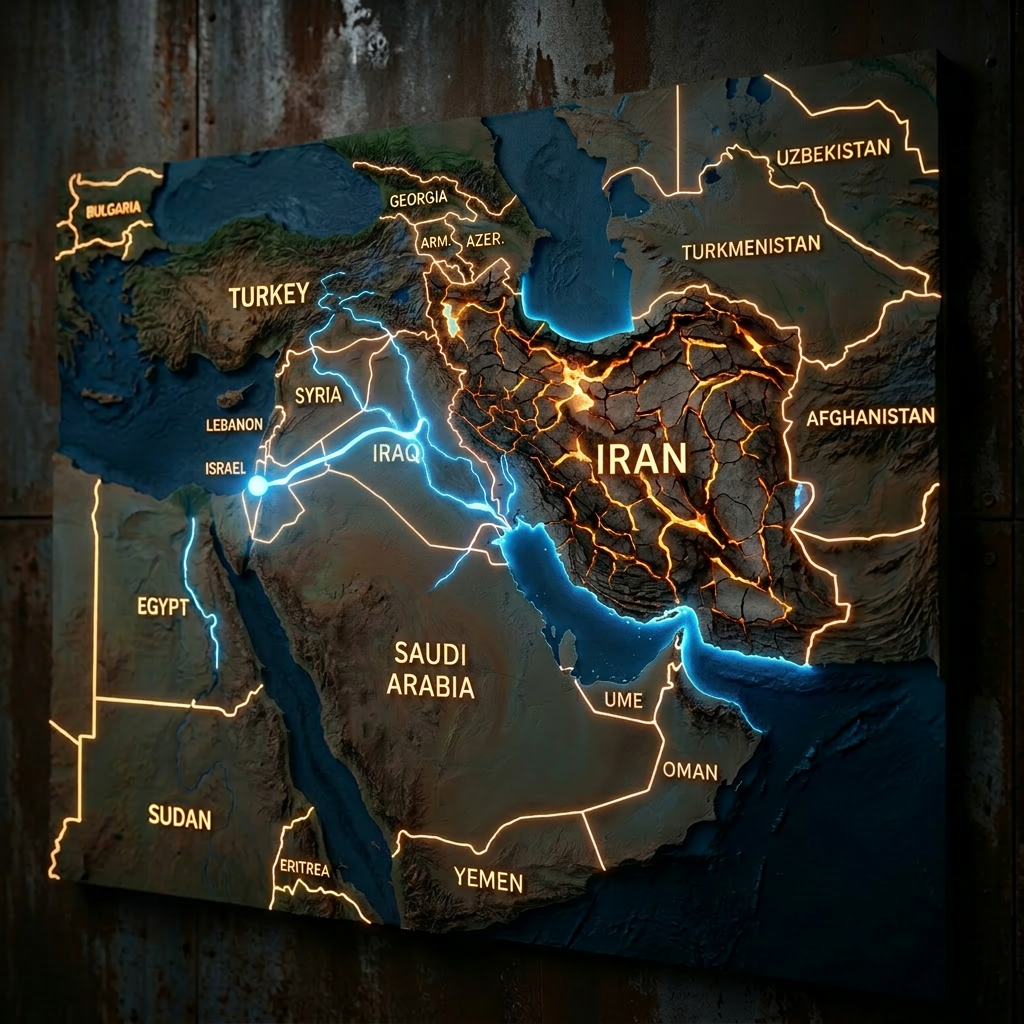
The temptation after a successful military campaign is to mistake damage for resolution. That temptation is now shaping how Western governments think about Iran. After the strikes of 2026, a familiar conclusion has hardened across allied capitals: Tehran is broken, its network of proxies is spent, and the long contest over the Middle East has tipped decisively. This reading is comforting, and it is premature. Worse, it risks directing attention away from the arena where the next phase of the struggle will actually be decided—not the airspace over Iranian nuclear sites, but the emerging architecture of trade corridors, ports, and energy routes that will define regional order for a generation.
The distinction between weakening an adversary and defeating one is not academic. It determines what follows. A weakened regime that retains its institutions, its ideological project, and its capacity to wait is a different strategic problem from a defeated one. And the evidence, read carefully, supports the first description rather than the second.
What the strikes accomplished, and what they did not
The physical damage to Iran’s nuclear program is real and documented. The Institute for Science and International Security, which relies on satellite imagery rather than official claims, found that at least six nuclear-related sites were struck during the second phase of the 2026 war, with as many as nine possibly hit. Fresh strikes marked the Shahid Meysami center near Tehran. Imagery captured impact points outside the Bushehr complex. At Esfahan, where a significant portion of Iran’s enriched uranium is believed to be stored, tunnel entrances were sealed and left undisturbed. This was not a symbolic campaign. It was demolition.
Yet the same analysis that confirms the damage also cautions against treating it as conclusive. Infrastructure can be rebuilt; knowledge cannot be destroyed; and the location of relocated stockpiles cannot be verified with confidence. The Institute itself frames the path forward in terms of verification and nonproliferation rather than victory. The damage is attested. Its permanence is not. Regimes that have endured war, sanctions, and revolution rarely abandon long-held ambitions because a centrifuge hall was buried. They adapt and they wait, and patience is the resource a wounded autocracy is least likely to exhaust.
This matters because it reframes the central question. The issue is no longer how severe the blow was, but what the sustained pressure that follows is meant to achieve. One reading, circulating among Israeli and Western strategists, holds that Washington has shifted from coercion by force to coercion by attrition—isolating Tehran, tightening economic pressure, and prolonging negotiations until exhaustion delivers what air power could not. This is an analytical inference rather than a stated doctrine, and it should be treated as such. But the indicators of strain are difficult to dismiss: the rationing of water and fuel, the closure of failing wells, and a quickening pace of executions. A revolutionary state that once aspired to export its model now struggles to maintain order at home.
The durability of proxies
If Iranian decline is overstated, the resilience of its proxy network is underappreciated. Military degradation and political durability are not the same thing, and the gap between them is precisely where Iran’s regional influence survives.
Hezbollah has absorbed severe losses since October 2023. It nonetheless remains embedded in the Lebanese state, dominant within its constituency, and woven into institutions too compromised to discipline it. Hamas presents a parallel case in a different register: its military capacity has been gutted, yet it continues to govern through officials, police, and ministries. Power exercised through bureaucracy outlasts power exercised through formations in the field. An organization can lose every conventional engagement and still administer territory the morning after—and still function as a local instrument of a broader strategy.
This is the analytical error embedded in declarations of victory. Deterrence achieved on the battlefield decays unless it is converted into something more durable: political arrangements, institutional containment, and an economic order that structurally disadvantages the adversary. Absent that conversion, military success becomes a temporary condition rather than a settled outcome.
The contest over corridors
The arena in which that conversion will succeed or fail is increasingly economic and infrastructural. Here the analysis must turn from the front line to the map of trade.
The India–Middle East–Europe Economic Corridor, launched at the 2023 G-20 summit, envisions a route running from India through the Gulf, across Saudi Arabia and Jordan, and onward to Israel and the Mediterranean. Built around transport, energy, and digital connectivity, it represents, in effect, a democratic counterweight to China’s Belt and Road. The Atlantic Council estimates it could reduce shipping times by roughly 40 percent and generate some $5.4 billion in annual savings on Asia–Europe trade. Its strategic logic is geographic: it bypasses Iran entirely. Its vulnerability is equally concrete—a financing gap of roughly $5 billion concentrated in the unbuilt middle stretch through Saudi Arabia, and a competing Turkish-Qatari concept positioned as an alternative.
A coherent reading of recent U.S. behavior places this corridor near the center of American strategy. The aim is neither occupation nor ideological transformation, but the restoration of American centrality through commercial architecture—positioning the United States as the indispensable convener of a region connected by rail, pipelines, fiber, and ports rather than by garrisons. Within that framework, the relevant question is not only whether Iran is contained, but who anchors the new order. Geography supplies the answer. A corridor moving Indian and Gulf commerce toward Europe requires a secure, technologically advanced, and politically reliable terminus on the eastern Mediterranean. Israel’s ports, rail links, data infrastructure, and security guarantees make it the logical pivot. This is less a concession to Israel than a function Israel performs within a Western-aligned system.
Why two capitals prefer a different map
This arrangement is precisely what Ankara and Doha have reason to resist, and their resistance should be understood as interest rather than conspiracy. Turkey envisions itself as the Eurasian bridge through which Asian goods reach Europe; a corridor that exits through an Israeli terminus routes commerce around Turkey rather than through it. The Turkish-Qatari alternative is the logical response—a map designed to keep Europe’s gateway under Turkish control and reduce Israel to a marginal node. Qatar’s preferences run in a parallel direction, favoring an order less dependent on Israeli integration.
The strategic consequence deserves emphasis precisely because it is easy to underestimate. Marginalizing Israel within these networks would do more than reduce its commercial standing. It would convert a potential pivot into a strategic dead end, and a state pushed to the periphery of the economic map is exposed to a slower and more durable form of pressure than any military campaign. Isolation, sustained over time, functions as encirclement. The adversaries who could not defeat Israel by force understand that redrawing trade routes around it can accomplish, gradually, what direct confrontation could not.
The strategic task ahead
The policy implication follows from the analysis. Iran is constrained but not defeated. Its proxies are degraded but not dismantled. The military phase has produced leverage, not resolution. What remains is the less dramatic but more consequential work of translating a fragile advantage into durable order: a corridor that is financed, constructed, and secured, with Israel anchored at its western end. To degrade Tehran militarily and then permit rival powers to redraw the regional map around Israel would be to win the visible contest and lose the structural one.
There is a final caution worth stating directly. Some have proposed addressing the proxy problem through radical measures, including the displacement of Gaza’s population on the model of the PLO’s expulsion from Beirut in 1982. Such proposals conflict with international law and with the standards democracies are obliged to uphold, and they would undermine the legitimacy on which the broader strategy depends. Strategic resolve and legal restraint are not in tension here; the former is strengthened by the latter.
The danger has not disappeared. It has changed form—from the warhead to the route, from the strike to the map. The states that prevail in the next phase of this contest will be those that recognize the shift early, and that resist the comfortable conclusion that the war is already won.
Discover more from Responsible Public Affairs
Subscribe to get the latest posts sent to your email.