
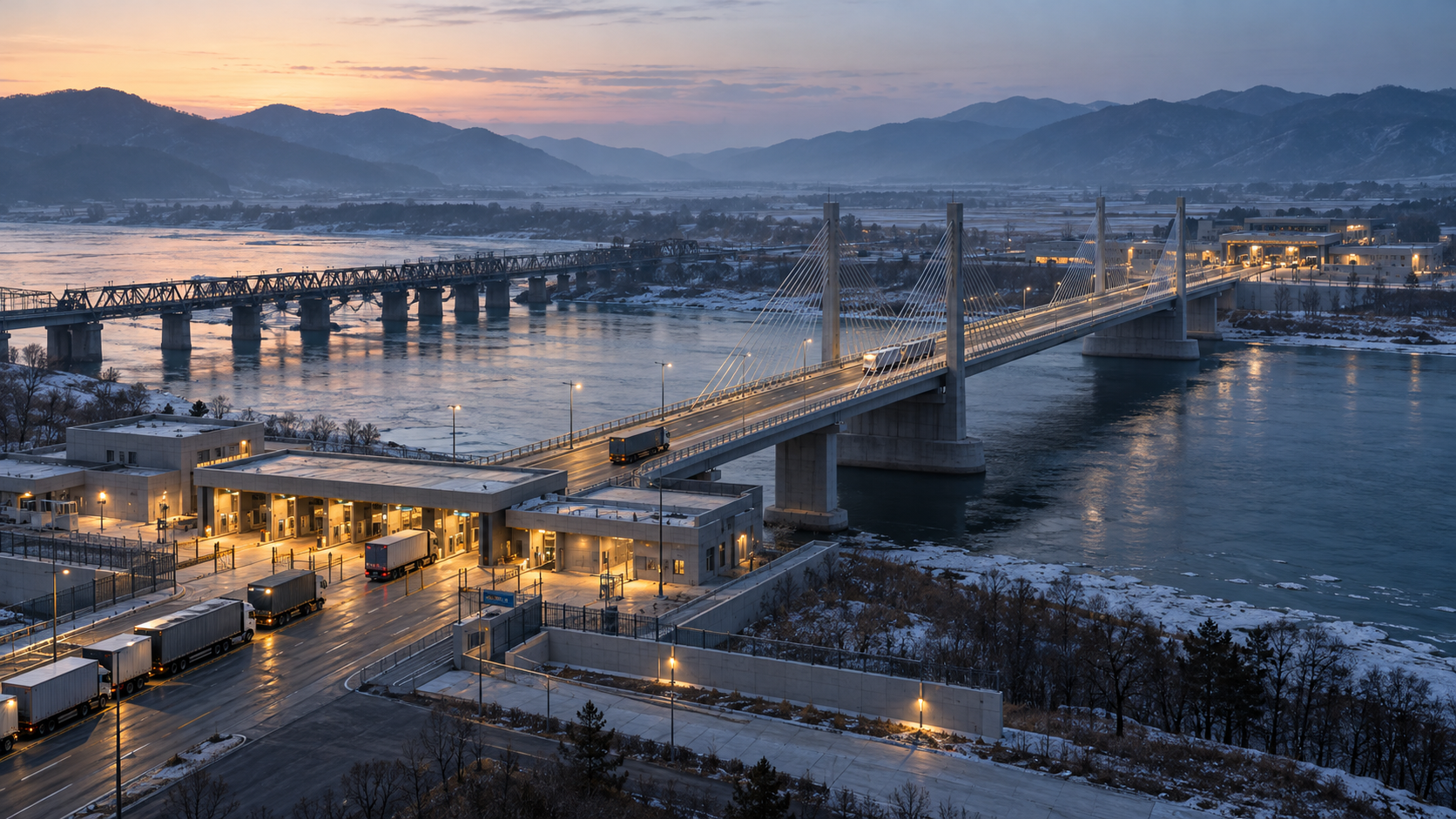
Geopolitics | Northeast Asia | Economic Statecraft
The New Yalu River Bridge was physically ready on the Chinese side in 2014. It is due to open on October 15, 2026. The twelve-year interval explains more than the concrete: cross-border infrastructure becomes strategic only when political permission, customs practice and diplomatic purpose align.
By Frank Farnel | Responsible Public Affairs | October 14, 2026

Executive Summary
- China and North Korea are due to open the long-delayed New Yalu River Bridge on October 15, 2026. China completed its side in 2014; North Korea only recently finished the approach roads and customs facilities needed to make the crossing usable.[1]
- The timing follows a political thaw marked by Xi Jinping’s June visit to Pyongyang and an agreement to deepen cooperation in trade, infrastructure and other sectors.[3] It also follows North Korea’s September opening of its first proper road bridge to Russia.[7]
- The bridge does not by itself end North Korea’s isolation or cancel United Nations sanctions. The sanctions regime restricts specified goods, financial relationships, petroleum supplies, labor and designated actors; it is not a complete embargo on every civilian transaction.[4][5]
- The strategic significance lies in optionality. Pyongyang gains a second high-capacity continental road connection within weeks—one toward China and one toward Russia. Beijing, meanwhile, restores a physical channel capable of reinforcing its economic relevance as Moscow’s role grows.
- The correct analytical test is not whether the bridge exists, but how wide the border’s operational aperture becomes: which cargoes are authorized, how customs rules are enforced, whether passenger movement resumes, and whether the crossing connects to functioning logistics and payment networks.
- For governments and companies, the early indicators will be traffic volume, commodity composition, changes in rail-versus-road flows, financial intermediaries, sanctions designations and the reactivation—or continued emptiness—of the development zones around Dandong and Sinuiju.
A Bridge That Waited for Politics
On October 15, China and North Korea plan to open a bridge that has spent most of its life leading nowhere.
The New Yalu River Bridge links Dandong in China’s Liaoning province with Sinuiju in North Korea. The Chinese side of the roughly three-kilometer, dual-carriageway crossing was completed in 2014. Yet North Korea did not finish the road, customs and immigration infrastructure required on its bank. The bridge ended, literally and politically, in an unfinished landscape.[1][2]
That long delay makes the opening more revealing than an ordinary transport project. The engineering was never the main obstacle. The missing components were strategic consent, administrative readiness and a bilateral relationship strong enough to activate the asset.
For years, goods continued to move through an older crossing about ten kilometers upstream: an 83-year-old bridge combining a railway track with a single-lane road. It remains the busiest of roughly fifteen crossing points along the approximately 1,350-kilometer China–North Korea border.[2] The new bridge therefore adds potential capacity, redundancy and heavier road access. It does not start trade from zero.
The opening also arrives at a consequential moment. Chinese exports to North Korea reached a six-year high of about $2.3 billion in 2025, a 25 percent increase from the previous year, according to Chinese customs data reported by Reuters. That remained below the levels recorded before the major United Nations sanctions adopted in 2017.[1] Meanwhile, North Korea has deepened its strategic and material relationship with Russia, including through military cooperation linked to the war in Ukraine.
The bridge is therefore neither a simple commercial reopening nor proof of a new alliance. It is an instrument through which all three governments—China, North Korea and Russia—can adjust leverage without announcing a formal realignment.
Why Is the Bridge Opening Now?
First, Beijing and Pyongyang have repaired enough of the political relationship
Relations deteriorated during the years of North Korean nuclear and missile testing, tighter United Nations sanctions and the pandemic-era closure of the border. The physical non-completion of the bridge tracked that diplomatic distance. Construction on the North Korean side accelerated only after relations began to thaw.
Xi Jinping’s June 2026 visit to Pyongyang supplied the clearest political signal. The Chinese Foreign Ministry’s account of his talks with Kim Jong Un identified trade, infrastructure, science and technology, education and people-to-people exchanges among the areas for closer cooperation.[3] Passenger trains and direct flights have also resumed. The bridge converts those statements into durable capacity.
Second, China has reason to prevent Russia from becoming North Korea’s only expanding option
Pyongyang’s relationship with Moscow now extends beyond diplomatic coordination. Russia and North Korea opened their first dedicated road bridge over the Tumen River on September 7. The one-kilometer, two-lane crossing is designed to handle up to 300 vehicles a day and links to Russia’s federal road system.[7][8]
It would be an overstatement to describe the Yalu opening as a direct Chinese response to that bridge. The project is far older, and work on the North Korean side preceded the Russian inauguration. Yet the sequence changes the strategic context. Within little more than a month, North Korea will have activated new road capacity on both its western and eastern frontiers.
For Pyongyang, that is diversification. For Moscow, it is a direct continental logistics channel. For Beijing, it is a reminder that influence cannot rest on historical proximity alone. A functioning crossing helps preserve China’s position as the principal economic gateway even as Russia offers military, energy and diplomatic value.
Third, the bridge offers both governments control as well as connectivity
It is tempting to treat a wider road as a sign of liberalization. That is not how tightly governed borders work. A modern crossing can increase the volume of authorized trade while also making it easier to inspect, channel and stop traffic. Customs halls, vehicle lanes, gates and surveillance systems are not merely conveniences. They are the physical expression of state authority.
Research on border crossings describes them as places where states manage the tension between sovereignty and interdependence. Infrastructure both enables movement and filters it.[10] The New Yalu River Bridge may therefore widen the channel without making the border open in any ordinary sense.
The Explanatory Framework: Capacity Is Not the Same as Access
A bridge becomes geopolitically meaningful through four interacting layers. Treating the concrete alone as the outcome produces exaggerated forecasts.
1. Physical capacity
This is the visible layer: lanes, load limits, inspection bays, approach roads, parking areas and connections to warehouses, rail terminals and national highways. The new crossing can accommodate road traffic that the old single-lane bridge could not handle efficiently. But maximum engineering capacity says nothing about actual daily use.
2. Legal aperture
The second layer determines what may legally cross. United Nations sanctions prohibit or limit arms, nuclear- and missile-related items, certain minerals and industrial goods, textiles, petroleum products, overseas labor arrangements and transactions involving designated entities. Resolution 2397 further tightened fuel and trade restrictions in December 2017.[5] Other civilian goods and humanitarian supplies are not automatically prohibited, and the 1718 Committee operates an exemption mechanism for humanitarian activity.[6]
The bridge’s opening does not alter those resolutions. It changes the physical channel through which permitted commerce—or prohibited commerce disguised as permitted commerce—could move.
3. Operational control
Customs practice converts law into reality. The material questions include inspection frequency, manifests, beneficial ownership, transshipment controls, payment arrangements and the treatment of dual-use goods. A formally open border can remain commercially narrow through permits and quotas. A formally restricted border can become porous through weak enforcement, trusted networks or selective tolerance.
Research based on interviews with traders along the China–North Korea frontier found that informal commerce depended heavily on personal networks, trust and access to routes capable of bypassing normal regulatory controls.[11] RUSI’s study of Dandong similarly documented the city’s role in North Korean trade networks and sanctions-evasion risk.[9] A new customs-controlled crossing may bring more activity into observable channels; it may also create new enforcement demands.
4. Strategic network effect
The fourth layer asks what other routes the bridge connects to and what choices it creates. An isolated crossing is local infrastructure. A crossing tied to highways, railways, industrial zones, banks and political agreements becomes a strategic network.
The opening matters because it sits beside three other changes: restored China–North Korea transport links, Xi’s political re-engagement, and the new Russia–North Korea road connection. Together, these do not integrate North Korea into the world economy. They give Pyongyang more ways to manage dependence within a narrow continental triangle.
Does the Bridge Weaken Sanctions?
The verified answer is that it increases the capacity that must be monitored. It does not, by itself, establish a sanctions violation.
This distinction is essential. The United Nations measures are extensive but targeted. They are designed to restrict the resources and technologies associated with North Korea’s nuclear and ballistic-missile programs, constrain particular revenue sources and financial relationships, and limit specified imports and exports. The sanctions are not written as a total blockade of food, medicine and all civilian merchandise. The Security Council has repeatedly stated that the measures are not intended to harm the civilian population, while maintaining procedures for humanitarian exemptions.[4][6]
A higher volume of legal trade can therefore coexist with the sanctions regime. It can also make compliance harder. Road freight is divisible, frequent and dispersed across many commercial actors. Compared with a limited rail schedule, trucks permit smaller shipments and more flexible routing. That is useful for legitimate commerce and humanitarian delivery. It also increases the number of transactions that customs authorities, banks, insurers and counterparties must screen.
There is an additional analytical complication. Better infrastructure can strengthen enforcement because it concentrates traffic in a modern inspection environment. If the new bridge replaces informal or weakly documented routes, visibility could improve. If it simply adds throughput while enforcement remains selective, evasion risk could rise. The direction cannot be inferred from the opening ceremony.
The evidence to watch is operational: cargo categories, declared values, frequency, ownership of carriers, the identity of brokers and banks, changes in nighttime activity around warehouses, and the relationship between customs-reported trade and observed traffic.
Three Crossings, Three Political Functions
| Crossing | Physical form | Political function | Constraint | What the opening changes |
|---|---|---|---|---|
| New Yalu River Bridge, China–North Korea | Approximately 3 km; modern dual-carriageway road bridge; Chinese side completed in 2014 | Restores a large western gateway and signals repaired China–DPRK coordination | UN sanctions, customs enforcement, payment channels and North Korea’s controlled border policy | Adds latent road capacity and gives Beijing a renewed material role in North Korea’s external options |
| Sino-Korean Friendship Bridge, China–North Korea | Older combined rail and single-lane road crossing near Dandong–Sinuiju | Concentrates the traditional bilateral trade route | Age, limited road capacity and dependence on a narrow node | Remains a useful baseline for judging whether new traffic is additional or merely diverted |
| Yakov Novichenko Bridge, Russia–North Korea | 1 km, two lanes, up to 300 vehicles per day according to the Russian government | Materializes the expanding Russia–DPRK strategic partnership | Small bilateral border, sanctions exposure and limited published trade data | Creates North Korea’s first proper road link to Russia and a second continental logistics option |
The comparison shows why the new Yalu bridge should not be read in isolation. The old Chinese crossing represented concentration; the Russian bridge creates diversification; the new Chinese bridge restores scale. North Korea’s emerging position is not one of broad global integration but of greater maneuver within a tightly bounded set of partners.
Is China Regaining Control Over North Korea?
“Control” is too strong. Influence is more plausible, and even that should be specified.
China possesses structural advantages: geography, the size of its economy, established commercial networks, the Dandong–Sinuiju gateway and a long political relationship. North Korea, however, has repeatedly demonstrated that dependence does not equal obedience. Its nuclear program advanced despite Chinese objections. Its relationship with Russia reduces Beijing’s exclusivity. Its leadership has an enduring interest in playing partners against one another while limiting external intrusion.
The new bridge gives China a larger instrument of engagement. It does not guarantee the political outcome Beijing wants. Infrastructure can create leverage because access may be expanded, restricted or conditioned. It can also create dependency for the provider if sunk costs generate pressure to keep the route active.
That history is visible around Dandong. China built the bridge and associated development zone in expectation of a commercial future that did not arrive on schedule. The Guomenwan trade zone, launched in 2015, remained largely empty years later. Local businesses learned that concrete does not create demand when diplomatic relations, border rules and sanctions close the market.[2]
Beijing is therefore not merely opening a door for North Korea. It is attempting to recover value from a stranded asset while ensuring that the door to China remains at least as consequential as the newer route to Russia.
Will Dandong Receive the Economic Boom It Was Promised?
Possibly, but the evidence does not yet justify that conclusion.
The bridge can reduce transport friction and shift truck traffic away from the older crossing. It may support logistics, warehousing, food exports, consumer goods and construction supplies that are legally tradable. Local services may benefit if passenger travel and tourism resume.
Yet three conditions could limit the effect.
Demand may remain narrow. North Korea’s foreign-exchange constraints, state allocation system and restricted private market limit the volume of ordinary cross-border consumption.
Trade may be diverted rather than created. If trucks simply move from the old bridge to the new one, Dandong gains efficiency but not a proportional increase in aggregate commerce.
Sanctions and banking constraints remain decisive. A truck can cross a bridge only after somebody finances, insures, clears and pays for the cargo. Physical connectivity cannot substitute for compliant financial infrastructure.
The first months of operation should therefore be treated as a measurement period. Truck counts are useful, but commodity composition and value matter more. Passenger lanes may be politically symbolic without generating substantial trade. Empty warehouses beside a busy ceremonial crossing would tell a different story from sustained commercial flows linked to functioning industrial zones.
What Leaders Should Watch Now
For governments, sanctions authorities, transport operators, financial institutions and companies exposed to Northeast Asia, seven indicators will separate symbolism from structural change.
- Actual throughput: daily truck movements, direction of travel and seasonality, compared with traffic on the older bridge and rail route.
- Cargo composition: whether growth is concentrated in food, consumer goods and construction materials or extends into sanctioned and dual-use categories.
- Customs practice: inspection intensity, electronic manifests, ownership checks, transshipment controls and public enforcement actions.
- Payment channels: which banks, settlement currencies, intermediaries and trade-finance structures support the flows.
- Passenger movement: the reopening of tourism, business travel or labor mobility, all of which carry political as well as economic significance.
- Network connections: whether the bridge feeds active logistics zones and highways or remains a modern crossing attached to underused commercial infrastructure.
- China–Russia balance: whether trade with China grows alongside Russian exchange or whether the two corridors specialize in different economic and strategic functions.
These indicators should be read together. A higher truck count without transparent manifests could indicate commercial recovery, rerouting or evasion. A customs announcement without observed traffic could indicate political signaling. A shift toward Chinese consumer goods alongside Russian military-industrial exchange would suggest diversification by function rather than a change of camp.
Key Evidence
- October 15, 2026: scheduled opening date for the New Yalu River Bridge, according to Xinhua as reported by Reuters.[1]
- 2014: the year China completed its side of the bridge; the crossing then remained unusable because the North Korean approaches and customs facilities were unfinished.[1]
- Approximately 3 km: reported length of the modern dual-carriageway bridge between Dandong and Sinuiju.[12]
- $2.3 billion: Chinese exports to North Korea in 2025, a six-year high and 25 percent above 2024, but still below pre-2017 sanctions-era levels.[1]
- September 7, 2026: Russia and North Korea opened their first dedicated road bridge, designed for up to 300 vehicles per day.[7]
- 125 humanitarian exemptions: total approved by the UN 1718 Committee as of September 18, 2026, illustrating that the sanctions system includes a formal humanitarian channel.[6]
Conclusion: The Border Is Becoming More Selectively Connected
The New Yalu River Bridge is easy to photograph and easy to misread.
Its opening does not mean North Korea is entering the global economy. It does not erase sanctions. It does not prove that China has recovered control over Pyongyang, or that Russia has displaced Beijing. It establishes something narrower and strategically important: North Korea now has additional physical capacity to manage trade and political relationships across both ends of its continental frontier.
The twelve-year delay is the essential fact. China could build the span, but it could not make the relationship ready to use it. The crossing became operational only when infrastructure, diplomacy and administrative permission converged.
That is why the bridge matters. It is not simply a route across the Yalu. It is a controlled aperture in North Korea’s isolation—and a reminder that in geopolitics, connectivity is never measured by concrete alone.
Glossary
1718 CommitteeThe United Nations Security Council committee created in 2006 to oversee sanctions relating to North Korea’s nuclear and ballistic-missile programs.Dual-use goodsProducts, software or technology with legitimate civilian applications that may also support military, nuclear or missile activity.Operational apertureThe effective degree of cross-border access created by physical capacity, law, customs practice, finance and political permission.TransshipmentThe transfer of goods through an intermediate country, port or carrier before reaching their final destination; it can be legitimate or used to conceal origin, ownership or end use.Infrastructural geopoliticsThe study of how transport, payment, energy and communications systems do more than serve political strategy: they structure which relationships and choices are possible.
References and Further Reading
Official and Primary Sources
- Ministry of Foreign Affairs of the People’s Republic of China, “Xi Jinping Holds Talks with Kim Jong Un,” June 8, 2026.
- United Nations Security Council, “Security Council Committee Established Pursuant to Resolution 1718 (2006),” accessed October 14, 2026.
- United Nations Security Council, “Security Council Tightens Sanctions on Democratic People’s Republic of Korea, Unanimously Adopting Resolution 2397 (2017),” December 22, 2017.
- United Nations Security Council, “Humanitarian Exemption Mechanism of the 1718 Committee,” updated September 18, 2026.
Academic and Analytical Sources
- Royal United Services Institute, “Project Sandstone Report 7: The Billion-Dollar Border Town—North Korea’s Trade Networks in Dandong,” RUSI, 2020.
- Michael R. Kenwick, Beth A. Simmons and Richard J. McAlexander, “Infrastructure and Authority at the State’s Edge: The Border Crossings of the World Dataset,” Journal of Peace Research, Vol. 61, No. 3, 2024, pp. 500–510.
- Justin V. Hastings and Yaohui Wang, “Informal Trade Along the China–North Korea Border,” Journal of East Asian Studies, Vol. 18, No. 2, 2018, pp. 181–203.
- Jong-Woon Lee and Kevin Gray, “Cause for Optimism? Financial Sanctions and the Rise of the Sino-North Korean Border Economy,” Review of International Political Economy, Vol. 24, No. 3, 2017, pp. 424–453.
- Marieke de Goede and Carola Westermeier, “Infrastructural Geopolitics,” International Studies Quarterly, Vol. 66, No. 3, 2022.
Current Reporting and Case Evidence
- Reuters, “China–North Korea Bridge to Open on October 15,” October 14, 2026.
- Reuters, “China Border Town Can’t Shake the Blues Despite Promise of Bridge to North Korea,” October 8, 2026.
- Reuters, “North Korea and Russia Open Their First Road Bridge, a Symbol of Expanding Ties,” September 7, 2026.
- Associated Press, “Russia and North Korea Open the First Road Link Across Shared Border,” September 7, 2026.
- Reuters, “North Korea Nears Completion of Bridge with China, Analytics Firm Says,” September 9, 2026.
- Center for Strategic and International Studies, Beyond Parallel, “Progress at the Much-Delayed New Yalu River Bridge,” December 11, 2025.
Source and Methodology Note
This article was researched through October 14, 2026, 03:45 UTC. The opening date and recent trade figures come from Reuters reporting that attributes the announcement to Xinhua and the trade data to Chinese customs. The June diplomatic context comes from the Chinese Foreign Ministry. The sanctions analysis relies on United Nations Security Council and 1718 Committee materials. The Russia–North Korea comparison uses Reuters and Associated Press reporting, including figures attributed to the Russian government. Academic and specialist sources were used to explain border authority, informal trade and infrastructural geopolitics.
Important limitations remain. The bridge had not opened at the research cut-off; no observed traffic data were yet available. North Korean official economic data are limited, and Chinese customs figures do not capture all informal or concealed activity. The article therefore distinguishes established facts—construction, announced opening, existing sanctions and recorded trade—from analysis about Beijing’s leverage, Pyongyang’s diversification and future commercial effects. It does not infer sanctions evasion from infrastructure alone.
Suggested Internal Links
- The Map After the Missiles — on how transport corridors can reorder strategic influence.
- The Tank Is Ready. The Route Is Not: Europe’s Military Mobility Test — on the difference between physical infrastructure and usable strategic capability.
- The Strategic Asset Is Not the Cable. It Is the Ability to Repair It. — on infrastructure, access and operational sovereignty.
- Understanding the Multipolar World: Geopolitical Dynamics and Risks — for the broader context of strategic competition involving China and Russia.
#Geopolitics #NorthKorea #EconomicStatecraft
Discover more from Responsible Public Affairs
Subscribe to get the latest posts sent to your email.