Influence

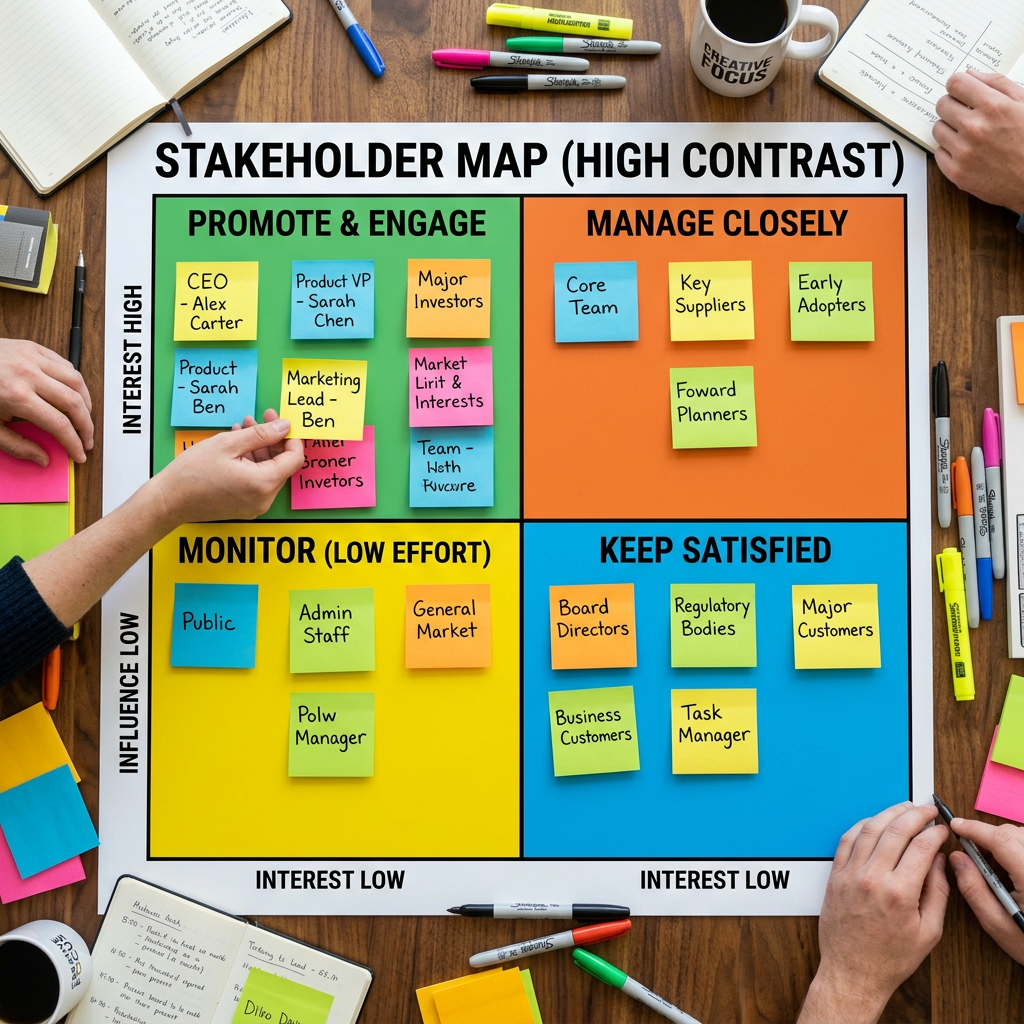
Stakeholder map chart with sticky notes categorizing stakeholders by interest and influence levels

Mastering Policy Engagement in Complex Regulatory Environments

This article advocates for transforming policy engagement into a proactive strategy that influences regulatory outcomes. It outlines eleven best practices, including stakeholder mapping, cross-functional coordination, and evidence-based advocacy. Companies that implement these strategies can shift from vulnerability to establishing a competitive advantage, effectively shaping the regulatory landscape.

Mastering Policy Engagement in Complex Regulatory Environments Read More »

Business team discussing financial documents in a modern boardroom with city skyline at dusk

Public Affairs Belongs in the Boardroom: Why It Is a Strategic Leadership Function, Not a Support Role

Public affairs is now a crucial strategic function for companies, influencing external forces that impact value, such as policy, regulation, and reputational trust. Firms that proactively engage in public affairs avoid significant costs and crises. Elevating this function to the boardroom enhances decision-making and provides a competitive edge in a fast-paced business environment.

Public Affairs Belongs in the Boardroom: Why It Is a Strategic Leadership Function, Not a Support Role Read More »

Lighted domino standing at the front of a curved row of black dominoes on a wooden surface

The Quiet Advantage: How Foresight Beats Firefighting in Public Affairs

This article emphasizes the need for public affairs teams to shift from reactive strategies to proactive issue anticipation and horizon scanning. It outlines a five-stage framework to identify emerging legislation and regulatory changes early, allowing organizations to influence outcomes before they solidify, thus avoiding crisis management and enhancing strategic decision-making.

The Quiet Advantage: How Foresight Beats Firefighting in Public Affairs Read More »

Earth with illuminated cities and lines representing global digital connections at night

Political Intelligence as Organizational Capability: Strategic Implications for Firms in Contested Policy Environments

This article explores political intelligence as a crucial organizational capability that aids firms in navigating regulated environments. Through various case studies, it demonstrates how systematic political analysis fosters strategic advantages by creating lead time for proactive engagement. Institutionalizing political intelligence enhances decision-making and organization-wide preparedness against policy shifts.

Political Intelligence as Organizational Capability: Strategic Implications for Firms in Contested Policy Environments Read More »

Brass compass on strategic policy framework documents

Lobbying in the Fishbowl: How Leaders Build Trustworthy Influence

In the evolving landscape of corporate lobbying, transparency and alignment between public commitments and private advocacy are crucial for maintaining credibility and effective governance. Organizations must elevate lobbying to board-level discussions, rigorously audit their advocacy practices, and embrace ethical principles to build trust and withstand scrutiny in an increasingly transparent environment.

Lobbying in the Fishbowl: How Leaders Build Trustworthy Influence Read More »

Map showing NATO member states and phased eastward expansion waves in Europe with arrows and years

NATO’s Strategic Expansion in Eastern Europe: Deterrence, Risk, and the Remaking of European Security

NATO’s enlargement into Central and Eastern Europe has fundamentally redefined the continent’s security landscape, post-Cold War. While offering protection to former Soviet-dominated states, it heightened tensions with Russia, amplifying perceptions of encirclement. The ongoing conflict in Ukraine underscores NATO’s pivotal role and the necessity for credible deterrence and commitment among member states.

NATO’s Strategic Expansion in Eastern Europe: Deterrence, Risk, and the Remaking of European Security Read More »

A high-tech command center with a large curved screen displaying a detailed world map and data visualizations. The room is dimly lit with ambient blue and white lighting, creating a focused and professional atmosphere. In the foreground, a sleek glass desk holds a tablet showcasing a digital dossier titled "Unified Geopolitical Analysis Rewrite," surrounded by minimalistic office items like a pen, notebook, and coffee cup. The scene conveys a sense of global strategy and data-driven decision-making.

La poudrière : repenser la dissuasion face à la nouvelle donne stratégique

Synthèse stratégique Qualifier le monde actuel de « poudrière », selon le général Pierre de Villiers, n’est pas du simple alarmisme : c’est le cœur des enjeux sécuritaires contemporains. Le « dividende de la paix » post-Guerre froide a disparu. À sa place, la résurgence des rivalités, l’effritement des régimes de contrôle des armements et

La poudrière : repenser la dissuasion face à la nouvelle donne stratégique Read More »

A high-tech command center with a large curved screen displaying a detailed world map and data visualizations. The room is dimly lit with ambient blue and white lighting, creating a focused and professional atmosphere. In the foreground, a sleek glass desk holds a tablet showcasing a digital dossier titled "Unified Geopolitical Analysis Rewrite," surrounded by minimalistic office items like a pen, notebook, and coffee cup. The scene conveys a sense of global strategy and data-driven decision-making.

The Powder Keg: Rethinking Deterrence in an Age of Strategic Chaos

Executive Overview General Pierre de Villiers’s description of our world as a “global powder keg” is more than hyperbole—it’s a stark reflection of the current security reality. The “peace dividend” of the post-Cold War years has evaporated. In its place, we see renewed great-power rivalries, fading arms control structures, and a weakening of unified political

The Powder Keg: Rethinking Deterrence in an Age of Strategic Chaos Read More »

Democracies at Risk: The Global Shift Toward Authoritarianism

Throughout history, political alliances have shaped the global order in profound ways. During the interwar years, the Soviet-led Communist International supported revolutionary, anti-capitalist movements, laying the foundation for communism’s post-World War II expansion. Similarly, after the Cold War, the U.S.-led global order promoted democracy and liberal values, albeit inconsistently, sparking waves of democratic transitions. But

Democracies at Risk: The Global Shift Toward Authoritarianism Read More »